











Neon Hope Deep Dive
What the Community Thinks About Neon Hope
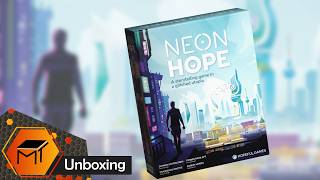
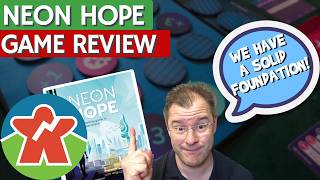
Neon Hope arrived as a surprise favorite at Spiel 2024, capturing reviewers who were hungry for a fresh take on the living card game formula. What stands out across every reviewer perspective is that this game succeeds by stripping away the overwhelming complexity that keeps many players from ever touching Arkham Horror LCG in the first place. Board Stupid's preview after Spiel captured the collective enthusiasm: a tight cooperative experience that respects player agency, storytelling, and accessibility in equal measure. The Broken Meeple, despite noting significant barriers to entry in components and rules presentation, concluded it as a "pretty solid game" with real potential. Dungeon Dive and Let's Table It both emphasized how the hand management system creates meaningful tactical decisions without the metagame deckbuilding exhaustion that plagued earlier attempts at this genre.
Core Mechanics That Define Neon Hope
Hand Management Over Deck Construction
The heart of Neon Hope diverges sharply from its inspirations by committing to hand management rather than deck building. You begin with a fixed hand of eight to ten cards representing your character's stamina and action potential. This hand is your resource, your timer, and your primary strategic tool all at once. Each turn, you play cards to accomplish tasks at locations, then rest to draw back up. But here is the cost: when you rest, your endurance decreases, which means one fewer card returns to your hand next time. As the scenario progresses, your hand shrinks. This creates a natural escalation of pressure that mirrors how your character grows more exhausted. Board Stupid was emphatic about this mechanic: you can choose any card from your hand to discard and attempt any task you wish, meaning success relies on clever sequencing and readiness to risk failure. The Broken Meeple praised it as fundamentally different from Arkham Horror's chaos bag approach because it places control in your hands rather than leaving you hoping the randomness breaks your way.
The Matrix: Skill Checks With Visible Consequences
When your character attempts an action, you flip tokens from a face-down matrix to resolve the outcome. Unlike the chaos bag's blind draw, you see every token as it reveals. This makes the grid a tactical tool. You know which good modifiers you have already spent and which negative ones remain, so you can make educated bets on future checks. The Broken Meeple explained it as semi-deterministic: not fully random, but impossible to game entirely because three tokens sit face-down in the archive, unseen. This system encourages tension and careful decision-making while remaining elegant compared to Arkham Horror's sprawling keyword list. Reviewers consistently noted how this single mechanic creates a feeling of agency even in setback moments.
The Neon Hope Experience
A Cyberpunk World That Offers Hope
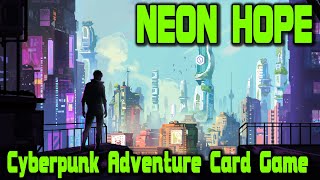
The setting splits the difference between dark cyberpunk and hopeful futurism. Berlin, near-future, surveillance systems, and resistance: these form the backbone. But unlike the bleak nihilism of traditional cyberpunk, characters are trying to make things better. Board Stupid and The Broken Meeple both highlighted the mix of solar punk idealism with cyberpunk aesthetics. Reviewers could set the mood with synthwave music in the background and emerge feeling like they had lived a small, consequential moment in this world. The artwork drew mixed reactions. Dungeon Dive and Board Stupid praised the vaporwave aesthetic and neon pastels as a refreshing alternative to the typical grimdark aesthetic. The Broken Meeple was less convinced by the character illustrations, though acknowledged the location cards and backdrops captured the atmosphere effectively.
Story That Branches and Actually Remembers Your Choices
Neon Hope presents narrative through a campaign book and chapter cards. When you interact with locations, characters, or complete objectives, you unlock story passages. Multiple conclusions branch based on what you accomplished and how. Let's Table It noted that your actions shape which story beats you encounter and which endings become available, creating genuine replay value beyond simply trying a different difficulty. Board Stupid emphasized how the story never feels like a reading assignment: text snippets on cards are snappy, a few sentences, enough to set the scene without slowing play. You are always playing the game more than passively consuming narrative. The Broken Meeple found roughly 33 different possible endings across the five scenarios, meaning your specific path through the campaign feels genuinely yours.
What Makes Neon Hope Stand Out
Accessibility Without Sacrificing Depth
Multiple reviewers positioned Neon Hope as the entry point that Arkham Horror LCG wishes it was. Board Stupid called it significantly more streamlined and accessible, addressing how many players simply do not know where to begin with expansions, keywords, and metagame deckbuilding. Neon Hope forces no such barrier. You pick a character, play your hand, upgrade your tools when the game tells you to, and move forward. Difficulty scales from story mode, where you simply want to experience the narrative, to challenge mode, where survival matters. The Broken Meeple confirmed that once you push past the rulebook's organization issues and component setup, the core loop is straightforward: move to a location, attempt tasks, manage your endurance, survive the encounter phase. Dungeon Dive praised the lack of overwhelming keyword density compared to other living card games, allowing you to focus on the decisions that matter.
Character Progression That Happens During Play
Unlike most deckbuilders, where upgrades happen between scenarios, Neon Hope lets you improve your character mid-scenario when you focus. You earn resources from completed tasks and can spend them immediately to unlock better tools or upgrade your action cards. The Broken Meeple appreciated this as a departure from Arkham Horror's end-of-scenario accounting, creating mini-decisions throughout that feel more like an RPG progression moment. Each character has a unique starter deck of eight action cards, supplemented by two cards from a partner, plus access to personal tools. Board Stupid highlighted how small this deck actually is compared to the 30-40 card minimum of traditional deckbuilders, which makes deckbuilding feel like genuine character customization rather than a meta-puzzle solved in advance.
Potential Drawbacks
Component Quality and Price Barriers
The Broken Meeple was direct: the 80-100 euro base game price is steep for basic cardboard tokens and no insert. The deluxe version, with poker chips and an e-raptor insert, jumps to 190 euros. By comparison, the production value does not immediately justify the cost if you lack the upgrades. Setup involves identifying cards by tiny expansion symbols on each corner because cards from different scenarios are all mixed together in the box. The Broken Meeple called this a barrier to entry; you either need the insert or you will spend significant time organizing every play. Reviewers noted the card artwork is good, though The Broken Meeple found some character faces and hacking card illustrations bland compared to Arkham Horror's consistent visual quality. Let's Table It, however, praised the immersive world and vibes as winning elements despite component concerns.
Rulebook Layout and Initial Learning Curve
The Broken Meeple spent considerable time on this: the rules themselves are not complicated, but the book layout is scattered and illogical. Key information appears two pages later than where it would be useful. The quick-start rules are too bare-bones to actually teach the game without guessing. Once you reach the core loop, it becomes fast and intuitive. But the first couple of plays involve FAQ references and clarification hunting. The Broken Meeple recommended the rulebook need a second edition with better organization, suggesting that future printings or late pledges could address this. Let's Table It noted similar friction with the rule book presentation, though found the game itself easy to navigate once learned.
If You Enjoy Neon Hope
If you love Arkham Horror: The Card Game, Neon Hope is the streamlined alternative you did not know you needed. It captures the investigative, story-driven loop while cutting the deck construction metagame entirely. If Earthborne Rangers appealed to you, Neon Hope delivers a tighter, more action-driven experience with less fiddly management. The Broken Meeple saw it as a solid contender in the same space. For fans of Marvel Champions or other simplified LCGs, Neon Hope's hand management system and mid-game upgrades offer a fresh take on how characters grow throughout a scenario rather than between them. If you enjoy cyberpunk narratives like Android: Netrunner, Neon Hope's solarpunk-inflected world building and hacking mechanics will resonate, minus the collectible card game arms race. Gloomhaven enthusiasts who wanted more story and less campaign bookkeeping may find the chapter-driven structure and branching outcomes more satisfying.
What Reviewers Are Saying
"It's a cooperative storytelling game set in the near future Berlin between cyberpunk and solar punk and each player takes on the role of a character and tries to lead the world into a better future. It has some RPG elements, some tactical stuff, and the game is all built out of cards you interact with. You flip them to progress the story and it's set in a campaign over multiple episodes with a branching narrative."
— Board Stupid
"Think of this game as the cybernetic offspring of the Arkham Horror LCG and Android Netrunner. If you combine those things, I think you'll have a pretty good idea of what Neon Hope is. It's got this really cool card play and I really like the fact that unlike something like Arkham Horror LCG which really digs into the deck construction and deck building, this is you have a fixed hand, so you have your hand of eight cards in a two-player game and that represents your stamina."
— Dungeon Dive
"I really appreciate how no matter the outcome of your game session, you'll make progress on the story. Your actions and what you achieve might have consequences as you move forward, but you'll uncover more of the story without getting stuck. I really love this sort of not really deck-buildy kind of hand management. It's more hand management where you can choose any card of your hand and then discard them and then they will come back to your hand at the end, but you might have to discard a card and you might get less cards over time as your stamina decreases."
— Board Stupid