SILENCE in Board Games
Games in This Video
9 games are featured in this video — they unlock as you watch.




Transcript
Has anyone ever given you the silent treatment? Well, do you know what? Board games encourage it. I know it's not really the most effective way of communicating with each other, but it definitely sounds like a lot of fun. Today, I'm going to be talking about how games use silence and lack of communication to try and enhance a board game experience. I guess it kind of gets rid of the talk in table talk, right? Anyway, this is a video where I'm going to explore this concept by categorizing the games into different categories that kind of explore silence in a different way. Hi, my name is Danny. I'm an avid modern board gamer from Australia and I love sharing my passion for board gaming with you, my friends, and my family. Come and join me for this journey. Hey Danny, do you want to play a board game?
I'll take that as a yes. About 9 years ago, I kind of started and entered this board gaming hobby for the first time and taking it quite seriously. And so I was on the lookout for really small box games that were different, that felt a little bit left of field. And so I came across this one game that seemed really abstract in nature upon first glance, but I really liked the twist on how you play it. And I always was on the search for really cool, easy to get to the table two-player games cuz I often play with my hubby. But yeah, this was a game that really just enthralled me, not because of way it looks, but because of the way you felt when you played it. And the game is called And Then We Held Hands.
And Then We Held Hands is a game where players going to be playing emotion cards. And each of the emotion cards has different colored bands on either edge of the card and you're actually going to be playing them as a splay in front of you. You can then also sometimes throughout the game flip them to the other side and splay them the other way. There's some really interesting balancing mechanisms that happen in this game. So, the goal of the game is basically to work silently with your partner to cooperatively move around these three concentric circles or nodes, I guess you could kind of describe them as. And as you jump from node to node, you're strategically trying to enter the center of this circle and you only win if you enter the center of the circle with your partner on consecutive turns and that is a truly challenging feat to be able to get to in this game. And I've done it once in my entire time I've owned this game. Now, what I really like is that everything that you do in this game creates this off balance effect. You'll shift towards being happy, but then you'll move towards being sad. And you want to keep in balance with the other player so that you can synergize your minds together, read each other's thoughts, and get in motion and get in sync. In some ways, the theme of this is basically repairing like a broken relationship or a broken friendship, but I find this game immensely fascinating
because it's about what you think the other player is thinking in their mind about their plan to get in sync with you based on what you can see in front of them, based what they can see in front of you. Often when we play games, we're encouraged to discuss with each other our strategies, our thoughts, and opinions. But silence really adds a new twist to the mix. Silence really promotes your ability and players' abilities to try and figure out each other's intentions. Having that suggested intention of what the other player wants you to do is something that feels really quite unfamiliar at first, but it does add to some really interesting gameplay decisions. There are two games I wanted to share with you today that kind of suggests this, the idea that when a player does something, it's suggesting to the other players something that they intend for them to do or to make a conclusion about. And I really like the inferencing that revolves around the intent of other players as they try to achieve a common goal in a board game. So, the first game I really wanted to talk about is one of my favorite programming games. It's called Quirky Circuits, and basically, it's a book which has lots of different scenarios, and there's four different like robots, and I particularly like the little cat robot because it's basically riding a Roomba, and you're collecting dust bunnies and cleaning the house. And then there's one that makes sushi, one that fixes things in the garden, one that digs for like bones in this archaeological style scenario. Players
are cooperatively trying to operate one of these four robots to achieve an objective. And what the limited communication really does well in this game is it makes players try and tap into the minds of each other. So, what's really cool about this game is that the deck of action cards that players will be playing all have a suggested dual action on the back. So, it might be a action that turns the Roomba clockwise or turns it right or reverses it or turns it 180 degrees. So, whatever the action may be, because players are just playing them when they think it fits the sequence of actions, players really have to think, "Okay, what actions do I have in my hand of cards? How is it going to fit in with a potential action that another player has placed in the main area? How does my action contribute to the movement of the robot in order to achieve our objective?
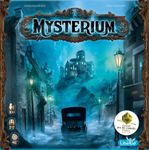
And is the objective that I'm thinking my brain the same as what the other players are thinking. So, creates for this unexpected level of chaos as well, but I've often found that with Quirky Circuits, everyone really really does sync their minds together. And so, when you reveal the cards, you then resolve the action of the robot and see how successful you are. Think of Clue, the game Clue, with elements of deduction using beautiful illustrated pictured cards. There is one person who plays the victim, who's the ghost. They cannot speak. They know who the murderer was, the weapon, and the location. They've got to give players picture cards that suggest to those players which suspect they've got, and then at the end of the game, the group collectively tries to work out which of those suspects was the culprit. And so, this game uses limited communication in an interesting way because the person who's the ghost needs to look at the picture cards, then they need to look at the solution, and then give those picture cards to the right players so that they can deduce the three components of the crime that they need to solve. And so, this kind of invites an interesting level of interpretation. I might give a player a card because it's got a symbol of the moon, and the moon might suggest that it's night time, so the candle might be the weapon. But, then another player
might interpret the moon as something else. It might suggest to them, for example, something you would do at night, or something that you do before you go to sleep. There's lots of different interpretations that can be invited from just giving players these different clue cards. Now, I know I just spoke about Mysterium and how it resembles Clue. Rear Window is based on Alfred Hitchcock's famous movie Rear Window, and I studied this in E7 actually. It's kind of like a who done it. It's basically a guy who breaks his leg and he sits in his apartment and he watches all the other people in the apartment complex do their daily things and then he thinks someone's a murderer. And so Rearwindow is about observing other people through the apartment windows and one player is kind of like the director. They play clue cards to try and get the group to guess who the who the um culprit is and where they did it and etc. etc. There's similar to Mysterium. But what I really wanted to highlight about Rearwindow is that the person who's the director can also indicate that might be a murderer. And so most of the time when you play Rearwindow, you're thinking, "Oh, this is cooperative. We're working together, working together." And then all of a sudden there's that one round where the director is the murderer and you're like, "Oh my goodness. He's been leading us straight or she's been leading us straight all this time." There are a lot of games where the game master can't talk, but they can also participate in
really interesting ways. And it does remind me of another crime game, um Murder in Hong Kong, where the clue giver can only give, you know, words that are listed on these tiles. And the next thing that silence does is it amplifies the tension. You start out the game going, "We got this. This is pretty easy. We're going to be able to beat the game. No worries." And then 5 to 10 minutes in you're like, "Actually, this is a lot harder than I thought." That's happened to me so many times. There are two games that I think that uses silence or limited communication as a way of building tension. And I love tension in games cuz it really gets the atmosphere of the game going. The first one that I like to talk about is Grizzled. The Grizzled is like this war game where it evokes that sense that you're on the front line, you're with your brothers and your sisters or your the other soldiers and your comrades and you're just literally trying to survive. You've got this deck of cards that everyone's kind of playing different symbols or backgrounds from and you're trying to not get three of the same type. And this game is incredibly punishing because you're holding these cards, you're seeing what your comrades are playing but you can't explain to them what you've got and they can't tell you what they've got and so you're like they played two for example night cards and you're like no, don't play those night cards because I've only
got night cards in my hand. Also got speeches and then you can give play support by passing little coffee tokens around but then you've got to kind of give it to the right people who are probably suffering the most and then you've got hard knocks which literally makes the game 10 times harder. You're like, "Oh, this is really hard." and then you get like two hard knocks in front of you and bang, you your brain and the group all of a sudden just become like we've got to get through this. This is torturous but we can do it. We can do it and that sense of accomplishment in that one game and I did play this and we only won once, we all stood up and just like cheered. Like it was such a great moment of game play that um yeah, it just felt so good to be able to clear um the little deck of cards with all the little barb wire on it and just like be like, "Oh my god, we actually won."
Crypto's probably my favorite word game of all time and I love it because the tension and I think there was one night where I played this game with a group of friends and I was like, "Guys, I think I need to stop because this game is getting way tense for me. And so, Decrypto is all about knowing that other people are listening into your conversation, but then trying to use your conversation that they're listening into to pass kind of like a hidden message across or hidden codes. Well, each team is given a series of words, and each team is trying to figure out the other team's codes cuz each of the four words is related to a number between one to four. If players can tap in and be in sync with the other team and work out their code for that round, then that team wins. So, the interesting element here is you're giving clues out loud to your team. They kind of know what your numbers are, but the other team don't. And so, the other team as they're listening are recording all the clues that you're giving down matched up to the four numbers, and they're like saying, "Okay, the team said lion, um king, uh Africa. So, maybe the word is Maybe the word is royal, for example."
Like, once you're kind of looking at your clues that the other teams have been giving and you're and you finally decipher what their number matches are, it's such a monumental moment where you're like, "Hey guys, I think we know what your code is." Quite often, board games will use limited communication as a way of trying to get players to draw on their contextual knowledge of how well they know each other. And this is a common thing that you might see in party games, where basically they say, "Ooh, you can't talk to the other players, but you might need to suggest something that the other players know about you in order to solve a common problem." One of the best games that I've discovered that helps to build community, build discussion, but also uses limited communication such an intelligent way is the game Wavelength.
Basically, this game has this really cool cogwheel, which has um numbers or scores written in the cogwheel underneath a closed window from I think three to one. And basically, players are going to be drawing these cards, and the clue giver is going to give a clue that lies um or that will help the players or on their team to pick or move the wheel to a point where it's going to lie within the highest scoring range. Parameters might be hot and cold, and then you might say boiling water. And so, players will know that it's going to uh right towards the hot side. But then when you reveal it, you see whether your team was right and whether you were on the same wavelength. The use of silence here is more about what you think your friends know. They know that you don't you think that going to the beach is really really cold and you even on a 34° day, they they are going to know that you're implying that the spectrum should be placed on the most extreme end of the cold side. And so, it's that knowledge of each other, the experiences that we have with our friends, our family in the real world, it's all being drawn and tied together into a board game. The idea that a board game not only brings people together, but brings their experiences, their passions, their stories. The use of limited communication board games can often lead to a more thematic and rich experience, especially if the limited
communication really pairs well with the theme itself. There are two games I want to share with you that really kind of use limited communication and integrate it into the theme of the game. The first game I wanted to show you is a game called Skyteam. It's a two-player game where you're cooperatively trying to manage the controls on your plane as it comes in for landing. And it's a little bit more difficult than it sounds. You've got some dice which you're going to roll and then you're going to assign those dice to different controls on the panel board which will allow you to satisfy the conditions that will help you gain your victory. It'll be conditions like having the plane perfectly balanced, clearing the runway, turning on the flaps, making sure that you know, the the jets aren't firing too hard. There's a lot of things that you and your co-pilot think about in order to land it successfully. And the fact that you're rolling these dice behind screens and the values of the dice, you can't actually see what each other's playing. So when someone plays a six, you're thinking, "Wow, it's a big number to play. Maybe that implies that that your your partner doesn't have any other sixes and they're trying to tell you this through this use of limited communication." Really evokes that sense that, "Okay, we are preparing for a common goal. We both want to succeed and this is a puzzle that we're going to have to solve and through the limited communication, everything that you're
doing is suggestive." And I really also like how this game allows you to talk in between rounds just to kind of be like, "Hey, this is what we want to achieve. This is what we want to do." But you still don't know which numbers you're going to roll. So you still have that chance to be like, "Hey, we really need to get on sync with the wings here in the next round because if we don't get that ready, the you know, we'll not you know, reduce our altitude to a level where we'll be able to land." And so the sky team really evokes that feeling of like safety, wanting to do well, wanting to achieve that common goal. comes with all these really cool scenarios of varying difficulties and modules to really make you feel like you're in the cockpit of a plane controlling all of these dials and all of these knobs. So Corum is probably one of my favorite two-player games. I've also played at three and four player. very challenging at those player counts. But you're basically trying to suggest to the other players, this is what you want the house to be. And so, when the other players place a wall painting in a room, or change the color, or move the furniture out, you say, "Oh, I really like what you've done." Or, "I really do not like what you've done." And based on that, players have to make changes until it satisfies the hidden condition that they're allocated at the beginning of the game. And so, it's all about this to-and-fro of trying to communicate to the other players what you want them to do, but without saying what you actually want them to do. And so, it's very passive-aggressive.
It's like, "Oh, why did you move that? I just put that there. Why did you do that?" There's all these really cool conversations that comes from not Things that are not being said. And so, the use of like this passive-aggressive nature feels really thematic because often I've been passive-aggressive with my hubby when we've disagreed on things. So, what is your opinion on some of the games that you've played where you're not allowed to talk to the other players? Do you find that an enjoyable experience, or do you find that it really hinders how much fun you could potentially have? Do you find it really thematic and immersive? Please let me know in the comments section below. I'd love to hear some of your favorite games which involve limited communication. I'd love to compile a list and start a conversation and share some more stories with you. If you really, really enjoyed my video, please consider liking and subscribing to my channel. It would mean a lot. Um as well as that, if you want to support this channel and help it grow even further, then please head over to my Patreon page. Uh link in the description box below. Otherwise, this is Danny signing out. I hope no one gives you the silent treatment unless it's part of the game, and enjoy your next board game experience. See you next time.
Mhm.