Graeme's Top 100 Games of All Time: 60-51
Games in This Video
10 games are featured in this video — they unlock as you watch.






Transcript
So this is next group of games 60 through 51 and you'll probably guess what you're going to see. More euros, some familiar and again probably a few you might have forgotten about. So let's get right into it. Number 60 is an absolute classic power grid. Players take on the role of energy tycoons completing to power the most cities. Each round consists of an auction phase with players building on power plants with different kind of fuel capacities to power more cities and different fuel type requirements, coal, oil, garbage, nuclear, or even renewable. Next, players are purchasing from the resource market, and this will fluctuate during the round. Players earlier in turn get the first crack at the cheaper fuel, but turn orders dependent on who is leading. The better you're doing, the later in turn order you go. But spending all of your money on power plants and fuel will do you no good unless you can expand your network, which of course costs more money. Finally, after all these phases and expenditures, you get to power cities by spending your fuel from your power plants to get more money for the next round. For me, the joy of power grid comes from the economic planning and watching what the other players are doing. It is vital in this game to be cognizant of what the other players are doing. You only ever want to be spending the minimum amount of money to reach each round. So, figuring out what power plants you really want and how much you're willing to pay for it is critical. Getting wrapped up in a bidding war is hardly ever advantageous, but forcing someone to pay a little bit more because you know they need it is fun. The game does have very little randomness to it and you can see the end coming. As soon as the player has connected a certain number of cities, that triggers the last round. But it comes down to who can power the most cities in that final round. So timing is absolutely key to this one. And rushing to build might mean you can't power everything that you've built. And that
is my number 60 game. 59 on my list is from 2022 and it's based on the life of Andrew Carnegie. And that game is well Carnegie. Players take on the role to manage employees, expanding your business, invest in real estate, and basically produce goods. All this is done through a very interesting action selection process. The game takes place over 20 rounds. And each round, the active player will select one of the four actions: human resources, management, construction, or research and development. And all players take their action simultaneously. Each round also include an event, income, donation, opportunity, or transport mission. And these are all tied to the region on the event track. And this is where the true elegance comes in and why I enjoy this game so much. The game is not only choosing what is best for you, but also trying to get those regional events to trigger when you want them to trigger. Taking an action at least your opponents getting the exact event that they need is never a good plan. One of the key gameplay mechanisms for me is I always have to be anticipating the future actions and making my board ready to take full advantage of it. Combining that with the fact that all players are doing this simultaneously means that although this is a fairly complex game, the downtime is kept to a minimum.
Combine that with some really good tough decisions to be made for each action means that this one has a lot of avenues that I still want to explore. The actions themselves are not overly complicated, but it's the repercussions that make the decision so interesting and why Carnegie is number 59 on my list. 58 is one that I'm glad is getting a reprint and it also just had a reimplementation. That game is Santa Maria. The game does an excellent job of blending dice drafting, tile placement, and engine building into a satisfying strategic puzzle. Now, each player has their own player board where they're going to be buying and placing tiles. You're also going to be drafting dice from a common pool. When you use a die, you'll activate that column that matches the number from top to bottom. If you're using your personal dice, you're going to go from left to right. All buildings along that row or column will be activated, either producing something or maybe another action, but you must leave your die on the last building activated, and that building cannot be activated again this round. And you can do one-off activations by using coins. For me, the enjoyment comes from basically a couple things. Each game there's going to be a different set of ongoing bonuses in the end of game scoring. Figuring out the right combination of these is always enjoyable. Combine that with dice drafting and it's a tricky balance. You can spend your first turns drafting dice, but delaying that to maybe buy buildings to make your columns better when they're triggered is also a good option. But waiting too long to grab a die may mean that you have a die you can't use. But the real joy is the puzzle placing the buildings in such a way that when you activate them, which must be done in order, you pull off the perfect combo. was just so satisfying.
And like a lot of the elements in this game, it just seems to be the right balance of difficulty to pull off. So that is my number 58. 57 on my list is another Uve Rosenberg game. This is all about being a Viking chieftain striving to build a prosperous community through exploration, trade, and conquest. And there's more worker placement spots you can shake a stick at. This game is a feast for Odin. Now, the main core gameplay of this is worker placement piece, and you have 60 different places to choose from. But to be fair, many of them are variations are identical to stuff that's already on the list, but you're going to be hunting, crafting, pillaging, and trading. The second main piece of the game is the polyomial style tile placement. During the game, you're going to be crafting items to fill up your board, in essence, covering up negative points while leaving some spaces open when you do the income. You can go out to explore new islands to open up more opportunities to place tiles to gain greater rewards. But they also have penalties to match. Like a lot of Rosenberg's games, there is an element of feeding your people, but this game finds that good balance. You do have to feed them, but often it's fairly easy to get the correct food to feed your hungry Vikings. Now, the main reason why this is on my list is because there are multiple ways to get points.
I've not found the perfect strategy. Each time I play, I'm trying something slightly different to some degree. It's an enjoyable puzzle that keeps me coming back to see if I can do better, which is always a plus for me and why it's my number 57 on my list. Number 56 is called Qashqar Merchants of the Silk Road. For me, this game all comes down to the engine building and kind of a deck builder. The theme is pretty shaky for this one. It's all about trading spices along the Silk Road between Asia and Europe. But the core mechanism is what has this game on my list. On your turn, you can do one action, choosing from one of the top three cards of your three families. After activating the card, you move the card to the end of that line of that family if you choose to keep it. Or you can discard the card from your caravan for its parting action. Some cards are better with a lot more cards in that family stack, but it means it takes longer to cycle through those cards. Through these actions, you can acquire more goods, which will be spent to make deliveries from the middle of the table. there are they are a first come first-s serve type of thing.
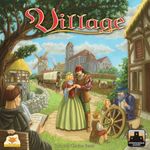
There's also a card action allows you to add new cards. Each caravan has a matriarch and a patriarch double-sided card and flips each time you use it. Either drawing cards from the deck uh or the discard to add to your caravan. And it's this main mechanism of managing your caravan which will change with every play. And it's a race of 25 points which is also compelling that it keeps this game on my list at number 56. Next is number 55. And this game is village. You guide your multigenerational family through the life in a medieval village. The game consists of taking a cube from one of the action spots on the board and taking that action. Often these action spaces are multiffold. So taking a cube from the farm section means you could either harvest grain or train a farmer or use a farmer. The cubes are randomized each round and at different action spots and can be used for various things during the game like crafting, trading at the market or activating special effects for fulfilling conditions. Getting the right mix of cubes can be important as the game progresses. Looking at what actions are available and which cubes you want to take is critical. If you really want a cube of a certain color, but it's not an ideal action, is it still worth taking that action? Although that sounds like a lot of euros, what sets this game apart is the time aspect. Each action you do takes a certain amount of time. And when your marker marker passes a certain threshold, one of your eldest family members dies. But death in the village should be part of your strategy. Getting your deceased family members into the village chronicle will score you points.
So, planning the deaths to maximize your points and open up room for your younger generation needs to be part of your strategic planning. This is a relatively thematic euro sort of that tells a good story during the game and ends up being my number 55 game. Number 54 is another game set in the Old West and the very start of the California Gold Rush in 1849. You take on the role of a pioneer coming to Col, the fastest growing boom town in the country. You're here to make a name for yourself through their prospecting for gold, recruiting workers, rustling up horses, and establishing a business. You'll also want to be able to explore the countryside. The game combines simultaneous action selection and a rondelle. Each round, the players will select a card from their hand for an action corresponding to a section on the board. If multiple people go to the same action, it's a bust and all players can only do the weaker action. If you're the only player to take an action, you'll hopefully get the boom action. After each player has gone, the board rotates and slightly changes the layout of these actions for the next round. I always love games like this where you're trying to get into the heads of the other players. It looks like me and Jack are going for the same thing. So, do I risk playing this action thinking he'll change or does he think that I'm not going to do it? The game also has a piece of semi-ooperation in it, and it's kind of slight. At the end of each day, the bandits will come to attack the town. If all players have contributed enough workers to fend them off, the players will get bonuses based on who contributed the most. If the town is not defended enough, the rewards are reduced and some players may lose some of their workers, which can cost points at the end of the game. This is a game of second-guessing your opponents and getting into their heads to try and tease out whatever advantage you can, which I always absolutely enjoy doing
and why this game is number 54 on my list. Now, this might seem like a bit of deja vu and it's just where things ended up on my list, but my number 53 is another game about the American gold rush. This game is Gold West. This time, you take on the role of a budding prospector building up your mining empire to mining surrounding areas for copper, silver, and gold. You'll also be collecting timber and stone to build more buildings into your mining operation. There will be some area scoring based on the hexes you occupy along with a track to advance on and some uh resource investments and bonuses. All in all, a pretty standard euro. What makes this one stand out for me is the mala aspect of the resources. When you get resources on a turn, you add them to your track. The further back you place them, the more they're worth. But they're not going to be available to be used until later. On your turn, you're going to choose one slot of resources to activate and move those resources forward. one per slot until they reach the front. The resources that end up in the first slot are the ones you can use this turn for building, shipping, investing, or whatever else you need them for. This mechanism is the most interesting part of the game.
Managing this track is critical. You can get points by putting resources later, but careful managing the resources so you always have a good supply to use on your turn is a fun puzzle this game and why it's my number 52. Number 51 is not set during the gold rush, but is set on Earth. And that game is well, Earth. This is another engine building game where players are cultivating the ecosystems by placing flora, terrain, and growth elements into their 4x4 tableau. Each turn, the active player will choose an action to do. They get to do the strong version of the action, and all other players will do a weaker version. This means that all players are playing on all turns, which makes this game a lot more engaging. I care what action you pick almost as much as what I pick. What makes this game even more engaging is no matter which players triggers the action. Not only do all players get the action, all cards in their tableau that match that action are triggered in order. It means later on in the game, most players have a pretty neat engine going. There are multiple ways to score from personal scoring cards, public scoring cards to goal cards, which can be claimed by each player once. The earlier these colds are gold cards are claimed, the more points they're going to be worth. There are also over 280 unique cards in this deck.
And the joy of this one is seeing what cards you have to work with and coming up with a long-term strategy, but being agile enough that if you get cards that may be a better engine or scoring, you can pivot midame, maybe even pivot several times during the game to figure out what's best for you. And that's why Earth is my number 51 game. And for the final game in this section and the last game in the bottom half of this top 100 list, that game is Coinbra. Players take on the role of Portuguese families in the Renaissance, seeking prestige through politics, religion, and exploration. The key mechanism in this one, and the reason why it's on my list, is kind of the dice drafting piece of this. Each round, players will be drafting dice, which come in five different colors. Players will choose the dice in order. The colors will determine which influence track you're going to gain income from later. The value determines the turn order for acquiring cards, but also the cost to buy them. After drafting, you'll be placing them in one of the four city areas. Then, in each area, the dice are resolved in descending order of value.
Higher value dice act first, but pay a higher cost. Lower value dice may have fewer choices and maybe even consolidation rewards instead of cards. The dice drafting is not just about luck. It is a layer decision-making puzzle. Each die you choose influences your economy, your turn order, and your scoring potential. The rest of the game is a good solid standard euro with various tracks, but it's that dice mechanism that has this game at my number 51. So there it is, the last of my bottom half of my top 100 list. The next 50 will continue this trend. More euros you know what to do with. You'll see more felds, more splatters, some new, some old, but all will be some flavor of euros. So until next time, thanks for watching.
Hey folks, thanks for joining us for that video. So, if you haven't yet, like the video, subscribe to the channel, and hey, make sure you check out what's happening where I'll cover an app on an iOS or a Switch device, and you can check it out along with me. Thanks very much. You've been watching the Dice Tower.