10 Best Games to Play WITH Your Kids (Ages 6–10)





Transcript
Today, we're looking at my 10 favorite games that parents can play with their kids ages 6 to 10. So, by that we mean these are kids that understand games, objectives, scoring, and winning. If your kids are a bit younger, be sure to check out my video on board games for kids age 4 to 8. But, if these are your kids, let's jump right into it.
Number 10 is the game Incantabis. This is a new game. The first thing you're going to notice it is as you open the box, the game is already set up. Players play right inside the box. They are wizards exploring a tower knowing that in the end they're going to face off against some wizard villains. So, at the top of the box there is a description of all of the possible foes that you'll have to face and their weaknesses. Some of their weaknesses are beasts that you can set for you against them, others that you have to make. Now, in order to defeat these monsters or make these potions, you're going to need the weapons and the ingredients which you will encounter in the tower. So, each round several different materials are going to be revealed and players are going to simultaneously make a selection by going 3 2 1 Incantabis. Whatever you point to you get unless two wizards point to the same thing. In such a situation, the wizard with the higher ranking wand will win.
Now, the other player gets nothing but they do trade wands. So, this game is all about reading the incentives of your opponents and trying to leverage your rank to get what you want most when you really want it. What it does best is it's easy to teach, it's fast to play, and kids absolutely love the theme and the wands. It is only for four players though. I don't know if it's really quite the game that I would play with my adult friends and it doesn't quite get into the level of problem solving that I usually encourage. So, the other thing about Incantabis is that because it's so new, it might not be available for purchase yet. Be on the lookout for it though. All of the other games can be purchased now.
You can find links to buy them in the description and when you use those links, those are affiliate links that help support the channel. Thank you. Tiny Towns is a six-player game that is a lot more challenging and this is the kind of game that I often encourage parents to bring out with their kids because it's going to get them really thinking hard. The rules are very simple though. One player, the active player, is going to call out a resource. Everyone takes a resource and places it on their grid and that race resource stays there until it gets used. There are several things that the resource can be used for as indicated on cards which can be swapped out to mix up how the game is played. Uh once a player has accomplished that pattern, they get to swap out the resources for the building which is going to be a scoring them points at the end of the game. Pretty simple. The challenge is you only have so many spaces. So, as these resources are being collected, you got to be strategic where you place them in order to satisfy those patterns. It's challenging.
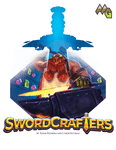
So, to augment the challenge in this game, I would really encourage the Fortune expansion which gives players coins. The coins are kind of like used as a wild and it gives a little bit of flexibility so that if a resource gets called by a player and it's not a resource that you want, you can use a coin to buy something you would wish to have instead. Provides a bit of a handicap. Next, we have Sword Crafters. This is kind of like a three-dimensional tile placing game because players are using the tiles they collect to build a physical sword. It's a lot of fun, and it's quite challenging, too. Uh it features an I cut, you choose mechanic. So, from the selection of tiles, players are slicing it up and then drafting uh their favorite slice and then what gets cut out of it.
It is a really interesting game. Kids like it cuz they like making the sword. Uh I think that the rules are very easy to understand. It does play up to five players. The only thing about this game to be aware of is that, unlike Tiny Towns, where you can pull in the Fortune expansion and use those coins to help players that are younger, in Sword Crafters, it is a challenging game, and usually the most experienced player is probably going to win. If you're looking for a game that has an even playing field, let's take a look at the next one. This is Twin Palms. Twin Palms is a trick-taking game, but there's something about this game that I really love and makes it accessible to everyone. In Twin Palms, you don't play a single card for each trick.
You pay you play a pair of cards. And so, from your hand, you can construct the strength of the card that you want to play. Do you play two cards of the same suit, which is a stronger pair and is more likely to win, or do you intentionally play two cards of different suit and low value, which may be an intentional loser? The point of the game is not winning as many tricks as you can, but rather accurately bidding how many tricks you can win. You can win this game by never winning a trick. And I think that rule alone is why my kids like it so much. It provides different access points for how you want to win. Do you want to win by taking tricks, or do you want to win by losing?
That's what I really like about Twin Palms. Here's another little game that has a good deal of strategy, but also is augmented by enough luck that anyone can win. It's called Don Quixote, the Ingenious Hidalgo. It comes in this awesome little like book-shaped box. Uh it is a card storytelling game. It's It's pretty different. Um during the course of the game, players are going to be playing events that are going to be influencing the character Don Quixote. And every player has secret objectives about how they want the story to turn out for their hero. They will then vote on the events, and the vote card that they play does two things.
One, it casts a vote for the event as either a success or a failure, which can provide an outcome that the player really wants, but also the color of that card is a scoring card towards the end of the game. So, the question you're always thinking is, do I want to play a card that is going to make a strong vote in the direction that I want the game to go in, or do I want to play a card that I think is going to score well with the voting of everyone else? If you can predict the direction the majority is taking, you can kind of you can kind of leech onto that and and get points from it. So, there's a lot of different directions that this game can go on go in. Uh there's also events that will allow you steal or take uh items, which are worth scoring at the end. Uh you can cancel out the vote of your opponents, or cancel out the effects of other cards. There's a lot of really cool things that you can do and really even though there's some really thoughtful decision-making in here, playing Don Quixote it always feels like it is it's anyone's game. The next game is the Wandering Towers. This is a game that I have been enjoying for several years.
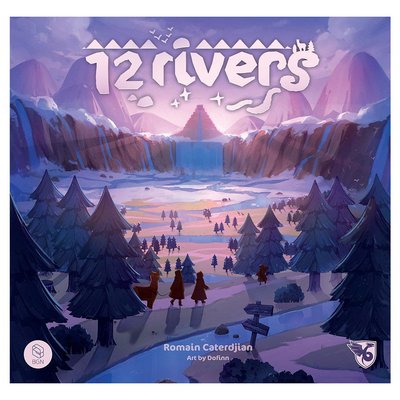
It's a card-based movement game. You're holding a hand of only three cards and on your turn you can play two cards to move your wizards or towers and your objective is to move your wizards around the board and into the tower. Now, the the challenge in the game is that the towers are always moving. So, sometimes the tower that you want to get to is right in front of you, other times it's all the way around the board. Sometimes you can move a tower on top of a hopefully an opponent's wizard and block them from taking another movement. When you do this, you get a potion. That's what I really like about the game because aside from playing a card from your hand, if you have a potion, you can use a special ability which can kind of unlock some really cool combos. You can create situations that are really advantageous to you or can even be really aggressive, but it's a fun game, quick flow to it, plays up to six, the Wandering Towers. 12 Rivers has a table presence that's really going to draw in your kids. My girls love this game. They love watching the marbles roll down the hill. Uh in the game you are trying to collect these pearls in order to complete sets which are going to be worth points. The thing is, in order to ensure that you can get the pearl that you really want, you want to put your gate higher up on the river, but this is going to cost you more. So, the trade-off is, do you use your cards to their advantage or do you spend your
cards to get your gates higher up and get the pearls that you want or do you take villagers in order to have more objectives so that you have more flexibility? There's a lot of different things that you can do. Uh each round, you're just drawing more pearls to go up on the top of the mountain, and you got to make your decisions from there. So, really easy to understand. The objectives are very clear, but what we love most about the game is how the experience of placing, releasing, capturing these pearls brings in everyone playing. Granted, it is a limit only for players again. So, let's take a look at another game for more people. Planet Unknown. All right, to be honest with you, this is my favorite game on the list.
I thought about putting it at number one.
[snorts]
We'll talk about why it's number three, but Planet Unknown is a tile-placing game for up to six players where everyone is simultaneously taking their tile from one of two spots at a lazy Susan in the center of the board. You're just taking the tile from the space that faces you. And what's cool about the game is that every turn, you get to spin the Susan around till you get piece that you want. Um the objective is generally to fill rows and columns in your planet, but as you place these tiles, you also get to move up on tracks, which will give you different kinds of abilities to help you with your tile-placing strategy. So, there's some really cool things to to going on as you're placing tiles, getting benefits from moving up on the track. Um the idea of simultaneous tile placement that is supported by the lazy Susan, I think is brilliant. I've done full reviews on this. I've raved about it. I love this game.
I think it's an awesome one for adults. Your kids might not be so much into like the whole space adventure theme. Not sure about that. So, let's look at the next one. In addition to Encantado 12 Rivers and Sword Crafters, story probably has the most inviting theme for kids. In this game, you are a superhero and you are building your own origin story. It's a trick-taking game and every round you're mostly getting points for bidding and collecting the tricks that you want, but what's cool is that as you play, you keep acquiring new superpowers and these superpowers kind of change the rules for you with respect to how it is you take tricks. Um There are a lot of cards in the game.
There are a lot of different ways that the rules can get mixed up as you build your unique uh combination of powers. Play for five rounds at the end, you have a special objective superpower that you've been holding onto from the beginning of the game and at the end, whoever has the most points wins. Origin story checks all of the boxes, but that first one, that approaching problem-solving. I'd like to see something a little bit more challenging, a little bit more strategic. That's why my number one is our long-standing favorite for all the kids that is satisfying, challenging, makes you want to play again and again. It's the game Karuba. Now, Karuba says that it plays two to four players. However, I have combined two boxes of Karuba, so two boxes combined it can easily play eight. That's why I'm going to say it checks all the boxes. Uh this is a tile-placing game where the objective is to build a route from the explorers to the treasures.
Now, everyone has identical tiles, their own set and one person calls out a tile out loud. Tile number 16. Number seven. Number 23. Whatever they call out, everyone takes it and they can place it anywhere on their board without rotating it. And the objective is to place their tiles in such a way that eventually there is a clear path to get treasure. Anytime you have a tile that you can't place or you don't want to place it, you can discard the tile and you can move your explorers along the route. This is a racing game where the end is triggered as soon as somebody collects all the treasures, but the winner is the person who has the most points. Karuba was introduced to me when I was playing in a group of adults, but I've been playing it with my kids since they were five years old. It really is an awesome game.
Karuba. Those are my best recommendations, but every family is different. That's why I built the perfectboardgame.com. Games are organized categorically, so you can browse by shelf or search a shelf like Board Game Dad Favorites. But what you'll find is more than just a list. As you review games on the site, it learns your likes and dislikes and you can filter any shelf by the best matches for you. So, go to the perfectboardgame.com, review some games and find the perfect board game for your family. Again, this is Board Game Dad. Thank you so much for watching. I'll see you next time. Bye-bye.