Efka's Top Ten Games of All Time
Games in This Video
8 games are featured in this video — they unlock as you watch.


Transcript
How did that get in there? Board games are delicious, and these are the 10 most delicious ones. It's time for a list. There's nothing wrong with the list as long as you don't do it too often, and the last time we did our top 10 board games was 7 years ago and that information is just outdated. Plus, it was a weird amalgamation of mine and Elaine's top 10 and that's just nonsense. So we're fixing that today. We're going to go over my 10 favoritest board games right now, at this moment in time. If you ask me, I think these board games are the best. If you'd asked me yesterday, the list would have been different. If you asked me tomorrow, I will have regrets.
But for now, let's capture this snapshot in time. 5:00 p.m. BST 9th of April 2024. Efka's top 10 board games. Oh and we'll have a video for Elaine's top 10 board games too, that's coming sometime in the future. If you have a good time watching this video and want some more of it, the subscribe button's just down below. No pressure. [Jazzy Music] [Lounge music] Vroom vroom! I think Heat is the best racing game out there, because unlike other racing games, it's not trying to be a racing game. You might say to me 'Efka, that does not make any sense'.
Hear me out. Obviously Heat looks and plays like a racing game. You've got these dinky little cars, a gear stick, the board looks like a racing track, and your objective is to pass the Finish Line first. Sort of. There's extra rules, we're simplifying things. A little bit about me: I am not a car person, I don't know how to drive, I've obviously never raced a car. I appreciate the modern miracle that is cars, but most days I'd just rather take the bus or cycle. The objective of Heat isn't to simulate being a racer. What it wants to do is simulate the drama of racing films, and that I can get behind. Racing films are all about drama, high stakes, unpredictability, and horrible car crashes, which obviously not a good thing but kind of exciting when you're watching a film.
Which is probably why every racing film has at least one horrible car crash. Let's not unpack that. Heat is a board game that has drama, high stakes, unpredictability, and every game I've played so far has had a horrible car crash. Every player draws a hand of seven cards, and then from that hand select some depending on their speed, and then when their turn comes reveals them. This generates endless moments of [shocked noise] But then Heat lets you push your luck by pushing your clunky metal contraption just a little bit further, usually with no immediate consequences, getting you right into the thick of it, right into the danger zone. But no immediate consequences does not mean no consequences at all.
All those push your luck systems make you spend heat from your engine, and if you find yourself with very few or none at all, that could mean major danger. This creates a fantastically tense environment. Every turn feels like it matters. Going down a straight lane at top speed? Important. Slowing down at the corner to safely cross it? Important. Every ounce of risk and efficiency? Important. And also Heat is as light as a feather. I am talking minimal rules. If your family play Ticket to Ride, this is maybe just a smidge of a step up. [Jazzy Music] Can you just pass me the...
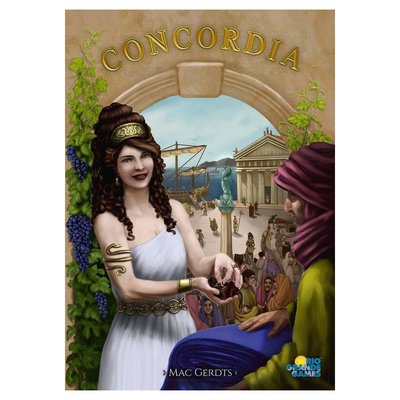
Sorry, I didn't realise you were back. Have you ever had a board game that you have loved, but never ever won? I don't know what this relationship is, it's certainly not reciprocal, but I've owned Concordia in one form or another for nearly a decade now and each time I play it there is a twinkle inside of me. Maybe this time. Like, I try not to get my hopes up but I give my heart this little window so it can look out and see Concordia's shadow in the sunset. When my friends lose a game to me and I feel a little sad about it, I just say to them 'It's okay, let's play Concordia next time, I won't be winning that one.' Imagine that feeling spread across the vastness of time that is 10 years.
The reason Concordia is so compelling yet so hard to master is because it looks like your average beige Euro game, complete with a score track wrapped around the board. I think what's telling here is that that score track does absolutely nothing. In fact, these maps would look so much better if this score track didn't exist. Why does it exist? Who knows. Euro game. Therefore must have score track, even though a score pad would have been much more functional. You also do very standard Euro game things in Concordia. You collect resources, you build outposts, you create scoring opportunities. But the way you do them feels completely alien. To this day, no other game - including other games designed by designer Mac Gerdts - feel anything like this. What you can do is determined by your hand of cards.
Each card is an action - like collecting resources or building outposts. But each time you play a card it goes into your discard pile and is no longer available until you take a reset turn, which wastes your time. Better cards are available to be purchased but, this is the final kicker, each card that you have in your deck at the end of the game is also a multiplier for your score, and it multiplies very specific things. So the more you play, the more Concordia asks you to specialise and narrow down your strategy, but the more you specialise, the more the game punishes you. To summarise, this is a game that wants you to specialise but also remain flexible.
It wants you to be a rubber steel bar, and if you can't transform yourself into a rubber steel bar over the course of 2 hours it will sneer at you. What's also nice is that Concordia is regularly supported by the publisher. Each year, you will at least get a map pack with each map putting further twists onto this sadistic puzzle, and as a nice side effect completely destroys your box as you succumb to hubris and try to mangle all of these maps inside of it. It also now comes in two versions - Concordia and Concordia Venus, and if you are intrigued, get Venus. It has the same base game as regular Concordia but also the team game, which some people who are really wrong don't like.
But you don't have to play that, there's both versions inside - there's no downside. The only downside is that if you're anything like me, you might never win this. Even in team mode. [Jazzy Music] [Lounge Music] I like tight games. I don't need competition, but I also don't want aimlessness or doing things just to do them. I like games to push, and propel me with some crunch. A Feast for Odin has 60 plus different actions you can do, including some with random dice rolls to see if you succeed... ...and I can't get enough of it. In A Feast for Odin you can: build boats, gather relics, build huts, explore islands, milk cows, breed cows, breed horses, do some raiding, go hunt some animals, do some whaling, breed pigs, grow some crops, and how many more of these do I need to list before it becomes evident that this is whatever is the board game version of cottage core?
But, you know, with a lot more exploitation and murder because, it's Vikings. It is the quintessential 'do things' game. There's so many paths and avenues to explore that you can just potter around this game, endlessly just pushing buttons, to see what kind of biscuit it throws out. But it's also got some tightness, introduced via a Tetris puzzle. In fact, A Feast for Odin is the progenitor of Tetris pieces in a board game... that's not a legal placement... and is still one of the finest examples of the genre. You get a player board, and you can put all the Tetris pieces you've hunted, plundered, grown, and pillaged - growing it outwards diagonally. The further you cover it up, the more money you're going to get at the end of the round.
And money is points, and a versatile resource. It acts as a gentle propellant. A Feast for Odin can be a game where you do what whatever is the Viking version of a farming simulator, or it can be an optimisation puzzle, or both. Do whatever you like, play however you want, you'll always find some reward. There is, however, one caveat. Some viewers might remember that a long time ago we have reviewed A Feast for Odin and it wasn't exactly glowing, so what changed? Well, I have. But also the Norwegians expansion, which completely rejigged the entire game. Norwegians replaced the whole action board, completely recontextualizing all the 60 plus action spaces. What before was an odd collection of pathways fluctuating between no-brainers on one end and nonsensical strategies on the other, now shines as a vast space of possibility and exploration.
Norwegians together with A Feast for Odin is a hefty purchase, and also Norwegians is hard to find, so we wouldn't recommend to rush out and get this. But so far this is the only game that managed to seduce me with the pitch of 'just do things for the heck of it'. [Jazzy Music] This isn't included in the game, this is just something I own for fun. But what is included in Ra, is the true spirit of auctions. As you can see, I own the ultra-absurd version, which I don't recommend unless you already know that you really love Ra. Plus, the standard version is a bargain, and has the exact same artwork. I'm actually not going to talk about Ra a lot because we have a video coming for Ra very soon and I don't want to spoil my thoughts on it, but here's what I will say: So many auction games are about winning the auction - the bidding is the exciting part: it has the zhuzh, the verve, it makes sense right?
The air crackles with anticipation... Rah asks a different question. So you just went to an auction and bought yourself a crumbling house, a car that falls apart as soon as you look at it, maybe you bought a farm and you've never even seen a cow in your life. Rah is the story of what happens next. In Ra you don't bid on one thing, you bid on a collection of things. It will sell you piles of tiles that you can reliably win almost any time you choose to, and whilst there is a gleam of something shiny in that pile it also comes with a lot of baggage. That baggage might ruin you. And if you've played very badly you might end up in a situation where you are forced to buy something awful, which is simultaneously the worst and the best feeling?
Rah isn't a game of excitement; it's a game of consequences. And this new edition is just a ride of colour and nice chonky components, all lovingly produced for a reliable modern classic. [Jazzy Music] Moo moo mother duck. Remember in the A Feast for Odin segment I said I need games to propel me, and in the Heat segment I said I like trains? Well... Great Western Trail is a weird game to explain because it has so many funky Euro game mechanisms implemented in bizarre ways. You have deck building, a rondel system, obfuscated tracks, and a bunch of other mini mechanisms littered throughout. But honestly, none of those are the selling point.
The gist is that you have a cowboy. You move it across the board in what is effectively a loop, stopping on various spaces you choose, to perform actions on it. You can only move so far, so your choice is somewhat limited. Plus, some spaces you stop on will only be effective if you have the right cow card in your hand. Finally, you want to sculpt your hand by stopping and spending these cards and redrawing new ones for the final stop in Kansas City, where you will cash out big if you've done well. This system creates a framework that always encourages you and guides you. Every stop is a suggestion, a guidepost to how you could carve out your path in the future. Great Western Trail has this fantastic ability to always offer just enough not to drag you by the heels but just gently nudge you forward, always offering choice.
It's lightning in a bottle stuff. No literally, Great Western Trail has had two revisions. One as GWT Argentina and the other as GWT New Zealand. This one is bunk, this one is all right, but neither has managed to capture that persistent spark that makes me skip over the moon every time this game hits the table. Plus this has an expansion if you really want added complexity, which this already has heaps of. Not for board game novices, but if you... wrangle the Euro game, listen, you owe yourself to play this. [Jazzy Music] Euro, Euro, Euro. Another Euro?
Another Euro. Listen, I like Euros. I know this might come as a surprise to some viewers because on our channel we tend to cover big recent releases, but at the back of my heart it's this beige stuff. I know this isn't beige, it's maroon or burgundy, maybe, I don't know, I'm not a colour guy, I'm a Euro guy - and this is one of the best. Age of innovation is a marriage of three things: a symbiotic leech-like uneasy relationship with your rivals on a shared map, unique player powers, and... tracks. I hate tracks. I tolerate them here because they are contextualised by all the other things in this game that make them fun, but otherwise tracks can go in the bin. The further we go down this list, the more cautious I have to be about my favourite games as recommendations, because they are becoming something very specific, tuned to things I like, and Age of Innovation is just not going to be appreciated by everyone.
There is a progression system in this game that telegraphs very well how you are doing. It wants you to build outwards to create scoring opportunities and if you make a misstep, it will punish you by not letting you do things. So players who do well get to keep going and players who do badly have to end their turn early. This is not good game design and yet I love it in spite of that. There is something very specific about this progression of maintaining resources, leeching opportunities from your opponents, and building outwards that really vibes with me... and has vibed with me all the way back since 2012, despite Age of Innovation being a 2023 release. How does that work? Age of Innovation is a reimagining of a game you might have heard of called Terra Mystica, and I was fortunate to play and compare both recently with my friend Carley Reinhard.
She's a real Terra Mystica aficionado - played it over 100 times, and she also has a board game YouTube channel - link in the description. There's also another version called Gaia Project. It was really hard for me to choose between these but right now Age of Innovation is a fresh new space to explore, and also it is kind of like the best of both. Terra Mystica has always been the leaner and cleaner one, and Gaia Project bizarre and esoteric. So Age of Innovation is a straight replacement for Terra Mystica, but I'm probably going to keep Gaia Project for when I want that really weird game space. [Jazzy Music] See it's not just Euros! I like this too! But what is... this? What is Earthborn Rangers?
I struggle to come up with a better example of a game that defies definition. On the surface things are simple. It's a cooperative campaign game that leans strongly on the deck construction ethos of cooperative CCGs. Or LCGs if you're a pedant for commercial distribution models as meaningless genre tags such as: the Lord of the Rings card game, or Arkham Horror The Card Game. Do not comment about part two of the Arkham Horror LCG video. We said numerous times we are not going to do it, why we don't want to do it, and why it gives us bad feels. Just leave it alone okay?! Please! Anywho, who you pick some cards, build a deck, go on an adventure - Bilbo's your uncle. What's so special about that?
Earthborne Rangers at first play will seem confusing. You'll understand the mechanisms, you just won't know what to do. Your first quest in this post, postapocalyptic environment forward setting is to hand out some biscuits, which okay that's sort of a goal, but the way you interact with the game itself feels opaque. The mechanisms seem distant from what you're trying to achieve. You look at your cards, you look at the issues presented to you in card form and you'll find yourself asking: 'What is the point? There's some sort of a wolf thing harassing me, and currently I'm capable of making some tea. What does that achieve?' Now that I think about it, a cup of tea and some biscuits does sound nice. I've spent too much time in England.
But then things sort of start happening on their own - the environment starts to interact with itself. The wolf notices a deer, starts eating it, and then itself gets eaten by some living acid slime, and then a person comes along and says 'Here's your biscuits!'. The world in Earthborne Rangers simulated by a intricate combination of cards isn't just alive. It unfurls and reveals itself to those patient enough to observe it. It's slow, plodding, and methodical, and provocative. It gently nudges at questions about the human role in environment and by environment, I don't mean necessarily environmental issues, I mean nature. What part of it do we take? How do we live *with* it? It's heady stuff.
Anywho, it's worth noting that this is so high on my list because this is my current campaign game, and I am really enjoying it. But it also has a lot of frustrating elements, which I will leave for our review of it. But even when it disappoints me, after the play session is done, I keep dwelling on it. I keep wanting to explore more of it. I keep wanting to watch this world. [Jazzy Music] Elaine: I made an El Grande sandwich! This is a page from a tabletop magazine called Senate which, last year, asked me kindly to write for the segment called 'Shelf of Shame' which is where you take a board game from your shelf that you haven't played, and then play it, and then say what you think.
I wrote: 'It's so very obviously great, perhaps the best in the genre. Easy, crunchy, moreish, funny. It knows when to reward you and when to punish you, but most importantly it brought me closure. It's deservedly a classic, and yet it taught me absolutely nothing I need to know about games.' Well, half a year later and this is my third best game of all time. Again, much like in the Ra segment, I won't go on about this because we literally covered El Grande a month ago and you should go and watch that video because it goes over everything that makes this game special. But I will say that out of all the games on this list, El Grande is the most precise, lean, ruthless one, and it squeezes the maximum amount of fun out of every rule.
The tension this game creates out of fundamentally simple systems stood the test of time for three decades. Its persistent longevity speaks for itself. Anything I say just does it a disservice. [Jazzy Music] Heavens to Betsy! This worm looks like something else! I start with the worm because it's such a preposterously misjudged piece in an otherwise perfect blend of mechanisms, tactics, and then there's the Dune stuff which honestly I could take or leave. I'm not ... it's not my thing, okay? I'll get more into that in our review of this game, but otherwise what a delight this is! What a treat! what a board game!
Dune colon Imperium dash Uprising wormed its way into my heart, ho ho! And it had an uphill battle because I just wasn't interested in what it was doing - melding tried and true Euro game mechanisms like deck building, worker placement, and area majority seemed like a recipe for disaster. Not to mention the copious amounts of the colour brown, spread very liberally across the board. On its surface it seemed as lifeless as the desert, but surprise! The desert is alive with the sound of thumping. I should have saved these Dune puns for the upcoming review really. Uprising made me consider deck building in a way I haven't quite experienced before. These cards that you purchase will come out three, maybe four times in the course of the entire play, but they're still very impactful so every purchase matters.
Plus it leverages the cards you spend to do actions against the cards you save to purchase more cards. Everything feels pivotal. It's also incredibly opportunistic, forcing you to evaluate your opponent's needs against your own. Every decision is a dot in The Matrix - a web of consequences that unfurls in a crescendo in a desperate clamor for the last few victory points. In Dune there is no room for a mistake. Every move you make, every breath you take... Dune is watching you. Get it? 'Cos... Sting... he was in the movie. Here's a clip of him holding a cat: [Shouting] [Blast] I love this game! Out of any board game I own, if I had to choose to play one right now or any day for that matter, Dune colon Imperium dash Uprising would be that game.
But it's only my number two board game. Why not choose number one? Because number one is only for special occasions. [Jazzy Music] Siderial Confluence is not a game for most people, it's a game for me. It is everything I want in a board game, and I wish, I wish more people shared my love for it, but I understand why they don't. It is first and foremost impractical. There is no image that can do this game justice, because any actual play image you take of it looks like someone just vomited cards on the table and then went for an inebriated nap.
Siderial Confluence is grand. It is so grand it will not be contained by such trivialities as a table, and the way it looks is also the way it feels. The sprawling mess of intersecting mechanisms... actually scratch that they don't even intersect. They just pass each other by like spaceships in the long night. Poetry and Chaos. That's what Sidereal Confluence is. The gist is that you are playing an alien species. You could be space dragons, space bugs, space Mafia - a faction you *can* play but I sincerely recommend you don't. Some of my most conflicted and fractured play moments ever come from playing that faction. You are convened at a galactic council - trading resources, knowledge, technological developments for the betterment of the universe.
That's the narrative description, but also what you do in play. For 10 minutes each round you partake in the most arcane form of real-time trading for anything that isn't glued to the table including, in a very good twist, promises that *are* binding. You cajole, you plead, you haggle, you coerce, you'll do anything to get you what you need. You let your guard down, make a bad deal - it's glorious! After the trading is done, you play a resource conversion Euro game where the drunken evidence board of cards becomes an input-output converter. This card, for example, takes two green cubes... outputs a blue and a brown cube. And thus every card on this table is a potential for profit.
Then repeat that five more times and that's Siderial Confluence. But that doesn't show you the heart of the game, which is surprisingly positive. Each faction in the game is unique. From trees that make their planets lush and verdant... and profitable, to hive minds that generate wild resources. They feel sufficiently alien, their mechanisms have personality. If you thought Root was gloriously asymmetric, wait till you give this a try. These factions have their own visions, goals, and desires but the only way to succeed in Sidereal Confluence is to actually try to improve the general state of things. Making deals that are beneficial to both sides is the only way you can win. It's not enough to win by itself but you cannot win without being positive.
I've learned that the hard way. Sidereal Confluence has an ethos. Sure that ethos is the same as Bill and Ted's - be excellent to each other
but it's something so many competitive board games forget. For that, for the wild chaos that it is, for the exuberance it deliverers, Sidereal Confluence is my number one game of all time. All the other games on this list will fluctuate wildly. I don't see this number one spot budging anytime soon. At this point you might have questions. Questions like 'Why isn't any of the Gloom Havens on the list?' or 'Why are some of the games that I've given the Game of the Year award to not on this list?' I will answer those questions now. I didn't put any of the Gloom Havens in because we designed one of the many, many, many scenarios in Frost Haven and we got paid money to do it. I love that game series, but it would be gauche of me to include it.
Now Boarding, For Science, Undaunted Stalingrad and Pipeline were all very close but they were also Game of the Year decisions jointly with Elaine. There're still up there, like in my top 20, but they didn't quite make the cut. Tremendous games all in all. King's Dilemma, on the other hand, I haven't had a chance to return to and maybe even won't, even though I have an unplayed copy upstairs - because the sequel isn't that far away and I'll probably just play that. So this game is on a sort of a 'list hiatus'. I hope that makes sense. And now I want to hear from you! Do you also love one of these games? More than one? Is Siderial Confluence also your number one game of all time? And if it is, who are you, you strange, strange person?! I thought I was alone in my eccentricities.
The only way to get more of this if you enjoyed it is to subscribe. A lot of the games that we've covered here we will cover in fuller detail in the future, so if they piqued your interest subscribing is the way forward. For everyone's benefit. Basically subscribing is like Sideral Confluence. And here's something that might surprise you. Not a single one of the games that were covered in this video are a review copy. We acquired them ourselves in an effort to remain independent from publisher influence. If you'd like to support independent board game media, you can do so on our Patreon - that's the website where you give us a bit of money every month patreon.com/nopunincluded We just launched our pledge drive for the year last week, and it's not too late to join that. Also, you can just follow us on Patreon for free, where we'll sometimes post updates that are available for everyone to read, so that's a way to get more No Pun Included into your feed.
See you soon!