

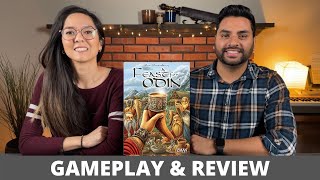
A Feast for Odin box art

A Feast for Odin

Game Info
Year
2016
Players
1-4
Age
14+
Playtime
90 min
Publisher
Collection
Ratings
Mechanic profile
Percentile rank vs. all games
Vibe profile
How this game feels to play
Description

A Feast for Odin is a saga in the form of a board game. You are reliving the cultural achievements, mercantile expeditions, and pillages of those tribes we know as Viking today — a term that was used quite differently towards the end of the first millennium.

When the northerners went out for a raid, they used to say they headed out for a viking. Their Scandinavian ancestors, however, were much more than just pirates. They were explorers and founders of states. Leif Eriksson is said to be the first European in America, long before Columbus.
In what is known today as Normandy, the intruders were not called Vikings but Normans. One of them is the famous William the Conqueror who invaded England in 1066. He managed to do what the king of Norway failed to do only a few years prior: conquer the Throne of England. The reason the people of these times became such strong seafarers was their unfortunate agricultural situation: crop shortfalls caused great distress.

In this game, you will raid and explore new territories. You will also engage in the day-to-day activity of collecting goods with which to achieve a financially secure position in society. In the end, the player whose possessions bear the greatest value will be declared the winner.

--gameplay description from @StoryBoardGamer's review:
A Feast for Odin is a points-driven game, with a plethora of pathways to victory, with a range of risks balanced against rewards. A significant portion of this is your central hall, which has a whopping -86 points of squares and a major part of your game is attempting to cover these up with various tiles. Likewise, long halls and island colonies can also offer large rewards, but they will have penalties of their own.

Each year follows a familiar pattern of preparation, worker placement, and then meeting the requirements of your feast. The main phase of each year is a worker placement affair. You start with a selection of Vikings, and a large action board with a whopping 61 different options to choose from. Each of these will be arranged from left to right in one of four columns. Each column requires an additional Viking to activate, but they are proportionally more powerful.

At the end of each round, you will need to fill a feast table with food, alternating between plants and vegetable matter. You will also have a chance to lay the valuable green and blue tiles into your main hall. The configuration of these tiles must follow certain requirements, but your main goal is to both cover up a line of coin icons to increase your income, while otherwise encircling certain printed icons to generate those.

You will build your engine over time, following an alternating pattern of outward expansion and hunting against development and cultivation. It all comes down to how much you’re willing to take on at any one time, and what risks you’re willing to set yourself up with for their rewards.

UPC 681706716909

Ask a Rules Question
All mentions
Browse transcript mentions, sentiments, pros/cons, mechanics, topics, quotes, and references.
Total mentions: 211
This page: 11
Sentiment: pos 8 · mix 1 · neu 0 · neg 0
Mentions per page
Showing 201–211 of 211
Video cQ-ooH8h0X4 Beyond Solitaire Top List at 20:58 sentiment: positive
Beyond Solitaire - A Feast for Odin video thumbnail
Click to watch at 20:58 · YouTube ↗
Overall sentiment (raw)
positive
Pros
  • Sleek solo engine
  • Compact and engaging
Cons
  • Can feel heavy for some players
  • Expansion choices matter
Thematic elements
  • Roll-and-write/Euro-style planning with expansion options
  • Viking-themed, planet-scale resource management
Comparison games
  • Pax Premier
  • A Feast for Odin
Mechanics (from transcript analysis)
  • Roll-and-write on a polyomino/area-control core — Strategic placement and planning with evolving rules.
Video topics + discussion points
No key topics recorded for this video.
Quotes (from this video)
  • Spirit Island is just so engaging and interesting.
  • Words cannot express how dominant this is.
  • My true love is still Mage Knight… but Spirit Island ate and left no crumbs.
  • The solo gaming community is the best gaming community.
  • Thank you so much to the solo Community; you guys do a great job.
References (from this video)
No references stored for this video.
Video BT6IjJtx1GQ Before You Play Top List at 28:10 sentiment: positive
Before You Play - A Feast for Odin video thumbnail
Click to watch at 28:10 · YouTube ↗
Overall sentiment (raw)
positive
Pros
  • Massive depth and thematic immersion
  • Excellent solo and multiplayer options
  • Expandable with numerous modules
Cons
  • Complex rules and long playtime
  • Hard to teach to new players
Thematic elements
  • resource engine, fleet management, exploration
  • Viking-era exploration and raiding with island expansion.
  • dense, thematic euro
Comparison games
Mechanics (from transcript analysis)
  • Resource Management — Balance resources, space, and scoring to optimize performance.
  • Tile/engine building — Tiles and engines create pathways for scoring and production.
  • Worker Placement — Assign workers to gather resources and perform actions.
Video topics + discussion points
No key topics recorded for this video.
Quotes (from this video)
  • There's Nostalgia to it
  • Kanban EV is prettier definitely
  • the end game sneaks up on you a little bit faster than you're ready for
  • we've traveled with this game for about five six years
References (from this video)
No references stored for this video.
Video NV50fOuXDrk The Broken Meeple Discussion at 7:54 sentiment: mixed
The Broken Meeple - A Feast for Odin video thumbnail
Click to watch at 7:54 · YouTube ↗
Overall sentiment (raw)
mixed
Pros
  • Deep engine-building and multiple viable strategies
Cons
  • Long setup and lengthy play sessions
  • High cognitive load
Thematic elements
  • Resource management and engine-building
  • Viking exploration and raiding
  • Historic-inspired strategic flavor
Comparison games
none
Mechanics (from transcript analysis)
  • Resource Management — Must balance budgets of many resources with varied rewards.
  • Tile Placement — Tiles represent resources, voyages, and ventures.
  • Tile/polynomino placement — Tiles represent resources, voyages, and ventures.
  • Worker Placement — Multiple action spaces for resource gathering and actions.
Video topics + discussion points
No key topics recorded for this video.
Quotes (from this video)
  • BGG top 100 list is broken.
  • Two Brass games in the top 10? duplicates are broken.
  • I hate Eclipse Second Dawn for the galaxy.
  • Ticket to Ride should be number one on Board Game Geek.
  • Ark Nova being at number three, I would like to see it creep up a bit more.
  • This is how exploitative the BGG top 100 list is.
  • Three brass games in the top 25? It's going to highlight even more how broken this list is.
  • You cannot look at that and call it fair without being the most biased individual.
  • The system itself is broken.
  • It's a gamers list. It is purely based on diehard dedicated board gamers who make this list what it is.
References (from this video)
No references stored for this video.
Video dGP7D829e8U Chairman of the Board Discussion at 15:28 sentiment: positive
Chairman of the Board - A Feast for Odin video thumbnail
Click to watch at 15:28 · YouTube ↗
Overall sentiment (raw)
positive
Pros
  • Huge variety of actions and paths
  • Elegant Rosenberg-style engine with depth
  • Strong tension between sandbox options and end-game scoring
Cons
  • Complex and potentially overwhelming for new players
  • Sandbox breadth can obscure focus
Thematic elements
  • Sandbox worker-placement with heavy thematic flavor
  • Viking era with exploration, raiding, and island expansion
  • Strategic engine-building with a wide action surface
Comparison games
Mechanics (from transcript analysis)
  • Multi-use cards and tile-driven actions — Cards provide actions and scoring opportunities; tiles unlock bonuses
  • Polyomino tiling / shapes on boards — Filling shapes to maximize scoring potential
  • Worker Placement — Many distinct spots and islands to develop for income and bonuses
Video topics + discussion points
No key topics recorded for this video.
Quotes (from this video)
  • the infinity gauntlet is its own encounter set and i think that makes so much sense
  • the game really is the story and the skill checks
  • it's a real blast to play
  • the rules themselves are easy but it's the potential to string those bonuses together
  • the sandboxy feel is really appealing and addictive
References (from this video)
No references stored for this video.
Video bT35LJfUKlM BoardGameGeek Top List at 22:40 sentiment: positive
BoardGameGeek - A Feast for Odin video thumbnail
Click to watch at 22:40 · YouTube ↗
Overall sentiment (raw)
positive
Pros
  • huge sandbox with many viable strategies
  • deep worker-placement and engine options
  • exploratory and highly replayable
Cons
  • very large footprint and long setup
  • heavy for casual players
Thematic elements
  • worker placement in a sprawling sandbox
  • Norse exploration and Viking-age provisioning
  • exploratory, sandboxy strategy with massive options
Comparison games
Mechanics (from transcript analysis)
  • Engine Building — workers generate various resources and allow deeper actions
  • engine-building / resource management — workers generate various resources and allow deeper actions
  • multi-path scoring / island building — focus on diverse scoring avenues and exploration
  • Worker Placement — large board with columns of increasing power
Video topics + discussion points
No key topics recorded for this video.
Quotes (from this video)
  • Flavor text is absolutely on point because these cards that you're collecting are just kind of colors.
  • I melted my brain. It was just like way too heavy for me.
  • Star Wars in a box. This is Star Wars in a box.
  • I absolutely love the original Clank.
  • This is a cooperative programming game where you need to do one of them… it’s so much fun.
  • I love the networks.
  • I really like tiling games in general. I like citybuilding games and Quadropolis adds that really extra interesting unique uh tile selection mechanism.
  • Feast for Odin is a game where you are Norwegians. It is just so darn good.
References (from this video)
No references stored for this video.
Video kjmc0133j18 The Broken Meeple Top List at 25:38 sentiment: other
The Broken Meeple - A Feast for Odin video thumbnail
Click to watch at 25:38 · YouTube ↗
Overall sentiment (raw)
Dislike but Respect
Pros
  • Offers lots of different mechanical options
  • Sandbox-style Euro with high replay value
  • Good polyomino mechanics
  • Many worker placement options
  • Solo mode works well
Cons
  • Too many mechanisms - could cut 30% and still work
  • Loses focus and pure turn tension of great worker placement games
  • Requires expansion (Norwegians) to be balanced
  • Card/occupation system poorly designed
  • Occupations rarely worth pursuing
Thematic elements
  • Viking Era
  • Farming
  • Resource Management
Comparison games
Mechanics (from transcript analysis)
  • Card Play
  • Polyomino
  • polyomino placement
  • resource collection
  • Worker Placement
Video topics + discussion points
No key topics recorded for this video.
Quotes (from this video)
  • it delivers what it promises and it does have that true epic feel to it
  • bless you you've got you've got a game that's tailor-made for you
  • you can be set for life playing Magic with your group but yeah it's not for me
  • this is a game where if you are playing with somebody who knows the game they are going to absolutely trounce you
  • I think you'd cut 30% from this game and it wouldn't be a worse game for it
  • taking myself out of the equation this is like 10 but with my own enjoyment into it it's definitely significantly lower
References (from this video)
No references stored for this video.
Video N2MTuvjhc8k Adam in Wales - Board Game Design Analysis at 21:00 sentiment: positive
Adam in Wales - Board Game Design - A Feast for Odin video thumbnail
Click to watch at 21:00 · YouTube ↗
Overall sentiment (raw)
positive
Pros
  • Rich, immersive portrayal with strong avatar focus
Cons
  • Busy cover can feel a bit cluttered
Thematic elements
none
Comparison games
none
Mechanics (from transcript analysis)
Mechanics unknown.
Video topics + discussion points
No key topics recorded for this video.
Quotes (from this video)
  • It's iconic. It is at least eye-catching; it's a classic.
  • The box should tell us what we're doing in the game and how we're going to feel.
  • This is top-notch stuff.
  • I actually just ordered my copy, so this is obviously working for me.
  • The cover sells the game, it screams what you're going to do.
References (from this video)
No references stored for this video.
Video a7k2zYz3pgQ Going Analog Interview at 6:50 sentiment: positive
Going Analog - A Feast for Odin video thumbnail
Click to watch at 6:50 · YouTube ↗
Overall sentiment (raw)
positive
Pros
  • strong thematic coherence
  • engaging components and art
Cons
  • some players prefer lighter or heavier weight
Thematic elements
  • meat, drinks, and feast logistics
  • vikings and feasting
Comparison games
none
Mechanics (from transcript analysis)
  • Set collection and resource management — players collect meal components to maximize feast points.
Video topics + discussion points
No key topics recorded for this video.
Quotes (from this video)
  • it's amazing you were right it was 34
  • now everyone can stop watching and go play a game
  • how I Met Your Mother and I knew that Neil Patrick Harris was a really big nerd
  • follow me on Siege on games on Twitter and I'm trying to do a lot more Instagram there
References (from this video)
No references stored for this video.
Video j50oYkfv2Fk Rolls in the Family Top List at 35:56 sentiment: positive
Rolls in the Family - A Feast for Odin video thumbnail
Click to watch at 35:56 · YouTube ↗
Overall sentiment (raw)
positive
Pros
  • Deep, satisfying engine-building with high variability
  • Rich, thematic, and visually impressive components
Cons
  • Complex setup and long play time
  • Outcome variability can be high depending on card/board draws
Thematic elements
  • harvesting, food production, and population management
  • Viking-era resource management
  • epic, grand-scale farming and provisioning
Comparison games
Mechanics (from transcript analysis)
  • Engine Building — Income and production scale as you expand your grid and production.
  • Polyomino — Shapes represent resources used to fill boards and feed population.
  • polyomino-like shapes — Shapes represent resources used to fill boards and feed population.
  • tile-laying / island-building — Adding island pieces to grow your grid and access bonuses.
  • Worker Placement — Grid-based placement of actions and resources, driving your engine.
  • Worker placement / action economy — Grid-based placement of actions and resources, driving your engine.
Video topics + discussion points
No key topics recorded for this video.
Quotes (from this video)
  • "The pendulum die landed on a bullseye"
  • "Underwater Cities is a game that has managed to carve out its own niche"
  • "I ended up winning and it wasn't particularly close"
References (from this video)
No references stored for this video.
Video SHgmAN-PNOU Before You Play Playthrough
Pros
none
Cons
none
Thematic elements
none
Comparison games
none
Mechanics (from transcript analysis)
Mechanics unknown.
Video topics + discussion points
No key topics recorded for this video.
Quotes (from this video)
  • this game is a sandbox of sorts
  • I really adore this game for a variety of reasons
  • the Norwegians expansion elevates the game for us
  • it's a mess, it's a table hog, there's a lot going on
  • it's probably my magnum opus
References (from this video)
No references stored for this video.
Video SHgmAN-PNOU Before You Play Playthrough at 0:00 sentiment: positive
Before You Play - A Feast for Odin video thumbnail
Click to watch at 0:00 · YouTube ↗
Overall sentiment (raw)
positive
Pros
  • Deep sandbox with multiple viable strategies
  • Norwegians expansion adds meaningful new mechanics and asymmetry
  • Strong two-player balance with interesting island/exploration options
  • Engaging ROI-based decision making with curve of progression
Cons
  • High teaching overhead due to the number of rules and interactions
  • Table presence and component clutter can be intimidating
  • The color/shape interactions can be visually overwhelming at first
Thematic elements
  • Resource management, exploration, and settlement building in a sandbox/engine-building frame
  • Viking era with settlements on modular boards and expansion content
  • sandbox/engine-building
Comparison games
Mechanics (from transcript analysis)
  • animal_breeding — Animals reproduce when conditions are met; pigs reproduce every round, other animals breed for benefit.
  • Deck Building — Build ships or acquire them to raid or pillage for points and resources; ships may come with ores.
  • emigration_and_feeding — Ships emigrate to reduce food requirements; feed your people via banquet tiles and animal yields.
  • income_and_scoring — Income is gained each round from tiles and bonuses; final scoring aggregates ships, explorations, sheds, animals, occupations, and remaining silver.
  • island_and_exploration_board — Exploration boards provide end-game scoring bonuses and ongoing income; boards flip over across rounds.
  • Polyomino — Tiles come in varied irregular shapes and colors, creating a color-tiled hierarchy that guides placement.
  • polyomino_tiles — Tiles come in varied irregular shapes and colors, creating a color-tiled hierarchy that guides placement.
  • ship_building_and_pillaging — Build ships or acquire them to raid or pillage for points and resources; ships may come with ores.
  • Tile Placement — Polyomino tiles are placed on personal boards to reduce negative points and to gain income.
  • tile_forging_and_forgeable_tiles — Forgeable tiles at certain spaces can be created from ore, expanding your pool of tiles.
  • tile_placement — Polyomino tiles are placed on personal boards to reduce negative points and to gain income.
  • tile_upgrading — Tiles upgrade across color tiers (orange -> red -> green -> blue) without changing size, enabling higher values.
  • Tile/Map Shifting — Tiles upgrade across color tiers (orange -> red -> green -> blue) without changing size, enabling higher values.
  • Worker Placement — Players place Vikings on action spaces to gain resources, draw weapons, or trigger effects.
  • worker_placement — Players place Vikings on action spaces to gain resources, draw weapons, or trigger effects.
Video topics + discussion points
No key topics recorded for this video.
Quotes (from this video)
  • this game is a sandbox of sorts
  • I really adore this game for a variety of reasons
  • the Norwegians expansion elevates the game for us
  • it's a mess, it's a table hog, there's a lot going on
  • it's probably my magnum opus
References (from this video)
No references stored for this video.
Transcript Navigation
Showing 201–211 of 211
Game Deep Dive