













My Farm Shop Deep Dive
What the Community Thinks About My Farm Shop
My Farm Shop occupies a fascinating position in the board gaming landscape. Designed by Rüdiger Dorn for Pegasus Spiele, it arrived as a subtle evolution of the dice-rolling engine made famous by Machi Koro and Space Base, yet reviewers like Chairman of the Board and Actualol consistently recognize it as the strongest execution of that formula. The game strikes an uncommon balance, delivering genuine depth in a mechanically streamlined experience. While its distinctive box cover occasionally deters first-time buyers, those who engage with the gameplay discover a surprisingly satisfying tableau engine that rewards careful resource management and planning.
Core Mechanics That Define My Farm Shop
The Three-Dice Control System
My Farm Shop's signature mechanism revolves around rolling three dice, but unlike its spiritual predecessors, players gain meaningful control. On your turn, you roll all three dice and must choose one to purchase a card from the central market display. The remaining two dice sum together to activate a production field on every player's board simultaneously. This creates a fascinating tension: do you take the card you really want and hope the leftover dice pair works in your favor, or sacrifice card quality to enable stronger production for yourself? Early play tends to prioritize card acquisition and engine building, while late game shifts focus to managing which dice pairings benefit your tableau most. Reviewers emphasize that this decision space transforms what could be pure luck into engaging strategy.
Resource Collection and Conversion
Your farmstead produces goods including eggs, wool, milk, and honey. Rather than spending these resources as in traditional economic games, you accumulate them toward storage capacity and then convert them to victory points through specialized cards. This creates an elegant tightness, since you cannot simply spam production endlessly: you must balance acquiring new production cards against your ability to store and convert goods efficiently. Burlap bags let you modify dice results up or down by pip values, giving tactical mitigation when a particular sum would waste your production. Sunflower tokens further enhance fields, increasing yield each time they activate, letting players specialize their engines.
The My Farm Shop Experience
Breezy Flow and Accessibility
At around 45 minutes to an hour, My Farm Shop plays with remarkable elegance for a game containing engine-building elements. Setup is straightforward, and the turn structure stays consistent, preventing analysis paralysis even with experienced players. Reviewers frequently note that the game moves at a natural pace that keeps everyone engaged. The theme, while abstracted, provides gentle flavor without demanding immersion. This accessibility makes it genuinely appealing to casual players while offering enough mechanical texture to satisfy those seeking something beyond a traditional family game. Children as young as eight can understand the core loop, yet adults find real puzzle-solving in optimizing their production chains.
Satisfaction and Replayability
My Farm Shop demonstrates a quality common to excellent games: each session feels fresh despite shared mechanics. The market cards shuffle differently each play, the dice create organic variance, and different resource-specialization paths remain viable. Reviewers who played multiple times noted that you never feel locked into a single strategy; one match you might chase honey production, the next you focus on wool conversion, and both paths yield competitive scores. The genuine puzzle of constructing a functional farm within the constraints of the dice and available cards keeps players exploring new combinations.
What Makes My Farm Shop Stand Out
Control Within Randomness
While Machi Koro and Space Base embrace luck with minimal player mitigation, My Farm Shop respects player agency. The three-dice system and burlap-bag mechanic ensure that even unfavorable rolls offer meaningful choices rather than helpless turns. This reduces the frustration common to games where random chance can sweep away your plans. Reviewers consistently praised this as the game's greatest strength, noting that it preserves the excitement of dice rolling while rewarding skillful play.
Refined Engine Building for Gateway Audiences
My Farm Shop occupies a rare design sweet spot. It contains legitimate engine-building mechanics without the complexity that often intimidates casual players. Cards chain together in satisfying ways, sunflowers compound your production, and conversions feel earned rather than random. Yet the entire framework remains teachable in minutes and playable in under an hour. Reviewers noted that it bridges a gap few games address: players enjoy the experience of engines clicking together without the overhead of heavy euro games.
Potential Drawbacks
Aesthetic Communication Challenges
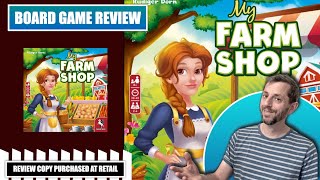
Multiple reviewers acknowledged that My Farm Shop's box cover creates marketing friction. Described as resembling a mobile-game app, the artwork reads as cute and approachable but lacks the visual punch that conveys thematic depth. Reviewers speculated that a more polished, inviting presentation could have substantially expanded the game's audience. The disconnect between the game's quality and its exterior packaging represents a genuine missed opportunity.
Interaction Limitations
While not a competitive attack game, My Farm Shop remains primarily solitaire in feel. Each player builds their own farm, and the dice activation benefits all players equally, reducing meaningful interaction. Some reviewers noted that players focused almost entirely on their own tableaus with minimal attention to opponents. For those seeking negotiation, direct conflict, or constant awareness of others' progress, the gentle, parallel puzzle-solving may feel isolating.
If You Enjoy My Farm Shop
Players who appreciate the streamlined efficiency of Cascadia or the resource management of Splendor will find similar satisfaction in tableau construction. Those who love the dice mechanism but felt Space Base or Machi Koro lacked depth should explore My Farm Shop as the superior execution. Fans of gateway games seeking genuine engagement without overwhelming complexity will also enjoy Rüdiger Dorn's other designs Las Vegas and Luxor, or the economic balance of Valeria: Card Kingdoms.
What Reviewers Are Saying
"This game is the best of the three, it's not even close. My Farm Shop offers that extra wrinkle or two but still remains simple, still remains inviting. You know everything, but that box cover, that's the only knock."
— Chairman of the Board
"Definitely a game that's flown under the radar, and by a great designer too with Rüdiger Dorn. The gameplay is rock solid and definitely caters to a wide array of different players."
— Chairman of the Board
"It's the perfect level for a gateway game, just like Rüdiger Dorn's other games Las Vegas and Luxor. It's simple enough for anyone to pick up but with enough clever twists to keep someone like me hooked. Don't be fooled by the cutesy cover, this one has hidden depths."
— Actualol