











Notre Dame Deep Dive
What the Community Thinks About Notre Dame
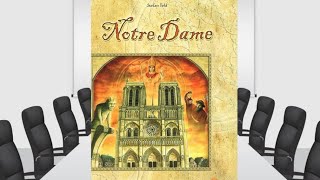
Notre Dame is a 2007 Stefan Feld design published by Rio Grande Games and alea as part of the Alea big box series. Reviewers tend to approach it as a clean, approachable entry in Feld's catalog. Ektorakos, Peaky Boardgamer describes it as one of the most classic, easy to learn family euro games available, and Ektorakos's rules walkthrough presents it as a game that is simple to explain. Other reviewers judge it more sharply. Chairman of the Board admits that Notre Dame is not necessarily one of their favorite Feld games, yet they appreciate the niche it occupies on the lighter end of the Euro scale. Enthusiasm tends to center on the tension the design creates. In a separate discussion, Chairman of the Board praises how the engine comes together, while Nerd Shelves calls it a pretty fantastic game even though it sits below the designer's other favorites. John Gets Games describes the title as a ten year old game that never found its audience, yet still looked worth a purchase at a holiday discount because of its hand drafting and engine building.
Core Mechanics That Define Notre Dame
Card Drafting
Each round opens with a pass-and-pick draft. Players draw cards from their personal decks, keep one, pass the rest to the left, and then choose again from the cards they receive. Ektorakos, Peaky Boardgamer walks through the full sequence, which leaves each player holding three action cards of different colors for the action phase. Because every kept card also determines what is passed on, the draft creates a steady tension between building a useful hand and feeding opponents what they do not need. In Harry Met Board Games summarizes the core loop as drafting cards and then placing cubes on actions according to what has been drafted. Ektorakos also describes a two-player variant that brings in neutral colors, presented as a cleaner alternative to returning cards to the opponent.
Escalating Area Influence
Most action cards direct a player to add an influence cube to a district around Notre Dame, and the strength of that action grows with the number of cubes already present. Ektorakos, Peaky Boardgamer explains that the more cubes in an area, the more powerful the action becomes, with examples that include gaining coins, victory points, and bonuses at the hotel and the park. In Harry Met Board Games describes the result as a multiplier, since a second cube in the same sector triggers that sector's action a second time. The carriage adds a movement layer, because players advance it by their influence in a sector and collect message tokens along the way. Reviewers treat this influence economy as the engine that drives the rest of the game.
The Notre Dame Experience
Tense
The most consistent emotional note in the reviews is pressure. The plague track advances each round based on the rat symbols on the person cards, minus the influence cubes a player has in the hospital, and a marker that reaches the end of the track costs victory points and an influence cube. Chairman of the Board points to the constant pending doom of fighting off plague-ridden rats, and that threat is what makes each choice feel expensive. Watch Review describes the sensation of always being just short of what a player wants to do, with each decision feeling incredibly important.
Satisfying Engine
Reviewers also describe the pleasure of building an economy that compounds over time. Chairman of the Board frames the game around investing in an engine by placing more cubes into action spots to raise the yield of those actions, and says the system "just works like clockwork." A point-scoring card illustrates the feeling, since each later play of the same card pays more than the last. The same reviewer notes that the rounds run out before everything can be done, which keeps the planning tight. For players who enjoy watching a plan click into place, that time limit is part of the satisfaction.
What Makes Notre Dame Stand Out
Cathedral Donations as a Scoring Race
The Notre Dame cathedral functions as a central scoring engine. Players spend one, two, or three coins to earn one, three, or six victory points, and any donation places a cube on the tile. At the end of each period, the tile's victory points are divided by the number of cubes on it, rounded down, and every player scores that value for each of their own cubes. Ektorakos, Peaky Boardgamer walks through this scoring step in detail. In Harry Met Board Games notes that donating to the cathedral is one of the ways to win majorities there. Because the per-cube value depends on how many cubes the whole tile holds, every donation changes the scoring picture for everyone at the table.
Quick, Elegant Play
Ektorakos lists the game at about an hour and a half, but reviewers often describe it as faster than that figure suggests. One Watch Review says it plays in no time at all while still offering a robust game experience, and a separate video from the same channel calls it quick and elegant (Watch Review). The pace comes from nine rounds, two action turns per round, and a limited set of options each turn, so the game moves without long stretches of downtime. The same Watch Review says the speed is why the game's punishing elements do not bother them as much.
Potential Drawbacks
A Punishing Plague
The plague is the feature reviewers most often describe as a negative. One Watch Review names the rats as the biggest negative of the game and calls them a freaking menace. A separate Watch Review notes that the game can be punishing in a way the reviewer usually dislikes, and says the quick pace is what keeps that punishment from becoming a burden. Players who prefer games where negative outcomes are rare should approach Notre Dame with that trade-off in mind.
Dwindling Cube Pools and Limited Options
Another caution concerns resources. In Harry Met Board Games warns that a player's pool of cubes dwindles as the game progresses, which leaves fewer actions and less room to maneuver unless the player finds ways to retrieve cubes or add new ones to the pool. Since both scoring and action strength depend on cube placement, a shortage in the late rounds can be costly. Some enthusiasts also rank the game below other Feld titles. Chairman of the Board and Nerd Shelves are both candid that it does not reach the top of their Feld lists, even though each considers it a strong design.
If You Enjoy Notre Dame
Reviewers who like Notre Dame tend to appreciate compact card-driven designs, worker-placement systems where the number of pieces scales an action, and tight economic games with shared scoring pressure. The comparisons offered in the transcripts point toward several titles:
- Architects of the West Kingdom: In Harry Met Board Games draws the closest parallel, describing Notre Dame's cubes in city sectors as similar to the worker placement in Architects of the West Kingdom, where the placed pieces trigger an action and grow in value as more of them accumulate.
- Earth: Chairman of the Board praises the interaction in Earth, where any player's action gives everyone else a follow-up action, which suits players who want to stay engaged between their own turns.
- Get on Board: The same Chairman of the Board discussion calls Get on Board a wonderful filler, a light option for players who want a shorter session than Notre Dame's plague-driven rounds allow.
Players who found Year of the Dragon too punishing, as one Watch Review describes it, should weigh Notre Dame's plague pressure before committing, since the two games share a sense of constant attrition.
What Reviewers Are Saying
"Well, there's not a lot to be said about this game, for it is one of the most classic, easy to learn and easy to play family euro games out there. The game is for two to five players, plays in an hour and a half and is designed by who else? Stefan Feld!"
— Ektorakos, Peaky Boardgamer
"I do really like this idea that you can't do everything. Do you want to kind of diversify and be a jack-of-all-trades, do everything moderately well, or do you want to be super skilled at one particular action? And you've also got that constant pending doom of having to fight off these plague-ridden rats um to avoid those negative points."
— Chairman of the Board
"You always feel like you're just short of being able to do what you want to do and each decision feels incredibly important. That being said though, it's also an extremely elegant design and the gameplay is ultra smooth."
— Watch Review