













Valeria: Card Kingdoms Deep Dive
What the Community Thinks About Valeria: Card Kingdoms
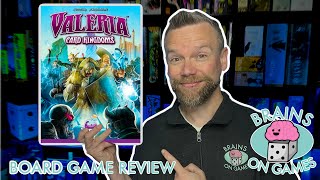
Reviewers consistently describe Valeria: Card Kingdoms as a light, accessible dice and card game with more strategic depth than its tabletop footprint suggests. Published by Daily Magic Games in 2016, the game for one to five players sits in the same family as Machi Koro and Space Base, and nearly every reviewer draws that comparison. Brains On Games called it "a simple fun easy quick game," praising how players build an engine that pays out on everyone's dice rolls while working toward a hidden Duke objective. Board to Death TV - Board Game Reviews was more enthusiastic, awarding the game an 8 out of 10 and describing it as "fun, light, with some depth, beautiful, and perfect for any range."
The areas of agreement are the art, the physical components, and the replay value. Reviewers single out the artwork and the oversized custom dice as thematic touches that make rolling more enjoyable. Disagreement centers on the experience at lower player counts and on how clear the rulebook is. Tabletop Turtle took a more pragmatic view, noting that the game occupies the same shelf space as other dice-driven resource games, so the household only needs to keep the strongest of the group. Board Games UnLocked offered the most enthusiastic endorsement, calling the game "a very much better version of Machi Koro for all intents and purposes."
Core Mechanics That Define Valeria: Card Kingdoms
Dice Rolling
Every round begins with the active player rolling two large dice, but the result matters to the whole table. Each player checks both the individual die values and their sum, then activates any citizen cards that match. The active player uses the left side of each matching card, while other players use the right side, so a single roll can pay out across the table. Brains On Games highlighted the probability consequences of this design: because each die shows one through six and the total is also checked, the outcomes that matter most are the lower numbers rather than the seven that dominates ordinary two-dice games. That detail rewards players who think about which citizens are worth buying before the dice ever leave the table.
Reviewers also value how the design keeps everyone involved. Board to Death TV described the pleasure of watching other players' turns, saying they loved how "even on other players turns, you're rooting for them to roll your specific numbers." The mechanic produces a steady flow of small rewards rather than long stretches of waiting.
Engine Building
The second defining system is the slow construction of a personal engine. Players spend gold to recruit citizens from a marketplace organized by number from one to twelve, and each additional copy of the same citizen costs one more gold. Domains, which are purchased with citizens acting as prerequisites, add instant bonuses, ongoing abilities, and additional victory points. Brains On Games summarized the goal as building "up an engine that's going to earn you the most victory points at the end," while Board Games UnLocked noted that the economy snowballs: resources start scarce and become plentiful as the engine grows. Because most purchases compound over the game, early recruitment choices matter more than they first appear.
The Valeria: Card Kingdoms Experience
Relaxed
Reviewers repeatedly describe a light, low-pressure atmosphere. Brains On Games placed the game in a category of "simple fun easy quick" titles, with a typical playtime of about thirty to forty-five minutes. Board to Death TV noted that "the game moves fairly quickly," and Board Games UnLocked praised its simplicity, saying that "you don't have to think too hard," which makes it easy to show to new players. The feel is less a tense race than a sequence of satisfying roll-and-collect turns, with enough decisions about purchases and monster battles to keep attentive players interested.
City Building
The game's kingdom theme gives it a constructive feel, even though the setting is fantasy rather than urban. Brains On Games observed that players are "building your kingdom but you're fighting monsters," distinguishing the experience from the village-building focus of Machi Koro. Board Games UnLocked described the tableau as a grid of heroes from one through twelve that players gradually hire, with domains extending the kingdom's infrastructure. The sensation is of steadily expanding a settlement while the monster stacks shrink, which gives many players a sense of progress from the first turn onward.
What Makes Valeria: Card Kingdoms Stand Out
Every Roll Involves the Whole Table
Reviewers return to the fact that the active player rolls but everyone benefits. Brains On Games singled this out as a distinctive feature, explaining that citizens carry an ability for the roll on your own turn and a second ability for when another player rolls their number. That design keeps every participant engaged through the entire round, and it places the game closer to Space Base and Machi Koro than to the solitary engine builders that share its tableau approach.
Modular Setup and Replayability
Variety is the other feature reviewers praise most. Brains On Games noted that the citizens, monster stacks, and domains change from game to game, and that the team had not yet seen every domain after several sessions. Board to Death TV highlighted that every citizen except the peasant and knight has an alternative version, and that the box supports a first game with a reduced monster and domain set. Board Games UnLocked agreed, pointing to the many expansions that add new layouts and monsters, which help the game stay fresh for players who already own the core box.
Potential Drawbacks
Two-Player Games Can Feel Thin
Several reviewers found the game works best with more players. Brains On Games reported that at two players it was easy to clear the monster stacks and that there was less competition for shared targets, saying the game "would play better with three or four players." Board to Death TV described a related concern, that the game can feel somewhat solitaire because each player mostly pursues their own engine. Reviewers who want direct interaction generally recommend bringing in more players or adding the optional rule that reveals Duke cards at the start of the game, which Board to Death TV said adds tactics to the planning phase.
Balance and Rules Questions
Board to Death TV raised balance concerns about the seven-value citizens. The Rogue and Thief were described as "a little overpowered," because they steal or grant large resource amounts despite seven being the most common total on two dice, and the reviewers said that pile was the first to empty in every game they played. The first player also gains a modest advantage by purchasing citizens before others can roll for them. Brains On Games reported that some card interactions were unclear in the rulebook and that the group had to agree on house rules to keep the game moving. Reviewers expect that community frequently asked questions will resolve many of these points, but the rules are not as polished as the rest of the box.
If You Enjoy Valeria: Card Kingdoms
Players who enjoy the shared dice activations in Valeria: Card Kingdoms will find similar satisfaction in Space Base, which Brains On Games and Board Games UnLocked both compare directly to the game. Players who want the same resource-generating engine in a more compact format should look to Machi Koro, which established the core dice pattern that Valeria: Card Kingdoms expands with monsters, domains, and a larger marketplace. Board to Death TV reviewed the game as "Magicoro on steroids," so Magicoro is a natural recommendation for players who want that same dice-driven economy with a different theme. Finally, Siege of Valeria suits players who enjoy the Valeria universe and want a solo experience, since Board Games UnLocked described it as a solo-only tower defense game with its own campaign expansion.
What Reviewers Are Saying
"In this game it's really one to six that you're going to see the most often because you get the individual die rolls plus the total. So you're also thinking about probability and trying to build up an engine that's going to activate each time."
— Brains On Games
"Besides the gorgeous artwork that does so much for its appearance, the mechanics are simple enough for anyone and are not at the expense of tactics or strategy which are plentiful in the game."
— Board to Death TV - Board Game Reviews
"This game is a very much better version of Machi Koro for all intents and purposes."
— Board Games UnLocked