




Way of the Panda Deep Dive
What the Community Thinks About Way of the Panda
Way of the Panda is a worker placement game from CMON in which players command three champions, a monk, a merchant, and a warrior, across a map of villages and roads guarded by ninjas. Reviewers agree that the box understates the game. They disagree sharply on whether the depth it adds is worth the effort.
The most enthusiastic view came from Rolling Dice & Taking Names, whose Scurry Report placed the game in the medium-heavy Euro range. Its hosts compared the weight to Lignum and Mombasa, judged it one level heavier than Council of Four and Lorenzo il Magnifico, and said it sits a step above Gentes. Meeple Mountain previewed the same design at Gen Con, emphasizing the worker placement system and the panda miniatures.
The critical view came from Board Games UnLocked, which ended its review at 5 out of 10 and called the game an average title it would not keep. The reviewer felt the game was more complicated than its payoff required, found the scoring outsized, and argued that the game plays closer to solitaire than to a head-to-head contest, with two-player games likely to suit it better.
Game Night Picks - Pair Of Dice Paradise was more measured, describing the game as almost more of a Euro than a figure game and calling the action selection system its standout mechanism. Board Gaming Ramblings played it during May and included it in its monthly roundup without placing it among the top three games of the month.
Core Mechanics That Define Way of the Panda
Worker Placement With Guards as Workers
Players spend small guard tokens, which double as workers, by placing them on spaces of a shared action board. Each space's action resolves when a guard lands there. Guards also serve a second purpose on the map. Rolling Dice & Taking Names noted that enough guards on a road defeat the ninjas there, after which a player can place a tile to claim that road. Placing onto a space another player already occupies does not block that player, but it costs one more guard. Board Games UnLocked described the rule plainly: others "can go there as well, they just need to do one more than the last number place."
Escalating Action Points and Downward-Only Placement
The action board is a grid with a column for each champion and a neutral column. Each row carries a higher action point cost, from zero at the top to five at the bottom, according to Rolling Dice & Taking Names. Once a guard is placed, every later guard placed that turn must go to the same space or further down and to the right, so a player cannot return to cheaper options after dropping lower. Board Games UnLocked said this differentiated the game from other action selection titles and "brought up a lot of like oh man how much do I want to do this." Rolling Dice & Taking Names noted that jumping to the bottom of the board forfeits every space above it for that turn.
Action points come from the guards a player retrieves once everyone has passed, one point per guard. Board Games UnLocked summarized it as "however many guards you retrieve by the time everyone passes is how many action points you get." Spending guards on cheap actions builds next turn's budget, while a big move now can leave the following turn weak.
The Way of the Panda Experience
A Charming Cover Over a Heavier Table
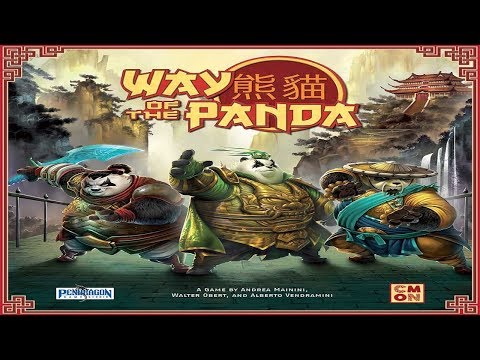
Rolling Dice & Taking Names said the cute pandas on the cover give little hint of a Euro with this much planning, and its hosts joked that the artwork is closer to Teenage Mutant Ninja Pandas than to the Kung Fu Panda films. The theme itself is pitched with flair. Meeple Mountain described human ninjas attacking the Panda Kingdom while the Emperor calls on rival panda clans. Board Games UnLocked was less won over, finding the choice of pandas unexplained at first, though it conceded the theme was unusual.
Racing for Limited Tokens and Points
The tension in Way of the Panda comes from scarcity. Strength and quest tokens for each champion are limited, so a player who ignores the race for a champion's tokens can find them gone. Rolling Dice & Taking Names described the Warrior as the strength-focused champion, able to clear four ninjas at once only with enough strength, while the Monk is slower to power up but can be lifted from the board and placed elsewhere. Endgame triggers add pressure, because placing enough city tiles ends the game, and the hosts said they were racing to place them. Board Games UnLocked won by five points after a late-game scramble for masks, which multiply the swords a player holds.
What Makes Way of the Panda Stand Out
Production Quality and Miniatures
Board Games UnLocked praised the production as "actually really good" and called the miniatures "pretty sweet," while noting that the champions, despite distinct sculpts, differ little in play. Rolling Dice & Taking Names described unique sculpts for each faction, with color-coded bases in blue for monks, red for warriors, and green for governors, which helps players sort the figures. Meeple Mountain called the panda figures "awesome looking" and the small worker pandas "the cutest."
Layered Strategy Across Distinct Champions
Strategic depth comes from the three champions and the map. Rolling Dice & Taking Names described how the roles diverge, with the Warrior's strength making roads passable and the Monk's mobility letting a player reposition in the middle of the game. The hosts praised how road clearing interacts with city building, because completed roads later score points for guards surrounding a city, which makes early road work a long-term investment. Board Games UnLocked described city bonuses as a source of tactical choice, since completing a city lets a player take an immediate bonus that a rival may improve upon.
Potential Drawbacks
Scoring That Rewards Other Players' Work
The most common complaint is that building can score points from guards that belong to other players. Board Games UnLocked described a build worth twelve points because an opponent had cleared the surrounding roads, and objected that one player could do the clearing while another collected the reward. The same reviewer found point totals outsized, with single actions swinging scores by fifteen points, and said the game lacks meaningful interaction, since players cannot destroy buildings, fight champions, or remove guards. Rolling Dice & Taking Names saw the map as a victory point engine rather than territory control, so players who enjoy contested roads may find the interaction more satisfying than that review suggests.
Length, Learning Curve, and Action Point Drag
The game runs longer than its listed time. Rolling Dice & Taking Names rated it at 90 minutes, but their four-player game took about two hours, and the hosts said the symbols on the action board take a turn or two to learn. Early mistakes are punished, since a player who places too few guards receives fewer action points the next round, and the hosts warned that a casual player could fall out of contention. Buyers should also weigh the price. Rolling Dice & Taking Names quoted an MSRP of $74.99, or $59.99 at Miniature Market, and advised spending that much only if you already know you will enjoy the game.
If You Enjoy Way of the Panda
The reviewers' own comparisons point to these titles.
- Lignum and Mombasa: Rolling Dice & Taking Names placed the game's weight in the same range as these two Euros, making them the closest guides for players who want a similarly meaty table.
- Gentes: The same channel felt Way of the Panda sits a step above Gentes in weight, so Gentes is the lighter route for players who find the game heavy.
- Council of Four and Lorenzo il Magnifico: These CMON games were described as one level lighter, which makes them natural stepping stones for players who want the publisher's style with less friction.
- Richard the Lionheart: Meeple Mountain previewed this CMON game at Gen Con, with secret card contributions and teammates who may betray one another, which suits players who enjoy hidden information.
- Masters Trial: Board Games UnLocked compared the board-grab selection in Way of the Panda to this game, which the reviewer found too random, so Way of the Panda offers the same kind of choice with more control.
- Blood Rage and Rising Sun: Board Games UnLocked warned that Way of the Panda comes from a different designer and should not be expected to play like either title. Meeple Mountain previewed Rising Sun, a game from Eric Lang, at the same booth, so those seeking a designer-driven experience can explore it separately.
What Reviewers Are Saying
"I could walk away from the board for thirty minutes, come back, and not care what anyone else did, which in my opinion is a negative because you want to be invested in what other players are doing."
— Board Games UnLocked
"I think we all agree the worker placement part of this, which is a separate board into itself, is definitely a highlight of the game."
— Rolling Dice & Taking Names
"I think one of the standout mechanisms of this game is the actions selection board, in which players can only select actions further down the list than what they have already picked, making the timing of not only what you do but when you do it just important."
— Game Night Picks - Pair Of Dice Paradise