


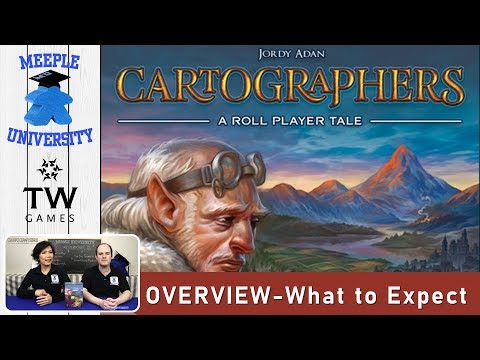


Cartographers: A Roll Player Tale Deep Dive
What the Community Thinks About Cartographers: A Roll Player Tale
Cartographers: A Roll Player Tale has carved out a rare place in the board gaming landscape: a game that people keep playing long after the initial marketing surge ends. One reviewer found themselves drawn to the game precisely because of its staying power, noting that while many board games are "flashes in the pan" with discussion driven by marketing spend, this title maintained genuine player enthusiasm well after publisher promotion wound down. This sustained interest speaks to something deeper than novelty.
The game has become a personal favorite and most-played title for dedicated players who invest heavily in the experience, acquiring every available expansion and component variant. Cartographers inspires the kind of collection completionism that typically only emerges from genuine love for a game's mechanics and feel. Players describe it as one of their favorite games of all time, ranking it among their most treasured personal possessions and most frequently accessed titles.
Core Mechanics That Define Cartographers: A Roll Player Tale
Flip and Write with Seasonal Scoring
Cartographers is a flip-and-write game where the shared input comes from revealed cards rather than dice rolls. Each round, cards are flipped, and every player responds by deciding which terrain type and shape to place on their personal map sheet. The genius of the design lies in its seasonal structure: across four seasons, different pairs of scoring cards are active. Players see the rotation in advance (cards A and B score in season one, then B and C, then C and D, then D and A), allowing them to build toward multiple scoring combinations simultaneously. This rotating scoring system creates a puzzle of prioritization: which patterns should you commit to early, and which can you adapt to as new cards are revealed?
Each card in the deck carries a point value of zero, one, or two, and players accumulate value until reaching the threshold for the season, triggering a scoring phase. The dual-card scoring each round means players juggle competing objectives constantly, deciding whether to play conservatively toward certain scoring cards or to pivot strategically when the revealed cards fail to align with their current board state. Thunderworks Games built the mechanic around personal agency: the same random card reveals produce vastly different results depending on where each player chooses to place their shapes.
Territory Mapping and Tactical Placement
Beyond card values and seasonal cycles, players spend each turn deciding where on their map to draw the depicted terrain. A revealed card might show a forest shape, an outpost, a river crossing, or ruins, and players must pencil that specific shape into their sheet. This draws gameplay closer to spatial puzzle-solving: placement matters not only for immediate scoring but for setting up future patterns. Players can earn gold coins by choosing shapes strategically or by completely surrounding mountains and forests on their maps, adding another layer of scoring consideration. Ambush spaces scattered across the map serve as hazards, deducting points for any that remain empty and surrounded by drawn spaces at season's end, which incentivizes dense, intentional map building.
The Cartographers: A Roll Player Tale Experience
Engaging Personal Strategic Decision-Making
The core loop of Cartographers places each player in an isolated puzzle where they must weigh the card's utility against their current board state. Every reveal is a micro-decision: take it now to bolster one scoring card, pass it mentally to optimize for another, or gamble on upcoming cards? Reviewers describe the experience as absorbing, with play sessions encouraging deep focus on one's own sheet. The game eliminates table politics and player interaction in the traditional sense, replacing it with independent optimization within the constraints of shared randomness. This creates a meditative, puzzle-solving atmosphere where the challenge comes from beating one's own strategy, not outmaneuvering opponents.
Solo-Friendly Gameplay with Multiplayer Complications
Cartographers shines as a solo experience, with dedicated players tracking it as their most-played title across digital and tabletop formats (Board Game Arena, mobile app, and pencil-and-paper). The game's solitaire appeal stems from the lack of direct player interaction: everyone works in parallel, making Cartographers ideal for people who love gaming but prefer independent play. In multiplayer settings, ambush placement becomes a strategic weapon, allowing players to penalize opponents by surrounding their hazards. One reviewer noted that "mean" play with ambushes feels necessary to compete effectively in multiplayer, yet uncomfortable for players who prefer cooperative or non-confrontational gaming. This tension makes multiplayer Cartographers a different experience than solo play: solo removes the emotional weight of aggressive tactics, leaving only the pure puzzle.
What Makes Cartographers: A Roll Player Tale Stand Out
Exceptional Longevity and Community Staying Power
Unlike many board games that peak during launch marketing and fade as publisher attention moves elsewhere, Cartographers has maintained genuine player enthusiasm across years. Reviewers specifically highlighted this as the reason they sought the game out: if people are still playing and enjoying it after marketing spend has dried up, the game's core must be strong enough to sustain long-term interest. This kind of word-of-mouth durability is rare and suggests a game with mechanics that reward repeated play and personal mastery, rather than novelty appeal.
Deep Collection and Expansion Support
The game's design encourages ownership of multiple expansions and variants. Dedicated players have assembled comprehensive collections including the Heroes expansion, Stone Spine expansion, additional ambush cards, and other variants. This expansion ecosystem speaks to the game's depth: there are meaningful ways to expand and vary the experience without overwhelming players. The fact that collectors pursue completionist ownership of these materials indicates the base design is strong enough to carry new content and systems without losing its identity.
Potential Drawbacks
Multiplayer Requires Aggressive Play That Not All Players Enjoy
The ambush mechanic in multiplayer games creates a strategic incentive for confrontational play. To score optimally, players must use ambushes to surround and penalize opponents' territories. One reviewer noted that this aggressive strategy feels necessary to truly play the game well, yet can conflict with playstyles that prefer minimizing direct confrontation. Solo play sidesteps this entirely, but players seeking social multiplayer experiences may find the incentive structure pushes them toward strategies that feel less enjoyable or friendly.
Dependent on Personal Sheet Execution Rather Than Group Dynamics
Cartographers' isolated puzzle structure means the game offers limited group interaction or collaborative narrative moments. Everyone plays independently, making for a quieter table experience. Players looking for negotiation, real-time interaction, or shared storytelling will find Cartographers more about parallel play than genuine multiplayer engagement. The game's strength is personal mastery, which also becomes its limitation for players drawn to more socially dynamic board gaming experiences.
If You Enjoy Cartographers: A Roll Player Tale
If Cartographers resonates with you, consider exploring other flip-and-write titles that share its elegant simplicity and personal strategic depth. Welcome To offers a similar experience of responding to shared reveals on personal sheets, though with street-building rather than map terrain. Tiny Towns captures the same spatial puzzle satisfaction, challenging players to fit polyominoes into tight town grids in response to shared input. Yahtzee, the original roll-and-write mechanic, shares Cartographers' core premise of deciding where to slot random results on a personal scoresheet for maximum points.
For solo players specifically, World Wonders delivers satisfying spatial puzzle gameplay with polyomino placement and push-your-luck resource management, and the same meditative solo focus that makes Cartographers so appealing. Those curious about the Roll Player universe can explore the base game Roll Player itself, a dice-drafting character-building game, though Cartographers stands entirely on its own without prior familiarity. Reviewers noted the Roll Player IP connection is thematic window dressing; the game's systems work identically whether or not you know the universe.
What Reviewers Are Saying
"I do believe I like this one solo only more simply because the ambushes in a multiplayer game, you have to play mean and I'm not a mean player. I don't like playing mean against players, but I also feel like if you don't play mean with the ambushes, you aren't really playing the game."
— Where There's a Wilz, There's a Play
"People are still playing Cartographers now. It's not an old game by any means, but I'm surprised that it enjoyed a little bit more longevity than a lot of board games do. So I figured, just based on that, based on the fact that people are still playing it and still enjoying it after I think the marketing spend is mostly gone from it, that's a game that's, I think, worth my interest and perhaps yours too."
— Knights Around the Table
"Players serve Queen Gynx as cartographers, tasked with reclaiming Northern lands for the kingdom of Nalos by fulfilling the Queen's edicts and carefully mapping territory while thwarting the Dragon's influence. Players compete to earn the most reputation stars by the end of Four Seasons, aiming to be declared the greatest cartographer in the Kingdom."
— The Board Gaming Doctor