






Star Realms: Rise of Empire Deep Dive
What the Community Thinks About Star Realms: Rise of Empire
The release of Star Realms: Rise of Empire has sparked a notably divided response in the board gaming community. While a small but vocal group of reviewers found genuine enjoyment in the legacy campaign experience, the broader sentiment leans toward disappointment. Several prominent reviewers have been sharply critical, describing the game as a missed opportunity that fails to justify its legacy game premise. The criticism centers on a core contradiction: after the initial excitement wears off, the campaign devolves into simply playing the base Star Realms game repeatedly, with minimal mechanical progression to sustain interest over twelve scenarios. However, a few reviewers have praised its accessibility as a quick, two-player legacy experience with solid tactical gameplay underneath.
Core Mechanics That Define Star Realms: Rise of Empire
Stickering and Card Upgrades
The game introduces persistent card modifications through a sticker system. Players acquire stickers during the campaign that modify cards already in the market deck, granting them additional effects like damage boosts, healing, or coin generation. Each sticker sheet comes with a limit of five upgrades per card type. While this creates moments of excitement in the early scenarios, reviewers found the implementation underwhelming. The upgrades themselves are described as purely incremental, adding only minor bonuses like "two damage" or "one coin and healing three." More problematically, upgraded cards do not stay with individual players; they return to the shared market deck after each round, meaning opponents can benefit from your tactical investments, undermining any sense of personal deckbuilding progression.
Campaign Progression and Scenario Structure
Star Realms: Rise of Empire structures its legacy experience around twelve linked scenarios. Each scenario flip triggers thematic setup changes, victory condition cards, and occasional rule modifications. Players track campaign victory points that determine which faction has won the overall campaign arc. The first four scenarios are marked by sticker additions and optional rules shifts, giving players the impression of escalating changes. However, the legacy components run out midway through. After scenario five, the campaign largely abandons new stickers and significant mechanical additions, leaving players repeating core Star Realms gameplay with only minor scenario-specific tweaks until the finale, where a cooperative boss encounter abruptly shifts the competitive dynamic.
The Star Realms: Rise of Empire Experience
Early Excitement Fading Into Repetition
The first few scenarios carry a sense of novelty. Players apply stickers with anticipation, and each scenario card brings the promise of new wrinkles. Reviewers recall this period as genuinely engaging, especially when coupled with the solid base mechanics of Star Realms deck building. However, this honeymoon period is short-lived. By scenario six, players are largely repeating the same game loop with nearly identical card pools and mechanics. One reviewer described the experience of playing game six as the moment they realized the campaign was no longer trying: they stopped paying attention and began powering through scenarios just to see the ending. The repetition becomes exhausting precisely because Star Realms, while serviceable as a quick two-player deckbuilder, is not designed to sustain interest across twelve consecutive sessions without meaningful mechanical progression.
The "Rich Get Richer" Problem
The campaign's catch-up mechanics feel insufficient. When one player wins a scenario, they pick a benefit for the next game: either a starting health advantage or the ability to choose which events enter the trade deck. The losing player earns "Gambit" cards as a consolation only after their opponent has won three games in a row. This creates a snowball effect where early victories compound into future advantages, with catch-up mechanisms arriving too late to matter. Combined with the inherent luck swings of deck building, players can find themselves outmatched not by superior strategy but by fortunate card draws amplified by prior victory bonuses. Reviewers found this dynamic frustrating, especially in a legacy game where emotional investment is supposed to build across the campaign arc rather than diminish as one side pulls ahead.
What Makes Star Realms: Rise of Empire Stand Out
Solid Foundation and Two-Player Balance
Reviewers consistently acknowledge that the base Star Realms deck-building system remains mechanically sound. The core gameplay loop of building a fleet by purchasing cards from a shared market is elegant and encourages meaningful decisions. Star Realms: Rise of Empire's campaign does not break this system; it simply leaves it largely untouched. One reviewer praised the game for achieving good two-player balance, noting that even after ten scenarios, their outcomes remained remarkably close, with neither player pulling too far ahead overall. For players who love Star Realms itself, the promise of playing twelve curated games with the added texture of stickers and variable scenarios holds genuine appeal.
Quick Play Time and Accessible Legacy Entry Point
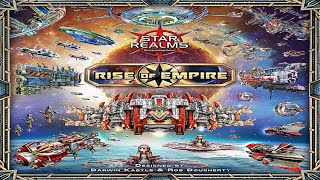
Unlike many legacy campaigns that demand 100+ hours of commitment, Star Realms: Rise of Empire can be completed in a single long session or spread across four to five play sessions of reasonable length. Reviewers noted this as a genuine strength for busy players or those intimidated by the time investment legacy games typically require. The two-player focus also positions it as an accessible entry point for couples or gaming partners who want to explore legacy games without gathering larger groups. The aesthetics also draw praise, with one reviewer highlighting the artwork as genuinely appealing and thematically cohesive.
Potential Drawbacks
The Campaign Collapses at the Midpoint
The most damning criticism across reviews is that the legacy campaign simply stops trying after scenario five. Stickers vanish from the component list, new rules cease appearing, and the scenario cards become mere setup reminders with no mechanical teeth. One reviewer compared this to deciding halfway through designing a legacy game that the work was too hard and just reprinting the base game for the second half. This isn't a minor pacing issue; it's a structural failure. Players expecting twelve connected scenarios encounter six unique scenarios and six padding games. The disappointment is compounded by the knowledge that better solutions existed: personal decks that persist and evolve, rotating faction abilities that unlock, or card pools that genuinely change. Instead, players stare at identical card markets game after game.
The Poorly Executed Ending
Scenario twelve represents a jarring tonal and mechanical shift. After eleven games of pure competition, the final scenario forces cooperation against a "blob" boss enemy while simultaneously keeping the competitive victory tracking alive. This hybrid creates logical contradictions that reviewers found frustrating. If players choose to attack each other during the boss fight, they incur a negative one victory point penalty, but surviving the boss grants three points. The math encourages cooperation, yet the competitive frame remains, creating awkward incentive misalignment. One reviewer described watching their table simply decide not to attack each other because the punishment made the setup nonsensical. The boss fight itself is also mechanically trivial for optimized deckbuilders, especially if one faction has healing abilities that trivialize the threat. The ending lands with what multiple reviewers called a "thud," leaving players with a shrug rather than the crescendo a campaign should provide.
If You Enjoy Star Realms: Rise of Empire
If this game resonated with you, the original base Star Realms remains your strongest companion. It offers the same tight deckbuilding without the disappointment of a campaign that doesn't deliver on its promise. You can also explore other Wise Wizard Games titles if you enjoyed the setting, though be aware that one reviewer expressed frustration with the publisher's recent communication and product delivery, noting delayed expansions and a sense that the company is stretching too thin across its product lines.
For those drawn to legacy deckbuilders, Clank Legacy offers a more mechanically cohesive campaign built on a stronger foundation, though it trades Star Realms' elegant simplicity for higher complexity. If you specifically loved the first four scenarios of Rise of Empire and want that stickering experience expanded into a full campaign, Charter Stone delivers compelling legacy worker placement with constant component evolution across all twelve scenarios. For those who simply want accessible, two-player focused legacy games, Pandemic Legacy Season 1 or Season 2 remain gold standards that don't punish you for playing; they reward engagement across all scenarios with escalating narrative payoffs.
What Reviewers Are Saying
"This is the most bog standard Legacy campaign I've played in a very long time. There's something to be said about bad games versus boring games, like mediocre games."
— Board Games UnLocked
"You cannot take a game and put 20 stickers in it and call it a legacy game. No, because that's what this is. It's not going to fly with us."
— Board Gaming Ramblings
"It's a legacy game in the Star Realms deck building universe where you're adding stickers, developing your cards, and the map is changing as you play. I love playing legacy games with my wife, it was really good at two-player."
— Quackalope