



















Size Wise Deep Dive
What the Community Thinks About Size Wise
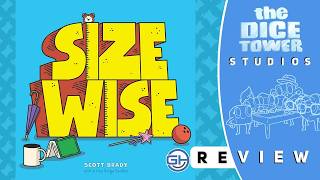
Size Wise has resonated with board game reviewers as a rare combination of genuine ingenuity and flawless execution. The party game, designed by Scott Brady and published by GameHead, appears on multiple reviewer wish lists for its ability to engage players across vastly different gaming preferences. What reviewers emphasize most is not just that Size Wise is fun, but that it has tapped into something that feels obvious in retrospect yet somehow went unmade until now. One sentiment echoes through the community: this should have existed years ago.
The game's appeal lies in a deceptively simple premise executed with thoughtful component design and framing. Rather than celebrating trivia knowledge or fast talk, Size Wise invites players to think about how others think, creating a dynamic where social intuition becomes the real skill being tested. This shift in emphasis has made the game accessible to families, casual players, and serious gamers alike, each finding something different to enjoy within the same framework.
Core Mechanics That Define Size Wise
The String and Bead System
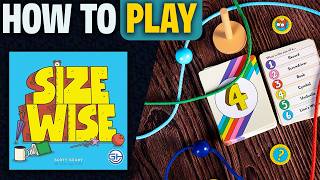
At its heart, Size Wise relies on a beautifully simple physical component: a string with a moveable bead and a ring at the top. Players slide the bead along the string to represent their estimate of an object's size, then place their rings on a wooden stand for direct visual comparison. Reviewers have emphasized how well this mechanism works. The strings themselves use a special material similar to shoelace, which prevents tangling even when multiple strings are bundled together on the stand. The reveal itself becomes theatrical: everyone lifts the stand sideways, and the strings hang in a row from shortest to longest. The simplicity of this comparison eliminates ambiguity about who has the extreme measurements. No arguments, no debate about which is longer: the visual hierarchy is immediate and undeniable.
What makes the string mechanic particularly elegant is that the same physical simplicity makes teaching instantaneous. New players can watch one round and immediately understand not just what to do, but why it matters. The game requires no rulebook explanation beyond showing players the string, pointing to a card, and asking them to estimate. This accessibility is intentional and purposeful, not accidental.
The Estimation Principle
The core rule of Size Wise inverts what most party games teach: accuracy is irrelevant. Players lose wisdom tokens (the game's life total) only if they guess the longest or shortest estimate at the table. Everyone in the middle avoids penalty. This single rule creates profound strategy depth despite the game's appearance of simplicity. Each round, players must consider not what the actual size is, but what they think their opponents will estimate. An item might have an objectively correct size that players could verify, but Size Wise explicitly tells players this verification is beside the point. A bicycle helmet's actual dimensions matter far less than understanding whether your fellow players will measure its circumference or its length, and guessing correctly about their reasoning.
This principle reframes the entire experience. Players stop trying to be right and start trying to be aligned with the group. Reviewers have praised how this creates an engaging social dynamic where success comes from perspective-taking rather than knowledge.
The Size Wise Experience
Addictive Accessibility
Reviewers frequently describe Size Wise using words like "ridiculously addictive" and "super addictive," often with surprise at their own enthusiasm. What makes the game so compelling to play repeatedly, despite its simplicity, is the quick pace and the constant novelty of different estimation challenges. Players report playing the game multiple times within a single week, finding reasons to return for another round before moving on to more complex offerings. The game plays in 15 to 25 minutes depending on player count, making it an ideal filler or opener for game nights. Because nearly anyone can play regardless of board game experience, the game functions equally well at a casual family gathering or a convention demo. One reviewer called it a "chameleon game", flexible enough to work in almost any social context without falling flat.
Inclusive Social Experience
Size Wise creates a particular kind of social engagement that reviewers have noted works across age groups and gaming backgrounds. The game doesn't require specialized knowledge, pattern recognition, or strategic depth to participate meaningfully. A young child and a board game veteran can compete on equal footing because the game is fundamentally about intuition and social understanding. Reviewers have imagined the game thriving in classrooms, conventions, and casual game nights. The elimination mechanic, though straightforward, also creates low stakes: someone runs out of wisdom tokens, the game ends, and everyone moves on to the next round without lingering resentment. One reviewer noted that Size Wise could function effectively as an icebreaker game or a tournament game, functioning either to ease players into an event or to create exciting player-elimination drama depending on context. The ability to play multiple copies simultaneously for larger groups adds flexibility, turning the game into a genuine social event rather than a spectator experience.
What Makes Size Wise Stand Out
Conceptual Originality
Reviewers have marveled at how obvious Size Wise feels in hindsight while remaining genuinely novel. The question board game reviewers asked themselves repeatedly was: why didn't someone create this years ago? The answer lies not in the complexity of the concept but in the clarity of its execution. Many party games attempt to measure something: social alignment, knowledge breadth, communication ability. Size Wise takes physical estimation and frames it as a test of social intuition, creating an entirely different experience from trivia-based party games. Designers have learned that outstanding party games often tap into concepts that almost seem to already exist in culture or play but have never been formally packaged. Size Wise achieves this perfectly. The string-and-bead system is so natural that it feels like a thing players might have invented themselves during a casual evening.
Elegant Mechanical Execution
Every component choice in Size Wise serves the game's core experience. The strings, the beads, the wooden stand, the card format, even the box size: each element could have been executed differently and poorly. Reviewers praised the thoughtfulness evident in every part of the design. The ambiguity built into some items (how to measure a record, an envelope, or a helmet) emerged as a deliberate feature rather than a flaw. Because the game doesn't specify whether measurements should be height, width, circumference, or length, players experience genuine cognitive dissonance that makes the estimating game thinky without being laborious. One reviewer noted that this ambiguity creates the "dramatic reveal" when strings are compared, generating moments of genuine surprise and discussion. The component quality suggests that GameHead invested significantly in getting details right, from the sturdy wooden stand to the specially-selected string material that resists tangling. This attention to detail elevates Size Wise beyond what the simple concept alone would justify.
Potential Drawbacks
Single-Clue Repetition
The card deck contains numerous items, each with multiple different options on the back. As players work through the deck during multiple sessions, eventually they will encounter the same item twice. Reviewers noted that while this isn't a major problem (the game is still fun to play even with familiar items) it does represent a potential constraint on long-term engagement. Each round feels slightly less fresh when a player recalls having estimated that item before, even if the group composition and social context have changed. Modern party games solve this puzzle through other mechanisms. However, reviewers were clear this is a minor concern, especially given the modest price point relative to the amount of gameplay value delivered.
Ambiguity and Player Expectations
The game's deliberate ambiguity around what "size" means (circumference, length, height, volume) occasionally generates player debate. Some groups might find this ambiguity clarifying and engaging, treating it as the game's secret sauce. Other groups might find themselves debating specifics (Is a bicycle helmet measured by circumference or diameter?) rather than enjoying the estimation game. Reviewers noted that groups get the best results when players avoid discussion and clarification, as the game works best when ambiguity is preserved. This isn't a flaw, but rather a tuning consideration: the game achieves its best form when groups embrace the ambiguity rather than try to resolve it through definitions.
If You Enjoy Size Wise
Reviewers recommended Size Wise to fans of party games that emphasize group alignment and social intuition over knowledge. Codenames and So Clover emerged as natural comparisons, though reviewers noted Size Wise's streamlined elegance stands apart. Decrypto and Just One offer similar focuses on thinking together as a group. Green Team Wins, another group-alignment game, received a mention as a game with similar mechanical DNA, though reviewers felt Size Wise's simplicity gives it an edge. Things in Rings, a game about matching objects to categories, shares Size Wise's spirit of easy-to-teach accessibility combined with engaging gameplay. For those seeking games that work equally well for families and serious gamers, Apples to Apples delivers a comparable "thinking like the group" dynamic, though through voting rather than estimation. Cockroach Poker emerged as a comparison for games where a single player elimination works gracefully rather than leaving someone feeling defeated.
What Reviewers Are Saying
"Size Wise is so much fun. This game is just ridiculously addicting because you can just rattle through a whole lot of cards. It's fun. It's chaotic. It has that party aspect to it where it's so easy to teach incorporate. It works well at a variety of player counts. It is satisfying at most player counts."
— BoardGameCo
"The mechanism of hanging the strings works really well. It's such a simple mechanism that works really well. And it's one of those ideas that could have been executed poorly. But instead it was executed just wonderful. It fits exactly what it needs to. It looks bright. People walk by and and are interested immediately and it has almost no rules to it."
— The Dice Tower
"I cannot recommend enough. This is not my favorite game on the table, but it's certainly one that will probably get played the most. It's very addictive. I think this is going to do well. It deserves to do well. Size Wise is fantastic."
— BoardGameCo