Top 10 Auction Games - with Mike DiLisio
Games in This Video
10 games are featured in this video — they unlock as you watch.




Transcript
Hey there everybody, it's Mike Delisio and today I'm going to be talking about my top 10 bidding {slash} auction games. I really like this mechanism driving games auctions or bidding, but they're kind of divisive because there are a lot of people that don't really love the idea of having to set a valuation on goods or resources or victory points, whatever the case may be in the particular game you're playing. I totally get that, but this is something that I've always found appealing as long as I've been playing these modern hobby games and so here's my top 10 auction {slash} bidding games starting with number 10, which is Q E. And this is a wacky one right out of the gate. This is almost more a party game than anything else, but the idea is that you are a central bank and you're going to be bidding on companies. And the trick here, kind of the hook of this game, is that you're not constrained to preset value amounts that you are bidding. You could bid whatever you want. So, you can make your opening bid $4 million. Why not? $40 million. Why not? Well, the why not comes in in that after everyone has totaled up their victory points, you're then going to be seeing who spent the most money, who printed the most money because again, you're a bank. And that player is wiped out. Basically, they can't win. And so, that's really the main hook to the game. It's wild, it's
wacky, it's silly, probably not to be taken too seriously. It's not really an economic game. As I said, it's more a party game, but it's a lot of fun and I think it does something very unique within this sphere. That is Q E. At number nine is a very new game called Compounded. And this is a game where you are going to be doing some blind bidding in a in sense where you are going to be using dice to kind of determine six-sided dice to determine which areas you're going to on a central board which you're going to be competing over. It's a bit of an area majority thing going on. And behind your little player board you're you're putting dice with a certain number of pips into the different areas based upon how many cubes that you're able to spend and then everyone reveals and you're going to be placing your cubes on all of those different regions as they come out and more and more areas come out every round.
And so the idea is that whoever has the majority in each area is going to get the benefit of the tile. These are basically tiles that make up a board. But for players that did not win, their cubes stay out on the board so it puts them in a better bidding position in the next future rounds. And so that's a neat little idea. I like this kind of bidding to drive an area majority game. It's not unique to this one. There are other area majority games that do something similar. Maybe others even on this list. But Campania really charmed me with how quick it is, how simple it is to teach and how dynamic that bidding feels because you're able to increase your bidding power by taking different actions as well. And so that adds a neat little hook to it. That's Campania. All right, at number eight is Railway Boom.
This is also well there's a new edition of a game. It's not a brand new game but a new edition came out last year I believe. And Railway Boom is cool because it is for all intents and purposes a train game where you're purchasing locomotives and you're laying out track on a on a board, hex tiles. It looks very much like a standard train game. But in Railway Boom, it is really a series of auctions that you're going to be doing using different resources for the different auctions. And so, it really changes it. It still has the trappings of a train game, but it feels to me less like a train game and more like an auction game. And that's why this game really kind of spoke to me because train games for me are they're I could take them or leave them in most cases, but this is really at its heart a series of auctions where you're having to manage your resources to be able to participate and do well in each of these auctions.
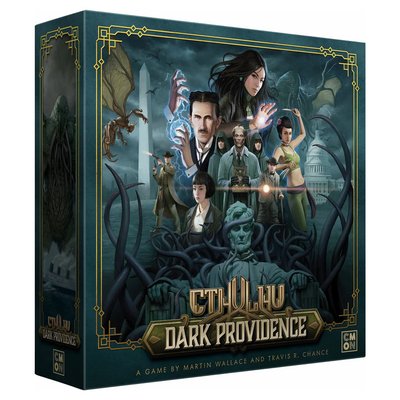
And so, it's this push and pull of managing resources, putting yourself in the best bidding positions. Do I take a huge jump here and then put myself in a weak position for future auctions that use this resource? Very, very cool game from Hisashi Hayashi. That is Railway Boom. At number seven is Cthulhu: Dark Providence, which is um a newest version of a game called A Study in Emerald that came out many years ago from Martin Wallace. And so, A Study in Emerald was this big, wild, crazy Eurogame, off the rails, do does all kinds of nutty things. And then, um but maybe a little bit hard to to wrap your mind around. It had some rough edges. They came out with a second edition years later that what smooths out the rough edges, but kind of smooths out a lot of the personality, too. And Cthulhu: Dark Providence is kind of a best of both worlds, where it kept a lot of the wackiness of the first edition, added some of the uh the smoothness of the second edition, and put it in the world of Cthulhu: Death May Die, which the game Study in Emerald always had a connection to the Lovecraft mythos in the first place. And so, this one is really cool in that much of the game is about gaining cards. So, it's a slightly deck building game, but how do you get the cards that you put in your deck? They don't have any fixed costs. All of the cards that you're going to be getting to place into your deck for the deck-building purposes have no cost on them. So, how are the cards
bid? Well, the players are setting the cost, and I love that idea. Basically, you know, I could put one cube on a card, and if no one comes in and outbids me before it's my turn again, I'm getting that card for one cube. That may be an incredible deal. Um but other players have to manage that, right? So, you're Everybody is policing each other on the table saying, "That card is way too powerful. I was going to do this action, but no, I'm not giving you that card for two cubes. That's crazy. That would put you in a ridiculous position." So, I love this idea of auctions where the prices are driven by the players, uh not by some set uh kind of mechanism in the game. So, that's Cthulhu: Death May Die. And number six is Tammany Hall. This is another area-control area-majority game that uses an auction element. And so, this one is, you know, the five boroughs in New York set back in in uh you know, early American history. Not earlier, but yeah, earlier American history. And um what you're doing is vying for control of these different regions, and um that's going to be done during an election phase where you're going to be doing some dirty dealings behind the scenes. But really what it comes down to is you're going to be having your party bosses around on the board, and in areas where you've got those, you are going to be trying to gain the majority. And the way you do that is by adding the actual physical presence you already have on the board with voting chips, which that's the blind bidding part of this
game. And so, you have to announce to everybody how many potential chips you have going into this auction. And I love that tension. Basically, you know, you know where everyone is standing going into a particular particular election. How much are they willing to invest into this particular election? Are they going to save some of those voting chips for a later region that maybe they think is more powerful? Very mean game, but it suits the theme. Very tense. I really like Tammany Hall a lot. At number five, we have For Sale. And that's right. That's perfect. I didn't work it out this way, but For Sale is in the middle of my list. It basically separates the two halves. This is a game that has two distinct phases. In the first phase, you're bidding on properties. Okay? And so, you're going to be doing some uh blind bidding on properties. Well, actually, it's not exactly blind bidding, but you can choose to bid or pass. And if you uh I'm not going to get into the specifics.
This is an overview. Basically, first half, you're bidding for properties. Second half, you're trying to sell off those properties for the highest potential profit. And then whoever has the most money at the end of the game wins. It's a classic card game, super fast. Um and it's something that most people get the idea of pretty quickly. And after they played it for the first time, they're like, "Oh, yeah, yeah, I could Now I get it. I want to play it again." So, it's been around for years, continues to be a game that people play and enjoy. That is For Sale. All right. At number four, Modern Art from Dr. Reiner Knizia. This is a pure auction game, and it involves five different types of auctions where you are auctioning off modern art. There have been so many different editions of this game throughout the years, uh from different publishers, sometimes highlighting actual artists, sometimes made-up artists. Um a lot of people have said that this game is kind of a commentary on the whole idea of speculation on on art and and of that. I don't know about any of that.
All I know is that this is a game where you are doing nothing but auctioning five different types. It is just so clever and it is a pure, pure, pure auction game where you are getting to kind of indulge in five different types of auctions and then seeing who comes out best in the end. So, Modern Art is fantastic. And number three is Colosseum. Uh this is a game where you are going to be doing a lot of different things. You know, in some senses it's a roll and move game, believe it or not. Uh but it also has other things going on, some contract fulfillment. But where you getting the resources to fulfill those contracts, which in this game thematically are putting on shows? Well, you're going to get them through these bidding phases and it can be so tense uh because you really sometimes are desperate for a particular type of resource. And so, it just puts you in this position where you're willing to do almost anything. I got to do this. I got to get this. So, you you're going to be bidding. You're also going to be doing some trading and sometimes you put yourself into a situation where you're having to make a very unequal trade because you really need this one resource. Uh and so, the bidding is a big part. It's not the only part in Colosseum, but it's the part that I think creates the most dynam- uh dynamism in the game, dynamism, sure, and the most excitement and the most intrigue. And so, that's why it's number three on this list. And number two is Cyclades. Yes, this is a another area majority area control game driven by an
auction. And uh what are you auctioning for? You're auctioning for the power of gods that are going to be letting you do different things on this central board driven with area majority and area control. And this bidding system is so smart. It is so clever. Basically, you can bid on a god, you're going to be placing it on one of uh several predetermined values, okay? So, these have set values and you can start on any one of them that you can afford. Your money is kept behind a screen, so people don't know how much money you've got to be able to bid on these different gods. And then someone could come in and they can knock you out of that spot by going to a higher place. Well, when that happens, your piece comes back and you immediately will place it onto a different god. And so, it's this idea of constantly jockeying for position, getting bumped and rebumped. You can't necessarily go right back to the god you were on before.
And so, it really leads to some tension and and you you really are trying to not necessarily make it obvious which god you want to go for, although a lot of times it's very obvious which god you need and so people are going to try to keep you from getting that god. Just a brilliant auction system. It's not the only place that you'll see this type of auctioning, but I think Cyclades is maybe my favorite version of that type of auction. And then finally, number one is probably not going to be a surprise for a lot of people and this is Ra from Reiner Knizia as well. And this is not only my favorite game of all time, but it's my favorite auction game. And so, I should have said that the other way around. Not only is it my favorite auction game of all time, it's also my favorite game of all time. That sounds That has much more impact, right? So, this is a game where you're going to be bidding on lots that are essentially used for set collection through the different eras of the game.
And the way you're going to do this is that you have got bidding chips that are of specific values. And so, um when you call an auction, either you can call an auction on your turn or a Ra tile can be cuz you're pulling tiles out of a bag, a Ra tile can come out and that immediately sets an auction. You're going to be you using one of your values to place out to bid on that lot of tiles that have come out. Other players can increase, you know, come out with a higher bid or they can pass. The trick here is that there's always one value that is on the central board. And so, when you are using your chip to place a for a bid, you put your token that you used on that central board and you take what that one was. Well, it leads to some really, really interesting things. Like, I really want this lot. I'm going to put out a very high value, but I'm getting like a two, a very low value. And now you're stuck with that for the next epoch, which is kind of the stages of the game. And so, that's really very, very, very clever.
It There's a push-your-luck element to this game that can be very, very exciting. I just love Raw in general and I think that the auctioning, the closed economy auction, is brilliant, brilliant, brilliant. And that's why it's my favorite auction game of all time. All right, there you go. My top 10 auction/bidding games. I'm Mike Delisio and I'll see you on the next one.
Hey everybody, thanks for watching another video from The Dice Tower. Hey, do you want to learn more about us, communicate with us? We have a Facebook group, we have a Discord channel, lots of different ways to get involved with The Dice Tower. You can find that in our link tree link below. So, just click that, it will take you and you can communicate with us on Facebook, join our Facebook groups. There's lots of cool things that you can find and become part of The Dice Tower. Thanks so much for watching. I'm Tom Vasel.