Reimagined Retro Board Game Classics - Connect Four
Games in This Video
11 games are featured in this video — they unlock as you watch.




Transcript
Miniature Market has thousands of board games at discounted prices. Click the direct link below to see all those discounted games. Hello my friends. Today I'm starting a new series that I'm really excited about because I've been playing games all my life. Tons of the kid. In fact, my my channel name is Game Boy Geek. Not for the Game Boy from Nintendo. In fact, before Nintendo Game Boy was out, that's how old I am. I used to walk around the house with a stack of games from my hands above my eyes, bumping into walls, bumping into doors, going to every single person in the house going, "Want to play a game?" And I would usually get the answer, "Nope." "Want to play a game?" "Nope." I would go to every person. And once I got all nose, I would round them around again and keep asking till someone said yes. And I would play games. And I played a lot of these old classic games. And I've been noticing that there's a really cool resurgence going on where newer modern games are using and in being inspired by, you know, retro classic board games and using some of those mechanisms to build deeper newer games, sometimes even a lot larger games. And so this is a series that I'm calling re-imagined retro board game classics. And I'm going to be taking all sorts of these older games and showing you what are new games that use this. And today we're going to be talking about Connect 4. So here we go.
Now, Connect 4 has a special place in my heart. Played it a lot as a kid. It was created by Howard Wexler, and it was first sold under the Connect Four brand by Milton Bradley in February of 1974, even before I was born, even though I'm an old guy. Uh, you know, this game has perfect information for both sides, meaning that nothing's hidden from anyone. Everything you see is calculated. Uh, Connect 4 also belongs to the classification of sort of an adversarial or zero sum game since a player's advantage is an opponent's disadvantage. Now, it has actually about 4.5 trillion different board positions that the game can end in. Now, James Dal Allen and Victor Alice back in 1988 sort of quote unquote solved the game and describes basically a knowledgebased approach with nine strategies as a solution for Connect 4. So, obviously this game had a lot of followers. It was very popular back in the day. And so now I'm going to talk about some of the games uh that have been clearly inspired by this. Now the first is Fairy Tale in.
I think this is the one that's most like it from a production standpoint because this is a two-player game like Connect 4 and it has this big contraption where you're dropping tiles pieces which in this case are tiles in sort of a shared Connect 4 style stand. Now in Connect 4 also it's a shared stand and just like this. And so what you're trying to do is have the most coins in the end of the game. And you're doing this by essentially, you know, taking a tile and sometimes there's four tiles you can see. Some of them, these are all sort of fairy tale characters that pretty people are familiar with. And sometimes you'll be taking one of those and they're free and you drop it in. Sometimes if you want one that's a little bit newer that have been only been available a turn or two, you need to pay some of those coins in order to get them, which essentially is points. You're paying points to get something that you might really want and you're dropping them down. And it's really interesting because sometimes it their ability depends on what's on the side that you see because these are sort of double-sided tiles. You see a colored version, the other player sees like a penciled in version, like a white version. And they do all sorts of different things like the little pigs gain you coins for each of your other connected tiles to this. Some pretty much doing like connect four. Um sometimes the the you'll be gaining coin for each row where you have more than than than the other players. Uh that's like the big big bad wolf for example.
Um and sometimes you'll have like an evil queen. So when your opponent drops another character directly on them, they pay you a coin. Uh and some spots themselves on where on the board that you drop the piece actually gives you coins. Uh and essentially the game ends when three columns are filled. So this is a very interesting example because a lot of it feels connect forish even in the production. But there's a lot more mechanisms going on. There's all sorts of every fairy tale tile type has a different ability and you don't play with one ability with all the abilities every game. There's two that are left out. So you the game's a little randomized as well, but it is also sort of as very similar to connect for the way it's played what you're trying to do mono mono. So I thought this was a cool example. Now another one that also uses that a similar contraption is called my shelfie. Now, in this you're building sort of shelves with different items and essentially you're also dropping tiles in your own stand. So, in Connect 4 and in fairy tale in uh fairy tale in you you're dropping things in a shared stand. In this, everyone has their own stand. So, that's different. And you're dropping your tiles in and you're every game you're trying to build like contiguous groups of similar items which are essentially different colors of tiles. So, you're building the big groups. Uh but there's also additional different goals each game. So maybe you're trying to get four groups uh each containing at least four tiles of the same type. So again, connect four, connecting, you know, groups of four. Uh sometimes you're trying to get four tiles of the same type in the corners.
Again, kind of connect fourish. But you also have a personal goal card where it's just for you and you're trying to get specific items in specific spots. And the more you get in there, the more points you have. Um now, in this game, essentially, you're taking one, two, or three items from a board in a straight line, and then you're placing those tiles all into a single column. Now you get to pick the order that you place them there, but they all go in a single column. So it's like you're not just placing one piece like Connect 4. You're take while you're taking one, two, or three. You're deciding the order and dropping them all in and trying to line them all up. This is another sort of deeper game that uses this interesting Connect 4 aspect. Now, a game that uses it's not quite like Connect 4, but also is probably inspired by Connect 4 is Drop It because it uses this same type of contraption where you're dropping these shapes and essentially you have your own colors of shapes and you can't have it touch any of the same colors or any of the same shapes, but you're getting points as you layer things up and up. But again, you're you're dropping things in. It's a little bit of a asymmetry there, and you're trying to line things up on top of things. So, it's not quite the same type of thing as connect for. But clearly, I think the original idea was somewhat inspired to it. And since there's no like actual spots that you're laying them in on, things go all over the place. And that was like an interesting twist like, "Hey, what if we took Connect 4 and instead of just dropping it in one row, you drop it and the pieces can jump around and bounce around and go all over the place." And so, I think this was inspired by Connect Four 2. And this is one of my favorite sort of family games.
It's a great team game. Drop it is one of the favorite ones that I introduce new people to as well. Uh, and actually right now I just received this other game called Links L I N Kx two-player game where you're dropping sort of polyomino sort of tetra style pieces down this grid like a connect forward grid. It's a shared grid. You're dropping a piece, they are dropping a piece. Uh, you can't leave any blank spaces below and you're simp you're simply trying to connect uh either um one side to the other side. So like the left to the right or bottom to top and you're trying to just link things together diagonal counts. So you're essentially it's very connect forish where you're dropping pieces, you're trying to block the other ones, you're trying to get on top, you're trying to link things together, but instead of getting four in a row, you're trying to like link it from one side to the other side. Again, very much inspired by Connect 4. And this game isn't even out yet. It just came here. And even in 2025, people are still doing things that are inspired by Connect 4, which is amazing. Now, let's talk about some games that don't use that whole sort of grid thing that you're dropping things into that are very much Connect Forish.
Recently, I did a video where it was the top five games for competitive families. And if you, it's a great video to look at. You can uh I'll put the the little link up there that you can watch it. And in this game, you're trying to get four in a row just like Connect Four. The game is basically Connect Four, but instead of dropping things down, you're auctioning it off numbers. A number will come up, you'll auction it off, and if you win and spent the most money, you get to place your piece there. You get four in a row like Connect Four, you win. It's basically Connect Four on a 2D grid. The key to this game is it's an economic game because every so often statistically every fifth card, there's going to be a payout and each player is going to get $7 for every every chip they have on the board. So sometimes you're trying to get it to get the four in a row. Sometimes you're doing it to get things to block people, but other times you're trying to just get chips on the board because that's going to give you more income which going to give you more money to spend in the auctions.
Fantastic. Go watch that. I've reviewed this one as well. This was also used to be known as the game of 49. Okay. The next one is a small little two-player abstract game called Nia or Nia some people call it Ni Ya. Now in this game it's done by my favorite designer Bruno Catala. Now in this game you're going to take one of your pieces that looks like connect four piece and you're going to place it on this grid. Now when you place it there that tile is going to have two things about it. It might be a cloud and a flower or it might be a bush and a and a and a bird. the next player has to place their their their piece on a tile that has one of those two things. So they might see that and go, "Okay, I'll place it on a bird." But now this is a bird and a cloud. So now I have to place on either a bird or a cloud. And you're trying to sort of back this player in. And it's interesting because the one of the win conditions is get four in a row. The other one is get four like in a box. So it's like four in a row or four in a box. Very much connect four. And the way it's abstract, the pieces are round. It's in a set grid.
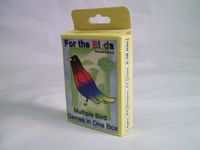
Lots of this I feel like was was uh inspired by Connect 4. A great little abstract game, Nia. Now, the last sort of smaller game I have here is called For the Birds with the number four there. Now, in this game, you win by getting four in a row and just like connect four. And it's you roll these two dice and like if you roll a 64, you can place your board on you can place your bird on 46 or 64. But there's also other things that come out like crows will come out, you can push other birds away. Uh sometimes you're putting hawks out there that are scaring some other birds away. You have a hand of cards that you can use to do some special abilities and manipulate things to try to get four in a row. So again, this is another abstract strategy game that plays two to four players. Has a very open numbered grid and then you're using, you know, a placement of dice, rolling of dice to place, but also cards to manipulate that mitigation and try to get four in a rows by moving people around. There's also this interesting thing of pecking order where if you go to a space that's occupied, you might have pecking order on them and push them out which might push out another bird which cascades different things. So, a lot more mechanisms lined up on this sort of connect for you know base set of rules. Now, those are all sort of short and small games. There's a game uh there's some heavier games like some mediumweight Euro games like Montana where this is a worker placement game where you're placing your workers, you're getting resources, you're trying to spend those resources to place settlements on a on a grid. And if you connect four in a row of your settlements, and the game's a race, you're trying to get rid of all your settlements and place them all. The first person to get rid of them all wins. If you get four in a row, even in
a diagonal line, you get to place an extra one for free. And so connect four is a huge bonus in this game that allows you to basically save yourself two or three turns in the game and it's a race. So connecting if the one who connects four the best in this game is going to be the one who wins. Um and the last thing I'm going to talk about is at a much heavier game like Windmill Valley. It's a heavier mediumweight Euro game that's maybe 90 minutes long, sometimes two hours or four players. And you're you're you know you've got this board and you're putting these tulips out. you're trying to line them up in same colors, but you have this these player boards, and you're able to unlock bonuses as you get four in a row in columns to unlock things. So, there's lots of heav he heavier games. Another one was Unconscious Mind, a very heavy game that came out last year where you're trying to get three in a row on your board. And when you do that, you unlock new actions and such. So, it's just interesting of all these different things that were inspired by this 1974 classic retro game, Connect 4.
Well, I hope you liked this beginning of this series. I have a lot more of these planned that are going to be coming out hopefully weekly. If there's a classic or retro game that you want to see covered in the series, please let me know. I imagine I probably am covering most of these already, but who knows? You might come up with a good one that I didn't think about. Uh, and if you do come up with one, send some suggestions or what other games you think uh have have been inspired by these. I look forward to doing these for you. This is the Game Boy Geek, breaking down barriers, growing relationship, support games by helping you on the next one you love. Game Toppers upgrades every game you play. And they just launched their 4.5 Kickstarter, which will introduce the new Galactic Microoft and Watson game toppers with interchangeable rail inlays, as well as new game mats, miniature gaming terrain packs, leg kit options, dining covers, accessories, and amazing package deals. Search for Game Toppers on Kickstarter or go to gametopperslc.com.