/pic3539689.jpg)
In First Class: Unterwegs im Orient Express, players try to score as many fame points as possible by building a rich network of rails, by building luxurious train cars, or by serving well-paying passengers.
From the Publisher's website:
In the early days of the twentieth century, rail is the preferred mode of transportation for the elite. Luxury lines scramble to accommodate the needs of business tycoons, diplomats, and even royalty. Step into this world and compete to build the most luxurious train lines possible in First Class. Guide your lines from humble beginnings into rivals of the fabled Orient Express itself as you carry out actions each round. Add cars to your trains, upgrade those cars to attract wealthier clientele, extend your lines towards Constantinople, and more. A limited number of action cards is available each round, so pick your actions carefully and choose a path for your rail lines. There are many ways to score points, but only a true railroad baron will accumulate the most points and win the game.
First Class is a card game that includes aspects of board games, creating a unique and dynamic experience every time you play. Cards represent your train cars and provide a visual reminder of your empire's growth as they extend out from your player board. On top of that, every game of First Class uses two of five interchangeable decks of action cards. Each deck provides new challenges for building your rail empire. One game might have you catering to the celebrities on your trains and fulfilling contracts along your route, while another game asks you to accommodate passengers and their luggage while you get swept up in a murder mystery. Each combination of modules opens many possible strategies and provides even more thematic flair. Return to a time when rail was king and grow your empire!

- Good for two players and more
- Different decks add variability
- Solid train game mechanics
- So many train games, easy to lose track
- train travel, building routes
- Orient Express train journey
Mechanics (from transcript analysis)
- Card Driven — It's a card driven game and you're collecting cards.
- Engine Building — It's like an engine builder basically.
- Route Building — You can use the track ones to build your track which have bonuses.
Video topics + discussion points
Quotes (from this video)
- It's really one of those ones where you almost need a bunch of markers to be like okay this is making triggering this and this is triggering this and that is triggering that and you don't want to forget anything.
- I really like Fort, you have a really special spot for Fort.
- It puts the child's perspective into games. Really trial and for adults to play games like this, it's just kind of bring me back to being a little kid.
- Every time I play it and every time I teach it I laugh my head off.
- It's like an engine builder basically.
- It's super fun and easy.
- It's really described as everything that because he's got so many great games right. Well known well known. But it a lot of people say it's all of the good things that he does in his games with all of the fat trimmed off into this really small shorter game.
References (from this video)

- five different modules and you pick two of them every time you play
- variability seems pretty great
- three rows of six spots with open draft and set collection flavor
- potential for analysis paralysis
- Russian Railroads
Mechanics (from transcript analysis)
Video topics + discussion points
Quotes (from this video)
- the bones of this game the stuff that's going on is so cool and so I'm looking forward to playing this one some more
- it's evolving game State as you play game to game it's sort of like a legacy style thing going on but you're not permanently altering the game
- this is a quick game
References (from this video)
- cards provide a clear, modular action structure
- illustrates alternative action selection without a worker on the board
- Stone Age
- Lords of Waterdeep
- Puerto Rico
- Pan Am
- Snowdonia
- Alchemists
- Dungeon Lords
- Crystal Palace
Mechanics (from transcript analysis)
- Action Drafting — described as a round-based action draft without a direct worker placement mechanic.
- Card-based actions — actions come from cards laid out and taken by picking up the card and resolving its action.
- round-based action draft — described as a round-based action draft without a direct worker placement mechanic.
Video topics + discussion points
Quotes (from this video)
- one of the most well-known
- it's essentially a round-based action draft
- my first worker placement was stone age
- you can just knock the other player's worker out
- cards that let you jump in and mess up other people's plans
- it's not competitive
References (from this video)

- More accessible than Russian Railroads
- Includes many modules in the base game
- Russian Railroads
Mechanics (from transcript analysis)
- Card Drafting — you are basically drafting these cards out of this big Tableau kind of like seven wers duel honestly you're drafting these cards and then you're putting them into uh your board either as tracks for trains to go on or tracks for passengers cars for passengers to go on uh or special abilities to enact as well or scoring opportunities
- Modular Board — there's a bunch of different little modules all the different modules are all in the base game they act as like kind of mini expansions that you play with
- Set Collection — cards for passengers to go on
- Track building — you're putting them into uh your board either as tracks for trains to go on or tracks for passengers cars for passengers to go on
Video topics + discussion points
Quotes (from this video)
- this is kind of a placeholder for all of the ticket to rides we own like five maps to this I think we own like nine if you factor in the sand alone Germany and Europe and London we have a ton of these Maps we really like these games they are extremely streamlined to what a game is
- this is the game I would recommend every library to purchase if they have a circulating board game collection because it will get played and it will get circulated
- also a great game by the way it's going to be higher up on my list spoiler alert but this game is also great
- I just really really like that you don't have to be good at games be good at this game cuz you're just rolling dice like that's it that's all the game is you're just rolling Dice
- because of that corers is in my heart
- you are either playing a card you're getting a card or you're picking up your cards and that's it that's all you're doing
- it's really challenging to know when to do that and when it's going to be beneficial
- people feel really smart and clever while they're playing it but also not like overwhelmed with all these different things
- this is a game that you have an action you get to play an action but then everyone to do that exact same action you just have to do a stronger version of it
- the actions that don't get drafted actually get a little bit of money added to them
- it's a classic
- you're trying to draft all these marbles in order to make these drinks
- there's also some that are not like what you want they will do bad things to you but some of those selections might have just a ton of marbles in them so you're willing to risk it risk this negative thing happening to you in order to gain all of these so you can complete your orders
- it's really cool with this recessed board as you're putting all of these marbles in all of these places and you're drafting this these cards it just it's a really fun one to play
- worker placement game but usually worker placement what that means is when you place a worker no one else can go there it's the exact opposite in fact you want to go where you already have people placed
- my favorite mechanism in this game is you can go and you can arrest other people's groups of people and basically sell them to the jail for money
- there's kind of this morality track as well as you're um as you're going up kind of building this church this Cathedral as well
References (from this video)
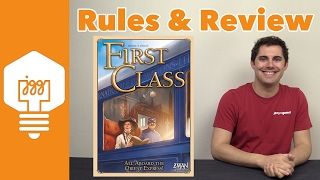
- Elegant central drafting mechanic that creates denial pressure and meaningful choices
- Excellent pacing for a Euro: dense decisions without drag, even at higher player counts
- Massive replayability thanks to module variety (two of five modules, ten total combos possible)
- Money actions are thematically flavorful and highly combinatorial, enabling big turns
- Strong integration of modules with base game dynamics, expanding tactical options
- High-quality insert simplifies setup and teardown, reducing clutter
- Strong performance across 2-4 players with scalable pacing
- Murder mystery module is underwhelming and can disrupt balance or theme for some groups
- Setup/teardown can be a chore due to initial sorting and module prep (takes time, especially for new players)
- Possible downtime at higher player counts, though still manageable
- railway logistics, card-driven engine-building, and tempo-based scoring
- 19th-century European railway expansion with train construction and scheduling
- mechanical, modular, highly procedural with abstract scoring and engine-building goals
Mechanics (from transcript analysis)
- Conductor movement and race — Conductor tokens move along tracks; advancing them unlocks bonuses and creates a race-like element for end-game rewards.
- Currency as multi-use bonus actions — Money acts as a resource that can be spent to draw more cards, upgrade trains, or acquire endgame objectives—creating explosive turns when cashed out.
- Drafting — On each turn you pick a card from anywhere in the central tableau; the chosen card triggers immediate impact and denies others access to that action.
- Drafting from the middle — On each turn you pick a card from anywhere in the central tableau; the chosen card triggers immediate impact and denies others access to that action.
- End Game Bonuses — Score based on train progress, bonuses unlocked via stopwatches, and remaining money converted to points.
- Endgame objective cards and green contracts — Drafted contracts provide ongoing goals and endgame bonuses, flipping over when achieved.
- Endgame scoring and stopwatch bonuses — Score based on train progress, bonuses unlocked via stopwatches, and remaining money converted to points.
- Map cards and track extension — Center map cards extend track length and reveal new bonuses tied to track advancement.
- Modular Board — Two of five modules are chosen at setup, each changing the rules and adding new cards to the mix, creating varied play each session.
- Modular rules via modules — Two of five modules are chosen at setup, each changing the rules and adding new cards to the mix, creating varied play each session.
- Multi-Use Cards — Money acts as a resource that can be spent to draw more cards, upgrade trains, or acquire endgame objectives—creating explosive turns when cashed out.
- Track Advancement — Conductor tokens move along tracks; advancing them unlocks bonuses and creates a race-like element for end-game rewards.
- Train construction and upgrading — You build and upgrade trains by adding and upgrading cars, with constraints on value progression from left to right.
Video topics + discussion points
Quotes (from this video)
- the central mechanic of pulling a little card up from the middle of the table and then evaluating the actions on it
- five different modules that you get to choose from
- this is such a neat mechanism
- you get more bang for your time Buck than I'm used to with your typical Euro
- setup and tear down for this game is a bit of a chore
- the murder module is the weakest module that I played
- you can have really big explosive turns by cashing out all this money
- there is a wonderful insert in the Box I think we'd be in big trouble if that insert wasn't there
- I've mentioned earlier that you make 18 real decisions in the game ... every time you evaluate the actions on your player board you're making decisions with them as well
- this game plays two to four players and I've played all of those player counts and can honestly say that it's great at each of them