/pic6605448.jpg)































Flamecraft Deep Dive
What the Community Thinks About Flamecraft
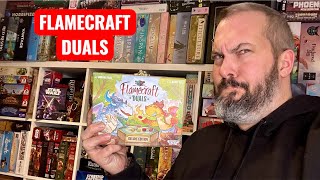
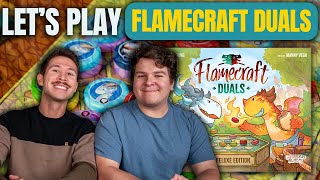
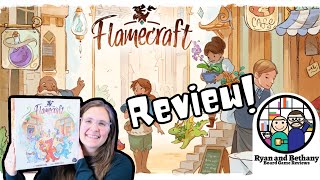
Reviewers agree almost universally that Flamecraft's dragon-and-shop theme is the game's biggest draw. BoardGameBollocks calls the theme "absolutely delightful" and singles out the artwork and production quality as best in class. Allies or Enemies, who received their copy from the publisher but say the opinions are their own, describe the art as "about as adorable as it gets" and note that the neoprene mat gives the table a striking centerpiece. Tim Chuon, who scored the game 4.6 out of 5, is similarly effusive, praising the theme, the components, and the way the design keeps escalating as more shops and dragons come into play.
The clearest note of dissent comes from No Pun Included, whose reviewer spends much of the video wrestling with a game they admit is well made but personally cannot warm to. They acknowledge that the puns, artwork, and positivity work exactly as intended, and still conclude that the game does not click for them, framing their resistance as a reaction to how relentlessly cheerful it is rather than a flaw in its design. That tension, loving the craft while resisting the tone, sets No Pun Included apart from the more straightforwardly enthusiastic takes from BoardGameBollocks, Allies or Enemies, and Tim Chuon.
Core Mechanics That Define Flamecraft
Gathering and Enchanting at the Shops
On a turn, players move their dragon piece to any shop on the board and choose to gather or enchant. BoardGameBollocks explains that gathering means collecting every resource icon shown on the dragons and enchantments already at that shop, then optionally placing an artisan dragon from hand into a matching slot and firing off that one dragon's ability. Enchanting instead means paying the resource cost on a face-up enchantment card, sliding it under the shop, and then firing every dragon stationed there instead of just one. Tim Chuon adds that visiting a shop already occupied by another player costs a gift of one resource to whoever is already there, and that enchanting is the main way players convert resources into reputation, the game's victory point.
Firing Dragons and Building a Communal Engine
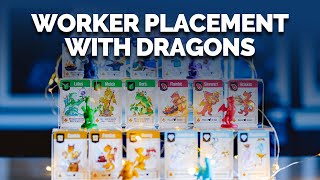
Each of the six dragon types has a fixed ability that fires whenever it is activated, so bakery dragons always draw a new dragon card and smelters always produce extra resources of the shop's type. Tim Chuon describes this as a communal engine: every player is placing dragons and enchantments onto the same shared board, so the shops and combinations available keep shifting as the game goes on. Allies or Enemies notes that the variety mostly comes from which of the many shops appear in a given game and from two separate enchantment decks, which together keep games from playing out the same way twice.
The Flamecraft Experience
A Warm, Whimsical Town to Sink Into
Every source describes Flamecraft as a game defined by its atmosphere before its rules. BoardGameBollocks says the theme gives them a "warm fuzzy feeling" from the moment the neoprene mat hits the table, and Allies or Enemies talks about wanting to live in the town the art depicts. No Pun Included goes furthest, describing the game as an unrelenting "charm offensive" built from pun-named shops and dragons, and admits that this same positivity is what eventually wears them down by the end of a session, even while crediting the design for knowing exactly what tone it wants to hit.
Gateway Simplicity That Deepens Over Time
Tim Chuon frames the base game, played with only the starting shops and the beginner enchantment deck, as an easy entry point with no unique abilities to track. Once asymmetric shops and the upgraded enchantment deck are introduced, they say the game "completely shines on a whole new level," with abilities like paying resources to fire the same dragon multiple times opening up a much larger decision space. That scalability lets the same box serve as an accessible gateway game and, once the advanced components are shuffled in, a much deeper strategic puzzle.
What Makes Flamecraft Stand Out
Production Quality and Art Direction
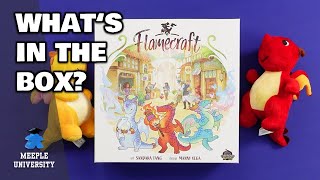
The production values draw the most consistent praise from every source. BoardGameBollocks calls the artwork "fantastic" and the production quality "second to none," while Allies or Enemies highlights the retail edition's dragon miniatures, metal coins, and wooden resources alongside the oversized neoprene mat as a genuine centerpiece. Tim Chuon, crediting designer Manny Vega for the game, says the production quality alone is worth a perfect score, and notes that Flamecraft is published by Cardboard Alchemy together with Lucky Duck Games.
Dragon Abilities That Stay Easy to Track
BoardGameBollocks appreciates that dragon abilities are grouped by type rather than assigned individually, so a player only has to learn a handful of ability patterns instead of memorizing dozens of unique cards. They argue the designers could have made every dragon distinct but chose clarity instead, which keeps the game legible even once the board fills up with fancy dragons and enchantments. Tim Chuon makes a similar point about the base shops, noting that stripping out the asymmetric abilities gives new players a clean foundation before the game's fuller complexity is introduced.
Potential Drawbacks
Weak Penalties and Slack Pacing at Low Player Counts
BoardGameBollocks's biggest complaint is that visiting a shop another player already occupies only costs a single resource gift, a penalty they call too weak to create real tension. They also note that at low player counts the shops fill up slowly, leaving players with fewer meaningful choices and, in a two-player game, noticeably empty space on the board. Allies or Enemies makes a similar observation about two-player games, where players rarely need to pay each other to share a shop, and suggests three or four players is the sweet spot. Tim Chuon agrees that at two players there is comparatively little player interaction, since players rarely end up visiting the same shops.
No Individual Powers and a Muted Endgame Surprise
BoardGameBollocks wishes Flamecraft gave each player some kind of individual ability to differentiate themselves, since everyone currently plays with an identical set of options. Tim Chuon's gripe is different but related: the two endgame scoring conditions, leftover gold and moon dragons, are mostly visible information rather than a genuine surprise, and they suggest the design is missing one or two more hidden endgame conditions to sharpen the final turns.
If You Enjoy Flamecraft
No Pun Included places Flamecraft alongside Splendor and Century: Spice Road as games built on the same reliable collect-and-convert reward loop. When asked what they would recommend instead of Flamecraft, they suggested Evergreen, describing it as similar in length and complexity, family friendly, and beautifully illustrated. Allies or Enemies makes a different comparison, pointing to Wingspan as an example of the kind of gateway-plus-depth design that Flamecraft's combo-heavy turns are following.
What Reviewers Are Saying
"The theme is absolutely delightful, it gives me a warm fuzzy feeling deep inside. The artwork on this game is fantastic, they've really worked hard to give a nice personality to this game. And the puns on the shops are mildly amusing."
— BoardGameBollocks
"It's competent, lighthearted, engaging and joyful. Its exuberance captures the imagination like no other. If it can convert this tide, think of the formative attachments it can create for someone who's younger. In that regard, it's not only a real winner, it's unique."
— No Pun Included
"Flamecraft will bring in a lot of folks with its charming theme and adorable art style, but it is more than just a cute, dragony package. The gameplay is easy to understand but offers opportunities to create rewarding combos, and it's simple enough to work as a gateway game."
— Allies or Enemies