





Mists over Carcassonne Deep Dive
What the Community Thinks About Mists over Carcassonne
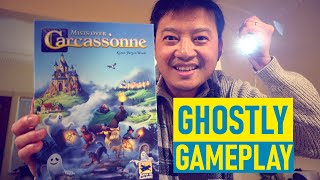
Reviewers broadly agree that Mists over Carcassonne is a clever cooperative reshaping of a familiar tile-laying game, and that its appeal depends on how much a group enjoys both Carcassonne and co-op play. Meeple University praises the designers for taking the game everyone knows and giving it a new spin, while noting that it is a standalone product that can also be combined with the competitive base game. Danny, Board Game Sanctuary is the most enthusiastic voice, calling it a step up from the original and an easy recommendation for anyone who loves cooperative games and wants something simple to learn but challenging to play.
The main point of disagreement concerns cooperative play itself. John Gets Games says they are usually not a fan of cooperative games, but they were intrigued by the Carcassonne connection and flagged a concern that one player could take control of every decision. kovray raises the same warning about alpha players, but reports that the game was a pleasant surprise and far better executed than they expected. Most reviewers who finished a game describe it as tense and hard, and several admit they nearly lost early on.
Core Mechanics That Define Mists over Carcassonne
Cooperative Game
Every player shares one outcome, and the game itself is the opponent. Watch It Played summarizes the goal as trying to enclose ghosts before too many overrun the board, while also reaching a score threshold before the tiles run out. Running out of ghosts to place is an immediate loss, so the team must keep the spectral population under control while still building toward points. Meeple University explains that the difficulty scales across six modes, with the first scenario closer to a tutorial and later scenarios introducing cemeteries, hounds, timing pressure, and flipped tiles that restrict building. Because all scoring is shared, players trade off a team-wide goal rather than personal advantage, which is why the discussion around communication and alpha play matters so much in every review.
Tile Placement
Each turn, players draw a tile from the Carcassonne deck and place it using the familiar road, city, and field matching rules. Mist can extend over roads or fields, and every time a placed tile connects to an existing Mist, the number of ghosts that must be added drops by one. Watch It Played highlights the key choice: a player can seal a Mist to remove its ghosts, or can deliberately forgo scoring points to spend a tile on removing up to three ghosts. Board Game Sanctuary describes how each placed tile reshapes the landscape, creating awkward nooks where three sides must match, so that planning ahead becomes central to the experience.
The Mists over Carcassonne Experience
Tense, Pressurized Decision Making
Reviewers consistently describe the game as stressful in a productive way. Watch It Played calls it tense and quite difficult, with each choice carrying real consequences for the next few turns. Board Game Sanctuary talks about a strong tug-of-war effect, where the game pulls the table in one direction and every drawn tile matters because it affects both the current score and the layout of future ghost-filled Mists. The feeling is less like a traditional cooperative battle and more like firefighting, with the group constantly deciding which crisis to address first.
An Addictive Push to Win
The challenge also creates a strong desire to try again. Watch It Played recalls that after the first game, the response was simply to play again, and again, and again. Board Game Sanctuary jokes about repeated losses across many sessions, describing the urge to keep playing until a win finally arrives. This replay pull is a major reason reviewers keep recommending the game even when they struggle to beat it.
What Makes Mists over Carcassonne Stand Out
A Familiar Base Reshaped Without Losing Its Soul
Reviewers repeatedly note that the game feels like Carcassonne while playing differently. Meeple University credits the designers with taking a game that everyone knows and giving it a clever new spin that does not abandon the original tile-matching core. Watch Review chose it for a newer-gamer draft because it lets players build the map together from a single center tile, which they described as genuinely unique and a good way to show new players something they have never seen before. Because the base rules are familiar, new players can begin quickly while experienced Carcassonne fans still find fresh decisions.
Points as a Resource, Not Just a Score
The most praised design choice is the dual use of points. Watch It Played explains that points are not only the goal but also a currency for removing ghosts, so a player can sacrifice a small score to clear a dangerous Mist. Board Game Sanctuary describes the same tension as deciding whether to use a piece to score or to place it next to another Mist to shrink the ghost count. This constant trade-off gives even modest turns a meaningful choice, which reviewers repeatedly highlight as the heart of the design.
Potential Drawbacks
Risk of an Alpha Player Taking Over
The most common concern is that one player may direct everyone else's turns. John Gets Games says their only real worry is that the game could be prone to one person quarterbacking all of the decisions, noting that cooperative games often struggle with this. Meeple University observes that because every tile is visible to the whole table, a dominant player could easily steer the group. kovray recommends playing with friends who do not dominate the table, or holding the tile up and placing it yourself to avoid suggestions. Reviewers agree that the rules do not enforce a hands-off approach.
Tile Luck and Punishing Difficulty
Draw luck can decide a game. Board Game Sanctuary describes drawing two triple-ghost tiles in a row, which forced the team to deploy six ghosts out of a limited supply of fifteen. The reviewer found a way to recover, but suggests a variant that draws two tiles per turn and passes one to a partner for groups that find the pressure too unforgiving. Meeple University compares the play experience to solitaire with a deck of cards, because players only ever draw one tile and sometimes it is not what the position needs. Watch It Played adds that the game is not for everyone, and Meeple University noted in an earlier preview that the German edition they received still contained a German title in its English rulebook.
If You Enjoy Mists over Carcassonne
- Carcassonne (base game): Every reviewer treats the original as the reference point. Players who enjoy the tile matching, feature building, and scoring of the base game will recognize nearly everything in Mists over Carcassonne, and Board Game Sanctuary describes the original as one of the designs most worth keeping in a collection.
- Pandemic: Board Game Sanctuary draws the comparison directly, describing a small Pandemic-like feel as ghosts appear across the board and the table works to contain them. Players who like escalating cooperative threats should find the same pressure here.
- Ghostbusters: The theme of containing spectral creatures is central to the game, and Board Game Sanctuary jokes about calling in the Ghostbusters when the ghosts overwhelm the board. Fans of the film who want a cooperative take on ghost containment will find the premise appealing.
- Carcassonne: The Mists: The title shares the mist theme, and reviewers in these videos did not compare it in depth, so it is a logical next step for players who want more of this atmosphere.
What Reviewers Are Saying
"The Cooperative nature here feels really intuitive it actually really works so well. It really takes the game and something familiar and goes you know what how about we bring you together and have you work against this common goal."
— Danny, Board Game Sanctuary
"It's tense. It's quite difficult and there's varying levels of difficulty as the game goes on. But I really liked it and the first time I played it, it was just let's play again."
— Matthew, Watch It Played
"It's kind of like playing Solitaire with a deck of cards because you're only ever drawing the one tile. Sometimes it's just not what you need."
— Meeple University
DISCLOSURE: This overview was compiled by MindForge's AI from 10 community video discussions. Watch the featured videos above for the full human perspective.