














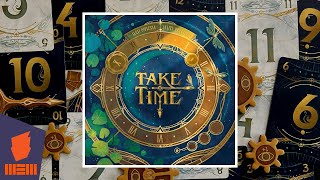








Take Time box art

Take Time

Game Info
Year
2025
Players
1-4
Age
10+
Playtime
45 min
Publisher
Collection
Ratings
Mechanic profile
Percentile rank vs. all games
Vibe profile
How this game feels to play
Description

Take Time is a cooperative game where players either win or lose together.

To succeed, you must strategically play 12 cards facedown around a Clock, following specific rules for each Test. You can work together through a series of games to pass all 40 Tests available in the game.

—description from the publisher

Ask a Rules Question
All mentions
Browse transcript mentions, sentiments, pros/cons, mechanics, topics, quotes, and references.
Total mentions: 82
This page: 32
Sentiment: pos 28 · mix 1 · neu 1 · neg 0
Mentions per page
Showing 51–82 of 82
Video 4MhnO04ufSY Banter and Boards Top List at 0:26 sentiment: positive
Banter and Boards - Take Time video thumbnail
Click to watch at 0:26 · YouTube ↗
Overall sentiment (raw)
positive
Pros
  • cooperative play with accessible teamwork
Cons
none
Thematic elements
none
Comparison games
none
Mechanics (from transcript analysis)
  • Cooperative Game — Players work together to achieve shared objectives.
  • cooperative_play — Players work together to achieve shared objectives.
  • Hand Management — Players manage a hand of cards to coordinate tasks.
  • hand_management — Players manage a hand of cards to coordinate tasks.
Video topics + discussion points
No key topics recorded for this video.
Quotes (from this video)
  • a simple but tricky area control game.
  • a ladder climbing game, but with a fun little twist.
  • a fast-paced word game.
  • simple but hilarious betting game.
  • Moon Colony Bloodbath, a deck building game about survival, and woo, so good.
References (from this video)
No references stored for this video.
Video JwM1jJRmM24 Banter and Boards Review at 2:30 sentiment: positive
Banter and Boards - Take Time video thumbnail
Click to watch at 2:30 · YouTube ↗
Overall sentiment (raw)
positive
Pros
  • Easy to teach and quick to learn
  • Tense moments grow as rounds progress
  • Beautiful artwork and elegant design
  • Replayability through multiple scenarios
Cons
  • Cooperative play may not appeal to all groups
  • Limited to four players
Thematic elements
  • Team coordination under time pressure
  • Cooperative puzzle-solving around a clock
  • Calm, methodical, tension-building
Comparison games
none
Mechanics (from transcript analysis)
  • Ascending-order constraint — When cards are revealed, they must be in ascending order around the clock.
  • Hidden card placement around a clock — Players place a card face down around a clock to create a sequence that must be revealed and ordered correctly.
  • Limited Communication — During placement, players cannot communicate; discussion happens after all cards are placed.
  • non-verbal coordination — During placement, players cannot communicate; discussion happens after all cards are placed.
  • Scenario / Mission / Campaign Game — Multiple scenarios with increasing difficulty levels.
  • scenario-based difficulty — Multiple scenarios with increasing difficulty levels.
Video topics + discussion points
No key topics recorded for this video.
Quotes (from this video)
  • This is one that I would for sure pull out when I'm going to any family gathering because it's so simple to learn and teach.
  • The funnest part is just seeing how the actual race plays out.
  • Distilled, very thematic, very approachable for a Euro game.
References (from this video)
No references stored for this video.
Video egyp-UPSrE0 The Dice Tower Top List at 4:05 sentiment: positive
The Dice Tower - Take Time video thumbnail
Click to watch at 4:05 · YouTube ↗
Overall sentiment (raw)
positive
Pros
  • very approachable and easy to learn
  • lots of missions for replayability
  • pre-game discussion adds social depth
Cons
  • similar to Eternal Decks in feel
  • not a personal favorite style
Thematic elements
  • time/ordering and mission-driven play
  • cards around a central area with ascending order goals
  • light, approachable puzzle
Comparison games
Mechanics (from transcript analysis)
  • Card placement — players place cards around a central area to form ascending sequences
  • mission-based goals — numerous missions in the box guide goals and challenges
  • pre-game discussion — rules allow talking before play to coordinate plans
Video topics + discussion points
No key topics recorded for this video.
Quotes (from this video)
  • Pondscape is a game about laying frogs into a pond.
  • There's just too many symbols in this game.
  • A Hoy has a very fun theme.
  • Tiwanaku, just an absolutely fantastic deduction game.
  • I adore deduction games.
References (from this video)
No references stored for this video.
Video AnlcClnjnec BoardGameGeek Rules Teach at 0:00 sentiment: positive
BoardGameGeek - Take Time video thumbnail
Click to watch at 0:00 · YouTube ↗
Overall sentiment (raw)
positive
Pros
  • Engaging group puzzle driven by discussion and strategy
  • Clear progression with escalating difficulty
  • Innovative information-management and signaling mechanics
  • Sleeve of regret provides a tangible path to replay and mastery
Cons
  • Steep cognitive load; potential for analysis paralysis
  • Requires careful etiquette to avoid signaling cards
  • First rounds may feel punishing if mis-coordinated
  • Dependence on cooperative dynamics; can polarize groups if participants diverge in approach
Thematic elements
  • Collaboration and deduction under timed constraints
  • Time-based cooperative puzzle with clocks and tests
  • Procedural, instructional with escalating difficulty
Comparison games
Mechanics (from transcript analysis)
  • Clock-segment placement — The board uses 10 chapters with 4 tests each; players place cards into segments with constraints.
  • Color-agnostic placement — Cards of any color may be placed in any segment; color is not a determinant.
  • End Game Bonuses — The sum across segments cannot exceed 24 unless the infinity rule is active.
  • Endgame total cap — The sum across segments cannot exceed 24 unless the infinity rule is active.
  • Face-up allowances — Up to three cards can be face-up to reveal values for strategic planning.
  • Hand Management — Players hold a hand of cards unseen by others and choose how to place them into segments.
  • Hidden hand management — Players hold a hand of cards unseen by others and choose how to place them into segments.
  • Infinity rule / sleeve of regret — Awakening chapter allows ignoring the 24 max; failing a clock yields a sleeve of regret for replay.
  • Limited Communication — Communication is allowed before cards are drawn; after drawing, no talking or signaling about cards.
  • Non-decreasing segment sums — Once cards are revealed by segment, the sum of cards in each successive segment must be greater than or equal to the previous.
  • restricted communication — Communication is allowed before cards are drawn; after drawing, no talking or signaling about cards.
Video topics + discussion points
No key topics recorded for this video.
Quotes (from this video)
  • This game is fun.
  • The mind aspectish to it a little bit but with discussion.
  • I enjoy this game a lot.
  • This one's a lot of fun and the sleeves add depth.
  • The discussion portion is what makes this really shine.
References (from this video)
No references stored for this video.
Video yW1fSCQiLAs Tantrum House Review at 0:25 sentiment: positive
Tantrum House - Take Time video thumbnail
Click to watch at 0:25 · YouTube ↗
Overall sentiment (raw)
positive
Pros
  • Engaging deduction and reading of other players' nonverbal cues
  • Clear escalation in puzzle difficulty across envelopes
  • Multiple player counts (2-4) and a clever two-player variant
  • Cheat sheets simplify learning and memory of envelope-specific rules
  • High replayability with 40 distinct clocks/envelopes
  • Accessible and family-friendly while offering depth for experienced players
Cons
  • Luck can influence outcomes in some rounds
  • Requires players to make assumptions about others' hidden cards, which can be frustrating for some
  • Early rounds may feel overwhelming to new players until rules are internalized
Thematic elements
  • Time management, teamwork, deduction
  • Envelope-based cooperative puzzle sessions centered on clock-like constraints
  • Scenario-based with modular rules per envelope
Comparison games
Mechanics (from transcript analysis)
  • ascending order constraint — Within each clock segment, the values of the cards laid must rise in ascending order as cards are revealed.
  • clock-segment card placement — Players place cards face down around six clock segments; each segment has a constraint to be met with ascending card values.
  • disappointment envelope — If a round is failed, players can move the clock to the envelope of disappointment to save the round for later.
  • envelopes with puzzle variants — Each round starts with a new envelope containing a puzzle with its own special rules; new rules vary per envelope.
  • gear tokens for partial visibility — Gear tokens allow players to reveal some of their cards face up during a round, aiding planning.
  • pre-round strategy discussion — A planning phase where players discuss strategy but avoid signaling the specific cards or plans.
  • reveal tokens to confirm requirements — Players can flip reveal tokens to indicate that a particular requirement has been met.
  • Simultaneous Reveal — Players can flip reveal tokens to indicate that a particular requirement has been met.
  • two-player variant — A special variant for two players using different deal mechanics and shared information.
  • Variable Phase Order — A planning phase where players discuss strategy but avoid signaling the specific cards or plans.
Video topics + discussion points
No key topics recorded for this video.
Quotes (from this video)
  • This is a two to four player card game that feels a little bit like if the mind and the crew had an elegant, attractive little child.
  • During the next phase of the game, players will lay cards one at a time, face down around the six segments of the clock.
  • However, for the next time, you do have a little bit of help. For the next round, you'll add gear tokens, which basically allow you to decide to play a couple of your cards face up during the round.
  • There are some tough ones.
  • There is a lot of nonverbal communication that's just observatorily based.
  • The hardest part I would say about this game is that you have to play based on assumptions.
  • The two-player variant is pretty clever.
  • We've had lots and lots of fun just playing through the rounds that we have played through.
  • There's a lot more to be played, which is going to be exciting.
References (from this video)
No references stored for this video.
Video n_XZRWVH3wE Tabletop Tokki Review at 9:31 sentiment: mixed
Tabletop Tokki - Take Time video thumbnail
Click to watch at 9:31 · YouTube ↗
Overall sentiment (raw)
mixed
Pros
  • could be very fun for fans of chapter-style progression
Cons
  • preference for one-sitting, consistently challenging loop
Thematic elements
  • chapter-like progression with escalating challenges
  • cooperative card progression
  • cooperative, laddered difficulty
Comparison games
none
Mechanics (from transcript analysis)
  • Cooperative Game — players collaborate through levels that increase in difficulty
  • cooperative play — players collaborate through levels that increase in difficulty
Video topics + discussion points
No key topics recorded for this video.
Quotes (from this video)
  • Two Win was a sleeper hit for me.
  • Park Ranger was a delightful little solo treat that really stood out for me.
  • I really enjoyed it. It is a quick, concise puzzle
  • This one was too long, and I did not enjoy the take that element.
  • Flower Fields hit a really nice intersection of being clean, easy to learn, easy to teach, but also having just enough going on that it felt like it has a little bit of a competitive edge.
References (from this video)
No references stored for this video.
Video 8eRO4eOmU80 UndeadVikingVideos Discussion at 59:31 sentiment: positive
UndeadVikingVideos - Take Time video thumbnail
Click to watch at 59:31 · YouTube ↗
Overall sentiment (raw)
positive
Pros
  • fast rounds
  • accessible
  • easy to pick up after learning
Cons
  • missions can feel repetitive
  • thematic depth limited
Thematic elements
  • teamwork to complete tasks before time runs out
  • cooperative card game about time management and actions
  • episodic missions with variable deck/power updates
Comparison games
  • Battle Stations
  • DnD co-op card games
Mechanics (from transcript analysis)
  • Cooperative Game — Players work together to beat missions
  • cooperative_play — Players work together to beat missions
  • Deck Building — Create a hand/deck as you progress
  • deck-building — Create a hand/deck as you progress
  • Multi-Use Cards — Cards scanned by an app for instant feedback
  • scannable_card_actions — Cards scanned by an app for instant feedback
Video topics + discussion points
No key topics recorded for this video.
Quotes (from this video)
  • Silence has never benefited the oppressed. It only helps tyranny.
  • This is the longest running weekly live stream on YouTube.
  • Gen Con is a big deal; rooms vanish; it's a business.
  • If you fail, there should be some kind of downside.
  • You should draw one; just keep two? Two would break it time-wise.
References (from this video)
No references stored for this video.
Video 9qa2OZxr7ro TheGameBoyGeek - Hi Quality Hi Energy Board Game Reviews Top List at 18:12 sentiment: positive
TheGameBoyGeek - Hi Quality Hi Energy Board Game Reviews - Take Time video thumbnail
Click to watch at 18:12 · YouTube ↗
Overall sentiment (raw)
Highly Positive
Pros
  • Great limited communication cooperative game
  • Scales well at all player counts
  • Engaging scenarios
  • High replayability
Cons
none
Thematic elements
  • Cooperative limited communication puzzles
Comparison games
Mechanics (from transcript analysis)
  • cooperative play — Players work together to achieve common goals.
  • Hand Management — Players manage a hand of cards to achieve objectives.
  • Limited Communication — Players cannot talk about the specific cards in their hands.
  • scenario-based gameplay — The game progresses through a series of different scenarios with unique rules and objectives.
  • Set Collection — Players collect sets of cards based on certain criteria.
Video topics + discussion points
No key topics recorded for this video.
Quotes (from this video)
  • Comic Hunters is sort of four games in one, like I said.
  • Comic Hunters is four games in one, one of the four games in one.
  • This game just looks gorgeous.
  • Mandala is just an absolute masterpiece.
  • The Mind is one of these games that I've played a hundred times plus in person easily and it's still something special.
  • Century Spice Road is the first of the sort of Century series of games and still the one that I just play the most.
  • Century Spice Road is dirt simple.
  • It's such an efficiency puzzle and there's no fat.
  • For Sale is amazing. It's amazing because the game has two halves.
  • Beasts? No, The Mind is special—becomes one mind when played with a good group.
  • The Crew is launching a subgenre of cooperative trick-taking games.
  • You become one mind. You speak an unspoken language together.
  • It's just amazing. It's mean. It's like great like uh abstract tile placement. It's so streamlined.
  • talk about people just missing the boat because it is it is clever.
  • it's a cooperative trick taking game where each new scenario and it sort of tells a story of being sort of lost in, you know, traveling through space
  • I think the crew is sort of launched a new sort of subgenre of like these cooperative trick taking games.
References (from this video)
No references stored for this video.
Video esC4r5IDgxI Meeple University Rules Teach
Pros
none
Cons
none
Thematic elements
none
Comparison games
none
Mechanics (from transcript analysis)
Mechanics unknown.
Video topics + discussion points
No key topics recorded for this video.
Quotes (from this video)
  • Time twisting teamwork turns into a frantic race to place the right cards on the right place in take time.
  • In Take Time, players will work collaboratively and silently to arrange these cards around one of these clocks meeting any special conditions on the clock.
  • The team could collectively agree that someone should play a face down 12 in this slot or agree to play whatever card is placed there face up if it's not a 12.
  • The sleeves of regret. This is specifically designed to set aside the clocks you failed to complete so you can come back and try again later.
  • The only basic communication rule is that you can't contrive a nonverbal means of direct communication that doesn't involve the simple act of playing the cards.
  • Pretty much anything else is fair game.
  • An introverted dream.
References (from this video)
No references stored for this video.
Video esC4r5IDgxI Meeple University Rules Teach at 0:09 sentiment: positive
Meeple University - Take Time video thumbnail
Click to watch at 0:09 · YouTube ↗
Overall sentiment (raw)
positive
Pros
  • Cooperative, silent teamwork emphasizes careful coordination and shared problem solving.
  • Deep, layered puzzle design with multiple sleeves and evolving rules provides high replayability.
  • Sleeve of regret mechanic creates a structured path for learning through repeated attempts.
Cons
  • Nontrivial learning curve due to evolving rules and multiple objective types.
  • Strict communication restrictions may be off-putting for players who prefer overt collaboration.
Thematic elements
  • Time management, collaborative problem solving under strict communication rules, layered objectives across chapters.
  • Players gather around a clock tableau in a cooperative, puzzle-oriented setup with multiple sleeves and clock scenarios.
  • Educational/tutorial delivery with staged rule introduction across sleeves; emphasizes gradual escalation of complexity.
Comparison games
none
Mechanics (from transcript analysis)
  • Conflict resolution apparatus — Resolution is determined by the sums within wedges and the order of wedges; a clock hand can influence starting position.
  • Hand Management — All or most cards are dealt face down and kept hidden; players manage limited information as the clock objectives unfold.
  • Incremental rule reveal — Clocks sleeves introduce new icons and rules gradually, altering objectives and constraints per chapter.
  • Layer Building — Each clock has standard and optional special objectives that must be completed in sequence or in combination.
  • Limited Communication — Precludes verbal or nonverbal signaling beyond the act of playing cards; strategic discussion occurs only before reveal.
  • Objective layering — Each clock has standard and optional special objectives that must be completed in sequence or in combination.
  • Penalty and recovery cycle — If objectives fail, players gain a bonus token (to reveal an extra card next time) and replay with shuffled cards.
  • restricted communication — Precludes verbal or nonverbal signaling beyond the act of playing cards; strategic discussion occurs only before reveal.
  • Simultaneous Reveal — Clocks sleeves introduce new icons and rules gradually, altering objectives and constraints per chapter.
  • Simultaneous/secret placement — Players place cards into wedges around a clock without communicating, with a portion of face-up cards allowed.
  • Sleeve of regret — A dedicated sleeve to set aside failed clocks for future retry, supporting learning and replayability.
  • Sleeve-based progression — 40 scenarios split into 10 chapter sleeves, each adding complexity and new rules.
Video topics + discussion points
No key topics recorded for this video.
Quotes (from this video)
  • Time twisting teamwork turns into a frantic race to place the right cards on the right place in take time.
  • In Take Time, players will work collaboratively and silently to arrange these cards around one of these clocks meeting any special conditions on the clock.
  • The team could collectively agree that someone should play a face down 12 in this slot or agree to play whatever card is placed there face up if it's not a 12.
  • The sleeves of regret. This is specifically designed to set aside the clocks you failed to complete so you can come back and try again later.
  • The only basic communication rule is that you can't contrive a nonverbal means of direct communication that doesn't involve the simple act of playing the cards.
  • Pretty much anything else is fair game.
  • An introverted dream.
References (from this video)
No references stored for this video.
Video LKQ_xtCSXrA Meeple University Top 20 List at 4:03 sentiment: positive
Meeple University - Take Time video thumbnail
Click to watch at 4:03 · YouTube ↗
Overall sentiment (raw)
positive
Pros
  • cooperative play
  • limited communication encourages teamwork
  • puzzle-like objectives and timing
Cons
  • learning curve around signaling
  • depends on group familiarity
Thematic elements
none
Comparison games
Mechanics (from transcript analysis)
Mechanics unknown.
Video topics + discussion points
No key topics recorded for this video.
Quotes (from this video)
  • Yay. There's a rule book about it. So technically, we create our own rule book.
  • It's our video. There's a rule book about it, so technically we create our own rule book.
  • This video technically should be called Meiple University's top games of 2025 plus Terren revised game of 2024.
  • Formidably so this is a contract card shading game.
  • Kingdom Crossing is the seven bridges of Königsberg in game form.
References (from this video)
No references stored for this video.
Video RzGtp7w8Aso TheGameBoyGeek - Hi Quality Hi Energy Board Game Reviews Top 10 List at 3:19 sentiment: positive
TheGameBoyGeek - Hi Quality Hi Energy Board Game Reviews - Take Time video thumbnail
Click to watch at 3:19 · YouTube ↗
Overall sentiment (raw)
positive
Pros
  • Clever, compact cooperative design
  • Strong appeal if you like The Crew or The Mind
Cons
  • Can be repetitive across levels
  • Learning curve for new players
Thematic elements
  • collaboration under evolving level constraints
  • cooperative, limited-communication card game with levels
  • structured progression across 40 levels with varying rules
Comparison games
Mechanics (from transcript analysis)
  • Limited Communication — players know very little about others' hands; play unfolds with minimal hints.
  • multi-level structure — each level introduces new rules and constraints, escalating difficulty.
  • turn-based card play — cards are played in turn order with specific win conditions.
Video topics + discussion points
No key topics recorded for this video.
Quotes (from this video)
  • "Where's Waldo? The cooperative game that you can play with kids."
  • "This is one of those games where it's like yes, it feels familiar."
  • "It's a really good cooperative game where you're trying to work together to kind of like place everything there."
References (from this video)
No references stored for this video.
Video tw7jS5F5pQA The Dice Tower Discussion at 1:45 sentiment: positive
The Dice Tower - Take Time video thumbnail
Click to watch at 1:45 · YouTube ↗
Overall sentiment (raw)
positive
Pros
  • cooperative tension without direct communication is engaging
  • lots of content and escalating challenge
Cons
none
Thematic elements
  • nonverbal coordination and puzzle solving
  • cooperative timing puzzle without direct communication
  • calm, methodical, clockwork
Comparison games
Mechanics (from transcript analysis)
  • Cooperative Game — players work together to achieve a sequence without talking
  • cooperative play — players work together to achieve a sequence without talking
  • Hand Management — managing a hand of cards to fit a clock-like structure
  • Limited Communication — players rely on subtle cues to coordinate moves
  • Nonverbal communication — players rely on subtle cues to coordinate moves
Video topics + discussion points
No key topics recorded for this video.
Quotes (from this video)
  • It's a complete filler, but I really enjoyed it.
  • This is my game of the day.
  • I love the tightness and I also love the different options you have on there.
  • cooperate to play out your hands of cards, but you can't communicate.
  • You rotate the card around it. It says up, but backwards it says it either way.
References (from this video)
No references stored for this video.
Video NWT8flpDrZ8 The Broken Meeple Review at 2:23 sentiment: positive
The Broken Meeple - Take Time video thumbnail
Click to watch at 2:23 · YouTube ↗
Overall sentiment (raw)
positive
Pros
  • high production quality with attractive art and sleeves
  • compact, well-presented components and rule sheets
  • strong replay value through 10+ sleeves and 40+ clocks
  • tense, engaging group dynamic and social deduction elements
  • two-player mode works surprisingly well
Cons
  • some players may find the deduction/guesswork frustrating
  • not as strong as the designer's best entries (The Gang, The Crew)
  • scaling to four players makes coordination harder
Thematic elements
  • time, deduction, social interaction
  • Clock-based, time-management puzzle in a cooperative setting
  • puzzle-like, procedural
Comparison games
Mechanics (from transcript analysis)
  • card placement to clock segments — Cards are placed on six segments to meet objective criteria, with day/night variants and ascending order.
  • Cooperative Game — Players work together to meet clock-based constraints.
  • cooperative gameplay — Players work together to meet clock-based constraints.
  • Limited Communication — Players discuss strategy before playing cards, then play silently.
  • limited communication (pre-discussion phase) — Players discuss strategy before playing cards, then play silently.
  • phase-based play — Three phases: discussion, card placement, reveal.
  • replayability through sleeves (scenarios) — Multiple sleeves with four scenarios each, increasing variety and challenge.
  • risk/reward and memory deduction — Deducing others' cards and patterns to optimize placement; includes uncertainty and potential guesswork.
  • Variable Phase Order — Three phases: discussion, card placement, reveal.
Video topics + discussion points
No key topics recorded for this video.
Quotes (from this video)
  • Take Time comes with 12 pouches with four scenarios in each.
  • It's a silent game.
  • The idea is is that after everybody has played the cards to these segments, they must adhere to certain rules as given by the scenario.
  • I was actually quite surprised by this.
  • I'm giving this one a solid 8 out of 10. It's a great game.
  • Two-player is surprisingly well in this.
  • The Gang and The Crew are benchmark games for this genre.
  • The Mind can go burn in the seventh layer of hell.
References (from this video)
No references stored for this video.
Video fRlKVR5MU44 BoardGameCo Top List at 22:11
BoardGameCo - Take Time video thumbnail
Click to watch at 22:11 · YouTube ↗
Pros
none
Cons
none
Thematic elements
none
Comparison games
none
Mechanics (from transcript analysis)
  • cooperative trick-taking — Players play cards in rounds to fulfill clock-based constraints and objectives.
Video topics + discussion points
No key topics recorded for this video.
Quotes (from this video)
  • This is 10 through 1. This is not easy.
  • Logic and Lore is a two-player logical game with tons of variants.
  • Shout out to Puerto Rico. That would have been my number one.
  • Flamecraft DS is a two-player head-to-head where you are placing out these different dragon tile chips.
  • Zenith is absolutely delightful.
  • Amber Leaf is my number one game from 2025.
References (from this video)
No references stored for this video.
Video rj3krBN4qZ4 The Dice Tower Top List at 9:56 sentiment: positive
The Dice Tower - Take Time video thumbnail
Click to watch at 9:56 · YouTube ↗
Overall sentiment (raw)
positive
Pros
  • gorgeous production and quick onboarding
  • smooth rule set that gets to table quickly
Cons
  • may feel lightweight for players seeking heavier strategy
  • replay variety depends on scenario selection
Thematic elements
  • quintessential co-op with barrier-free play
  • deluxe cooperative trick-taking with timed or themed tasks
  • short, snappy rounds designed for quick wins
Comparison games
Mechanics (from transcript analysis)
  • cooperative trick-taking — players coordinate to achieve goals through card play and follows.
  • deluxe production — high-end components and polished presentation.
  • Limited Communication — puzzle-like coordination without full hand disclosure.
Video topics + discussion points
No key topics recorded for this video.
Quotes (from this video)
  • This is incredibly impressive and players can work together to try to solve these cases.
  • There are thousands of cases; it scales in complexity and replayability.
  • There are so many scenarios so that every game doesn't feel the same.
  • This one is back to being really unique because this is based in the entire Dungeons and Dragons world.
  • Two versions of it. There's retail and the miniatures, and they both play the exact same, which is what I love.
References (from this video)
No references stored for this video.
Video ZCJhON2zxus The Dice Tower Playthrough at 0:43 sentiment: positive
The Dice Tower - Take Time video thumbnail
Click to watch at 0:43 · YouTube ↗
Overall sentiment (raw)
positive
Pros
  • Cooperative puzzle with escalating envelopes and interesting tension
Cons
  • Potentially punishing when information is insufficient; requires many tells and careful discussion
Thematic elements
  • coordination under time pressure; sequencing and timing
  • Abstract time-management puzzle with clocks and lanes; solar vs lunar color coding
  • procedural puzzle with envelopes and clock tokens; no strong narrative
Comparison games
  • Wavelengths
Mechanics (from transcript analysis)
  • cooperative play — players work together with limited communication to achieve a shared objective.
  • Hand Management — players hold a hand of 3 cards per player and choose how to play them to satisfy envelope constraints.
  • information sharing & inference — players reveal and infer information about other players' hands and planned plays; some cards are face-up.
  • pattern/sequence building — cards must be placed in ascending order within each clock segment.
Video topics + discussion points
No key topics recorded for this video.
Quotes (from this video)
  • This is going to be a cooperative limited communication game in which we are trying to meet some sort of objectives that are revealed here on our clock.
  • There is a lot more in the box. This is just the first envelope.
  • We have to go from the hand around.
  • The game is won or lost on this play right here.
  • It's too bad there's a game called wavelengths cuz this is it.
  • Trust the player.
  • A one or two here, but you can only play a single white card then.
  • We should probably cut stream right there because I will say some of the later ones get trippy.
References (from this video)
No references stored for this video.
Video sgRD0Me5MRs Going Analog Discussion at 8:51 sentiment: positive
Going Analog - Take Time video thumbnail
Click to watch at 8:51 · YouTube ↗
Overall sentiment (raw)
positive
Pros
  • Tightly designed timing puzzle with escalating challenge
  • Engages players with a mind-game feel and direct interaction
Cons
  • Not immediately intuitive to new players
  • May require a couple of plays to grok the clock dynamics
Thematic elements
  • time management and scheduling with circular clock layout
  • Abstract timing game around a circular clock
  • abstract, puzzle-like
Comparison games
none
Mechanics (from transcript analysis)
  • Ascending stacks constraint — Each stack around the clock must be in ascending order, creating strategic pressure to order cards correctly.
  • Card placement around a circular clock — Players place face-down cards into positions around a clock, with some face-up options revealing values 1-12 and two suits.
  • Rule progression and escalation — As the game advances, special rules or conditions modify how places around the clock can be used.
Video topics + discussion points
No key topics recorded for this video.
Quotes (from this video)
  • BGcon is the highlight of my year.
  • The BG library is huge; 99% of your time is spent playing games.
  • We ran the board game quiz show live at BGCon in the fall in Dallas, Texas.
  • This is not a pipe. This is a game about a pipe.
  • The double wheel system of selecting actions is just fantastic.
  • Take Time around the clock is a great mind-share battle; it makes you yell at each other in good fun.
References (from this video)
No references stored for this video.
Video gZ-M5fNTf9c BoardGameCo Review at 7:17 sentiment: positive
BoardGameCo - Take Time video thumbnail
Click to watch at 7:17 · YouTube ↗
Overall sentiment (raw)
positive
Pros
  • enjoyable to play
  • accessible to learn
Cons
  • unclear if it will be a forever game
Thematic elements
  • memory and timing
  • time-based gameplay
  • abstract
Comparison games
none
Mechanics (from transcript analysis)
Mechanics unknown.
Video topics + discussion points
No key topics recorded for this video.
Quotes (from this video)
  • I'm optimistic that everything is probably good, but I recognize that for every time that I'm right that things are good, there's a counterpoint that sometimes bad things happen.
  • Content lives forever, but it is often not found forever. Revisiting content has value.
  • Enth Throne is a very solid game. It's what I hoped it would be.
  • The strike is over and Kickstarter has locked in a 4-day work week.
References (from this video)
No references stored for this video.
Video To57_FF0yRY Board Stupid Top List at 33:17 sentiment: positive
Board Stupid - Take Time video thumbnail
Click to watch at 33:17 · YouTube ↗
Overall sentiment (raw)
positive
Pros
  • Highly accessible to families and casual players
  • High replayability with 40 scenarios
  • Compact and fast-paced play
Cons
  • Strategy can be opaque to some players until familiar with scenarios
Thematic elements
  • communication/deduction in a clock-based layout
  • timed scenarios with limited pre-game discussion
  • scenario-driven planning with pre-play strategy
Comparison games
Mechanics (from transcript analysis)
  • clock-face card placement — place cards around a clock in a way that satisfies scenario rules
  • limited pre-game talk — players discuss strategy before cards are revealed
Video topics + discussion points
No key topics recorded for this video.
Quotes (from this video)
  • It's a banger.
  • That is a banger for me.
  • The theme elevates to my heart.
  • This is the dream because the theme is done so well and interwoven with the mechanics.
  • It's a solid for me.
  • I want to play more.
  • It's a fantastic production.
  • The world’s limits are pretty big and a lot of moral choices.
  • Take Time is the biggest surprise of the year.
  • It is a wonderful deterministic experience that doesn't last 4 hours.
References (from this video)
No references stored for this video.
Video P3wzYN2P2k0 Board Stupid Top List at 4:22 sentiment: positive
Board Stupid - Take Time video thumbnail
Click to watch at 4:22 · YouTube ↗
Overall sentiment (raw)
positive
Pros
  • Accessible for non-gamers
  • Great production
  • 40 scenarios
  • Cooperative tension
Cons
  • Potentially heavy on luck depending on scenarios
Thematic elements
  • time pressure and teamwork
  • Cooperative time-based card game with scenarios
  • accessible, puzzle-like
Comparison games
none
Mechanics (from transcript analysis)
  • Cooperative Game — players work together to complete scenarios.
  • cooperative play — players work together to complete scenarios.
  • pre-game strategy discussion — players may discuss strategy before looking at cards.
  • Scenario / Mission / Campaign Game — 40 scenarios with varying rules.
  • scenario-based challenges — 40 scenarios with varying rules.
Video topics + discussion points
No key topics recorded for this video.
Quotes (from this video)
  • it's a very fun game for £29.50
  • there's a lot in that box
  • a cool little combo element if you like to be a little bit more board gamey
  • it's a cooperative card game that you can play with people that are not board gamers that will get it immediately, but you're having a lot of fun
  • you can just keep playing it until you get bored
  • Just One is the ultimate Christmas party family. It is incredibly enjoyable with the simplest rule set that you can explain in 30 seconds
References (from this video)
No references stored for this video.
Video viQTqSrufoE BoardGameGeek Review at 0:00 sentiment: positive
BoardGameGeek - Take Time video thumbnail
Click to watch at 0:00 · YouTube ↗
Overall sentiment (raw)
positive
Pros
  • Minimal rules that emphasize player interaction and communication
  • Envelope progression provides scalable challenge and variety
  • Cooperative feel with shared success/failure rather than lone spotlight
  • High replay potential across multiple levels and player counts
  • Accessible to casual players while offering depth for seasoned gamers
Cons
  • Early levels can feel straightforward, which may lessen perceived tension for some players
  • Pacing and information balance shift between two-player and multiplayer setups
  • Advancing through many envelopes requires sustained group engagement
Thematic elements
  • time, synchronization, and collaborative problem solving under partial information
  • A clock-based cooperative puzzle where players place numbered cards into six segments to form non-decreasing sums around a circular clock.
  • abstract/puzzle-like
Comparison games
Mechanics (from transcript analysis)
  • Deck of 24 cards (12 day, 12 night) numbered 1-12 — Cards are distributed and used to fill six clock segments; players see day/night distribution and cooperate to avoid decreasing sums.
  • Envelope-based level progression — Each envelope contains a new level with tighter constraints; levels can be skipped forward once a player chooses to progress.
  • Face-down placement and later reveal — Players place cards face down in segments; after all cards are placed, cards are revealed to determine sums.
  • Non-decreasing sums per segment — As the clock is completed, the sum in each segment cannot decrease as you go around the circle; planning is required to avoid violations.
  • Pre-play discussion and hidden information — Players may talk before turns about strategy, but cannot reveal exact card contents to others.
  • Track Advancement — Each envelope contains a new level with tighter constraints; levels can be skipped forward once a player chooses to progress.
  • Variable player counts and hand management — Two-to-four players share a deck of cards with different hand sizes and reveal dynamics; level two and beyond alter constraints.
Video topics + discussion points
No key topics recorded for this video.
Quotes (from this video)
  • The rules being minimal and with everyone contributing to your success or failure.
  • It's not one person who will just blow the game completely. It's all of you together that are responsible for making things happen and conveying information to others in different ways based on where you play, how you play, what you actually reveal.
  • It's very straightforward. Put down a card, reveal a card if you think it's not clear what you've played.
  • It's a potato chip style game where you finish one and you're like, 'Oh, let's just start another one. It's only going to take a minute.'
  • There is a clock hand that is separate.
  • I greatly enjoy this game.
References (from this video)
No references stored for this video.
Video y57S7HT01J4 The Dice Tower Review at 0:00 sentiment: positive
The Dice Tower - Take Time video thumbnail
Click to watch at 0:00 · YouTube ↗
Overall sentiment (raw)
positive
Pros
  • Beautiful production and presentation, with glossy cover and accents
  • Replayable via multiple envelopes and varied timing
  • Flexible playtime (as short as 30 minutes or longer)
  • Fits well as a family or casual game night filler
  • Adds puzzle depth beyond The Mind with more structure
Cons
  • Lack of thematic cohesion (no strong theme)
  • Potential group-dependent experience (not for all groups)
  • Can feel repetitive if played for long sessions
  • Limited tension until the reveal phase
  • Some players may struggle with reading the table and following clock rules
Thematic elements
  • Clock-based puzzle space with modular envelopes
  • procedural puzzle, no strong theme
Comparison games
Mechanics (from transcript analysis)
  • cooperative card placement — Players work together to place cards on clock-like lanes according to envelope-specific rules.
  • Hand Management — Each player holds a hand of cards and selects which to play to satisfy constraints.
  • Limited Communication — Players discuss strategy before cards are revealed but cannot communicate once the round begins.
  • scoring/failure tokens — Passing rounds yields no token; failure yields a bonus token enabling a face-up play.
  • tile/envelope modularization — Each envelope represents a module with its own placement rules; after completing an envelope, a new one is drawn.
Video topics + discussion points
No key topics recorded for this video.
Quotes (from this video)
  • gamified version of the mind
  • it's a great filler for us
  • incredibly adaptable to the amount of time you have
  • no theme here
  • a gorgeous production
References (from this video)
No references stored for this video.
Video OhqzdE0YN_0 Our Family Plays Games Discussion at 31:31 sentiment: positive
Our Family Plays Games - Take Time video thumbnail
Click to watch at 31:31 · YouTube ↗
Overall sentiment (raw)
positive
Pros
  • short play time
  • easy to teach
Cons
  • can rely on luck in some variants
Thematic elements
  • abstract, casual
  • card scoring and drafting
  • abstract
Comparison games
none
Mechanics (from transcript analysis)
  • Card Drafting — players draft and play cards to minimize points
Video topics + discussion points
No key topics recorded for this video.
Quotes (from this video)
  • i believe there's an element where having a game acknowledge that you exist can be validating in a way most people never consider
  • the embrace of individuals who are LGBTQ plus happen in spaces in the games themselves
  • we have to make spaces in our worlds where we are safe where we can kick back and be our authentic selves
References (from this video)
No references stored for this video.
Video WrR3wn3DGWQ The Dice Tower Top List at 11:11 sentiment: positive
The Dice Tower - Take Time video thumbnail
Click to watch at 11:11 · YouTube ↗
Overall sentiment (raw)
positive
Pros
  • tense, satisfying cooperative moments
  • high replay with different scenarios
  • accessible tempo
Cons
  • hard constraints and silence rule can be challenging for new players
Thematic elements
  • time and cooperation under escalating constraints
  • cooperative time-management puzzle
  • tense, collaborative, hopeful
Comparison games
Mechanics (from transcript analysis)
  • clock/slots mechanic — cards placed around a clock influence scoring and feasibility.
  • cooperative play — players work together to meet mission constraints without talking during play.
  • scenario-based objectives — varied missions create different constraints each play.
Video topics + discussion points
No key topics recorded for this video.
Quotes (from this video)
  • This one's very quick. It's very quick to play and to teach.
  • There are player interactions, but it doesn't feel mean.
  • The narrative is so well written. The actual boss battling part is gripping.
  • Above and Below Haunted gave it a little more oomph. Ghosts add consequence.
  • It feels like a video game in board game form; very smooth and substantial.
References (from this video)
No references stored for this video.
Video CeR45VbEj88 Paula Deming Top List at 2:59 sentiment: positive
Paula Deming - Take Time video thumbnail
Click to watch at 2:59 · YouTube ↗
Overall sentiment (raw)
positive
Pros
  • Strong cooperative tension with satisfying payoffs
  • Accessible to teach and learn, quick to play
  • Congruent theme and mechanic pairing creates cohesive experience
Cons
  • Limited communication can be stressful for some players
Thematic elements
  • Time management and teamwork under pressure
  • Cooperative clock-based challenges with limited communication
  • Cozy puzzle with tense moments
Comparison games
Mechanics (from transcript analysis)
  • Card play to clock segments — Cards are allocated to different segments of a clock to meet value requirements.
  • Cooperative Game — Players work together with restricted communication to solve clock-based puzzles.
  • cooperative play — Players work together with restricted communication to solve clock-based puzzles.
  • Hidden Information — Hands are hidden; only limited information is revealed via tokens.
  • Token Pairing — Tokens allow selective revelation or signaling of intent.
  • Token-based signaling — Tokens allow selective revelation or signaling of intent.
Video topics + discussion points
No key topics recorded for this video.
Quotes (from this video)
  • It's just so cozy and charming.
  • The theme is thin. [laughter] Okay, y'all. It's thin, but I do not care.
  • Zenith, my number one game of 2025.
  • The further down you go with your pyramid, the more times you get to take the actions on the card.
  • This game feels different every time you play, with a big deck of different cards and you hope you flip the right ones at the right time.
References (from this video)
No references stored for this video.
Video Z1Z-7G5mnAs Sir Thecos Top List at 10:57 sentiment: positive
Sir Thecos - Take Time video thumbnail
Click to watch at 10:57 · YouTube ↗
Overall sentiment (raw)
positive
Pros
  • Really like it
  • Really nice two-player game
  • Can also play solo
  • Nice puzzly game
  • Small form factor
  • Adorable theme
Cons
none
Thematic elements
  • Two-player puzzle
  • Puzzle game
Comparison games
none
Mechanics (from transcript analysis)
  • Hand Management — Manage cards as two-player game
Video topics + discussion points
No key topics recorded for this video.
Quotes (from this video)
  • I rank like games pretty much like how I feel right now about them right it's possible that next month I will rank the games way differently
  • Stonespine Architects definitely an a rank game for me um really amazing
  • I just absolutely love this one of my most favorite puzzly polyomino games
  • Château Burgundy is still in my top three games has been for a few years
  • I do not like auction games but I absolutely love Modern Art this is amazing
  • My City is like an amazing entry level deck builder but you can also play with people who like to play games a lot
  • Slay the Spire could be one of my games of the year wow this game is amazing
  • Fallout is really messed up by its winning condition
  • Pop-Up Pirate it's funny but is it a good game no it's not really a game right
  • I like vegetable themed games it sounds very specific but that's the way it is
References (from this video)
No references stored for this video.
Video g2ZRFfT_2EE The Dice Tower Review at 10:02 sentiment: positive
The Dice Tower - Take Time video thumbnail
Click to watch at 10:02 · YouTube ↗
Overall sentiment (raw)
positive
Pros
  • Beautiful and gorgeous production
  • Simple rules but difficult how to play
  • Similar to The Mind game concept
  • Solid cooperative experience
Cons
  • Some hand deals are unwinnable based on conditions
  • Wish liked this one a bit more
Thematic elements
  • Cooperative clock puzzle
Comparison games
Mechanics (from transcript analysis)
  • Clock constraints — Cards must follow rules based on clock positions
  • cooperative play — Play cards face down around clock trying to increase total value
  • Silent deduction — Can't communicate but read based on how players play cards
Video topics + discussion points
No key topics recorded for this video.
Quotes (from this video)
  • This is an excellent, excellent trick taking game that you should have in your collection
  • One of the most brilliant trick-taking games I've ever seen
  • The game has the word kids in the title, but it's better than you might think, but it's simpler than you might think
  • Really pleasant. Really surprising how good this is
  • There are games that are fine and then there's games that have a lot of tension and those like those games that are really tense, that's when I love it
  • It's awful. It's really awful
  • I think that it's wonderful. It's an eight for me. Oh, I lost that bout, but my popcorn's popping. Love it
  • This is a cool trick taking game
  • I would 10 out of 10 times recommend you play distilled instead of this
References (from this video)
No references stored for this video.
Video ovKEq3LQ3bk Tantrum House Top List at 15:50 sentiment: positive
Tantrum House - Take Time video thumbnail
Click to watch at 15:50 · YouTube ↗
Overall sentiment (raw)
positive
Pros
  • simple rules; accessible to families
  • flexible play counts and puzzle variety
Cons
  • some players may miss the cooperative pacing
Thematic elements
  • timing-based cooperative challenges
  • clockwork time-based puzzles
  • puzzle-driven experiences
Comparison games
none
Mechanics (from transcript analysis)
  • clock-face section challenges — players place cards into clock sections to satisfy timing requirements.
  • face-up/face-down information reveals — some cards are revealed to inform decisions while others stay hidden.
Video topics + discussion points
No key topics recorded for this video.
Quotes (from this video)
  • This game has a lot going on.
  • the middle player counts works pretty well for this one.
  • It's not cooperative. It is too short.
References (from this video)
No references stored for this video.
Video kTU-_4ieokQ Board With Steve Top List at 7:46 sentiment: positive
Board With Steve - Take Time video thumbnail
Click to watch at 7:46 · YouTube ↗
Overall sentiment (raw)
very positive
Pros
  • quick to set up, quick to play
  • high variability across chapters
Cons
  • hard to win; very punishing when you miss a chapter
Thematic elements
  • time pressure and collaboration
  • cooperative, clock-driven puzzle
  • stressful but satisfying
Comparison games
none
Mechanics (from transcript analysis)
  • clock-based progression — progression is driven by a timed clock, adding tension and pacing constraints.
  • cooperative, non-verbal communication — players must coordinate without talking; games around a clock with unique rules per chapter.
Video topics + discussion points
No key topics recorded for this video.
Quotes (from this video)
  • Starting off with the two-player game, Agent Avenue.
  • It's a boatload of fun and it's another game which I've just brought out and it just never misses.
  • This is another two-player abstract game that I can't stop playing and that's Zenith.
  • Rival Cities takes Tug of War to another level.
  • The production on Shackleton Base is through the roof.
  • Ponzi scheme is one of the most stressful games you'll ever play and it's brilliant.
References (from this video)
No references stored for this video.
Video asPaDvRXqUE BoardGameGeek Discussion at 2:11 sentiment: neutral
BoardGameGeek - Take Time video thumbnail
Click to watch at 2:11 · YouTube ↗
Overall sentiment (raw)
neutral
Pros
none
Cons
none
Thematic elements
none
Comparison games
none
Mechanics (from transcript analysis)
Mechanics unknown.
Video topics + discussion points
No key topics recorded for this video.
Quotes (from this video)
  • This is so much to my taste and I played it a half dozen times really dig it and it's got fewer than 100 thumbs on the preview it's just like your tastes are not necessarily going to match up with anyone else's
  • The perfect thing is something you're only going to find through repeated play. It's not going to hit you instantaneously
  • It's more about playing something, liking it, you play it again, you play with different people, you want to introduce it to people, and over time it becomes the thing you love
  • The good and bad of this job is that you play something, review it, do a video, and then never touch it no matter how much I like it
  • You can do anything in games
  • I value sleep there more than I value getting a post out
  • It's just the cover the cover seems pretty funny to have around and just show people
References (from this video)
No references stored for this video.
Video VIsDVKmfjZk Board Stupid Top List at 11:29 sentiment: positive
Board Stupid - Take Time video thumbnail
Click to watch at 11:29 · YouTube ↗
Overall sentiment (raw)
positive
Pros
  • 40 scenarios provide variety
  • Good for social gatherings
Cons
  • Requires coordination and discussion
Thematic elements
  • cooperation and reading minds in a lighthearted way
  • clock-themed, timed play around the table
  • scenario-driven, casual party game
Comparison games
Mechanics (from transcript analysis)
  • communication/read minds lite — players infer strategy based on timing.
  • Scenario / Mission / Campaign Game — 40 scenarios with varying rules.
  • scenario-based — 40 scenarios with varying rules.
  • Simultaneous Reveal — cards are revealed around a clock face to satisfy constraints.
  • timed reveal rounds — cards are revealed around a clock face to satisfy constraints.
Video topics + discussion points
No key topics recorded for this video.
Quotes (from this video)
  • They're terrible. Terrible. Don't buy those people.
  • We love Hannabi. We talked about it a ton.
  • Merry Christmas.
  • You deserve it just like we deserve.
References (from this video)
No references stored for this video.
Transcript Navigation
Showing 51–82 of 82
Game Deep Dive