/pic5429837.jpg)












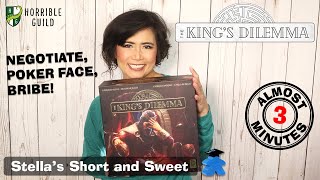














The King's Dilemma Deep Dive
What the Community Thinks About The King's Dilemma
Across the channels that have sat down with The King's Dilemma, one thing keeps coming up unprompted: the story. Actualol calls it a transformative experience and, without qualification, the best storytelling board game they have ever played. Board Stupid names it one of the greatest gaming experiences the hosts have had, describing it as something that transcends what they think a game even is. Stonemaier Games points to how nearly every decision in a full campaign came down to theme rather than optimization, with players sinking into their house's identity instead of chasing the board state. Getting Games, who carried a single group through a full seventeen-game campaign, keeps circling back to the forked paths in the six stories as the part that stuck with them.
Where the channels split is on how much game surrounds that story. 3 Minute Board Games loves the six main story paths and their compelling subplots but treats almost everything else, the voting tracks, the scoring cards, the envelope system, as busy work bolted onto a pick-a-path book. No Pun Included is split within its own two hosts: one names King's Dilemma their outright game of the year, calling it a shockingly good game where the mechanisms, the storytelling, and the tension all click together, while the other host cannot get on board with it, describing the experience as a ball of things they hate wrapped into a box and awarding it only half of the channel's game of the year prize. Getting Games lands somewhere in between, glad to have played through the whole campaign but wishing there had been less mechanical noise around the stories that actually held their attention.
Core Mechanics That Define The King's Dilemma
Bidding Power Behind a Yes or No
Every round in The King's Dilemma opens with a dilemma card that lays out a paragraph of narrative and a binary choice attached to it. Getting Games describes the flow directly: a card is drawn, it presents a scenario such as whether to send more troops to a border war, and the card shows which resources will move if the table says yes and which will move if it says no, without revealing exactly how much. Players then spend a personal stock of power tokens to push their side of the vote, and whoever commits the most power on a side becomes the council leader and effectively decides how the vote resolves for everyone to their left. No Pun Included frames this as a bidding system with teeth: bidders often commit power and wealth toward an outcome without knowing what they are actually buying, in both the narrative and the mechanical sense, which is what gives the voting its tension.
A Legacy Board Built From Stickers and Envelopes
The five resource tracks at the center of the board, covering the kingdom's military, wealth, morale, health, and scholarship, get permanently altered as the campaign goes on. 3 Minute Board Games explains that laws passed through voting get placed at the top of the board and can unlock numbered envelopes containing new cards and new events, which is what actually drives the unfolding story forward. Actualol highlights the sticker side of that same system: passing a law or making a discovery means signing a sticker to the board, and the country remembers it, so a tax pushed through against the poor keeps costing points in later sessions if welfare keeps suffering. Getting Games adds that a scoring card handed out at the start of each session tells a player how they want the five tracks positioned by the end of that reign, which is the personal agenda pulling against whatever is best for the kingdom as a whole.
The King's Dilemma Experience
Arguing Your Way Through a Kingdom
Sitting at the table means talking, not just voting. No Pun Included describes cajoling, begging, pleading, threatening, and negotiating with the rest of the table just to scrape together enough power to win a single bid, and admits to caring so much about winning that the actual content of the dilemma got lost along the way. 3 Minute Board Games frames the same loop as roleplay: a vote comes up over something like whether to let an insult to the king slide, and players start inventing self-serving justifications for whichever way benefits their house, then argue those justifications out loud at the table. Board Stupid describes the sense of discovery that follows once an event card actually resolves, comparing the feeling to watching a clue crack open a mystery that was not visible a moment earlier.
Feeling the Weight of Every Choice
Because the sticker system remembers every law and every vote, several channels describe the choices as carrying real weight rather than staying abstract. Actualol talks about deciding whether someone lives or dies and wanting the context to matter, then feeling the pull of shaping a nation session after session, admitting to ignoring a personal house goal more than once for the sake of the kingdom's welfare. Stonemaier Games describes making almost every decision in a full campaign based on what felt right for the kingdom rather than what a scoring card demanded, even when that ran against their own house's interests. Getting Games notes the campaign has an emotional cost too, describing frustration after repeatedly losing across seventeen games before deciding to stop caring about winning and just follow the story.
What Makes The King's Dilemma Stand Out
Six Branching Storylines
3 Minute Board Games breaks the campaign down to six main story paths, each going its own way depending on the choices made along the way, tied together into an overall structure but standing as six compelling subplots in their own right. No Pun Included describes arriving at one of the game's many endings as something the whole table reaches together, with the stickered board left behind standing in as a tapestry, a history of that particular kingdom. Getting Games singles out the forked paths inside those stories as the single most interesting part of the whole campaign, more interesting than the mechanical resolution wrapped around them.
A Sticker System That Remembers
Actualol calls the sticker mechanism genius specifically because it will not let a table off the hook: pass a law or push through a discovery and the country carries that decision into every future session, for better or worse. The same channel describes a moment away from the table entirely, overhearing a different group discussing a King's Dilemma session at a meetup and feeling a pang of guilt over decisions their own group had made to a similar set of people in their own kingdom, which is the kind of carryover most games never manage to create.
Potential Drawbacks
Busy Work Behind the Story
3 Minute Board Games is direct about this one: there is so much mechanical busy work here that it takes away from the experience of the storytelling game, and given the choice, they would rather play something simpler and more straightforward, like The Quiet Year. Getting Games arrives at a related conclusion after seventeen sessions, describing the gaminess of the scoring system as a detractor overall and wishing there had been less going on mechanically so the stories could carry more of the weight, especially once a rich-get-richer sticker engine let one player pull ahead on power alone.
A Legacy That Leaves Nothing Behind
Because the game consumes itself, cards get torn, stickers get applied permanently, and envelopes get opened and discarded, 3 Minute Board Games describes reaching the end of the campaign with nothing left worth keeping and everything from the board to the box insert headed for the bin. They contrast that with legacy games where something survivable remains once the campaign wraps. Getting Games echoes a version of that same fatigue from the story side, noting that the six stories they played through tended to end anticlimactically, several times catching the table off guard that a thread was over at all. Not everyone falls for the experience either: one half of the No Pun Included team is blunt that the game amounts to a pile of things they personally dislike wrapped into one box.
If You Enjoy The King's Dilemma
3 Minute Board Games points toward The Quiet Year as a closer fit for players who want the same shared exploration of a struggling territory without the mechanical busy work layered on top of it. Getting Games, describing the campaign's cutthroat endgame negotiation phase, compares the wheeling and dealing at that table to a version of Diplomacy, minus the map, once the campaign forces every house to fight for a single winner.
What Reviewers Are Saying
"There's so much mechanical busy work here that I think ultimately takes away from the experience of the storytelling game. And I think I would rather play again something a bit simpler, a bit more straightforward."
— 3 Minute Board Games
"One of the greatest gaming experiences I've ever had is playing through the King's Dilemma. And the King's Dilemma is an example of a competitive game."
— Board Stupid
"This is the best storytelling board game I've ever played, and it's not even close. Most games feel like you're pausing a normal board game to read a cutscene, with that jarring shifting graphics that kills the immersion. In King's Dilemma the story is at the heart of every decision, and it's well-written, thought-provoking, and to the point."
— Actualol