






























Coming of Age Deep Dive
What the Community Thinks About Coming of Age
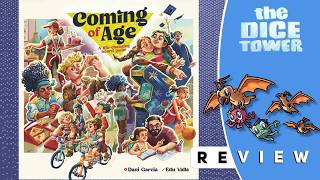
Coming of Age has resonated strongly with reviewers as a thematic Euro game that captures the experience of adolescence. The game draws positive responses for its design philosophy, though opinions diverge on how successfully it integrates theme with mechanics. Board Gaming Ramblings calls it "a fantastic game" that rewards multiple plays, while The Dice Tower recognizes it as "one of the better medium style Euro games" of recent years. Even critics acknowledge the care in the game's construction, though some feel the abstract nature undermines the coming-of-age premise.
Core Mechanics That Define Coming of Age
Dice Placement with Frustration Management
Players roll dice of increasing variety: starting with a D4 and progressing to D6s, D8s, and D10s as the game progresses. Rather than moving pieces, dice values determine which action spaces become available, creating meaningful choices about where to place limited actions. The frustration mechanic stands out as the game's signature system: when a roll doesn't align with your plans, you can take frustration tokens to move to a different action space. These tokens initially block valuable bonuses, but if you navigate back down a track to reach them again, they flip to award four victory points. This transforms bad luck into delayed rewards, embodying the theme that challenges overcome lead to growth.
Track Advancement with Dual Bonuses
Seven character development tracks progress from negative states to positive ones: fun to bored, brilliant to mediocre, active to sedentary, and others that unlock as the game evolves. Moving on these tracks yields immediate bonuses when you pass through them, and reaching the top space grants a passive ability that persists until you move again. Reviewers note this creates satisfying tactical decisions, as players must choose whether to pursue high-impact passive bonuses or gather quick points from movement bonuses. The track system gives the game its sense of progression; each round unlocks new tracks, visually representing how a player's concerns expand as they age.
The Coming of Age Experience
Warm and Engaging Accessibility
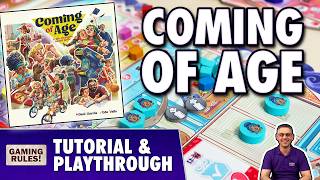
Despite its mechanical depth, Coming of Age delivers an enjoyable experience rather than a brain-burning puzzle. The simple gameplay loop: roll dice, choose an action, move the bus, resolve bonuses: repeats with increasing complexity as new options unlock each round. Reviewers describe the feeling as "warm" and "engaging," with a pace that keeps players invested without overwhelming them. The decision space remains manageable enough that turns flow smoothly, even on a first play.
Moments of Thematic Discovery
The game's strongest thematic moments emerge as players connect mechanics to meaning. Making friendships and watching them deepen, managing conflicting desires through track choices, and using memory cards to adjust your emotional state all reinforce the adolescent experience. Reviewers who lean into this interpretation find genuine joy in the theme-mechanics integration. Those who don't find these connections often perceive the game as a competent but abstract Euro with a surface-level coat of coming-of-age flavoring.
What Makes Coming of Age Stand Out
Brilliant Component Design and Presentation
Coming of Age's player boards are shaped like the silhouettes of heads, immediately grounding players in the game's psychological focus. The chunky, tactile components: chunky wooden buses, colorful memory tokens shaped like cassettes, friendship hexagons: create a sensory experience that reinforces the theme of childhood nostalgia. The Dice Tower reviewers emphasize that the quality and thoughtfulness of the presentation distinguishes the game on the table. Even critics who found the mechanics too abstract praised the beautiful artwork and intuitive iconography.
Innovative Frustration Mechanic Married to Theme
The frustration system does something remarkable: it mechanically incentivizes player resilience while thematically embodying the process of learning to overcome challenges. Players actively want to take frustration tokens because they understand the payoff, transforming a negative consequence into a strategic tool. The Dice Tower notes this as one of the most thematically successful mechanics in recent Euro games: it doesn't just flavour a system, it deepens the game's emotional resonance by making failure a stepping stone.
Potential Drawbacks
Limited Player Interaction
Coming of Age leans heavily into individual player boards and personal track management. While friendships can form between players through shared location visits, these interactions remain minimal. Reviewers consistently describe the game as "multiplayer solitaire," where each player pursues their own path with little meaningful interference or cooperation. For those seeking direct player conflict or negotiation, the game's low-interaction approach may feel isolating rather than intimate. The bus route creates moments of overlap, but these are more about shared bonuses than strategic maneuvering.
Theme-Mechanics Disconnect for Some
BoardGameBollocks offers a dissenting voice, arguing that the game's abstract nature contradicts its coming-of-age promise. While individual systems work mechanically: moving on tracks, managing resources, building friendships: the critic questions whether the collection of mechanics tells a coherent story of growing up. The bus system, the placement of memories on the board, and the progression of dice feel disconnected from the narrative of adolescence. Reviewers who prioritize thematic coherence find these moments of disconnect jarring, though reviewers who appreciate Euro games appreciate the mechanical sophistication despite: or because of: the abstractions.
If You Enjoy Coming of Age
Players drawn to Coming of Age's theme and mechanics will find similar satisfaction in related games. Pursuit of Happiness explores a similar life-passage premise, though some find it less mechanically satisfying. The Unconscious Mind and Dinosaur Island offer thematic experiments with Euro mechanics, though neither achieves the same emotional resonance according to reviewers. For those who love the dice-placement and track-advancement core, games like Trajan and other Feld designs provide comparable mechanical depth. Those seeking the same warm, accessible Euro experience with slightly different themes might explore Calico or Splendor, which share Coming of Age's ability to deliver satisfying choices without overwhelming complexity.
What Reviewers Are Saying
"Coming of Age, I think, is a fantastic game. I think that I liked this the first time I played, but I liked it more and more. I feel like it's just very fun and it's very, I'm not going to say cozy, I think it is just very warm in a good way."
— Board Gaming Ramblings
"The frustration mechanic alone, I think is brilliant, right? The notion of like, this is a challenge in my life, this is something that frustrates me, and therefore when I get my mood up enough, boom, I overcome it."
— The Dice Tower
"I think as you move on the different directions of the tracks, I think it's going to take a little bit effort, because the tracks are probably the part that feel the most straight up mechanical, but when you look at certain of the things, you're like, 'Oh, I'm being a little irresponsible moving up on this track, but I'm also moving down on this one.'"
— The Dice Tower