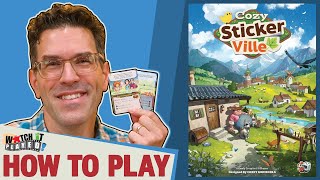









Cozy Stickerville box art

Cozy Stickerville

Game ID: GID0445837
Game Info
Players
1-6
Age
8+
Playtime
30 min
Collection
Ratings
Mechanic profile
Percentile rank vs. all games
Vibe profile
How this game feels to play
Description
No description available.
Ask a Rules Question
All mentions
Browse transcript mentions, sentiments, pros/cons, mechanics, topics, quotes, and references.
Total mentions: 75
This page: 25
Sentiment: pos 20 · mix 2 · neu 0 · neg 1
Mentions per page
Showing 51–75 of 75
Video UDOlnlkBm7o Unknown Top 10 List at 2:46 sentiment: positive
video_pk 66190 · mention_pk 160883
Unknown - Cozy Stickerville video thumbnail
Click to watch at 2:46 · YouTube ↗
Overall sentiment (raw)
positive
Pros
none
Cons
none
Thematic elements
Comparison games
none
Mechanics (from transcript analysis)
Mechanics unknown.
Video topics + discussion points
No key topics recorded for this video.
Quotes (from this video)
  • There is a chance to get these two exclusive pins which are also going to be so so hot.
  • I got my one ring pin last year. Everybody wants to trade for it.
  • I definitely want to get these two tower pins if I can.
  • This is a huge thing.
  • I'm really, really, really excited for this one.
  • Sunday from 11 till 2, you'll be able to get your picture taken with Santa and you'll be able to see Holiday Hills.
References (from this video)
No references stored for this video.
Video TLd7gHsRCnk BoardGameGeek Live Playthrough at 0:00 sentiment: mixed
video_pk 65712 · mention_pk 159473
BoardGameGeek Live - Cozy Stickerville video thumbnail
Click to watch at 0:00 · YouTube ↗
Overall sentiment (raw)
mixed
Pros
  • Rich, branching narrative with many pathways
  • Tangible town-building feel through sticker placement and resource management
  • High replayability via branching scenarios and year-by-year evolution
Cons
  • Complex and lengthy to play; can be overwhelming for new players
  • Messy components and sticker management can be fiddly and frustrating at times
  • Pace can drag in long play sessions
Thematic elements
  • Village-building, resource management, family dynamics, politics and social progress
  • A small town-building scenario spanning multiple years with evolving buildings, relationships, and community milestones
  • Branching, sticker-driven storybook with player choices driving events
Comparison games
  • Stardew Valley
Mechanics (from transcript analysis)
  • Branching choices / player agency — Decisions that affect relationships, milestones, and end-game conditions.
  • Deck-building / card-driven actions — Yearly or phase-based cards dictate actions and events.
  • dice resolution — Dice outcomes affect certain actions or events (e.g., hunting, baking).
  • Dice Rolling — Dice outcomes affect certain actions or events (e.g., hunting, baking).
  • Narrative Choice — Decisions that affect relationships, milestones, and end-game conditions.
  • Resource Management — Gaining and spending wood, food, gold, etc. to build and upgrade.
  • Set Collection — Track milestones via cards and stickers to unlock bonuses.
  • Set collection / milestone tracking — Track milestones via cards and stickers to unlock bonuses.
  • Sticker placement / tile placement — Place stickers on a map to build infrastructure and modify spaces.
  • Storybook / story entries — Narrative events accessed by reading story entries tied to locations.
  • Tile Placement — Place stickers on a map to build infrastructure and modify spaces.
Video topics + discussion points
No key topics recorded for this video.
Quotes (from this video)
  • Cozy Stickerville coming out next year.
  • Cake, cake, cake, cake, cake.
  • I'm bored.
  • Stardew Valley comparison came up in the discussion.
References (from this video)
No references stored for this video.
Video bqNDOgVtoEw Let's Table It Review at 0:00 sentiment: positive
video_pk 64790 · mention_pk 158284
Let's Table It - Cozy Stickerville video thumbnail
Click to watch at 0:00 · YouTube ↗
Overall sentiment (raw)
positive
Pros
  • Cozy, calm atmosphere with inviting art
  • Approachable decisions and relaxed pace
  • Encourages conversation and shared discovery
  • Narrative content feels living and unfolding piece by piece
  • Family-friendly and comforting experience
Cons
  • Not crunch-heavy or deeply strategic mechanics
  • Completionists won't see everything in a single playthrough
  • May not satisfy players seeking heavy optimization or challenge
Thematic elements
  • Cozy, comforting storytelling where choices shape the living world
  • Village-building across up to 10 years with evolving story
  • Branching, narrative-driven, living world that unfolds piece by piece
Comparison games
none
Mechanics (from transcript analysis)
  • Branching story paths — Make choices between options; the unchosen option is no longer available
  • Card drawing each year — Shuffle and draw a year-specific card and follow its instructions
  • Location interactions — Interact with board locations to trigger events or story beats
  • Narrative Choice — Make choices between options; the unchosen option is no longer available
  • Neighbor Interaction — Interact with board locations to trigger events or story beats
  • Progress saving — Save and resume progress between sessions
  • Progression across years — Play generally across 10 years with option to continue after finishing
  • sticker placement — Place starting or new stickers on the board to influence future interactions
  • Story book references — Consult a story book to progress narrative
Video topics + discussion points
No key topics recorded for this video.
Quotes (from this video)
  • This one might be right up your alley.
  • The decisions are approachable, the pace is relaxed, and it encourages conversation and shared discovery.
  • There is so much narrative content here. It genuinely feels like you're uncovering a living world piece by piece.
  • It's soft, familiar, and incredibly inviting.
  • If you're looking for something to snuggle down with and chase away those winter blues, this game delivers.
  • Cozy Stickerville absolutely blew me away in the best way.
References (from this video)
No references stored for this video.
Video RvpyyYn4ETI All You Can Board Analysis at 4:02 sentiment: negative
video_pk 64289 · mention_pk 157737
All You Can Board - Cozy Stickerville video thumbnail
Click to watch at 4:02 · YouTube ↗
Overall sentiment (raw)
negative
Pros
  • Relaxing, low rules overhead
  • Good fit for coffee breaks
  • Potential for future evolution and sticker variety
Cons
  • No win condition; limited replayability
  • Narrative and character depth feel shallow
  • Novelty wears off after several years
  • Feels more like a sticker book than a game
Thematic elements
  • Relaxation and cozy-world-building via sticker placement
  • A 10-year, 10-session solo sticker-book village-building experience
  • Relaxed, non-competitive, observational
Comparison games
  • Animal Crossing
  • Stardew Valley
  • Dreamlight Valley
  • Cozy Grove
Mechanics (from transcript analysis)
  • Event deck-driven turns — Each turn you draw and resolve an event card to unlock actions.
  • Events — Each turn you draw and resolve an event card to unlock actions.
  • No win/lose condition; open-ended progression — 10-year loop without explicit victory conditions; focus on relaxation and village-building.
  • Positive Player Interaction — 10-year loop without explicit victory conditions; focus on relaxation and village-building.
  • Sticker placement on a board — On your turn you place a sticker according to available actions.
Video topics + discussion points
No key topics recorded for this video.
Quotes (from this video)
  • Everything about Cozy Sticker Ville is supposed to be a relaxing activity.
  • There is no way to win, there's no way to lose.
  • I won't be playing this game solo or multiplayer again.
References (from this video)
No references stored for this video.
Video g6QPO98CEPA Watch It Played Rules Teach at 0:13 sentiment: positive
video_pk 63802 · mention_pk 157310
Watch It Played - Cozy Stickerville video thumbnail
Click to watch at 0:13 · YouTube ↗
Overall sentiment (raw)
positive
Pros
  • loads of secrets and surprises to uncover as you play
  • no matter how you resolve the instructions, the game will teach you the rules
  • You can save the game
  • You can play solo
  • New players can join or leave at any time
  • There is no way to lose
  • Five possible endings
  • You can play again on the other side of the map
Cons
none
Thematic elements
  • building a village, decision consequences, storybook progression
  • village-building across 10 years
  • storybook with year-by-year storytelling
Comparison games
none
Mechanics (from transcript analysis)
  • Catalog deck and numbers/letters — Cards drawn from a catalog deck with numbered/lettered references; some copies denote different sides or versions used during play.
  • End Game Bonuses — End-of-year effects are resolved; after 10 years, one of five endings is determined by choices made.
  • End of year and endings — End-of-year effects are resolved; after 10 years, one of five endings is determined by choices made.
  • Event deck with morning/afternoon turns — On a turn, players draw an event in the morning and resolve a single action in the afternoon, with consequences and options.
  • Events — On a turn, players draw an event in the morning and resolve a single action in the afternoon, with consequences and options.
  • Progress and upset stickers — Progress and upset stickers track village status and can affect future interactions; effects reference these stickers.
  • Residents and milestones — Stickers represent residents and milestones; their presence and subtitles influence game progress and endings.
  • Resolving actions with costs — Actions require paying resource costs to resolve; some cards instruct discarding after use.
  • Resource Management — Gains tokens for ore, wood, gold, and food; resources are spent to take actions and influence outcomes.
  • Resource tokens and management — Gains tokens for ore, wood, gold, and food; resources are spent to take actions and influence outcomes.
  • Saving and resuming game — Players can save the game to resume later, placing cards and resources in a save box and marking progress with a sticker.
  • Score-and-Reset — Players can save the game to resume later, placing cards and resources in a save box and marking progress with a sticker.
  • Sticker placement on map — Permanent placement of stickers on the map to build the village; edge alignment and overlap restrictions; clear stickers can be placed on top of others.
  • Tile Placement — Permanent placement of stickers on the map to build the village; edge alignment and overlap restrictions; clear stickers can be placed on top of others.
  • Yearly setup and story book — Each game represents a year; setup involves gaining resources, selecting starting stickers, and reading year-specific story prompts.
Video topics + discussion points
No key topics recorded for this video.
Quotes (from this video)
  • In Cozy Stickerville, players will be creating a village by making a series of decisions that will involve permanently changing the board as they cover it with stickers over the course of 10 games.
  • There are loads of secrets and surprises to uncover as you play.
  • Although there's no way to lose, you'll end up resolving one of the five possible endings based on the choices you made.
  • You can save the game and put it away until you're ready to play again.
  • You can even play the game solo.
References (from this video)
No references stored for this video.
Video V4fWXqFgUMY BoardGameGeek Playthrough at 1:00 sentiment: positive
video_pk 63741 · mention_pk 157244
BoardGameGeek - Cozy Stickerville video thumbnail
Click to watch at 1:00 · YouTube ↗
Overall sentiment (raw)
positive
Pros
  • Engaging branching narrative that rewards exploration and risk
  • Cozy, lighthearted theme with charming art and components
  • Rich interaction and a surprising amount of meaningful choice
  • Sticker-modified map adds a tangible, tactile layer to strategy
Cons
  • High number of simultaneous options can be overwhelming at times
  • Some rules interactions (stickers, map folds) require careful setup and can slow first plays
Thematic elements
  • Array
  • Rural, cozy village-building in a whimsical setting
  • Branching, choose-your-own-adventure style storylines threaded through year-based events
Comparison games
none
Mechanics (from transcript analysis)
  • Bridge and river-crossing theme via stickers — Roads and a potential bridge enable river crossing and expansion, influencing placement and growth
  • Cooperative Game — Gameplay is cooperative, with players discussing options and consensus decisions before executing actions
  • cooperative play — Gameplay is cooperative, with players discussing options and consensus decisions before executing actions
  • Dice Rolling — Some decisions require rolling a die to determine outcomes or rewards
  • Dice rolling for actions — Some decisions require rolling a die to determine outcomes or rewards
  • End-of-year progression and milestones — The game progresses through yearly decks (year one, year two, year three) with end-of-year effects and milestone tracking
  • Market and resource exchanges — A market provides a centralized place to exchange resources for others, enabling strategic conversion
  • Narrative Choice — Cards present branching narrative options that players discuss and resolve together, with outcomes affecting future play
  • Network/Route Building — Roads and a potential bridge enable river crossing and expansion, influencing placement and growth
  • Progress and milestone tracking with stickers — Milestones and progress are tracked with stickers and a milestone page on the sticker book
  • Relationship and narrative subplots — Story threads introduce relationship choices, babies, and personal stakes that impact gameplay
  • Resource Management — Players manage four shared resources (food, wood, ore, and gold) to fund actions and development
  • Sticker-board map customization — The map is customized with stickers that cover specific map squares, creating year-by-year changes and shaping the board
  • story-driven choices — Cards present branching narrative options that players discuss and resolve together, with outcomes affecting future play
  • Track Advancement — Milestones and progress are tracked with stickers and a milestone page on the sticker book
  • Turn structure with morning/afternoon actions — Each turn has a morning action (draw and resolve a card) and an afternoon action (take an action), with hourglass markers indicating actions
Video topics + discussion points
No key topics recorded for this video.
Quotes (from this video)
  • Cozy Stickerville, a game for one to six players.
  • Here's your first taste of a branching path that you've set in motion.
  • The village looks as bland as yesterday's oatmeal. Let's add some flavor.
  • A market is crucial for buying and selling goods.
  • This game is cool.
References (from this video)
No references stored for this video.
Video 4uWM7rBkgxk Get into games Review at 2:24 sentiment: positive
video_pk 61682 · mention_pk 154345
Get into games - Cozy Stickerville video thumbnail
Click to watch at 2:24 · YouTube ↗
Overall sentiment (raw)
positive
Pros
  • cozy, narrative-driven experience
  • accessible mechanics with a clear sticker-book system
  • high-quality components and attractive visuals
  • encourages exploration and collaboration, including family play
Cons
  • ending may feel unsatisfying to some players
  • some players may find sticker removal and sticker-overtracking fiddly
  • scalability with 3-6 players can be tricky due to sticker time and pacing
  • story path restrictions on second playthrough may feel limiting
Thematic elements
  • story-driven, memory-building, cooperative village life
  • village-building over a 10-year arc in a cozy, pastoral landscape
  • choose-your-own-adventure style with a sticker book and branching stories
Comparison games
  • Vantage
  • Ticket to Ride Legacy
  • Pandemic Legacy
Mechanics (from transcript analysis)
  • Legacy Game — permanent changes across the 10-year span; some options are removed or blocked in the second playthrough
  • legacy progression — permanent changes across the 10-year span; some options are removed or blocked in the second playthrough
  • Narrative Choice — read yearly cards, make decisions that unlock new actions or progress the story
  • Resource Management — gather apples, wood, gold, ore to build projects and pay for upgrades
  • see-through stickers — transparent overlays allow layering without obscuring underlying elements
  • Spatial Puzzle — board layout creates a spatial challenge as you connect areas and plan routes
  • sticker placement — place stickers on a board to build the village landscape and trigger story events
  • story cards and branching choices — read yearly cards, make decisions that unlock new actions or progress the story
Video topics + discussion points
No key topics recorded for this video.
Quotes (from this video)
  • It's accessible for all.
  • There are few points of no return.
  • This is a choose your own adventure story with stickers.
  • The story beats are there and the father asks if you've been successful in his eyes.
  • It's cozy. It's like a visual diary.
References (from this video)
No references stored for this video.
Video gunhg0zN9eY The Board Game Garden Discussion at 19:34 sentiment: positive
video_pk 42907 · mention_pk 130438
The Board Game Garden - Cozy Stickerville video thumbnail
Click to watch at 19:34 · YouTube ↗
Overall sentiment (raw)
highly positive
Pros
  • strong personal connection for the speaker (stickers business background)
  • family-friendly, accessible
Cons
  • legacy-like progression may require ongoing commitment
Thematic elements
  • stickers as a core mechanic; family-friendly
  • stickers in a book; a cozy, creative journaling vibe
  • legacy-ish, book-collection progression
Comparison games
none
Mechanics (from transcript analysis)
  • solo and up-to-six-player play — scales for many players with a shared progression
  • sticker placement in a book — place stickers to develop Stickerville and progress the story
Video topics + discussion points
No key topics recorded for this video.
Quotes (from this video)
  • I'm so excited to get there and hang out and see everyone.
  • This is the cozy season that we're moving into—winter, holidays, cozy solo and multiplayer gaming.
  • I love the board game community—it's so nice, kind, welcoming, and easy to start conversations.
  • Tend is probably one of my favorite games from 2025. I love it so much, both multiplayer as well as solo.
  • Cozy Stickerville... I cannot wait for this game. It is bringing two worlds together that I just love so much.
References (from this video)
No references stored for this video.
Video Hbo7TAcc1tk Stonemaier Games Discussion at 0:27 sentiment: positive
video_pk 42731 · mention_pk 129806
Stonemaier Games - Cozy Stickerville video thumbnail
Click to watch at 0:27 · YouTube ↗
Overall sentiment (raw)
positive
Pros
  • easy onboarding with minimal rules overhead
  • flow and accessibility noted by the players
  • scales from 1-6 players easily
Cons
  • long-term replayability and weight may be limited relative to heavier legacy titles
Thematic elements
  • cooperation, evolving village
  • village-building in a cooperative legacy campaign
  • legacy progression with yearly events
Comparison games
  • Charter Stone
Mechanics (from transcript analysis)
  • cooperative placement — players collaboratively build the village with limited turn structure
  • event cards — draw a yearly event card to determine year-specific effects
  • Events — draw a yearly event card to determine year-specific effects
  • on-board actions via stickers/cards — on a turn you place a sticker or take an action indicated on a card
Video topics + discussion points
No key topics recorded for this video.
Quotes (from this video)
  • legacy game where you are cooperatively building a village together
  • very little rules overhead
  • onboarding into the game was really easy
  • retail release for Wingspan Americas and Vidiculture Bordeaux is this Friday
  • the Nesting Box is designed to hold all Wingspan and Viticulture contents
  • I love that you asked the question. Jim, I appreciate that
  • Momentum is an amazing motivator
  • One thing that I've found is that progress, even tiny, adds up
References (from this video)
No references stored for this video.
Video RxOR0YQ_z24 One Stop Co-op Shop Review at 0:12 sentiment: positive
video_pk 41366 · mention_pk 125475
One Stop Co-op Shop - Cozy Stickerville video thumbnail
Click to watch at 0:12 · YouTube ↗
Overall sentiment (raw)
positive
Pros
  • Strong narrative through evolving events and branching storylines.
  • Compelling cooperative vibe with a partner, aided by a readable storybook framework.
  • Satisfying aesthetic and tactile appeal from sticker placement and village design.
  • Tension from resource management without becoming frustrating; pacing allows meaningful choices.
Cons
  • Sticker placement is largely cosmetic rather than strategically decisive.
  • Some character threads and endings can feel disconnected or fade after certain storylines conclude.
  • Legacy mechanics may not appeal to players seeking heavier competition or solo play.
Thematic elements
  • Community-building, growth, relationships, and evolving storytelling driven by player choices.
  • A cozy valley town built over a 10-year legacy campaign, where players add buildings, people, and decorations through actions and narrative events.
  • Branching, storybook-style narrative with ongoing character arcs and endings determined by event-driven choices.
Comparison games
  • Stardew Valley
  • The Sims
Mechanics (from transcript analysis)
  • event cards — Flip an event card each turn to reveal either an immediate effect or an ongoing action that shapes the village and its story.
  • Events — Flip an event card each turn to reveal either an immediate effect or an ongoing action that shapes the village and its story.
  • legacy progression — A 10-year campaign with evolving outcomes; the board can be flipped to run alternate storylines and endings, adding replayability.
  • Narrative Choice — Interactions with drawn characters and storylines that influence future events and endings; choices have consequences across the campaign.
  • Narrative exploration — Interactions with drawn characters and storylines that influence future events and endings; choices have consequences across the campaign.
  • Resource Management — Players manage limited resources (e.g., food, wood) to perform actions, build, and progress through years; scarcity creates tension.
  • sticker placement — Place stickers on a board to develop the village ambiance, upgrade structures, and add decorations; largely aesthetic but with visual impact.
Video topics + discussion points
No key topics recorded for this video.
Quotes (from this video)
  • the narrative exploration and the continuing story lines you have
  • Oh, and one of the great things with the game is while it is a legacy game, while you are putting stickers down, you can flip the board over and make the opposite choice for every eitheror choice you made in the game and play through the entire campaign again and see all the story lines you missed out on
  • If you like cozy games, if you like things like Stardew Valley, if you want a fun narrative, a game with low stakes and quick play time
  • this is an all pro game for me
References (from this video)
No references stored for this video.
Video OlVFirk3epo Stonemaier Games Discussion at 2:29 sentiment: positive
video_pk 39921 · mention_pk 120594
Stonemaier Games - Cozy Stickerville video thumbnail
Click to watch at 2:29 · YouTube ↗
Overall sentiment (raw)
positive
Pros
  • light and accessible for casual play
  • cozy theme that fits family game nights
Cons
  • less depth for heavy gamers
Thematic elements
  • city-building with cute aesthetics
  • Cozy, light family game atmosphere
  • playful, accessible
Comparison games
  • Sushi Go
  • Rolling Realms
Mechanics (from transcript analysis)
  • Tableau Building — simplified tableau-building with approachable decisions
  • tableau/engine-lite — simplified tableau-building with approachable decisions
Video topics + discussion points
No key topics recorded for this video.
Quotes (from this video)
  • The eight people who run Stonemire Games are all in service of you. You being customers, clients, retailers, distributors, and localization partners.
  • What matters to us is are we bringing joy to your tabletop? Are we serving you?
  • The numbers don’t matter all that much in the end.
  • I am not interested at all in generative AI in anything related to board games.
  • You are the boss and we are here to serve you.
References (from this video)
No references stored for this video.
Video hUMlrFQOn5s Meet Me At The Table Playthrough at 0:00 sentiment: positive
video_pk 39695 · mention_pk 119857
Meet Me At The Table - Cozy Stickerville video thumbnail
Click to watch at 0:00 · YouTube ↗
Overall sentiment (raw)
positive
Pros
  • Very quick to learn and play, with tight session length
  • Great banter and streaming-friendly dynamics between players
  • Two-sided board increases replayability and keeps things fresh
  • Clear path to multiple endings and branching content
  • Accessible for viewers and players new to tabletop
Cons
  • Sticker fiddliness and potential for alignment errors during setup
  • Map-fold and sticker overlays can be fiddly and confusing at first
  • Endgame goals can feel distant if players race through years quickly
Thematic elements
  • Town-building, resource management, and light storytelling with branching outcomes.
  • A whimsical frontier settlement built over a fictional landscape, explored via stickered components and narrative events.
  • Branching stories and endings driven by event cards and player choices; a light legacy-like feel without long-term permanence.
Comparison games
  • KDM
  • The Initiative
Mechanics (from transcript analysis)
  • branching paths — Choices lead to branching outcomes and multiple endings, including a few different endings per playthrough.
  • Event/monthly cycle — The game spans 10 years with 12 months per year; each month reveals or uses event cards that drive actions and outcomes.
  • Narrative Choice — Choices lead to branching outcomes and multiple endings, including a few different endings per playthrough.
  • Poll-based decisions — Players participate in polls to resolve ties or to decide between mutually exclusive actions.
  • Resource Management — Gaining and spending wood, food, coins, and other resources capped by physical tokens; stickers track production and inventory.
  • sticker placement — Players place building and resource stickers on a two-sided board, matching background colors and regions to place items.
  • Voting — Players participate in polls to resolve ties or to decide between mutually exclusive actions.
Video topics + discussion points
No key topics recorded for this video.
Quotes (from this video)
  • This game is very quick to play. It is addicting.
  • Roads are crucial for a proper town, but they might disrupt the local ecosystem.
  • There are five unique endings for the game.
  • The big thing we have to do at the beginning of the game is decide which side we want to start our settlement on.
  • This game is quick to play and open to streaming banter as a major draw.
References (from this video)
No references stored for this video.
Video GVta3y98WKc The Board Game Garden Haul at 32:51
video_pk 39435 · mention_pk 119034
The Board Game Garden - Cozy Stickerville video thumbnail
Click to watch at 32:51 · YouTube ↗
Pros
none
Cons
none
Thematic elements
Comparison games
none
Mechanics (from transcript analysis)
Mechanics unknown.
Video topics + discussion points
No key topics recorded for this video.
Quotes (from this video)
  • spoiler alert, one of my current favorite games.
  • I cannot wait to play this one.
  • The Luna expansion for Galileo Galilei is my number one thing I had to grab at Pax Unplugged.
  • This is probably the game or one of the games that I'm most excited about coming home with from Packs Unplugged.
References (from this video)
No references stored for this video.
Video _BS6h4D_qxA Meet Me At The Table Playthrough at 6:08 sentiment: positive
video_pk 38241 · mention_pk 115027
Meet Me At The Table - Cozy Stickerville video thumbnail
Click to watch at 6:08 · YouTube ↗
Overall sentiment (raw)
positive
Pros
  • engaging thematic vibe and playful atmosphere
  • high replayability due to multiple paths and two-board sides
  • fun, banter-friendly player interaction
Cons
  • potentially lengthy sessions
  • stickering/removal can feel fiddly or tedious
  • requires players to tolerate tabletop setup time
Thematic elements
  • Town-building, resource management, community development, and playful storytelling around a growing village.
  • A stylized, toy-like town-building scenario where players develop a settlement called Stickerville using sticker placement on a modular board.
  • Array
Comparison games
  • Kingdom Death Monster
Mechanics (from transcript analysis)
  • covering/removing stickers — Sticker changes reflect town changes and influence scoring and options.
  • Events — Story-driven events and milestone goals steer progress and end conditions.
  • events and milestones — Story-driven events and milestone goals steer progress and end conditions.
  • Resource Management — Manage gold, ore, food, happiness, and other tokens to drive decisions.
  • sticker-based board manipulation — Players place and sometimes remove stickers to build roads, landmarks, and landscapes.
Video topics + discussion points
No key topics recorded for this video.
Quotes (from this video)
  • It is called Stickerville.
  • This is the greatest intro ever.
  • The roads are fun.
  • Don't screw this up.
  • We finished off our clock tower event.
References (from this video)
No references stored for this video.
Video 747ZCHRI5J4 Dice Tower Review at 0:00 sentiment: positive
video_pk 37136 · mention_pk 111495
Dice Tower - Cozy Stickerville video thumbnail
Click to watch at 0:00 · YouTube ↗
Overall sentiment (raw)
positive
Pros
  • Strong replayability across multiple years and two-sided board layouts
  • High degree of player agency with meaningful, non-linear choices
  • Calm, cozy vibe with accessible humor appealing to families
  • Good value for a disposable game format with multiple sessions
Cons
  • No traditional victory condition; could feel non-substantial to some players
  • Some players may balk at only 20 plays per game and the disposable format
  • Late-game option density can be overwhelming for new players
Thematic elements
  • Cozy, wholesome community-building with light humor and family-friendly arcs.
  • A small town-building scenario unfolding over 10 years, driven by sticker placement and evolving resident stories.
  • Progression-based, branching through player choices with multiple interwoven story threads and events.
Comparison games
  • Animal Crossing
Mechanics (from transcript analysis)
  • Character encounters and story cards — New residents arrive via actions, attaching cards and potential sticker interactions to the board.
  • Deck Building — Each year, draw year cards that offer choices and future effects; progression spans 10 years.
  • Deck/Year progression — Each year, draw year cards that offer choices and future effects; progression spans 10 years.
  • Narrative Choice — Many paths and stories emerge; players can revisit houses and stories in different orders.
  • Non-linear storytelling with branching paths — Many paths and stories emerge; players can revisit houses and stories in different orders.
  • Overlay/clear stickers and multi-layer board interactions — Clear overlays modify the board state and reveal new interactions as the game evolves.
  • Resource Management — Track four resources (wood, food, money, ore) that are generated by stickers and cards.
  • Sticker placement / board enhancement — Place stickers on a shared board to grow the town, unlock resources, and trigger events.
Video topics + discussion points
No key topics recorded for this video.
Quotes (from this video)
  • It's not really a game, but we are loving it.
  • This is barely a game in a sense of you are just kind of experienced. It’s like a very multi-faceted choose your own adventure.
  • There is no victory condition here.
  • The word cozy, which is in the name of the game and describes the game, actually makes sense.
References (from this video)
No references stored for this video.
Video aOmCnfo04P4 The Dice Tower Discussion at 2:11 sentiment: positive
video_pk 37022 · mention_pk 111129
The Dice Tower - Cozy Stickerville video thumbnail
Click to watch at 2:11 · YouTube ↗
Overall sentiment (raw)
positive
Pros
  • Sticker-driven construction is visually appealing
  • Loved by fans of Corey Kinesca’s works
Cons
  • Sticker overload might be imperfect for some players
Thematic elements
  • DIY crafty city-building
  • Quaint town-building with a sticker-heavy twist
Comparison games
  • Cozy Stickerville
Mechanics (from transcript analysis)
  • Layer Building — Build with a large set of stickers to shape districts.
  • sticker-based construction — Build with a large set of stickers to shape districts.
Video topics + discussion points
No key topics recorded for this video.
Quotes (from this video)
  • the most boring unboxings on the planet Earth
  • Ooh, it's the new Cities Cities USA
  • This is one I'm very much looking forward to actually
  • I remember hearing about this game
  • I'm very excited about this one
References (from this video)
No references stored for this video.
Video m_O8iULWbAo One Stop Co-op Shop Playthrough at 0:00 sentiment: positive
video_pk 36956 · mention_pk 110943
One Stop Co-op Shop - Cozy Stickerville video thumbnail
Click to watch at 0:00 · YouTube ↗
Overall sentiment (raw)
positive
Pros
  • Strong cozy theme and family-friendly vibe
  • Demo effectively conveys core loop without spoilers
  • Accessible setup with quick play sessions
  • High potential for replayability via cards, A/B choices, and randomized events
Cons
  • Demo uses a subset of components compared to the full game
  • Rules are simplified in the demo; the full game is more complex
  • Sticker placement and board management can feel fiddly in practice
Thematic elements
  • Cozy life simulation, community building, nature exploration
  • A small-town, cozy life setting across a sabbatical-like period with nature, farming, and community-building.
  • Story-driven with milestone-driven progression and optional story sheets; cards drive progress and flavor
Comparison games
  • Stardew Valley
Mechanics (from transcript analysis)
  • AB choice cards and story sheets — Cards present choices (A/B); choosing an option reveals subsequent actions or story elements and often consumes a resource or slot.
  • Building amenities — Construct buildings like cabins, wells, hen houses using resources to improve life in the settlement.
  • Engine Building — Construct buildings like cabins, wells, hen houses using resources to improve life in the settlement.
  • Event deck by year — Draw an event card at the start of each year that drives narrative and determines available actions.
  • Events — Draw an event card at the start of each year that drives narrative and determines available actions.
  • Milestones and end-of-year scoring — Milestones (e.g., farmer, happiness) affect end-of-year scoring and progression.
  • Multi-Use Cards — Many actions or story cards are one-use and may permanently occupy slots on the board or in play.
  • One-time actions and card slottings — Many actions or story cards are one-use and may permanently occupy slots on the board or in play.
  • Push-your-luck fishing and foraging — A fishing mechanic uses dice or draw-and-roll mechanics to gain food; foraging and other actions yield additional resources.
  • Resource Management — Collect and spend resources (food, wood) to perform actions; resources are shared among players.
  • Sticker placement on a map — Place map stickers on a grid-based map to shape the landscape and unlock actions.
  • Tile Placement — Place map stickers on a grid-based map to shape the landscape and unlock actions.
Video topics + discussion points
No key topics recorded for this video.
Quotes (from this video)
  • Cozy Stickerville, which is a one to six player cooperative cozy.
  • It's in the name. Little sticker placement game where you're basically building a town.
  • In the full game, you have a huge map and you're going through 10 years and each year has its own deck of 12 event cards that are shuffled up and randomized.
  • There are no spoilers in here for the full game.
  • In the full game, you can flip the board over and play through the game again and you get B cards instead of A cards.
  • If you're digging what you saw, if you want a cozy legacy game with some story and family fun, I think this is a great one to check out.
References (from this video)
No references stored for this video.
Video OBsDNtISXPA Beyond Solitaire Interview at 53:48 sentiment: positive
video_pk 36080 · mention_pk 108042
Beyond Solitaire - Cozy Stickerville video thumbnail
Click to watch at 53:48 · YouTube ↗
Overall sentiment (raw)
positive
Pros
none
Cons
none
Thematic elements
  • cozy, story-driven, exploratory
  • Cozy town/world-building
  • storytelling
Comparison games
none
Mechanics (from transcript analysis)
Mechanics unknown.
Video topics + discussion points
No key topics recorded for this video.
Quotes (from this video)
  • The creative experience is not just visual. It's everything. It's how the game feels in your hands.
  • Less is more when managing creative people.
  • Test everything and the players will tell you it's right.
  • QA and blind play testing.
  • There's a magic to it.
  • There might be a world in the future where we where we do have to kind of make little verticals for each imprint.
  • Cozy Stickerville, there is no game like it.
  • There is no need for four different card sizes; normalize to one card size to save on die lines.
References (from this video)
No references stored for this video.
Video QySCShbLDYI Gaming with Edo & Jessica Review at 0:00 sentiment: mixed
video_pk 35565 · mention_pk 106267
Gaming with Edo & Jessica - Cozy Stickerville video thumbnail
Click to watch at 0:00 · YouTube ↗
Overall sentiment (raw)
mixed
Pros
  • Relaxing vibe and pleasant mood despite some sticker aversion
  • Short, quick campaigns suitable for multiple sessions
  • Varied story moments and character interactions through residents and their narratives
  • Two campaigns provide additional content and replay value
  • Charming puzzle-like elements (garden maze, hidden clues)
Cons
  • Sticker-centric theme not universally cozy for the reviewer
  • Mid-to-late game can feel overwhelming with too many cards and choices
  • Resource management can become unwieldy, reducing strategic clarity
  • No true win/lose mechanism; ends feel inconsequential for some players
  • Endings can feel repetitive or unsatisfying if certain objectives are pursued
  • Second run can lock out many choices, reducing perceived replay value
Thematic elements
  • cozy life, community building, storytelling through sticker placement
  • A village-building campaign that unfolds over 10 in-game years with a light, pastoral, cozy atmosphere
  • Array
  • Light episodic storytelling with moments of discovery and character interludes, more RPG-like than a traditional board game
Comparison games
  • Legacy of Dragonholt
Mechanics (from transcript analysis)
  • branching endings — Endings depend on pursued objectives; some cards lock out certain paths on the second playthrough
  • campaigny structure — Two sequential campaigns with content locked on the first run and selective branching
  • Deck Building — A fixed 12-card deck that evolves year to year and dictates available actions
  • deck-building-lite — A fixed 12-card deck that evolves year to year and dictates available actions
  • Resource Management — Wood and food resources must be managed to perform actions or unlock content
  • sticker-placement — Stickers shape the village and trigger story elements rather than direct victory points
Video topics + discussion points
No key topics recorded for this video.
Quotes (from this video)
  • it's very very very light on gameplay to the point that it almost feels more like an activity than a game
  • I would compare this more to an RPG than a board game if you're familiar with both
  • There are six different endings
  • The ending how that wraps up with him sort of judging what you have done does not feel cozy to me at all
  • This is a nice experience. It was pleasant.
  • I didn't like how this wrapped up
References (from this video)
No references stored for this video.
Video ZLL6Jfm2gmw UndeadVikingVideos Discussion at 16:55 sentiment: positive
video_pk 34373 · mention_pk 102346
UndeadVikingVideos - Cozy Stickerville video thumbnail
Click to watch at 16:55 · YouTube ↗
Overall sentiment (raw)
positive
Pros
  • easy to learn and play
  • very cooperative and family-friendly
  • delightful theme and presentation
Cons
  • price around $39.99–$50.00 depending on retailer
  • depth can vary with group; may feel light for some players
Thematic elements
  • cozy, cooperative town-building, light legacy elements
  • Cozy Stickerville is a cozy town built around inheritance; nonviolent, family-centric community-building.
  • storybook/nostalgic
Comparison games
none
Mechanics (from transcript analysis)
  • card_to_action_flow — Each turn you draw a card and perform one action; the board evolves over time as you progress years.
  • Cooperative Game — All players work together; there is no loser per se; collectively build and manage the town.
  • cooperative_play — All players work together; there is no loser per se; collectively build and manage the town.
  • stickering/placement_as_legacy — Players place stickers on the board to mark progress; long-term evolution of the game state.
Video topics + discussion points
No key topics recorded for this video.
Quotes (from this video)
  • It's literally going to change things.
  • The pre-order button is really effective.
  • Cozy Stickerville is delightful.
  • Dream Escape is a dream Cthulhu world; nothing makes any sense, and that's part of the fun.
  • Station Fall is amazing.
  • Compile is amazing.
References (from this video)
No references stored for this video.
Video Q9yPxZLHOUo The Board Game Garden Top 5 List at 25:04 sentiment: positive
video_pk 34242 · mention_pk 101956
The Board Game Garden - Cozy Stickerville video thumbnail
Click to watch at 25:04 · YouTube ↗
Overall sentiment (raw)
positive
Pros
  • story-driven, co-operative storytelling with progression
  • long-term engagement (two 10-year cycles)
Cons
  • legacy components (stickers) may affect future replays
Thematic elements
  • legacy storytelling, route-building over time
  • story-driven life in a town across 10 years per playthrough
  • storybook progression with branching choices
Comparison games
none
Mechanics (from transcript analysis)
  • deck tableau and year-based actions — Draw a year card, choose an action, and place stickers to build a town over years.
  • Narrative Choice — Reading and choosing narrative outcomes to advance the story.
  • storybook progression — Reading and choosing narrative outcomes to advance the story.
Video topics + discussion points
No key topics recorded for this video.
Quotes (from this video)
  • I love this game so much.
  • Cozy Stickerville is releasing at retail.
  • Maple Valley Solo is the best solo game that I played in January.
  • I am obsessed with this game.
  • This game absolutely broke my brain.
  • F honestly broke my brain.
References (from this video)
No references stored for this video.
Video JH3pL-CB50c The Board Game Garden Playthrough at 0:00 sentiment: positive
video_pk 33228 · mention_pk 98663
The Board Game Garden - Cozy Stickerville video thumbnail
Click to watch at 0:00 · YouTube ↗
Overall sentiment (raw)
positive
Pros
  • accessible and relaxing with soothing sticker-based mechanics
  • high replayability due to 10-year campaign and two-sided board
  • affordable compared to other legacy-style games
  • tactile, satisfying components (wood tokens in upgraded bits option)
  • strong theme integration and narrative feel
Cons
  • sticker and catalog-card system can be fiddly, potentially confusing
  • some players may find the reading and setup lengthy for first time
  • streaming spoilers may impact viewer experience
  • camera/technical issues during the live stream
Thematic elements
  • community-building through sticker-driven map construction and shared milestones
  • A cozy forest village over a 10-year campaign
  • branching, story-driven with year-by-year progression and spoiler-aware storytelling
Comparison games
  • Charter Stone
  • Wild Gardens
  • Isla and Something Shiny
  • Stardew Valley
  • Pie Town
Mechanics (from transcript analysis)
  • catalog cards and actions — catalog cards provide one-off actions that can be used later; many actions are gated by card text.
  • Event deck — each turn begins with drawing an event card that poses a choice or introduces new actions.
  • Events — each turn begins with drawing an event card that poses a choice or introduces new actions.
  • Resource Management — gains and spends food, wood, coins, and ore; resources are shared in multiplayer.
  • resources and economy — gains and spends food, wood, coins, and ore; resources are shared in multiplayer.
  • sticker placement — players place stickers on a grid-based map to build their village across years.
  • two-sided board / replayability — board has two sides, enabling a full campaign replay; expansion/replayability discussed via packs.
  • yearly campaign / legacy — game spans 10 years; choices lead to different milestones and potential end states; can save progress between years.
Video topics + discussion points
No key topics recorded for this video.
Quotes (from this video)
  • This is the perfect mashup for me of both board games, which I love, and stickers, which I love.
  • Cozy Stickerville will be getting retail release on the 6th of February.
  • This game is very cute. I am already obsessed.
  • The vibes of this really does remind me a lot of Wild Gardens.
  • 20 plays for $40 is a great value.
References (from this video)
No references stored for this video.
Video R5eE_BjXh6g Rahdo Runs Through Top 10 List at 1:16:46 sentiment: positive
video_pk 32942 · mention_pk 97628
Rahdo Runs Through - Cozy Stickerville video thumbnail
Click to watch at 1:16:46 · YouTube ↗
Overall sentiment (raw)
positive
Pros
  • cozy, relaxing feel
  • engaging long-term story by stickered world
Cons
  • some players feel end might come too soon for their taste
Thematic elements
  • legacy sticker-style world-building
  • cozy village life
Comparison games
none
Mechanics (from transcript analysis)
  • Legacy Game — permanently changes game state through stickers as you play sessions.
  • legacy-style sticker placement — permanently changes game state through stickers as you play sessions.
Video topics + discussion points
No key topics recorded for this video.
Quotes (from this video)
  • solo mode is phenomenal
  • the two-player experience I did not enjoy at all
  • this is drop dead gorgeous
  • the puzzle is sharp
  • velocity is fantastic
  • the market is better in many different ways
References (from this video)
No references stored for this video.
Video zQMUAwasJRM Rahdo Runs Through Playthrough at 0:14 sentiment: positive
video_pk 31066 · mention_pk 91609
Rahdo Runs Through - Cozy Stickerville video thumbnail
Click to watch at 0:14 · YouTube ↗
Overall sentiment (raw)
positive
Pros
  • Legacy-style mechanics with meaningful, permanent decisions
  • Cozy, relaxing vibe paired with approachable rules
  • Supports solo play and multiplayer up to six players, ideal for groups
  • High replayability via board variants, evolving town, and many paths
  • Rich storytelling through events, stickers, and town development
Cons
  • Lacks a traditional win/lose objective, which may feel aimless to some players
  • Sticker placement can be fiddly and heavily aesthetic-driven
  • Spoiler management in video form requires careful handling to avoid accidental reveals
Thematic elements
  • legacy-building, community, and personal storytelling driven by permanent choices
  • A cozy, evolving town called Stickerville developed over a 10-year cycle with recurring yearly events.
  • story-driven with branching outcomes based on player decisions
Comparison games
  • The Sims
  • SimCity
  • Animal Crossing
  • Harvest Moon
Mechanics (from transcript analysis)
  • Campaign — Options include running for mayor, building houses, and adding new town buildings, influencing future events and interactions.
  • campaign_and_buildings — Options include running for mayor, building houses, and adding new town buildings, influencing future events and interactions.
  • event_cards — Each year uses a deck of 12 event cards representing months; events are drawn and resolved month by month.
  • Events — Each year uses a deck of 12 event cards representing months; events are drawn and resolved month by month.
  • permanent_decisions — Decisions cannot be undone within the current game; they set paths for future chapters and outcomes.
  • Resource Management — Track gold, wood, and food; harvest at the start of each year and use resources to develop the town.
  • resource_management — Track gold, wood, and food; harvest at the start of each year and use resources to develop the town.
  • sticker_placement — Place stickers on town tiles to modify structures and aesthetics; changes are often permanent.
  • Tile Placement — Place stickers on town tiles to modify structures and aesthetics; changes are often permanent.
  • turn_structure — On each turn you go through morning and afternoon phases with two actions (sometimes three), cycling through players until the year ends.
Video topics + discussion points
No key topics recorded for this video.
Quotes (from this video)
  • There are no wrong choices. You can't lose playing this.
  • Be creative when you're making your decisions.
  • Aesthetics are everything in this game.
  • Be creative; come up with a city that works best for you and reflects you as a player.
  • The rules suggest you be creative and reflect the vibe of Stickerville.
  • This is a legacy game where permanent unchangeable decisions guide the town's future.
References (from this video)
No references stored for this video.
Video hFSs2E7hGGk Meeple University Rules Teach
video_pk 56 · mention_pk 166704
Pros
none
Cons
none
Thematic elements
none
Comparison games
none
Mechanics (from transcript analysis)
Mechanics unknown.
Video topics + discussion points
No key topics recorded for this video.
Quotes (from this video)
  • Cozy Stickerville is exactly what it sounds like it is.
  • In a relaxed, fully cooperative environment, players will use story prompts and a sticker sheet to build and develop their own little slice of paradise.
  • This is your village to craft and your story to tell.
  • There is no win or lose in Cozy Stickerville, just the enjoyment of the story you've told.
References (from this video)
No references stored for this video.
Transcript Navigation
Showing 51–75 of 75
Game Deep Dive