






























Gaudí Deep Dive
What the Community Thinks About Gaudí
Gaudí is generating genuine excitement among board game reviewers, though it's important to note that much of this enthusiasm comes from anticipation rather than extensive play experience. Several major gaming channels featured the game in their 2026 preview lists, positioning it as one of the standout releases from Essen Spiel and other major conventions. Reviewers consistently praise the thematic integration and artistic design, with particular admiration for how designer Danny Garcia has captured the essence of Antoni Gaudí's life and works. The game's balance-focused scoring system has drawn favorable comparisons to other well-regarded designs, and its Catalan theme continues Garcia's tradition of deeply rooted, place-based game design.
Core Mechanics That Define Gaudí
The Three Pillars Balancing System
At its heart, Gaudí asks players to navigate three competing domains that shaped Antoni Gaudí's life and artistic vision: nature, art, and religion. Rather than rewarding specialization, the game's unique scoring approach encourages balance. Players build progress in each of these three areas throughout the game, but at the end, only the two lowest scores count toward their final total. This creates an elegant tension where racing ahead in one pillar becomes a liability unless you simultaneously develop the others. The nature pillar scores through cards played periodically during rounds, religion accumulates points primarily at game's end, and art is built through mosaic-tile placement on your personal board. This design forces constant decision-making about where to invest your limited actions.
The Chandelier Rondel and Mosaic Building
Gaudí's action selection hinges on a chandelier-themed rondel around which players move at their own pace. Rather than a fixed order, players choose how far to advance along the rondel each turn, claiming different actions based on where they stop. Moving further yields more powerful actions, but the distance traveled determines the round's length for all players. The game also integrates a trencadis mechanic, inspired by Gaudí's actual artistic technique of building mosaics from broken tile pieces. Players place these mosaic tiles on their personal boards throughout the game, gradually constructing visual representations of art while pursuing the victory conditions. This creates a tangible, aesthetic element to score advancement, reinforcing the theme that building Gaudí's legacy is a work of art itself.
The Gaudí Experience
Beautiful, Thematic Immersion
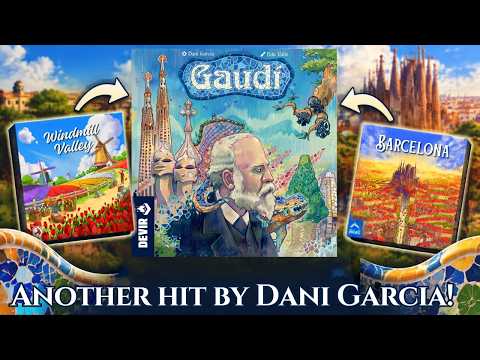
Reviewers describe Gaudí as visually stunning and deeply thematic. The cover art alone has drawn repeated praise for its aesthetic quality, and the game's components appear to honor Gaudí's architectural legacy through careful design. Multiple reviewers commented that the game feels like a celebration of a singular historical figure and their artistic vision, positioning it in a lineage with games like Footsteps of Darwin and Marie Curie that combine historical storytelling with mechanically interesting gameplay. The artwork and production values suggest Devir Games has invested significantly in bringing Gaudí's world to life. Players will spend the game not just scoring points, but gradually building visual representations of Gaudí's mosaic art on their boards, blending strategy with aesthetic satisfaction.
Accessible Depth with Compelling Puzzles
Gaudí appears to land in a particularly inviting weight class. While designer Danny Garcia is known for producing mechanically rich Eurogames like Arboria, Barcelona, and Windmill Valley, reviewers anticipate this release feels slightly lighter and more approachable. The rondel action selection system seems straightforward to explain but offers genuine strategic puzzles: how far to move on the chandelier, which pillar to develop, when to invest in the mosaic. The balancing requirement prevents autopilot play. For players tired of zero-sum conflict-heavy games, Gaudí offers a positive-sum design where your progress inherently creates opportunities without requiring direct opposition to others.
What Makes Gaudí Stand Out
Gaudí as Historical Figure and Game Designer Canvas
Few board games choose to honor a single artist or architect, and none have done so with Danny Garcia's recent track record of thematic depth. Barcelona proved Garcia's ability to layer history into mechanics, using the city's actual urban layout as both theme and strategic element. Gaudí extends this philosophy to the life and artistic philosophy of a singular visionary. Reviewers noted that choosing Gaudí as a subject provides a goldmine of thematic material: the interplay of nature, religious faith, and artistic innovation in Gaudí's work offers three mechanically distinct systems that organically flow from Gaudí's life story. This is not a game that merely slaps a famous name on a generic engine; the three-pillar structure mirrors how art historians and biographers actually discuss Gaudí's creative vision.
The Rondel Mechanic as Narrative Device
The chandelier rondel is not merely a functional action-selection tool; it embodies the concept of moving at one's own pace through different aspects of Gaudí's life and work. Reviewers appreciated how the mechanic creates natural variation in game length and urgency, with faster players rushing forward while others linger on particular actions. This flexibility in turn structure feels thematically appropriate for a game about an artist whose work spanned decades. The mosaic-building on player boards adds a second layer of mechanical depth, transforming abstract scoring into visual progress. Watching your personal mosaic grow as you progress through the game creates a satisfying sense of construction and accomplishment that extends beyond the traditional victory-point tally.
Potential Drawbacks
Anticipation Over Experience
A critical caveat: most reviewed content about Gaudí comes from gaming channels discussing the game at conventions, in preview lists, or as anticipated releases. Several major reviewers explicitly stated they had not yet played the game at the time of recording. This means the community's enthusiasm, while genuine, is somewhat speculative. Early gameplay feedback will be crucial to confirming whether the mechanical systems deliver on the thematic promise, and whether the balancing act between the three pillars creates the intended tension or leads to dominant strategies. Design space is always different in theory versus practice.
Weight and Playtime Uncertainty
Reviewers noted some uncertainty about the game's final weight and playtime. While anticipation videos suggest Gaudí will be lighter than some of Garcia's heavier designs, the actual complexity and table time remain somewhat unknown. If the rondel system and multiple scoring tracks create longer decision trees than expected, or if the mosaic-building adds administrative complexity, newcomers drawn by the beautiful theme might find themselves in deeper waters than anticipated. This is not necessarily a drawback (deeper games have their audience), but clarity on this front matters for correct audience-setting.
If You Enjoy Gaudí
If Gaudí resonates with you, consider Barcelona by the same designer, which shares the place-based historical approach and demonstrated Garcia's ability to weave urban geography into mechanical design. For lovers of artist and scientist-themed games, Footsteps of Darwin and Marie Curie offer similar thematic depth focused on singular historical figures. If you appreciate the balancing-act scoring system where specialization is penalized, Prodigals Club uses a comparable "only count your lowest scores" approach. For the rondel mechanic and painting-like progression of a personal board, Arboria and Windmill Valley showcase Garcia's other work. And if you love games with mosaic and artistic building themes, Alberelli and similar tile-placement designs offer that same sense of gradual, visual construction toward beauty.
What Reviewers Are Saying
"So, this is kind of about the life works uh and art and stuff of uh Gaudi and so, you are kind of balancing — I love games that do this. There's basically three arenas that that dominated Gaudi's life. There was nature uh oh gosh, what art and religion essentially."
— BoardGameGeek
"This is another Catalan themed game after Barcelona. Of course, Gaudi being from that region. It's a game that has kind of a heaven and hell rondel, I believe. So, you're taking a lap at your own pace and stopping and doing actions. And there's three types of points and you're trying to balance them."
— Meeple University
"Basically it's played over three rounds where you'll be working around this chandelier in the center and where you stop you're going to take a variety of actions. And once everyone's gone all the way around, that's the round. So it's kind of like a move, take actions, and play. The visual look of this looks spectacular."
— kovray