We Ranked EVERY Auction Board Game WORTH Playing (Light to Heavy)
Games in This Video
11 games are featured in this video — they unlock as you watch.





Transcript
11 auction games. Every weight class covered from 5-minute fillers to 4-hour epics. This is the genre that refuses to age. By the end of this conversation, you will know exactly which auction game belongs on your table. And which one you should probably leave on the shelf. Here's the thing about auction games. They are unlike almost everything else in the hobby. When you're playing worker placement or deck building, you can hide behind your engine. You can build something private and only really care about your opponents in the abstract. Auctions strip all that away. Every single bid is a statement, a bluff, a calculation, sometimes a flat-out provocation. Right. You are sitting across the table from people who want the same things you want, negotiating the price in real time. That is what makes the category so compelling. The social mechanism is what is driving it, not the rules themselves. And we have played all 11 of these extensively.
Three light games, four medium, four heavy. The lighter ones teach in 5 minutes, the heavy ones take a full evening. Every single one does something distinctive with the auction mechanic. Let us start light. Three games that prove you do not need rules complexity to deliver real psychological pressure. Number 11, High Society. Reiner Knizia design, originally published in 1995, and one of the most elegant card games he ever made. You are wealthy socialites collecting status symbols. 15 to 20 minutes, three to five players, teaches in under 5 minutes. The auction works like this. Each round a single status card flips from the deck. Players bid openly with money cards in denominations of 1, 2, 3, 4, 6, 8, 10, 12, 15, 20, and 25 dollars. You either raise or you pass, and the moment you pass, you are out of that auction, and you take your money back.
Winner pays, takes the card. But here's the rule that makes the whole thing sing. At the end of the game, whoever has the least money in hand is automatically eliminated before any scoring happens. Doesn't matter how many prestige cards you collected, if you bankrupted yourself winning everything, you don't even get scored. Every bid becomes a double calculation. Is this card worth the money and can I afford to spend it without becoming the poorest player at the table? You are never bidding freely. And because money cards are played face up, everyone knows where everyone else stands financially. The pressure is constant.
There's also a beautifully considered deck structure. 16 status cards total. 10 luxury cards that score positive points, three prestige cards that double your total status, and three disgrace cards that reduce it. Four of those 16 cards have a distinctive border. The three prestige doublers and one disgrace card. When the fourth of these bordered cards is revealed, the game ends immediately. That countdown forces decisions and stops the game from outstaying its welcome. The prestige doublers are worth chasing. The one negative bordered card is worth avoiding, and the elimination rule ties everything together. Almost no auction game punishes overspending as elegantly. 25 years later, it still hits. Number 10, For Sale. Stefan Dorra design from 1997, reprinted endlessly.
Probably the most recommended gateway auction game in the hobby. 20 to 30 minutes, three to six players, splits into two phases, buying then selling. Phase one, property cards numbered one through 30 are revealed in groups equal to the player count. You bid in turn order with coins, and to stay in the auction, you have to at least match the current high bid. Players who pass take the lowest available property and reclaim half your bid, rounded down. The winning bidder takes the highest property and pays the full bid. Repeat until all properties are drafted.
Phase two, check cards are revealed in groups and players simultaneously choose a property to sell. Highest property earns the highest check and so on down. Most money at the end wins.
The two-phase structure is brilliant. The first phase makes you care about acquiring good properties. The second forces you to realize that what counts as good depends entirely on what your opponents are holding. You might have the highest property in the game, but if three other players also have high cards, your top card only earns slightly more than theirs. The half your bid recapture rule when passing is the real innovation. Every auction has a soft floor. You can always choose to spend a little to secure something decent. Nobody comes away empty-handed. Everyone stays engaged from first auction to last.
Among short filler auction games, very few have the longevity and cross-group appeal of this one. It just works. Number nine, QE, short for quantitative easing. Gavin Birnbaum, published in 2019. Players are central banks during a financial crisis, bailing out companies too big to fail. 16 company tiles in a four-player game, divided into four countries and four industries. 30 minutes, three to five players. And here's the rule, you can bid anything. Anything. Each player gets a dry erase bidding board and marker. One player is the auctioneer, places an opening bid openly. Everyone else submits a secret bid by writing any number they choose. $1, 10 quadrillion, doesn't matter. The auctioneer reveals who won, awards the tile to the winning bidder, and secretly notes the winning amount on the back of the tile. Only the auctioneer and the winner know what the winning bid actually was. That asymmetry is the engine. At the end of the game, all bids are totaled. The player who spent the most overall is immediately eliminated.
Doesn't matter how many points they accumulated, they are out.
No other auction game in print operates without a currency constraint. The elimination rule is the master stroke. It turns unlimited spending into a recipe for chaos, into a psychological tightrope walk. You're trying to maximize your bids relative to everyone else while staying just under the threshold of being the most reckless spender in the room.
The scoring categories add structure. Sets by industry, by country, by individual company value. Careful players have a target, but every game ends with a story nobody planned.
Now that wraps the light category, now medium weight. 30 minutes to learn, 1 to 2 hours of play. Four games that show what happens when you build real systems around bidding.
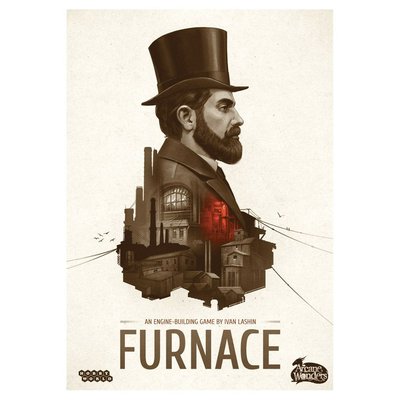
Number eight, Furnace, engine building auction game by Ivan Lashin, published in 2021. You are 19th century industrialists building production chains from raw resources through to converted goods and money. Four rounds, 45 to 60 minutes, two to four players. Each player starts with a company card and a capitalist card that grants a unique ability. Each round company cards are laid out based on the player count. Each player holds four bidding discs numbered one through four. In turn order, you place a single disc on any company card. No player can place two discs on the same card. No card can show two discs of the same value. Continues until all discs are placed.
Cards resolve left to right. Highest disc on a card wins it. Everyone else who placed a disc receives compensation, which is the resource or conversion effect printed at the top multiplied by the value of their losing disc. Lose with a three value disc on a card that produces two coal, you walk away with six coal.
That compensation mechanic is one of the most elegant innovations in recent auction design. Losing a bid is never just losing. Strategically losing with your highest disc can deliver a windfall of resources that fuels your engine for the rest of the round. The tension between wanting to win for production and wanting to lose for compensation, sits in every placement decision. Furnace turns the regret of losing an auction into a viable strategy. In most auction games, the goal is always to win. Here, winning the wrong card at the wrong time is actively bad. You might need oil to run your converter, not the converter itself. Knowing when to deliberately lose with a high disk separates experienced players from beginners. Number seven, Cyclades, mythological strategy game published by Matagot in 2009, designed by Bruno Cathala and Ludovic Maublanc. You are Greek city-states competing to build two metropolises, structures that trigger the end of the game and secure victory.
90 minutes to two hours, two to five players. At the heart of Cyclades is the divine favor system. Each round, one offering space per god is placed on the board. Players bid gold to claim each deity. Five gods. Ares controls military movement and lets you build fortresses. Poseidon builds ships and opens ports. Zeus grants priests who reduce future bidding costs and lets you build temples. Athena gives philosophers and universities, which are the keys to the intellectual path to victory.
Apollo generates income. Only one player can invoke each god per round. You bid openly in turn order, either overbidding the current holder or passing. And here's the wrinkle. Any player who previously held a god and gets overbid has to immediately move their offering marker to a different unbid god. One aggressive bid reshuffles the entire divine economy. The god auction is one of the most interactive economic systems in the medium weight space. Because each god enables a different action, fighting over Ares isn't just about wanting to attack. It's about denying your opponent's military plans while forcing them to take an action they didn't want. Every auction is both a purchase and a disruption. What we love is that Cyclades has no traditional action selection. Everything you do, moving armies, building ships, summoning creatures, has to be purchased through the divine favor auction. No bid, no action. Gold management becomes existential. A player who runs out of gold is locked out from influencing the board for that round. And the mythological creatures available to anyone invoking any god except Apollo add asymmetric power that can swing the board state in one turn. Get the Kraken at the right moment and everything changes. Number six, Nidavellir. Card drafting and set collection by Serge Laget, published by GRR Games in 2020.
You are Elvin envoys recruiting a dwarf battalion to defend the realm against the dragon Fafnir. 30 to 45 minutes, two to five players. Three taverns, each displays dwarf cards equal to the player count. At the start of each round, everyone simultaneously places one of their gold coins face down in front of each tavern. Then everyone reveals. In each tavern, the player who placed the highest coin chooses first, then next highest and so on. Ties are broken by gem value. The player with the higher gem picks first and then the tied players swap their gems. The crucial twist is the coin upgrade system. Each player has five coins, three assigned to the taverns and two held in reserve. If you deliberately bid zero at a tavern, you pick last from that tavern's cards, but you gain something in return. Your two reserve coins are added together and the higher one is replaced with a coin of the combined value from the treasury.
Your coins are never spent. They cycle and strengthen over time. The simultaneous bidding across three taverns is beautifully tense. You're never thinking about just one auction. You're allocating three coins across three competitions hoping to win the tavern with the dwarf you need most while accepting defeat in the others. Every allocation is a gamble. The coin upgrading system is what elevates this above simple drafting. Investing in better coins pays dividends in future rounds, but every round you spend upgrading is a round you are not bidding competitively. Managing the long-term economy while competing for immediate card value is the central puzzle. Simultaneous multi-auction format is rare in this weight class. Most auction games run one auction at a time. Ra runs three. And the fact that your coins are a fixed upgradeable set rather than a disposable currency creates a completely different relationship with your bids.
You never spend a coin permanently, you invest it. Number five, Ra. 1999 Knizia originally published by Alea, reprinted constantly since. Widely considered one of his finest works and one of the definitive push-your-luck auction games in the hobby.
Players are pharaohs of ancient Egypt accumulating civilization tiles across three eras. 45 to 60 minutes, two to five players. Each player holds a set of sun tokens with unique numbers. These are the bidding currency for the entire game. On your turn, you either draw a tile from the bag and place it on the auction track or you call Ra to trigger an auction immediately. Auctions also trigger when a Ra tile gets drawn. When an auction fires, everyone simultaneously reveals a single sun token. Highest token wins the entire collection of tiles on the track. The winning bidder exchanges their sun token for the central sun token that started the round, which has a different value. Players who don't win reclaim their token. Once you've used all of your sun tokens in a round, you're out of that round entirely. The game runs across three epochs, each with a limited number of Ra tiles that can be drawn before scoring. Ra generates exceptional tension from a small number of rules.
The ticking countdown of Ra tiles means every draw could end the era prematurely, saving valuable tile collections or stranding them. The sun token exchange creates a constantly shifting bidding pool. The value of your currency changes every time you win an auction. The central sun you receive might be weaker or stronger than the one you gave up. No two auctions in Ra feel identical. The stakes, the tile mix, the available tokens, all of it is always different.
It is the only auction game on this list where the currency actively cycles. You never gain new money. You exchange old money for new money of unknown comparative value. 25 years in print across multiple editions for very good reason. The mechanics age beautifully because they are built on principles that have nothing to do with novelty. That brings us to heavyweight, four games where bidding isn't a standalone mechanism, but the cornerstone of much bigger systems. You manage economies, plan across multiple rounds, read spatial patterns, negotiate with other players. Longer to learn, longer to play, but the rewards of a repeated sessions are on another level. Number four, Sidereal Confluence, sci-fi trading and negotiation game by Tau Ceti Deikman. First published in 2017 by WizKids. Remastered second edition in 2022. Players control one of nine radically asymmetric alien species in a galactic confederation. Two to three hours, four to nine players. One of the few designs specifically optimized for large player counts where chaotic simultaneity becomes a feature rather than a bug. The auction at the end of each round gives players something concrete to aim their trades towards.
You're trading resources during the negotiation phase specifically to arrive at the confluence with enough ships to secure the colony or technology contract that anchors your next round strategy. Every alien race is asymmetric in ways that change the trading and bidding. Some races produce resources they cannot use and must trade away. Some have converters that need imports other races can supply cheaply. The game almost feels cooperative despite being competitive in scoring because no race can thrive without trading. Playing the Eni Eat feels completely different from playing the Faderan. Number three, Skyrise, spatial auction game published by Roxley Games in 2024. Designed by Adam Wise along with Sebastian Pauchon and Gavin Brown. It is a re-implementation of Pauchon's 2008 Spiel des Jahres recommended game Metropolis, substantially revised and expanded. Players are visionary architects competing to build a magnificent floating city dedicated to art, science, and beauty. 60 to 90 minutes, two to four players. The auction system is unlike any other in the genre. The city board is a network of interconnected neighborhoods, each on one of several floating islands. An auction triggers when a player places one of their numbered buildings on any unoccupied neighborhood. Every subsequent player must then either pass or place a higher numbered building on any neighborhood adjacent to the most recently placed building. The auction snakes across the city map. Each bid not only claims a value, but stakes out a position on the board. When all
remaining players pass in sequence, the final building placed wins that neighborhood. All other buildings placed, but not winning, get returned to their owners. In the second era, each player gains access to a single wonder building that can be played to win any current auction outright. The spatial dimension is what elevates this above a conventional bidding game. When you place a building, you are not just making a bid, you are choosing a location that dictates where the auction can go next. You can intentionally drive an auction toward a neighborhood your opponent desperately needs, forcing them to either spend a high value building or let you claim territory adjacent to their scoring cluster. All scoring conditions are visible to all players throughout the game. The board tells a running story of who is winning and why. You can see the auction being used as a weapon in real time. The modular board creates a different city layout each game. No strategy dominates across sessions. The wonder building injects a beautifully timed wild card. Used too early, it wastes its power. Saved for the right moment, it steals a neighborhood that defines the outcome.
Number two, Rurik, Dawn of Kiev, Euro-style realm-building game by Stanislav Kordonskiy, art by Yaroslav Radezky, published by Peacekeeper Games. Set in the 11th century Kievan Rus following the death of Vladimir the Great in 1015. Players are competing successors to the throne. 90 minutes to 2 hours, one to four players. Rurik uses a mechanic it calls auction programming, one of the most original action selection systems in recent design. At the start of each round, players openly bid their numbered advisors onto a shared action board. The board has columns for each of six action types: muster, move, attack, tax, build, and scheme. Advisors stack in descending order within each column, highest at the top. And here is the core tension.
Advisors with higher numbers deliver stronger versions of their action, but advisors with lower numbers resolve first. Placing a low advisor means a weaker action, but you take it before your opponents. Placing a high advisor gives you the most powerful version of the action, but by the time it resolves, the board state has shifted under you. Auction programming creates a planning challenge that standard worker placement cannot replicate. In normal worker placement, you know what action you are taking when you take it. In Rurik, you are committing to a sequence of actions in the auction phase with no certainty about what the board will look like when those actions resolve. Your perfectly laid plan can unravel because a lower value opponent advisor resolved before yours and moved the army you were counting on. It is a brain-burner in the best sense. Highly interactive, tactically rich, and constantly surprising. Comparisons get drawn to Scythe because of the Euro plus area control blend, but Rurik has considerably more direct conflict and a more pronounced bidding spine. You earn points for regions controlled, adjacent buildings, resources accumulated, and warfare success. Multiple viable paths to victory, but everything runs through the auction.
Number one, Through the Ages: A New Story of Civilization. Card-driven civilization game by Vlada Chavacho, originally published in 2006, revised into its definitive form by Czech Games Edition in 2015. Consistently ranked among the very highest rated games in the hobby. Players lead civilizations from antiquity through the modern era. 3 to 4 hours, 2 to 4 players. One of the steepest learning curves out there. The auction operates through the card row. A shared draft of civil cards representing leaders, wonders, technologies, and actions. Cards enter at the far right and slide leftward each round. The cost is determined by position. Cards in earlier positions, closer to the discard end, are cheaper because they've been available longer.
Players spend civil actions, their most precious currency, to take cards from the row. The further right a card is, the more it costs because it is newer and more desirable. Separately, players draw military cards from the military deck at the end of each turn using any military actions they did not spend. These military cards represent events, aggressions, and tactical maneuvers that can be played against opponents. The tension between developing your civil engine and maintaining military readiness runs through every turn of the game. Through the Ages delivers a civilization experience no other card game replicates at this level of depth. The card row creates a running public negotiation about value. A card nobody wants becomes cheaper every round. A card everyone wants gets taken immediately, regardless of cost. Every era shifts the relative value of every card type. A technology that seemed expensive in antiquity may become essential in the modern era when its upgraded version appears. Leaders appear once and they are gone. That creates moments of urgency around the bidding that feel unlike anything in lighter games. Some of our most memorable plays have come down to whether someone could afford to grab a leader at the moment they appeared. What distinguishes this from every other game on this list is scale. The auction isn't a scene, it is the stage on which an entire century-spanning narrative plays out.
The military event system, which allows players to attack and raid each other through military card plays, adds an aggressive layer to what could otherwise be a pure economic puzzle. Civilizations that neglect military investment leave themselves exposed to events that drain their resources and culture. Managing the tension between civil development and military readiness, all while competing in the card row for the cards that enable both, is the central experience. No auction game produces richer emergent stories across a full game arc.