Board Game Interaction is Stupid
Games in This Video
9 games are featured in this video — they unlock as you watch.







Transcript
Something has happened over the years, like your favorite fast food burger getting progressively smaller, or everything at Tim Horton starting to taste like roadkill. Interaction in board games has fundamentally changed. It's gone from robust and interesting to tepid and unexciting. And that shift has been so gradual that many haven't even noticed. Or worse, they've convinced themselves it has always been this way. In short, contemporary board game interaction is stupid. Consider Katon. Every mechanical element of this game is perfectly tailored to maximize interaction at the table. On your turn, you roll the dice and instead of simply providing resources for yourself, those resources are dispersed among everyone holding buildings on those numbers. Once you've collected resources, you start trading, making offers to those who can benefit you, emphasizing a collective experience that extends beyond simply doing your own thing. Finally, you build, which opens up yet another avenue for interaction, blocking routes, stealing the longest road, cutting off expansion paths, all that. And we haven't even discussed the robber. Every part of that game is designed to make players engage with one another at the table. And all of that interaction, it was not anomaly at the time because in the late 90s and early 2000s, most popular hobby games were similar. Al Grand, Tigers and Euphrates, Samurai, Takal, Carcazone. The big names that stood the test of time were built entirely around player engagement and interaction.
Player interaction can mean a lot of different things to different people. But I think we could break it down into three categories that act as an umbrella for the smaller mechanical ways players engage with each other. Destructive, contentious, and symbiotic. The most familiar is destructive interaction. This is what most people think of when they think of competitive tabletop gaming. Players actively removing or undermining what other players have built. In chess, I'm trying to gain a stronger position and remove your pieces from the board so that I can capture your king. Or miniature gaming, where I structure my entire army for the primary purpose of defeating your army. For the longest time, this was the default assumption of what competition looked like in a tabletop game. In order to win, I have to destroy you. On the opposite end of the spectrum is symbiotic interaction where your actions produce benefits for your opponents whether you intend them to or not. This is a very broad category since I'm lumping in at trading, negotiating, cooperating, and shared incentives.
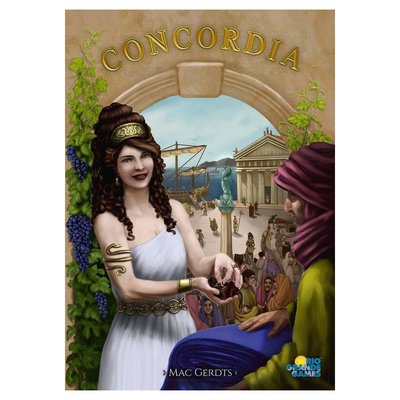
Concoria is the perfect example. You're navigating this map and placing trade houses on various regions. And when one player activates a region, everyone who has built a trade house in that area receives resources. The design asks you to weigh the benefit you're giving your opponents with your own personal gains, which I think is a beautiful way to keep everybody engaged on everyone else's turn. But the most common form of interaction today, at least in Eurogame, is contentious interaction. In the mid '90s, Germany experienced a surge of board games that became incredibly popular. And with them came an interaction type that was less it was less hostile and more subtle in its engagement. Consider Samurai. Despite the thematic suggestion, you're not rampaging through feudal Japan, massacring people with katanas. You're laying down tiles on a map and surrounding various tokens in the hopes that you outnumber your opponents and claim those tokens. It's a little less destructive, but you're still deeply engaged with others at the table, doing your best to undermine and anticipate the actions of everyone else. Which brings us to our bonus category. The one I'm not sure I count as real interaction at all and the one that has quietly over time become the most dominant mode of modern gaming. Parallel play. If you're unfamiliar with parallel play, it's a stage in a child's development where kids play beside each other with similar toys but don't directly interact. It acts as a social bridge between independent play and cooperative play and acts as a foundation for interaction for developing children. I was going to film this part with a bunch of kids around just because it felt like it made
more sense, but a middle-aged man filming in the park with kids would lead to some destructive interaction with the local police. Now, I'm certainly not suggesting that meaningful interaction has vanished completely. Old King's Crown was one of the biggest releases of last year, and Arcs was the year before that. But these games have grown few and far between in contemporary design. And I think a big part that drives the popularity of these titles is their rarity. At some point, Euro design stopped asking players to engage with each other and started asking them to engage with the game itself through parallel play. You have your tableau, your engine, your personal board, and I have mine. We occasionally brush against each other over a shared supply or a contested action space, but for the most part, we are each solving our own puzzle. The score comparison at the end isn't really a product of our conflict.
It's a product of our efficiency executed in isolation. So, how did we get here? As with most things, there isn't a simple answer. It was a combination of mechanical evolutions, social changes, solitary play, and market pressures. Each providing their part to slowly dilute what constitutes meaningful interaction in board games over time. One of the biggest changes board gaming has seen over the years has been the explosion of engine and tableau building games. You play a card into your tableau knowing it's weak now, but given time and smart decisions, its potential grows exponentially, rewarding your patience with a cascade of resources and actions that compounds turn after turn. It's deeply satisfying in a way that feels like this awesome accomplishment. When you look at older games like Katon or Carcazon, there really isn't much differentiating your first turn from your last turn. You gather, trade, build, but there's no real acceleration.
Then Puerto Rico, Race for the Galaxy, and eventually Dominion hit the market, and all of a sudden, engine building and tableau building become the predominant design mechanics. In fact, 42% of the top 200 board games on Board Game Geek feature either Tableau or engine building, and many of which have very tame interaction. The appeal is obvious in retrospect. It's enjoyable to piece together an intricate resource generating machine and enormously satisfying when it reaches the apex of its power, which is precisely what makes destructive interaction so threatening in this context. When an opposing player tosses a wrench into your perfectly constructed gears, it feels like it invalidates every turn you made to this point. And so the reduction of that interaction wasn't some unknown side effect of engine building. It was an attractive feature promoted and embraced as a means of protecting a player's investment and keeping the fun intact.
Would Race for the Galaxy work if you could militarize someone else's planet? Would Puerto Rico be as successful if opponents could burn down each other's sugar mills? Of course not. Personal growth and the freedom to execute your plan without the constant threat of someone dismantling it was something a growing audience wanted from their time at the table, which meant less destructive interaction. Think back on early hobby board gaming. The market was primarily catering to dedicated hobbyists, people with time, commitment, and a full table of equally dedicated friends. Games from that era tended to be long, rewarded aggressive play, and worked significantly better at four or more players. They embraced a nerd culture that demanded real investment. But the audience, they grew up, they got married, they had kids, took on jobs that left them with considerably less time and patience for a 4-hour fantasy flight brawl on a Friday night. Organizing a game night gets a lot easier when it's just you and one other person. Which explains a lot about the explosion of the two-player market. A space that outside of abstracts and war games was barely served before. It has since become so dominant that I'm fairly certain it was recently codified into law that every board game must inevitably have a dual version. And then there's cooperative gaming. Before pandemic, cooperative games were relatively sparse on hobby shelves. But by the mid 2000s, the allure of joining forces to beat the game instead of one another grew rapidly. You don't believe me? You can take a look at this chart. It is insane
the amount of cooperative games that have sprung up in the last 10 years. Whether this reflects a welcoming of new audiences or an adaptation to existing ones, publishers gave people what they wanted. And what people increasingly wanted was less direct confrontation and more individual control, whether through a personal board or carefully constructed engine nobody else can touch. Newer games are increasingly designed so that players feel good even when they lose. That matters to a lot of people, but something has to give. Cushioning failure produces more forgiving designs. And whether that's a worthwhile trade depends entirely on what drew you to the table in the first place. The diversity in both games and audiences is generally a good thing. Both are significantly larger today than they have ever been. But if you're an old chromagin like myself, it can feel like the ground shifted under your feet.
Sure, my preferred style of high interaction gaming, it didn't disappear. It just diminished and got buried under an avalanche of games that treat interaction as lower priority than protecting a player's ability to solve a puzzle sitting beside other players. Flip over the box of almost any board game released in the last 5 years, and I promise you'll see a one in that game's player count range. It wasn't long ago that solo board gaming was barely a footnote in the hobby. Now, it feels strange when a game doesn't include some way to play by yourself. Of the top 200 board games on Board Game Geek, 52% support solo play. I'm not saying this is a bad thing. I I enjoy playing by myself. It can be genuinely relaxing and a great substitute when friends are busy. I even released a solo board gaming documentary that followed my journey into this side of the hobby. But I do wonder whether a publisher deciding a game should support solo play quietly shapes the design process. Because replacing a human player, it's not a trivial problem. Other players brings something to a game that no methodical series of steps performed by the game itself can fully replicate. And when you remove those players, you have to fill the space with something. And what designers have reached for to fill that void is systems, automation decks, bot opponents, event cards, mechanism that simulate the presence of another player through scripted behavior. And in building those systems, you almost inevitably simplify the game's interactive space. A game that needs to function with one player cannot rely on other players as its primary source of
tension. The most telling evidence isn't the existence of solo modes themselves. It's how little many games change when you add them. When a designer can bolt a solo mode onto a finished multiplayer game with minimal modification, that tells you something important about how interactive that multiplayer game actually is. If the bot only needs to occasionally take an action space or advance a track, the game was already playing like solitire. Compare that to trying to design a solo mode for any early fantasy flight game like Game of Thrones or an early Euro game. It's essentially impossible because those games were designed from the bottom up with all three methods of player interaction in mind. And that human interaction is something I desperately miss in most games today.
I hate to admit it, board games are a product, and products need to sell, which means a game needs to be easily teachable, accessible to firsttime players, and digestible enough that a reviewer can assess it after a couple of sessions. Design decisions are absolutely being shaped by whether the end result will generate favorable reviews. Because positive reviews, they drive sales. And if you can convince someone who has only played once or twice that the game is worth the praise, that is a commercial success regardless of how it plays on session 30. And where are most of these first impressions being formed? Increasingly in public. When we went to Gen Con, it felt like the entire city had been conscripted into playing board games. Every bar, restaurant, warehouse, farmhouse, hen house, outhouse, and dog house in the surrounding area had copies of the latest releases at their table. And that's just one convention. Board game cafes have exploded across North America over the last decade, taking the hobby from the private spaces of people who know each other into the public spaces full of strangers. That matters because it's far more socially acceptable to poke and prod people you actually know than to do the same thing to complete strangers. I'm far more comfortable blocking a friend's train route and and pointing and laughing at them than doing the same thing to someone I just met.
Although that might simply be because I'm a bad friend. Games with a personal board is favored are simply more comfortable in public spaces. It's far easier to focus on your own actions than to look across the table at Joe you met 40 minutes ago and try to read whether he's going to attack your region next turn. And more importantly, at least for the publisher, will Joe leave the convention demo feeling good about the game? Will he recommend it? Will he buy it? If he's constantly being attacked and his play experience is bad, he might not do any of those things. A lot of high interaction games don't just benefit from familiarity with other players, they functionally require it. Cosmic Encounter's powers are deliberately unbalanced, and the whole experience depends on negotiation, alliance building, and ganging up on whoever is ahead. None of that works cleanly with strangers, and a game that tanks with an established group is a real commercial liability when your primary marketing strategy runs through convention floors and content creators. These days, the game needs to function like a fast food chain. The burgers in California need to be the same as the burgers in Prince Edward Island. And the biggest obstacle in board gaming to that consistency is high player interaction where one person can potentially ruin the experience for everyone else at the table. I understand that interaction in board games hasn't disappeared. The market is so massive now that there are more games of every taste than ever before and that's generally worth celebrating. But it does feel as though the player engagement I remember from years ago has slowly been
diluted, replaced with something that looks similar from a distance, but feels completely different when you're actually sitting at the table. The market grew, the audience changed, new mechanics took precedence, people started playing with strangers, and somewhere in all of that, the importance of having people actually engage with one another, more than the puzzle sprayed across the table, quietly got deprioritized to the point where forum threads on Boorgge Geek will now debate endlessly about how the latest family-friendly worker placement game is deeply interactive because you can take someone's spot on the board that maybe they might have wanted. If you don't believe me, go back and play those older games. Tell me it doesn't feel different. Tell me you don't feel that every decision you make depends on the actions of the people sitting across from you. Tell me you don't walk away from those games feeling like the people at the table were more than just the sum of their final scores. Was this simply an old man yelling at the clouds? Maybe.
Or maybe you agree. And I'm not crazy. Either way, let me know in the comments. Videos like this are always a good platform for some generally interesting discussions. And what better subject for that discussion than interaction. Thank you so much for watching. Be sure to like, comment, and subscribe. And if you can consider supporting us on Patreon because every little bit helps. Or just buy the merch, increasing the interaction between you and I by by giving me more money. Bye, guys. Praise the sun. Brace the sun.
Where am I going? I don't want that. I don't like this thing. This monitor sucks. and bread.