Eric Summerer's Top 100: 20-11
Games in This Video
10 games are featured in this video — they unlock as you watch.






Transcript
Hi, hello and welcome to my top 100. Boy, are you in for a treat.
Okay, hi. I'm Noah, Eric's eldest. Uh, you've been seeing me across the series. Um, I'm hijacking this episode. It's numbers 20 through 11. Dad had an intro planned, but he's at Dice Tower East right now and I'm stealing this episode. Um, so I have some unbridled beef, um, with Dad. Uh, as some of you may remember, 3 years ago, um, he had me do some musical intros. Um, and the one for number 85 had a kazoo solo and he didn't let me do it.
No.
No.
What?
Enough. It's long enough already.
Okay.
So, I'm taking it over this time. We're doing numbers 20 through 11. 10 new musical interludes and that's right. This time it's a cappella.
Duh, duh, duh, number 20 is the first one we have on our list today.
[singing]
20 is a game that I have played. And when Dad first taught it to me, his hair wasn't quite as gray. Number 20 is the first one on our list. Number 20 is the first one on our list.
Number 20, Tiny Epic Galaxies.
Remaining in the top 20, it's Tiny Epic Galaxies. Tiny Epic Galaxies is my favorite of the Tiny Epic series. Uh, Got this nice sleeve that keeps the expansion content together. Um in Tiny Epic Galaxies, you are I guess colonizing planets. You're trying to acquire them into your tableau. You are rolling your dice. At the beginning, I think you start out with four. You can eventually get five or six dice, or maybe it's even five, six, seven dice. I think that's the max. So, you were leveling up your civilization through resource collection uh and getting to to then you roll more dice, get more stuff. Uh you have two different resources. You've got a culture points as well as the other currency that I'm forgetting now. Um but those culture points allow you to follow other people's actions.
So, I take my turn. I have all sorts of joy. I'm colonizing planets. I'm moving up tracks on the different planets. There's two different ways to move up those tracks as well. There's an economic track and then there's a diplomacy track. Uh certain symbols will have you moving up those tracks and whoever gets to the top of the track on each planet then gets to acquire that planet. Now, you can do stuff with with that and and prevent other people from getting it and scoring those points. But on somebody else's turn, they can, when they say I'm going to use this economic symbol, if I have culture, I can follow and say, "Oh, I'm going to do culture, too." And so, they're trying to maybe race me for a particular planet. And every time they move forward, I go, "Yeah, I'm going to move forward, too."
If I have the culture points. So, making sure you have a few of those in your back pocket to make advantageous moves is sort of the key to Tiny Epic Galaxies. And I I love that. Just being able to pay attention on somebody else's turn, swoop in at the last moment or an opportune moment. They might think I'm going to spend my culture on a particular thing. No, I'll wait. And then I instead spend it to get a whole bunch of resources on their turn. So, I'm ready to have a powerful turn when it gets to me. Good times. In a very small package, there is also a ultra tiny Epic Galaxies where the the cubes or the dice are now just standard wooden cubes. It's a very tiny box. This is small enough, really. Number 20, Tiny Epic Galaxies.
[singing] [singing]
[singing]
Number 19, The Elder Scrolls: Betrayal of the Second Era.
Debuting at number 19 is The Elder Scrolls: Betrayal of the Second Era. This is a game from Chip Theory Games. This is the lid of the box of The Elder Scrolls. The full box is up here and it actually doesn't live in a state of full boxishness because it's sort of set up for an adventure. The The game fits in the box if you fully pack it up, but if you've set it up so that all of the cards and the characters and all this stuff are ready to be played in a particular adventure, which it is for our set right now, it doesn't quite go together the way that you're supposed to. But I I do have a few things. There are a ton of storybooks in this game. Each of these is a region in the game.
And so you're going to have you pick where you're going to explore, um, and that's the map you're going to use and the adventure set you're going to use. These will explain what towns you can visit, what encounters you're going to be finding, um, as you you work your way through. Um, here is here's a map of Skyrim. Uh, and so I'm going to be moving around based on my scenario, where where am I going to be trying to, uh, get to before the bad guys? Perhaps I need to go to a particular town and make something happen. Um, and then once I am doing something, I'm I'm now pulling out these neoprene mats, uh, that go in varying combinations, um, to create a scenario. And then I'm fighting. Um, and those fights take the form, as many Chip Theory games do, in the form of characters that are represented by stacks of chips. So, I've got my character chip and then I've got a certain number of chips below it that represent my health points, my HP, uh, and same with the bad guys. And so I'm going to be attacking them and doing stuff with them, which then reduces the number of chips below them.
Um, my character is represented by a mat, uh, that has docked dice, skill dice, uh, tons of different dice in this game, um, which then can be rolled and activated and spells and abilities and attacks and all sorts of stuff. There's a ton of different races and, uh, specialties and action dice and stuff. I can start out with just one basic attack. Then I go to a town and I train and I learn a new ability and now I'm getting new dice in that. But there's also this op- oppositional system on your your mat as you are building your character and putting dice over here. If I have another ability over here, I also want to earn dice over here, but now I can't I can't build both of them to the max.
So, I'm going to have to give up something on this side in order to build this really, really well, and that offers choices. Um it you are progressing your character very quickly in this game because the whole thing is designed to be a three-chapter campaign. Uh you do one adventure session, second adventure session, third adventure session, you are done. You will start over again. This isn't one of those games where you're just doing the same character for 65 adventures. It's three. Three and then you're done, and now you can re-roll a new one. Get get somebody new to do. There's still lots to explore, but you're not doing it with the same character, and I kind of like that. So, the it's an accelerated development of the character you have in order to reach that end point, and then you get to do it all again.
I like that. Gorgeously produced, so much to explore. There is an expansion, I think, uh that's coming that I really don't need yet cuz there's just so much that we're already exploring in here, but I am delighted by this one. Number 19, The Elder Scrolls: Betrayal of the Second Era.
18
18
[singing]
18
18
18
Number
18
18, [singing] and that is much
much older than that.
Number 18.
Number 18, Unlock.
Still hanging out in the top 20
at number 18 is the Unlock system of adventure games. Uh Unlock uses a card deck. Um you've got a particular scenario. They started out with these single deck scenarios, um like this one here that's, you know, no side story. They'll one one adventure in this little thing. They've since packaged them into triples. Uh they now have the the big boxes that um have multiple adventures um in varying difficulty levels. I think most of the box comes uh boxes come with a one, two, and three star difficulty level. Uh, you can get all sorts of wacky themes, Sherlock Holmes, there's a couple that are video game themed, uh, some, you know, racing uh, adventures. There's even one that's based around board games. You can get it's a I think it's a Pandemic, Ticket to Ride, and uh, what's the last one in here? I should pull it out and and look at it. Why not? Why not look at it? Um, it is an Escape Room adventure that uses the deck of deck of cards. Um, here we go. It's Pandemic, it's Ticket to Ride, and it is Mysterium. That's the third one in here.
Deck of cards, uh, often you are combining items. Uh, so I have, for example, a key that's number 14 and a lock that is number 10. If I put them together, I now I'm looking for card number 24 in the deck and if I'm correct, there is something on number 24 that says, "Yeah, you did it. You unlocked that door." Discard those things and you move on with the adventure. Um, there is often an app integration that goes with this. Sometimes puzzles involve the app as you're you're moving around. Unlock is a non-destructive uh, system, which is why I have all of these still as opposed to the Exit system, which is uh, destroyed as you go. So I've been able to pass these on. In fact, that's one of the holes in the shelf is that I've passed on a box to friends uh, to check out and and play those adventures and then they come and visit and we we trade things out. Swap them out, much like a library. Um, I I just really appreciate the Unlock. Um, it it brings to mind the old click and or point-and-click adventure games that I really like. Um, and then all the different themes with varying levels of complexity. Uh, I've had a lot of fantastic memories playing these Unlock games. And at this point, I could probably go back and play some of those original ones, like these guys. I've have forgotten what they all do.
I should do that. Unlock, if you're looking for an escape/puzzle adventure game, you can't go wrong with an Unlock Box. That's why it's number 18.
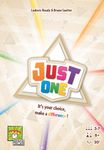
Even though he's 48. Number 17. Number 17, Just One. Just One has moved up to number 17. Uh it is probably I'd have to look at the list, but I think it is my top-rated party game. I think that's definitely true. Just One has you giving a single-word clue to the active player to try and get them to guess the word that they need to guess. They've got a card that's got five possibilities on it. They're like, "Uh give me number two." And everyone now has to give them whatever number two was. So, in here it was chocolate on this card. So, you have to give a one-word clue for chocolate.
However, if you give the same clue as one of your teammates, you are going to lose that clue entirely. Those clues are eliminated from contention. You will not show them to the guesser. They don't get to see it at all. So, if you've matched multiple words, they might only see one or two words to try and guess their clue. So, you have to give a clue that is unique enough that it won't get knocked out, but also a good enough clue that the person can guess what it is that they're looking at. And you're trying to score as many of these words as possible. There is a scoring system, but a lot of people don't play too strictly to the scoring system in Just One. It's just fun to go through the activity and see see how well everybody does. Um it's super easy to explain. It works for just about any group of people. The hardest part about this is just getting the dry erase pens to work.
And there are ways around that. In fact, I think new editions use a wax pen or something like a chalk pencil. They use a different system than than the version I've got. Anyway, Just One is a delightful party game. I highly recommend it to anyone who is looking for a group activity for a group of seven people or so. You can even have people jump in and and assist. You know, you can do one of those double chairs. I'll sit in be on your team. You can do that with this game without too much trouble. Um I've played this on stream online and it's worked out really well. Just One, delightful. Go get it if you don't already have it. 17.
When you play [singing] this game with dad, here's what you should do. Spend all of [singing] your resources pushing him into pits and yes, he'll surely beat you, but that will be okay. Pushing dad [singing] into pits is the way to play.
Number 16. Number 16, Robo Rally.
Robo Rally has seen some advancement this time. It's all the way up to number 16, having traveled around recently. Looks like it was at 45 last time, but not that long ago, well, maybe a long time ago. In previous editions, it's been in the top 20s, top teens. Part of the reason why it has made a resurgence is due to this new edition, which involves the Transformers, which I find to be a blast, but also the original Robo Rally has seen a resurgence. Oh my goodness, this is heavy now. Um in the new edition of the game from Renegade Studios. Um it turns it into basically a deck-building game, um which which offers some interesting usage of the uh the damage system. When you take damage cards, uh it it sort of goes into your deck and then comes out as messing with you later. Um Robo Rally is a programming game. You are trying to get from flag to flag, tagging the flags in order to reach the end of the course before your opponents. Uh in the process, you're going to collect all sorts of weapons and methods of messing with your opponents. You're going to push people into pits. You are going to fully plan out your perfect program, and then you're going to get pushed onto a conveyor belt and not be able to do the thing you thought you were going to do.
Um that delicious chaos is what this is all about. Uh at this point, the reason why this is so heavy is I have collected I think this fourth version of Robo Rally that I have acquired uh over the years, and the uh boards, other than one exception from 2016, the boards are compatible with each other. And so, you can uh drive around on giant maps. Don't do that. You it's going to last forever. You you can just pick and choose. Pick and choose a few boards and a few flags and just go on a delightful smash-'em-up adventure, whether it's the original with Twonky or the uh newer edition with Optimus Prime. Robo Rally's a blast. Number 16.
And now, a message approved by 15-year-old me.
Daddy's old. He's old.
Number 15.
Number
15, Apiary.
Apiary debuts at number 15. And if you've been paying attention, uh especially since we just talked about Wormspan last time, this really means I just like Connie Vogelmann. Um Connie uh designed Apiary, but was also uh the designer of Wormspan. Um and I both of them are are in the top 25, which is is pretty solid. Um Apiary is a game about space bees. Uh you have a colony of bees and you are trying to expand their little hive board by placing little hex tiles on them. Um the main mechanism involves worker placement uh with these upgradeable bees. Uh these lovely little bee ships um that start out at level one, maybe level two, and and then will upgrade as they go. You place them out on the board, they get to do cool things, and then when they get bumped off or you remove them, they upgrade, get stronger.
Eventually, they become level four bees and they get special powers and abilities and bonuses. But then they have to retire, they hibernate, uh and they get removed. And now you need to get a new bee, uh new bee ship at level one, and get a mechanism for causing that churn to happen. Uh which also triggers the end game as more and more bees retire and claim some uh bonus spaces at the end of the game. Um that will cause the the end of the game to happen. Lots of variation in the setup of the different hives. Um lots of cool ways to earn those points. Uh you've got like end game scoring tiles. There are certain actions that can only be done with those level four bees. And so you have to time that uh activation at the right time. But at the same time, if I don't if I use a bee uh four bee over there, then I won't be able to use a four bee over here this bonus, which is also super beneficial to me. Um lots of cool ways to to make my colony the best it can be. Plus, there's a giant queen bee uh space exploration mechanism. That space bees.
I could have just stopped there. Space bees. Apiary number 15.
Easy flow show, juicy info. Dad doesn't know that we're doing this. Also, he is really old and it's time for the top 100. Juicy info 14.
Number 14, The Seventh Citadel.
The Seventh Citadel. Citadel! Debuts at number 14. Uh this is an adventure game that is super dense. It's all uh using this card system um where you have everything is cataloged with these numbers. Let's see how far I can dig down here to show you. Um Oh, no. All my notes. Everywhere. That's probably not good. Um Seven Citadel has you beginning with a uh a plot a scenario book. One of these, like this one right here where my bookmark is in that I hopefully didn't knock out of position. Um you begin on a tile and uh you have a little adventure and that sort of gets you started. But then you're going to venture out into the wilderness and there are tons of cards just floating around in there. Uh and so you'll explore this tile. Uh it has something interesting over there. Let's see what it is. And I sift through here. I successfully explore and I uh now see what's over here and there might be a little hidden secret on a tile that looks interesting.
Or I've just learned that over in this distance there is a tree that is going to have an item I need for a future goal. Um and the map the board just gets more and more dense and uh and and and you've explored more stuff and what This is the map. I've barely explored this game. I've only explored these parts. Look at all these other pieces. There's so much stuff. Whoop. There's so much stuff to explore in the Seventh Citadel. Uh but not only that because this is a continuation of the system that began with the Seventh Continent, which isn't on this list. What makes the Seventh Citadel work for me is this deck building concept that represents your character and its ability to achieve its goals, to overcome its obstacles and you are gradually adding more and better cards into that system and making it easier for you to overcome stuff and um I I really like that. Um and and how your you can it's possible to add and remove players from the campaign. You'd sort of just hand off your group equipment in order to uh continue the adventure without the full complement or by adding people just for one adventure. It is pretty easy to do that. So many secrets in this box that I have barely scratched the surface of but I love the exploration of this game. Um just what could be around the next corner and you'll note there are a
couple of exploration games on my top 100 including one that's on the horizon just out of reach. The Seventh Citadel number 14.
[singing and music]
Number 13, Power
Grid. Number 13 is Power Grid. It's been on a bit of a journey. Power Grid was in my top 10 for a while. It fell a little bit last time, but it has had a resurgence because I think last Father's Day, I pulled it off the shelf and decided to play it with the kids. They hadn't played in a while. And I just rediscovered how much I love this game. Freedom and Freeze masterpiece. Power Grid has you building an electrical network across some sort of map. There are so many expansion maps. In fact, this is all expansion maps. It's just solid cardboard. You build this network. You have to pay for it and block off your opponents. Make sure they can't expand as usefully as you do. You are buying power plants that become more efficient as the game goes.
Those early power plants are terrible. You're burning all sorts of garbage and coal and you're powering one or two cities, but later on, you can power five, six, seven cities with whatever you've got going on. There is a resource market that is so delicious. It continues to be used in other designs of Freedom and Freeze like Fayum uses a similar market system to to Power Grid. So much fun. And and ways that you can mess with your opponents, getting in their way, buying up the resources that they want, getting into the trash market when they were the only ones in it at a particular moment. It's also got an auction mechanism where you can make people overpay for that solar panel plant, wind plant that they really really wanted.
I adore this game and I'm so happy that I've had a chance to bring it back and get to teach it to folks at conventions who maybe hadn't played Power Grid at all. That's that's been a blast as well. I have uh, original game. I've also hung on to Outpost. I think it's just different enough uh, that it offers some interesting new challenges. Power Grid, I am delighted to say, is working its way back up there at number 13.
Number 12. Number 12. Number 12. Dad had a cringey haircut
[singing]
back when he was 12.
Number 12. Zenith.
Debuting at number 12 is Zenith. Zenith is a two-player, although it can be a four-player game, tug-of-war using planets that you are pulling discs toward you and your opponent is pulling those discs toward them and acquiring a certain number of them is how you win the game. You can get just five of anything. You could get four different colors or three of the same color in order to win the game. The way you draw these tokens toward you is by playing various cards and they have all sorts of different abilities. Almost every one is going to bring one of those colors toward you. You have to pay for these cards. You need to have an engine for getting money. Uh, but then they're also going to do other stuff like pull other planets toward you, take stuff from your opponents, get you more things based on how many of another color you've got. Tons of different abilities that go with these cards. Adorable animation. They look very anime-inspired, but this art design of these characters, each card is a character with a name. They come in different factions. Um, there's also a technology track that if you ignore, your opponent is going to be getting all sorts of abilities that you just won't be able to keep up with. Um, there's also some actions that are going to earn you uh, like a leadership token that increases your hand size and that can make all the difference. If all of a sudden you have a lot of cards to choose from, you may be able to find exactly what you're looking for. I really enjoy this. You can play it on Board Game Arena, try it out. Um I have played a
lot of it there. Um but the pieces on the physical version are also really cool and chunky and tactile and I I just want to pull that Venus token toward me. Ah, it's so much fun. Number 12, Zenith.
Kazoo solo. Yes. Four.
Number 11.
Number 11, Slay the Spire the Board Game.
Number 11. Slay the Spire the Board Game. Just missing the top 10, but definitely debuting in a place of honor. This is another board game based on a video game uh that I haven't played. I've played maybe a little bit. Um the video game is a digital deck building game. This is also a deck building game that allows for cooperative mechanisms. You can play with up to four adventurers here. Uh you're going to work your way through a branching path, much like the video game. You're sort of working your way up to a boss that's at the top of the uh the path. You have your character deck uh that starts out basic. But you are then going to add cards to it as the game continues. Um you will constantly be presented with new cards uh that you can then choose to put into your deck, making you more powerful. Um each of the characters is slightly different. They have special abilities, all that stuff that you would expect.
You can help each other out in really cool ways. Uh I might be facing a whole lot of damage coming my way, but I don't have a ton of uh defense or attack power to reduce that right now. Somebody else can say, "Ooh, I've got an easy job. I'm getting rid of my guy really fast. I can help you out. I can attack. I can reduce their attack. I can do something to help you right now." So there's definitely a sense of help and then being able to do something about it. The really cool thing is that this is use that rogue-like mechanism where cards, as you do better as you complete more tasks, as you've played more, more cards are going to get added into the system, not necessarily into your deck because you always start with your starting deck. But now there are more and cooler cards in your possibilities for those rewards, both epic rewards and standard rewards. And those cards can be upgraded. So during the course of the game I can upgrade a card flipping it around in my in the sleeves. There are sleeves that are included in the game.
And it gets flipped and now it's a more powerful version of that card, maybe with fewer downsides or it's just stronger right off the bat, has a lower cost. And now my my deck is getting better. But you're constantly getting new things to explore because you're unlocking new cards to go into the system in the first place and now you're churning through those rewards more quickly and and just adventuring away. My youngest is a big fan of this one.
You know, this is my favorite game that we've played this year. I'm kind of sad it didn't make the top 10.
And we have since backed the the upcoming expansion where you can play as the bad guys and face the good guys as the big bosses. Wasn't originally going to do so, but um then we played a lot of this and it it became a priority, let's say. Number 11, Slay the Spire.
Why didn't you put Mice and Mystics on the top 100, Eric? Yeah, have you no care for the memories with your 5-year-old son?
Well, guys, uh I get I should have put it on the top 100. I was so wrong. This list is rigged.
Hey, I'm home from Dice Tower What's going on?
Uh Look, none of this would have happened if you had just let me do the kazoo solo the first time.
What?
Hey folks, I'm Tom Vassal. Thanks for watching this video. Check out our channel. We have a lot of videos on our channel. We have five videos that go up each week from live Q&As to videos where we take a look at the newest stuff on Kickstarter, crowd surfing, to top 10 lists and more. There's lots of stuff on this channel. We encourage you to explore it. You can find out more at our website, dicetower.com. I'm Tom Vassal. Thanks for watching another video on the Dice Tower.