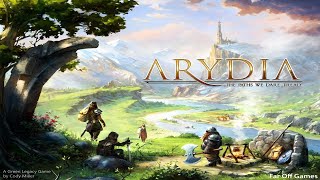





Arydia: The Paths We Dare Tread box art

Arydia: The Paths We Dare Tread

Game Info
Year
2025
Players
1-4
Age
14+
Playtime
180 min
Publisher
Collection
Ratings
Creator Score
Mechanic profile
Percentile rank vs. all games
Vibe profile
How this game feels to play
Description

Arydia: The Paths We Dare Tread is an open world, campaign-based, co-operative, fantasy-based, "green legacy" role-playing board game. The game of Arydia is built on four design pillars: Exploration, Progression, Combat, and Role-playing.

Exploration — Arydia is an open world to explore as you wish. Make your way across the world map, discovering new locations, interacting with memorable characters, fighting vicious monsters, and scavenging long-lost treasures. The world pulls you in through detailed descriptions and vivid artwork for each place you visit. Every location is unique, not randomized, and is built piece by piece as you explore.

Progression — Arydia is played as a campaign over the course of a number of game sessions; you start each session right where you left off! As you play, the game keeps track of your actions and decisions. Your characters will grow in power, collecting new items, weapons, and skills. NPCs and locations will change, depending on how you interact with them. All of this progression is done using a simple, but powerful, index system, which allows for quick and easy set-up and tear down.

Combat — Many of the locations you'll visit in Arydia are hostile, so you'll need your weapons, skills, and co-operation to overcome the challenges you encounter! Arydia features a tactical, co-operative combat system. Enemies are controlled by game cards and dice, while you and your companions work together to defeat them.

Role-playing — Take on the roles of a wide cast of characters as you encounter them throughout your journeys. Step into the shoes of a disgruntled shop owner, sniffling brat, or a poorly-dressed bandit leader. The incentive-based role-play system encourages you to engage in dramatic storytelling, without being intrusive.

As for being a "green legacy" game, publisher Far Off Games notes that Arydia features all the hallmarks of a legacy game — packages to open, hidden information, progression, discovery, exploration, all the while wrapping it in high-quality components — but allows you to reset the game when you have completed it so that you can start again or pass it on to someone else.

Ask a Rules Question
All mentions
Browse transcript mentions, sentiments, pros/cons, mechanics, topics, quotes, and references.
Total mentions: 112
This page: 12
Sentiment: pos 9 · mix 1 · neu 1 · neg 0
Mentions per page
Showing 101–112 of 112
Video E1yEkqRHt8o Playthrough at 0:16 sentiment: positive
Arydia: The Paths We Dare Tread video thumbnail
Click to watch at 0:16 · YouTube ↗
Overall sentiment (raw)
positive
Pros
  • Does not take itself too seriously, which is a strength.
  • Has a whimsical tone that works well.
  • The mechanics and narrative elements seem to blend well, creating an engaging experience.
  • The combat system, while complex, offers strategic depth with different enemy types and player abilities.
  • The game's variety in encounters and mechanics keeps things interesting.
Cons
  • Card sleeves are a bit too tight.
  • Some elements feel like backtracking or don't immediately seem useful.
  • The game can be complex to manage with multiple mechanics.
Thematic elements
  • Exploration, discovery, mystery
  • Wilds, Forests, Forts, Towers
  • Card-driven events, character interactions
Comparison games
  • 2K (NBA game for face scan comparison)
  • Chilla's Art games (for visual style comparison)
  • Original Tomb Raiders (for blocky graphics)
  • Golden Eye (Nintendo 64) (for visual style comparison)
  • Paper Mario
  • Paper Mario: The Thousand-Year Door
  • Grim Coven
  • Gloom Haven
Mechanics (from transcript analysis)
  • card-driven events — The game uses event cards and threat cards to introduce challenges and narrative elements.
  • character abilities — Characters have unique abilities and attacks (e.g., whip attacks, knife strikes, bows) and can gain new skills or improve stats.
  • Combat — Players engage in turn-based combat against enemies like goblins, utilizing character abilities and equipment.
  • Dice Rolling — Dice are used for combat rolls, checks, and determining outcomes of certain actions.
  • Itemization — Players acquire and use equipment like armor and weapons, with specific properties like damage or defensive bonuses.
  • looting — Players can search containers and defeated foes for items and resources.
  • map exploration — Players navigate a map, following leads and trying to piece together torn maps or discover new locations.
  • questing — Players undertake quests, such as rescuing captives or finding specific items, often given by NPCs.
  • Resource Management — Players manage resources like stamina, mana, and combo points to perform actions.
  • Symbol/Rune Interpretation — Players encounter symbols and runes that need to be deciphered to understand triggers or meanings on maps and items.
Video topics + discussion points
No key topics recorded for this video.
Quotes (from this video)
  • It almost fits the world because like it's never once tried to take itself too seriously.
  • The tightening is a little bit too tight. Like so if I if I could just almost go like fan through it, but then I'd probably rip the thing that's in it.
  • It's like whenever they tried to do um that NBA face scan for your character for like 2K and it was like horrific.
  • The voices of the game goes right out the window.
  • It's like you're just both leaving yourselves wide open just ah.
  • This is all make believe.
  • They're all on your ass cheeks for some reason.
  • Oh, he's still alive. No, no, he cuz you because my damage gets rid of the armor.
References (from this video)
No references stored for this video.
Video rjGwQUeJQeg Board Game Critique Review at 0:03
Board Game Critique - Arydia: The Paths We Dare Tread video thumbnail
Click to watch at 0:03 · YouTube ↗
Pros
  • Innovative directional combat with spatial reasoning
  • Strong tactical depth and collaboration
  • High production values and physical components
  • Map system that evolves with story
  • Green legacy resetability and flexible player counts
  • Drop-in/dropout system for varying attendance
  • Solo play support
Cons
  • Long initial tutorial (3+ hours) before gameplay starts
  • Pacing issues in the second half of campaigns
  • Quest variety vs playtime in a 60–80 hour campaign
  • Small enemy damage cards hard to read at table size
  • Shop storage system and card handling can be awkward
  • Roleplay prompts can break immersion or slow pacing
  • Table space and component visibility concerns at 4 players
Thematic elements
  • Redemption and homecoming through cooperative exploration and combat
  • Fantasy exile campaign world with modular maps and persistent world state
Comparison games
none
Mechanics (from transcript analysis)
Mechanics unknown.
Video topics + discussion points
No key topics recorded for this video.
Quotes (from this video)
  • The directional damage system is brilliant.
  • The green legacy resetability is another win.
  • This could be your game of the year.
  • Just make sure you're actually committing to 60 plus hours, not just wishing you had time for it.
References (from this video)
No references stored for this video.
Video gc4LtdBtR2k Totally Tabled Unboxing at 0:00 sentiment: positive
Totally Tabled - Arydia: The Paths We Dare Tread video thumbnail
Click to watch at 0:00 · YouTube ↗
Overall sentiment (raw)
positive
Pros
  • Impressive physical scope and component variety
  • Deep, roguelike flavor with flavorful paths and character customization
  • Strong setup narrative and thematic hooks that promise an engaging first session
Cons
  • The sheer volume of components may feel overwhelming for new players
  • Some content may feel opaque until rules are fully explained in quick-start
Thematic elements
  • Path-based character progression, stealthy exploration, and tactical combat in a perilous setting
  • Fantasy adventure world with rogues, exploration, and a grand quest structure, featuring multiple paths
  • Narrative-forward with flavor text and roleplay-friendly prompts, emphasizing player choice and world-building
Comparison games
none
Mechanics (from transcript analysis)
  • Character creation with attribute tracking — Players assign or develop core attributes (DEX, Intelligence, Charisma) and track HP and magic/stock resources.
  • Combat: Damage Based — Combat uses a D20 system with boards or markers indicating hit locations or target areas.
  • D20-based combat and hit-location concepts — Combat uses a D20 system with boards or markers indicating hit locations or target areas.
  • Decks, cards, and tokens management — A large assortment of cards and tokens organized across multiple boxes; some components are revealed progressively per quick-start rules.
  • Expansion content integration — Epic Hunt and Wild Hunt expansions alter skills and provide alternate character options.
  • Path selection and character progression — Players choose a path (e.g., Path of Shadows, Path of Valor) and gain starting skills; expansions offer alternate paths and skills.
  • Skill trees and equipment boards — Character boards display skills, equipment slots, and progression tracks linked to the chosen path.
  • Trap-based roguelike elements and rogue tools — Rogues use traps and clandestine tools (dagger, kunai, backstab) and employ stealth to gain combat advantages.
Video topics + discussion points
No key topics recorded for this video.
Quotes (from this video)
  • this is kind of a huge quick start guide
  • I haven't watched a lot of videos or anything so this is going to be quite a surprise for me
  • ah yeah now we can get a name and a title and I think I saw one here you could also make your own
  • this looks like exactly like what I want to play right now like a grand Adventure
  • I love playing a rogue
  • we might be ready to go through this little introduction that's going to teach us how to play the game
  • I'm very excited for this game
References (from this video)
No references stored for this video.
Video ZxXxKPkBJeU BoardGameGeek Top List at 19:20 sentiment: positive
BoardGameGeek - Arydia: The Paths We Dare Tread video thumbnail
Click to watch at 19:20 · YouTube ↗
Overall sentiment (raw)
positive
Pros
  • High production quality and engaging world-design
  • Resettable legacy design lowers entry barriers for new campaigns
  • Cooperative storytelling with meaningful player choices
Cons
  • Campaign maintenance can be time-intensive
  • Not always easy to fit into short gaming sessions
Thematic elements
  • investigation, discovery, monster encounters
  • cooperative open-ended exploration campaign
  • campaign-driven with evolving world effects
Comparison games
Mechanics (from transcript analysis)
  • Cooperative campaign — big cooperative campaign with ongoing story and decisions that affect future playthroughs.
  • Dungeon Crawl — players take on roles, explore monsters, towns, and encounters with evolving options.
  • Legacy Game — resettable legacy design allowing future playthroughs with persistent yet resettable state.
  • legacy/green legacy elements — resettable legacy design allowing future playthroughs with persistent yet resettable state.
  • open-ended exploration — players take on roles, explore monsters, towns, and encounters with evolving options.
Video topics + discussion points
No key topics recorded for this video.
Quotes (from this video)
  • This is a living website, which one we really like about it.
  • The list is a snapshot in time; it will morph over time as people rate more games.
  • BG is this living website; the community can contribute their own photos, their own feelings about a game.
References (from this video)
No references stored for this video.
Video SRFPVbHWSGU Totally Tabled Top 10 List at 8:30 sentiment: positive
Totally Tabled - Arydia: The Paths We Dare Tread video thumbnail
Click to watch at 8:30 · YouTube ↗
Overall sentiment (raw)
positive
Pros
  • Imaginative quests; engaging combat
Cons
  • Solo play may be challenging; lengthy sessions
Thematic elements
  • questing, exploration, humor
  • open-world campaign-based adventure
  • imaginative quests with humor and long-form play
Comparison games
none
Mechanics (from transcript analysis)
  • co-op open-world campaign — Quests with exploration and combat
  • NPC clues and rumors — NPCs provide hints and world-building
Video topics + discussion points
No key topics recorded for this video.
Quotes (from this video)
  • This War of Mine is brutal and depressing and sometimes disturbing because the stories presented are based on real events from real wars.
  • Being themed around Lord of the Rings helps, of course. It's so easy to visualize all the locations and the characters as this alternative narrative plays out.
  • Card games rarely feel this thematic.
  • Lands of Gowser features many streamlined mechanisms for making the game simple to set up, to play, and to put away.
  • Sleeping Gods has everything that I want in an adventure game.
References (from this video)
No references stored for this video.
Video dXSni7VFZCo No Pun Included Review at 0:00 sentiment: mixed
No Pun Included - Arydia: The Paths We Dare Tread video thumbnail
Click to watch at 0:00 · YouTube ↗
Overall sentiment (raw)
mixed
Pros
  • Ridiculously lavish physical presentation and premium components that create a strong sense of immersion.
  • Roleplay prompts generate memorable, often funny, interactions and keep the table engaged.
  • Campaign-in-a-box concept is appealing for fans of CRPGs and tabletop RPGs who want a self-contained experience.
  • The production scale and visual design deliver a striking product that stands out on a shelf or table.
  • Accessible entry point for a CRPG-inspired experience with clear, simple combat actions once you are through the tutorial.
Cons
  • The learn-as-you-play tutorial is painfully long and poorly structured, turning onboarding into communal instruction rather than active play.
  • The game struggles with scalability for larger player counts due to components and reference visibility issues during combat.
  • The main narrative is lightweight and feels like a string of disconnected quest vignette moments, lacking a strong overarching arc or stakes.
  • The heavy emphasis on physical components and 'unboxing' cycles can feel like a production gimmick at the expense of play time.
  • The pricing is steep (noted at £240) and this raises accessibility concerns for many potential buyers.
  • The game's aesthetic and marketing positioning as a 'green legacy' product can feel at odds with the amount of plastic and complex reset procedures.
Thematic elements
  • Campaign-in-a-box RPG experience that aims to capture the mood and mechanics of classic CRPGs and the sense of adventure through roleplay prompts, modular storytelling, and highly tactile physical components.
  • A fantasy CRPG-inspired world where exiles gather in villages, undertake quests, and explore a changing map full of events and encounters.
  • episodic vignettes with loose connective tissue between quests; a memoir-like tone of personal journeys within a dynamically evolving world.
Comparison games
Mechanics (from transcript analysis)
  • Advent calendars and premium components — The box is packed with pre-painted miniatures, exclusive tokens, and advent calendar inspired surprises. The unboxing and reveal moments are touted as a core joy, driving excitement and a sense of premium production but also contributing to cost and potential component management challenges.
  • Adventure Mode and Combat Mode nested on the same map — Exploration can trigger events and foes on the same physical map. When combat begins, players use the same spatial grid with dice, item cards, and class-specific abilities to resolve fights. The system emphasizes collaboration as players chain actions and coordinate damage lines to maximize effectiveness.
  • Combat: Damage Based — Combat uses a grid to track damage and positioning. Attacks have patterns that can interact with terrain, with optional mini-actions and a resource called combo points that power stronger abilities. The system is smooth in execution but can become mechanically predictable as games scale.
  • Dynamic map state changes and persistent evolution — Maps and encounters can change state in response to events (for example meteor impacts). Old map states can be superseded by new versions, creating a sense of progress and consequence. This is a strong conceptual hook but adds complexity in rule interpretation and memory load.
  • Grid-based combat with attack patterns and combo points — Combat uses a grid to track damage and positioning. Attacks have patterns that can interact with terrain, with optional mini-actions and a resource called combo points that power stronger abilities. The system is smooth in execution but can become mechanically predictable as games scale.
  • Physical dashboards, inventory slots, and item placement — Each chosen path unlocks a dashboard with inventory slots that players physically insert items into, echoing CRPG inventory screens. This tactile approach reinforces the fantasy of equipping gear and seeing your character come together in real time, at the cost of added physical space and component manipulation.
  • Roleplay prompts and catch-all dialogue mechanic — A central interaction system where one player adopts a character and the others can ask questions based on bolded prompt keywords. When questions touch content outside the prompt, the responding player must improvise a response such as 'Hmm, that seems to fall outside my recollection,' which preserves the illusion of in-universe dialogue and creates memorable roleplay moments.
  • World Exploration via hex-map with Travel Deck — Movement on a modular hex grid, drawing from a Travel Deck to determine terrain and events between locations. This deck evolves as you play, adding or removing cards based on prior encounters, which keeps exploration feeling fresh but also introduces bookkeeping and pacing considerations.
Video topics + discussion points
No key topics recorded for this video.
Quotes (from this video)
  • Everything Arydia gets right is distilled in this one ridiculous mechanism.
  • The gist of Arydia, like many board games of its type, is that it wants to be an RPG campaign in a box.
  • Pokémon. It wants to be Pokémon.
  • Arydia worships at the altar of silly.
  • This game is £240.
  • WHY? Why did you do this?!!
  • I'm not going to lie, never going to get tired of doing that.
  • It's impressive, how much of that it manages to pull off without enormous amounts of faff.
References (from this video)
No references stored for this video.
Video I7eIfX2wRBc slickerdrips Top List at 34:20 sentiment: positive
slickerdrips - Arydia: The Paths We Dare Tread video thumbnail
Click to watch at 34:20 · YouTube ↗
Overall sentiment (raw)
positive
Pros
  • ambitious open-world exploration with dense narrative
  • top-tier components and prepainted minis
  • strong solo experience and long campaign feel
Cons
  • very large upfront investment in time and money
  • some missed spoilers or surprises if not careful
Thematic elements
  • outcast heroes seeking redemption through favors
  • large box adventure with exploration and story joints
  • RPG-like roaming with evolving story events
Mechanics (from transcript analysis)
  • deck-building and card-driven abilities — play cards to trigger abilities and progress on levels
  • exploration and story events on a modular map — flip-housed hexes, travel/exhaustion mechanics
  • puzzle-like combat with tactical positioning — story-driven battles with unique enemy behaviors
Video topics + discussion points
No key topics recorded for this video.
Quotes (from this video)
  • It's got a really cool dice system for the players
  • I absolutely love it
  • There is an absolutely like huge world in there
  • The solo mode is really easy to run
  • it's the most exciting spreadsheet you will find
References (from this video)
No references stored for this video.
Video wwYEjnPNRso Tabletop Turtle Discussion at 1:50 sentiment: positive
Tabletop Turtle - Arydia: The Paths We Dare Tread video thumbnail
Click to watch at 1:50 · YouTube ↗
Overall sentiment (raw)
positive
Pros
  • Strong role-playing feel
  • Accessible, family-friendly energy with depth
Cons
  • Some may find it lighter in challenge or stakes
Thematic elements
  • Adventure and exploration with quirky NPCs and a redemption arc
  • Open-world fantasy campaign with exploration and light RPG elements
  • Role-playing infused, slightly abstracted storytelling
Comparison games
  • Dungeons & Dragons (spirit of cooperative storytelling)
Mechanics (from transcript analysis)
  • campaign_map exploration — Hex-based map exploration with new locations revealed by cards.
  • Character development — A path from a criminal past toward redemption through deeds.
  • dialogue_choice — Encounter cards present dialogue options that steer interactions.
Video topics + discussion points
No key topics recorded for this video.
Quotes (from this video)
  • And no other game does four players better than Black Rose War.
  • In Aridia, you read the character's encounter card and choose one of the available dialogue options.
  • There's even genuine character exploration here, which you almost never see in other board games.
  • The card you purchase or draft for the round comes straight to your hand.
  • This is the game that will push deck building to the next level.
  • The setup is a nightmare. The bookkeeping is tedious and the play time is insane.
  • Every decision here feels meaningful.
  • Nemo's War is exactly what I enjoy from a good solo board game.
  • The open seas feel ripped straight from a Jules Verne novel.
References (from this video)
No references stored for this video.
Video tWe30PkgNqs The Dice Tower Top List at 9:20 sentiment: positive
The Dice Tower - Arydia: The Paths We Dare Tread video thumbnail
Click to watch at 9:20 · YouTube ↗
Overall sentiment (raw)
positive
Pros
  • impressive storage system that reduces barriers to entry
  • clever exploration and location unlocking mechanics
Cons
  • potentially heavy and long play sessions
  • some players may find the rule depth daunting
Thematic elements
  • exploration and discovery with location unlocking
  • open-world exploration in a sprawling campaign
  • story-driven with a heavy emphasis on exploration and map progression
Comparison games
Mechanics (from transcript analysis)
  • card-driven/location-based play — your cards drive actions and locations you uncover become playable options
  • location unlocking with overlays — locations are revealed/modified using overlay components to change the board state
Video topics + discussion points
No key topics recorded for this video.
Quotes (from this video)
  • Beautiful artwork, a big story.
  • This begs the question, why does this need to exist?
  • I strongly disagree. I really enjoyed this one.
  • It's just another Cascadia.
References (from this video)
No references stored for this video.
Video GUBGY6rUNWY Sir Thecos Unboxing at 0:25 sentiment: positive
Sir Thecos - Arydia: The Paths We Dare Tread video thumbnail
Click to watch at 0:25 · YouTube ↗
Overall sentiment (raw)
positive
Pros
  • High-quality components (prepainted minis, detailed heads, heavy weight cards)
  • Thoughtful box organization with labeled containers and easy re-pack
  • Punch boards that are actually used in gameplay and can be re-inserted
  • Extensive map books and a wide array of campaign content including expansions
  • Open-world, solo-play capable and cooperative play supported
Cons
  • Very large physical footprint and substantial space requirements
  • Complex rule set may present a steep learning curve
  • Legacy/reset mechanics can be perceived as heavy or tedious to manage
  • Some components may appear extraneous or unused in an unboxing sample
Thematic elements
  • Exploration, progression, and legacy-like campaign development
  • Open-world cooperative fantasy exploration with modular maps and events
  • Story-driven progression with evolving content and events
Comparison games
Mechanics (from transcript analysis)
  • Bag Building — Punch-out components are used during play and re-inserted as part of setup and play flow.
  • Character creation and paths — Characters have distinct 'paths' (e.g., Path of Shadow) with skills and equipment customization.
  • Combat Dice — Hit dice and weapon-driven combat mechanics influence outcomes.
  • Combat: Dice — Hit dice and weapon-driven combat mechanics influence outcomes.
  • Cooperative Game — Players work together to overcome challenges and advance the campaign.
  • cooperative play — Players work together to overcome challenges and advance the campaign.
  • Legacy Game — Campaign progression unlocks content; game can be reset without destroying components.
  • Legacy/green legacy mechanics — Campaign progression unlocks content; game can be reset without destroying components.
  • Map books and battle maps — Multiple map books and battlefield maps guide exploration and combat scenarios.
  • Open-world exploration — Players explore a shared, expanding map with events and encounters.
  • Punch boards and tokens — Punch-out components are used during play and re-inserted as part of setup and play flow.
  • Resource Management — Currency, gems, and tokens are managed for inventory and encounters.
  • Save/load / session tracking — Mechanisms to save progress and resume campaigns between sessions.
  • Unique Player Powers — Characters have distinct 'paths' (e.g., Path of Shadow) with skills and equipment customization.
Video topics + discussion points
No key topics recorded for this video.
Quotes (from this video)
  • this is amazing. I've never seen anything like that in a game. Like, more games should do that. Seriously, that is amazing.
  • Open world exploration. You can play it solo.
  • these components here, the components here are all like through the roof.
References (from this video)
No references stored for this video.
Video keUMLQ3vgsM The Broken Meeple Discussion at 0:00 sentiment: neutral
The Broken Meeple - Arydia: The Paths We Dare Tread video thumbnail
Click to watch at 0:00 · YouTube ↗
Overall sentiment (raw)
neutral
Pros
  • Stellar production quality
  • Interesting title
Cons
  • Very complex campaign game
  • Too time-consuming
  • Miniatures focus
Thematic elements
  • Fantasy
  • Open world campaign
Comparison games
Mechanics (from transcript analysis)
Mechanics unknown.
Video topics + discussion points
No key topics recorded for this video.
Quotes (from this video)
  • it's only a game
  • Matt Leacock will you grow another thread of innovation in your skull and do something else
  • we're done with pandemic
  • I would rather be pessimistic and then pleasantly surprised then optimistic and then constantly disappointed
  • I could rank something like Alice's garden a 9 10 out of 10 for how perfect a game for its genre it is but that doesn't mean I want to play it game after game
  • this theme is going to speak to me heavily from a Nostalgia perspective
  • you're not as good as you used to be mate
  • this is why you've got to get your demos right
  • head cubes on tracks is that really what I'm supposed to get excited for
  • this one I think is the game that void fall should have been
References (from this video)
No references stored for this video.
Video -Y0PNXo4lJE Sir Thecos Top List at 15:51 sentiment: positive
Sir Thecos - Arydia: The Paths We Dare Tread video thumbnail
Click to watch at 15:51 · YouTube ↗
Overall sentiment (raw)
positive
Pros
none
Cons
none
Thematic elements
none
Comparison games
none
Mechanics (from transcript analysis)
Mechanics unknown.
Video topics + discussion points
No key topics recorded for this video.
Quotes (from this video)
  • Cascadia is a wonderful family tile-laying game that's cozy, puzzly, and endlessly replayable.
  • This is just my personal ranking. Your list will almost certainly look different.
  • A brilliant little solo game that I happily recommend.
References (from this video)
No references stored for this video.
Transcript Navigation
Showing 101–112 of 112
Game Deep Dive