/pic3562670.jpg)

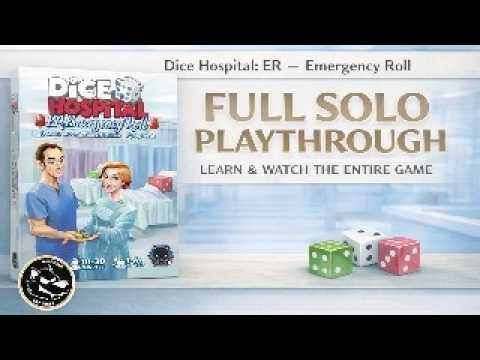












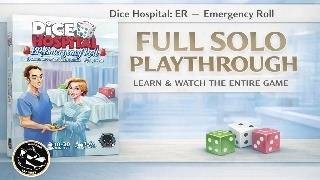
Dice Hospital Deep Dive
What the Community Thinks About Dice Hospital
Dice Hospital has garnered consistent appreciation from board game reviewers across multiple channels. The game appeals to players seeking a thoughtful puzzle experience with meaningful decision-making. Our Family Plays Games particularly praised how the game captures the thematic experience of running a hospital, where you must treat patients efficiently while managing limited resources. The common thread among reviews is that this is a game for experienced gamers who enjoy strategic depth, not an entry-level title for newcomers to the hobby.
Core Mechanics That Define Dice Hospital
Dice Drafting and Ambulance Selection
Each round begins with a double-draft mechanism that forms the foundation of Dice Hospital's gameplay. Players first draft an ambulance of incoming patients, represented by dice with varying pip values. The lower-numbered patients are sicker and more difficult to treat, while higher-value dice represent healthier patients. This initial draft is crucial because players who select lower-value patients are compensated by getting first choice from the doctors and departments available. Balancing whether to take difficult cases or secure better staff becomes a key strategic tension throughout the game.
Worker Placement with Dice as Workers
The game's distinctive mechanic uses dice themselves as workers. After drafting patients, players place their medical staff, nurses and specialists, into different hospital departments. Each worker may be placed only once per round, and each action space can be used only once. The basic action spaces treat a single patient by one pip value, while upgraded rooms and specialists can treat multiple patients simultaneously or increase a single patient multiple times. This allows players to build efficient combinations and chains of treatment, rewarding those who plan ahead and discover synergistic staff arrangements.
The Dice Hospital Experience
A Solitary Puzzle-Solving Challenge
Dice Hospital creates an intensely individual puzzle experience. As noted by Meeple University, the gameplay is quite solitary, each player works independently to optimize their own hospital rather than directly engaging with opponents. Players spend their turns determining which patients to heal in which rooms, how to allocate their limited staff, and when to discharge patients for maximum points. The social element appears mainly in the draft phase when ambulances are allocated and in the shared dice rolls that determine incoming patients. Once the action phase begins, players are largely occupied with solving their own spatial and timing puzzles simultaneously, creating minimal downtime.
Timing and Push-Your-Luck Elements
A key strategic layer emerges from the push-your-luck scoring system. Simply treating patients quickly does not yield the highest rewards. Instead, discharging multiple patients simultaneously grants significantly higher point bonuses than treating them gradually. This creates a fascinating tension: you must intentionally hold back treatment sometimes, managing your hospital capacity carefully to orchestrate large simultaneous discharges. Patients who receive no treatment each round deteriorate by one pip value, eventually dying and costing points. This creates urgency without making speed the only viable strategy. Players must navigate the challenge of planning ahead several rounds to achieve those satisfying, high-scoring discharge moments.
What Makes Dice Hospital Stand Out
Thematic Integration of Mechanics
The game's theme and mechanics work together seamlessly. Dice representing patients with low pip values as critically ill and high values as healthy creates intuitive understanding. The artwork on hospital room tiles is notably detailed, showing dice receiving treatments in X-ray machines, appearing in mortuary drawers, and receiving other appropriate care. Specialists are well-suited to their roles, the GP specializes in treating patients in the 4-6 health range, while paramedics focus on critical cases (1-3 range). This thematic cohesion makes the puzzle-solving feel narratively grounded rather than abstract. Players genuinely feel they are running a hospital, not just shuffling cubes.
Accessible Rules with Strategic Depth
Despite featuring multiple interconnected systems, Dice Hospital teaches relatively cleanly and plays quickly once understood. The core loop is straightforward: draft, select staff, place workers, resolve actions, score. The rules are not bogged down by excessive overhead or complex exceptions. However, this simplicity masks genuine strategic complexity. The many combinations of room upgrades, specialist abilities, and timing decisions mean that optimal play requires careful planning. As The Dice Hospital reviewer noted, matching bot bonus points across multiple categories is essential to competitive success. First-time players often grasp the rules but require experience to understand how to build cohesive hospital engines.
Potential Drawbacks
Limited Player Interaction
The game's solitary puzzle nature means minimal direct player interaction beyond the initial ambulance draft. Most gameplay consists of players manipulating their own boards simultaneously while others play their turns. There is no take-that mechanism, no negotiation, and no direct blocking of opponent actions. Players who seek games where they actively engage with others throughout the game will find Dice Hospital feels isolated. This makes it particularly well-suited to experienced puzzle-solver players but potentially less appealing to those seeking social, interactive experiences around the table.
Icon-Heavy Board Presentation
Dice Hospital relies heavily on iconography to communicate specialist abilities and room functions. Every room tile and specialist card features symbols that must be learned to play efficiently. While a reference card is included, Meeple University found it helpful to print extra copies for all players. The abundance of small icons on the game board can feel overwhelming initially, though players report becoming comfortable with them after a few plays. For players who prefer games with straightforward, text-heavy clarity, the visual symbol system may create friction in early plays.
If You Enjoy Dice Hospital
Players who love Dice Hospital should explore titles that reward puzzle-solving and engine-building with similar depth and thematic integration. Sagrada offers comparable dice manipulation and spatial puzzle-solving with a different theme. Cascadia presents tile placement puzzle mechanics in a nature-building context. Stone Age provides worker placement foundations with variable rewards. Tiny Epic Quest scales down engine-building concepts into a compact experience. For those wanting more complexity, the modular Community Care expansion introduces additional layers, experimental medicine modules, city expansion variants, investments that power deeper combos, and a maternity expansion that heightens the push-your-luck elements with special pink patient dice.
What Reviewers Are Saying
"The puzzle of trying to figure out what doctors and what rooms are going to be best to really get some good combinations of healing most effectively changes throughout the game because often when you're drafting those you're picking kind of what you need right now but then your hospital of patients is going to look very different in a few turns."
— Allies or Enemies
"It's a very straightforward dice drafting and manipulation game that isn't bogged down by a lot of complex rules and overheads. The many ways you can manipulate dice using the rooms and specialists means you'll end up feeling quite clever when you chain together a whole lot of moves."
— Watch Review
"The game lasts eight rounds and the right length. Each player can solve their own puzzle simultaneously so there isn't that much waiting time because everyone's doing it at the same time. With the different room tiles and specialists that all make the game replayable."
— Meeple University