/pic6230640.jpg)
/pic3979527.jpg)
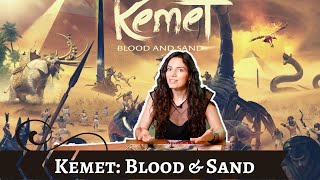
The epic Egyptian game Kemet is reborn with a new revised edition!
With Kemet: Blood and Sand, immerse yourself in a more realistic Ancient Egypt. Here, Gods are powerful, masters of both the desert and the Nile delta. They challenge each other in violent battles and show no mercy. Get ready to become an Egyptian God, open the gates of your city, and let your troops sing the song of war to please you and claim your dominance as master of Ancient Egypt.
Kemet: Blood and Sand features new art and upgraded gameplay with new approachable rules that go beyond the 1.5 version of Kemet developed with the help of the BGG community. Free from the constraints of existing components, designers Jacques Bariot and Guillaume Montiage go even further in fine-tuning the Kemet experience.
The game also features a redesigned map with a twist, bigger and more detailed figurines, and other surprises.
—description from the publisher
Part of the Kemet family — see Kemet for the combined view.
/pic6230640.jpg)



- reimagined Kemet experience
- Ancient Egypt, mythic warfare
- tactical, combat-focused
Mechanics (from transcript analysis)
- area control / area combat — heavily combat-oriented map interaction with powers
- tactical action selection — run around and bash opponents with variable powers
Video topics + discussion points
Quotes (from this video)
References (from this video)

- Rewards fighting and aggression
- Memorable visceral experience
- Focuses on tactical space
- Feels like it should be a Stargate game
- Twist is it's not anything like ancient Egypt
- Gods challenging each other in violent battles
- Egypt
- Mato
- Inish
- Chaos in the Old World
- Stargate
Mechanics (from transcript analysis)
- Area Control — It's a furiously contentious area control game.
- Tile Placement — Dizzying array of purchasable tiles.
Video topics + discussion points
Quotes (from this video)
- It's a memorable visceral experience that keeps the focus on the sharp tactical space that all players inhabit.
- It's Mad Max the board game but it's it's meant to be really really fun and just frivolous nonsense in a best way possible.
- I agree was this my favorite game of 2020 yes and I would S I would Hazard to guess it still is I love the red Cathedral don't me wrong I also love the White Castle that's a great game too but the red Cathedral there's something about this game...
- Rail Pass is just a little gem it's not something I need to play all the time for sure but Al convention Rail Pass might be one of the best convention games out there.
- This is my now goto solo game I love the small package it contains five different maps and 20 different games in one small box it's completely replayable with simple rules I've become a bit exhausted with complex campaigns that take a year to finish you complete a game of this in 10 minutes.
- Cloudit is supposed to be about fighting post apocalyptic terrorist militias from the futuristic airships but honestly it felt more like we were flying from City to City raining down Death from Above until the poor land bound inhabitants surrendered their precious water to us are we the baddies does it matter as long as you're winning that's all that matters right.
- Each character plays so differently it's Cooperative yet you're doing your own thing but you have common goals to achieve.
References (from this video)

- New art and improved miniatures.
- New content.
- Game itself holds up.
- Satisfying power tile system.
- Punchy combat.
- Moves faster than its complexity suggests.
- Rulebook feels like an archaeology project.
- Critical rules scattered across non-intuitive sections.
- Structure does not follow logical flow of a game round.
- Cannot build a coherent mental model.
- Edge cases buried or absent.
- Felt slapped together as an afterthought.
- Rulebook arrived rougher than the original.
- Rulebook created a first impression that took multiple sessions to shake off.
- Ancient Egypt
- Kemet
Mechanics (from transcript analysis)
- Action economy — The action economy is clean.
- Area Control — The original Kemet was a beloved area control game.
- Clear win condition — The winning condition is clear.
- direct combat — Combat is direct.
- Power tile progression — Elegantly structured around a power tile progression system in the original.
Video topics + discussion points
Quotes (from this video)
- Great games shipped with terrible rulebooks.
- The problem isn't the design, it's the documentation.
- When the gate is broken, it doesn't matter how amazing the garden behind it is.
- The rulebook is supposed to be the gate that lets you into the experience.
- This isn't getting better. We're not talking about ancient games... we're talking about high production releases from the last few years that arrived with rulebooks that simply do not work.
- That's not a learning curve, that is a wall.
- The rulebook tried as hard as it could to hide all the weird stuff.
- The cruelty of it is the context. This is a re-release.
- A reprint is supposed to be your second bite at the apple, your chance to sand down every rough edge.
- The BGG threads at launch were just flooded with rules questions, and people were asking whether later retail copies shipped with a corrected version, which is the most damning signal a rulebook can possibly send.
- The publisher rewrites the rulebook and releases the new version as a paid product.
- The irony is doing some heavy lifting there. That's almost too perfect.
- Players blame themselves first.
- And that is the real damage of a bad rulebook. It makes people feel stupid.
- There is a difference between density and dysfunction.
- A good rulebook scaffolds complexity. It layers information in the order a player needs it.
- The structure is so dense and so poorly sequenced that you consistently have to read it multiple times across multiple sessions before anything coheres.
- Community-built rule summaries became the standard learning tool, more reliable and more frequently consulted than the rulebook the game shipped with.
- More than a decade after release, the standard recommendation for new players is still to skip the rule book and watch a video tutorial first, which is a clear signal that the official documentation never became trustworthy enough to stand on its own.
- That's not an FAQ, that is a corrective supplement to a deficient primary document.
- That's what bad rule books generate, this cottage industry of third-party fixes that should never have been necessary.
- At some point, a pattern is a policy.
- The rule book was written for people who already know how to play.
- A game asking players to invest significantly in both time and money should not require that players outsource explanation to volunteer fans online.
- Simplicity is no protection.
- Writing a clear rule book is a separate skill from designing a clear game.
- When you've spent that much money and waited that long, opening the box to find a document that cannot explain how to play feels like a betrayal of the implicit contract between publisher and backer.
- Complexity is not an excuse for poor structure.
- Game designers are not naturally positioned to ask that question because they already know everything. They need editors who do not.
- Professional technical writers exist. Rule book editors exist as a dedicated specialty within the hobby now.
- Until publishers treat rule book production as a non-negotiable line item rather than an afterthought squeezed into the final weeks of production, we will keep having this conversation, and players will keep arriving at what should have been a great first session armed with a document that sets them up to fail.
- Every single game we've talked about today is worth playing.
- The rulebook failures we've documented are a reason to seek out community tutorials and third-party summaries and how to play videos before your first session. They are not a reason to avoid the games entirely.
- The rulebook is supposed to be the gate that lets you into the experience. And when the gate is broken, it doesn't matter how amazing the garden behind it is.
- The Conan rule books were universally panned, and that experience cost Monolith both bad press and the additional expense of rewriting and posting replacement rule books to backers.
- That's the line that should be tattooed on every studio's wall. A game designer understands their game completely and intuitively, which is exactly why they are poorly positioned to write the document that explains it to someone with zero context.
- Until publishers treat rule book production as a non-negotiable line item rather than an afterthought squeezed into the final weeks of production, we will keep having this conversation...
References (from this video)
- Fantastic game
- Love the mythological monsters and powers
- Great for kids to play repeatedly
- Fast-paced like Risk
- Controlling giant monsters is great
- Tech tiles feel great
- Intense pressure due to board layout
- Amazing theming
- Phenomenal edition
- Needs expansion to be played
- Mythological creatures and powers
- Ancient Egypt
- Risk
- Ankh
- Blood Rage
- Rising Sun
- Cyclades
- Cthulhu (expansion)
Mechanics (from transcript analysis)
- Action Point Allowance System — constantly praying for more points to do more stuff
- Area Control — Get points by winning battles.
- Set Collection — as you move up those tech tiles
- Teleportation — teleporting them around.
- Variable player powers — control these giant mythological monsters and also mythological powers.
Video topics + discussion points
Quotes (from this video)
- This is heavy metal as a board game.
- Almost no space of the board is more than two steps away from another space. So pressure is always on.
- push your luck worker placement in a co-op game. Bizarre, but it works really well.
- I think the mythological part is much stronger.
- a really solid auction game. One of the best auction games there is.
References (from this video)

- Amazing game
- Very nice version
- Perfect
- Wonderful game
- Board not particularly amazing
Mechanics (from transcript analysis)
Video topics + discussion points
Quotes (from this video)
- Hey everybody, I'm Tom Bassel. Welcome to look back. Here on the Dice Tower, I go back in time and I tell you what I think about games that I reviewed a year, five, 10, and 20 years ago. And I tell you what I think about them now, if I think about them at all.
- So, there you go, folks. Those are the games I reviewed one, five, 10, and 20 years ago. Thanks for watching. I'm Tom Vassel. We'll see you next time.
- Hey, uh, thanks for watching another video here on the Dice Tower. Uh, we really appreciate you stopping by and checking our things out. Thanks so much for joining us today.
- Tell your friends about the Dice Tower. Until next time though, I'm Tom Vassel, and I hope you enjoyed this video.
References (from this video)
- Strategic depth with multiple power tile combinations.
- High player interaction and combat.
- Variable powers offer replayability.
- Fast-paced gameplay due to limited rounds.
- Interesting combat resolution with cards and abilities.
- Monsters are a fun addition.
- The 'king of the hill' aspect changes the dynamic.
- Some rules were unclear due to the prototype nature.
- Some component sizes were mismatched.
- The 'Shadow' mechanic's effectiveness is debated in certain board states.
- The game can lead to 'analysis paralysis' due to the number of choices.
- Area control with mythological elements
- Ancient Egypt
- King of the Hill
Mechanics (from transcript analysis)
- Action Point Allowance — Players have a set number of actions per turn to spend on various activities like movement, recruiting, or acquiring tiles.
- Action Points — Players have a set number of actions per turn to spend on various activities like movement, recruiting, or acquiring tiles.
- Area Control — Kemet is described as an area control game where players compete for control of central zones to gain benefits.
- Card Drafting — Players select power tiles from available sets.
- Combat — The game features direct combat between players, resolved through card play and unit strength.
- Combat: Deck/Hand — The game features direct combat between players, resolved through card play and unit strength.
- Hand Management — Players manage a hand of combat and DI (Divine Intervention) cards.
- Modular Board — The expansion introduces a new board with a 'king of the hill' style objective.
- Set Collection — Players collect different sets of power tiles, influencing their capabilities.
- Unique Player Powers — The game utilizes different sets of power tiles that players can acquire, offering unique abilities and strategies.
- Variable player powers — The game utilizes different sets of power tiles that players can acquire, offering unique abilities and strategies.
Video topics + discussion points
Quotes (from this video)
- There will be blood. There will be sand.
- This is a sponsored gameplay.
- This is very much a prototype.
- The Gates of Thonus turns Kemet into a King of the Hill style gameplay.
- There's so many choices.
- This is a good play. This is a good play.
- My epiphany about the yellow tiles is assuming you're fine giving a victory point to someone who's not winning.
- This is a lot.
References (from this video)

- The host brought it with them and plans to do coverage of it next week.
- It was one of the 10 games the host wanted to 'obsess over'.
Mechanics (from transcript analysis)
Video topics + discussion points
Quotes (from this video)
- I'm not upside down with emotion or grief or loss I think I'm in a a good comfortable place I'm I'm sad I'll miss him um and I also am extremely grateful for you know everything my grandfather was to me the impact that he had on my life
- We do have some games planned for this weekend so and we've got some videos planned that we're going to be putting out hopefully you all can still hear me they're just being very rude this live stream
- you know it was a few days and then he passed away and his sleep and I I don't know you know how selfishly you want more time with people um the reality is you don't you don't always value the time that you have immediately
References (from this video)

- Fun, chaotic, and humorous with lots of upgrades
- Engaging theme with vivid flavor and colorful components
- Accessible and entertaining even when not fully strategic
- Some players may dislike the over-the-top theme
- Can feel silly if players expect serious tactical depth
- Dudes on a map with upgrade powers and faction play
- Ancient Egypt with gods and military might
- High-energy, humorous, and upgrade-driven
- Dudes on a Map trilogy
- Kiklardis
- Innis
Mechanics (from transcript analysis)
- area_control — competing on a map to gain influence and upgrades
- deck_based_engine_building — cards provide powers and engine benefits
- variable_player_power — upgrades grant unique abilities and enhance faction strength
Video topics + discussion points
Quotes (from this video)
- it's a classic euro that is very highly recommended by us.
- there's actually a big wealth of gameplay here.
- it's very interactive for a euro game.
- it's a party game almost because of the bidding and the interaction.
- gateway game, very accessible and colorful.
- it's a silly dudes on the map game.
References (from this video)
- Simple core actions that support deep tactical depth
- Rich power-tile system enabling near-unique faction flavors
- Dynamic battle system with multi-dimensional card interactions
- Strong miniature/board presentation that enhances thematic feel
- Divine intervention cards add surprise and strategic variety
- Rulebook can be hard to parse due to translation quirks
- Endgame can drag if players stall or loop tactics
- Board layout and space usage can feel awkward at certain player counts
- Two-player games may feel less optimal due to board design and balance
- divine-wue embattled control of spaces and resources to gain fame points
- Ancient Egypt-inspired mythic battlegrounds with temples, pyramids, and gods
- mythic, competitive, area-control driven
- Kemet
Mechanics (from transcript analysis)
- area_control — players move troops to control districts; control yields fame points and strategic advantage
- card_driven_battle — battles resolved via card play, combining own cards with opponent cards and combat bonuses
- divine_intervention_cards — one-use cards with diverse effects that can be played secretly to influence battles or position
- resource_management — prayer points as currency to move, recruit,Upgrade pyramids and buy power tiles
- teleport_and_land_movement — movement options include teleporting between temples or moving across land (costs prayer)
- tile_power_system — power tiles grant bonuses and upgrades; level of pyramids gates which tiles you can buy
Video topics + discussion points
Quotes (from this video)
- this is one of the best examples of the dudes on a map genre
- it's fun it's just really really fun
- the board is a table hogging game
- endgame can be terrifically exciting or terribly long and drawn out
- the rule book can be a bit of a tough read
References (from this video)

- Updated reprint of a classic, strong themed flavor
- beautiful production
- Rulebook complexity noted; setup can be lengthy
- Historical adventure with resource manipulation
- Quacks of Quedlinburg
Mechanics (from transcript analysis)
- Card-driven, area-influence — Updated version of a classic with varied powers; fast-paced combat and placement decisions.
Video topics + discussion points
Quotes (from this video)
- this is the most risky one i've put on my list
- it's a heavy roll and write and it's just really well done
- the sandra mechanic is a clever twist that punishes the least trained department
- we've just enjoyed it so much we keep going back to it
- it's not just about winning, it's about optimizing with what you have
References (from this video)
- Stunning component quality and visual identity; pyramids, miniatures, and board art are outstanding
- Tightens and polishes the core experience of the original while preserving its identity
- Improved setup and power-denial dynamics in two-player mode increase strategic depth
- Clear, glossy rulebooks and helpful clarifications via glossaries and extra pages
- Integrates new content (green pyramids, Book of Death) without losing the core flavor
- Strong thematic resonance with mythic conflict and ancient-Egypt iconography
- Rule ambiguities and day-one errata; translation nuances necessitate clarifications
- Some players feel certain design choices (board layout, storms, and storm-blocking pieces) could be cleaner
- MSRP concerns in historical context; perception of value depends on how much new content is used
- Inclusion of six-player expansion scope in a box can lead to confusion if not clearly bundled
- Mythic Egyptian gods collide with a chaotic, knife-fight-in-a-phone-booth style threat; godlike powers drive asymmetric play
- Ancient Egypt with Lovecraftian influences and mythos overlay
- Thematic, mythic conflict with direct player confrontation and a modular, power-driven agenda
- Eclipse
- Gloomhaven
- Blood Rage
- Root
- Game of Thrones (board game)
Mechanics (from transcript analysis)
- Area control / direct combat — Temple capture and skirmishes drive scoring; combat is a central engine to win by demolishing opponents’ forces.
- Board with desert/storm modifiers — Desert storm or storm-like tiles partially cover or modify board regions, influencing threat management and movement.
- Faction minis and pyramid tokens — Distinct faction units and pyramid components provide visual and mechanical identity to each power.
- Modular content via expansions — Green/Black pyramids, Book of Death, and other content alter rhythm and balance, offering new tactical options.
- Power card selection / drafting — Each color/power set provides unique abilities; limited pool in two-player games increases tension and denial tracks against opponents.
- Two-player scaling / color limitation — 2-player games reduce available colors and powers to tighten balance and intensify decisions.
Video topics + discussion points
Quotes (from this video)
- this edition is beautiful and if you didn't have it and i played it at a convention i'd probably be like all right Comet you're coming back to my collection
- one of the best revitalizations of a game out there
- it's the best version of what this game does best
- the components are upgraded and the pyramids look cool
- this edition is a beautiful representation of a classic
- you can frame the art on the back of the board and show it off, but you still need the board to play
References (from this video)
- Fluid and immersive gameplay
- Better iconography and more intuitive rules
- Higher playability and thematic depth
- New art that fits a darker, epic tone
- Potentially longer playtime and steeper learning curve for new players
- Increased complexity compared to base game
- Divine power, battle for godly dominance, pyramid-based strategy
- Ancient Egypt, divine realms and temples
- Epic mythic conflict with tactical combat and city-building
- Kemet
Mechanics (from transcript analysis)
- Area Control — Players compete to control districts via pyramids and military units.
- Card-driven combat — Battle cards and divine intervention cards influence battles.
- Power tile color system — Power tiles (Diamond, Ruby, Sapphire, Onyx) grant color-matched bonuses and unlocks.
- Prayer points resource — Prayer points used to recruit, expand pyramids, and activate abilities.
- Pyramid building and level advancement — Pyramids provide actions and point bonuses; levels determine cost and effects.
- Teleportation via pyramids to obelisks — Teleport units between districts for strategic repositioning.
- Two-phase turns (Day and Night) — Day phase for action tokens; night phase triggers nocturnal powers and new cards.
- Variable Phase Order — Day phase for action tokens; night phase triggers nocturnal powers and new cards.
Video topics + discussion points
Quotes (from this video)
- the bottom line of all this is that the new commence gameplay is definitely more fluid and the total experience is more immersive
- the iconography is better some rules are more intuitive and their playability is higher
- the minutes are bigger and more detailed
- the new art is gorgeous and I personally love the shift to a darker aesthetic that fits the theme of the game more
- overall the additions and the alterations bring the game to the epicness level that it deserves
References (from this video)

- Strong, thematic area-control core with evolving powers via power tiles
- Deterministic (diceless) combat that feels fair and predictable, avoiding random luck spikes
- Flavorful tile sets (red for combat, blue for defense, white for economy, black for tricks) that push varied strategies
- Exciting prospect of rampaging monsters and dynamic board interactions as power tiles are claimed
- Opening turns can be slow as players learn tiles, powers, and interactions
- Early rounds may feel slow or less exciting before powers and pyramids unlock more options
- Relatively high complexity can be daunting for new players, impacting upfront accessibility
- divine cults, temple control, pyramids, ancient beasts, and magical warfare
- mythic Egypt
- mythic, epic, with deterministic combat emphasis
- Galilean moons
- Lords of Helles
Mechanics (from transcript analysis)
- actions_per_turn — Each player has five action disks; players perform actions from different levels of their board, with a design that encourages multi-level planning and resource flow.
- Area Control — Players vie for control of key regions on the map; holding these regions yields victory points and ongoing benefits that influence late-game scoring.
- area_control — Players vie for control of key regions on the map; holding these regions yields victory points and ongoing benefits that influence late-game scoring.
- battle_system — The core combat is diceless and deterministic; battles use battle and divine cards, with sword icons, blood drops, shields, and special effects to resolve outcomes in a predictable yet tense manner.
- card_management — Battle and divine cards are drawn and managed throughout the game; card effects interact with actions, movement, and combat to shape outcomes.
- combat_modifiers — Combat is influenced by modifiers such as sword icons, blood drops that cause damage, shields that block effects, and special rules (e.g., green retreats) that shape battles.
- Combat: Damage Based — Combat is influenced by modifiers such as sword icons, blood drops that cause damage, shields that block effects, and special rules (e.g., green retreats) that shape battles.
- movement_and_ports — Troops can move across the board, with ports enabling faster travel; teleportation between a city and an obelisk is possible for two prayer points, adding mobility options.
- pyramid_construction — Pyramid levels are built progressively; advancing to higher levels costs more prayer points but grants greater control, victory points, and strategic options.
- Resource Management — Prayer points are earned via actions and are spent to pay costs for building, upgrading, and triggering special abilities; they are a central pacing resource.
- resource_management — Prayer points are earned via actions and are spent to pay costs for building, upgrading, and triggering special abilities; they are a central pacing resource.
- Unique Player Powers — All players begin on equal footing but can acquire and upgrade powers through pyramid tiles, enabling unique strategic trajectories for each player.
- variable_player_powers — All players begin on equal footing but can acquire and upgrade powers through pyramid tiles, enabling unique strategic trajectories for each player.
Video topics + discussion points
Quotes (from this video)
- Kemet could easily have been just another dull area control game and its bones are just that move troops, fight battles and control spaces
- the four sets in the box each with their own flavor, red is all about fighting, blue about defenses, white improves your economy and black tiles are full of dirty tricks
- the combat system is diceless and solid
- the best thing about this game is rampaging around the board with giant monsters
- opening turns can be pretty slow and dull
- for a similar area control game with evolving powers try Galilean moons
References (from this video)
- Prevents passive turtling through constant aggression
- Deep upgrade system with a lot of strategic variety
- Distinct, memorable faction/creature options
- Steep learning curve and rules complexity
- Can be heavy for casual groups
- Mythic divinities and armies clashing for dominance
- Egyptian mythos in a conflict-driven battlefield
- Fast-paced, aggressive play with a strong upgrade ecosystem
- Risk
Mechanics (from transcript analysis)
- action_pyramid — Turns use a pyramid of actions; players must select one action from each level over five actions.
- Area Control — Conquering and controlling regions remains central to scoring.
- area_control — Conquering and controlling regions remains central to scoring.
- combat_cards — Battles are resolved with cards that modify combat outcomes.
- Combat: Deck/Hand — Battles are resolved with cards that modify combat outcomes.
- upgrades_and_creatures — A broad array of upgrades (including giant monsters) shapes the map and battles.
Video topics + discussion points
Quotes (from this video)
- this is the game that actually introduced The Legacy concept
- it's layered on top of what's already a better version of risk
- the primary action selection mechanism on your turns you have this pyramid that has different actions
- two-player only game where you and your opponent are actually playing out the historical event of the Cold War
- it's highly asymmetrical and by that I mean the different factions literally play completely differently
References (from this video)

- Huge variety of powers to sculpt your strategy
- Satisfying tile-driven decision space
- Complex to optimize, high rule density
- Power tiles and divine powers
- Ancient Egypt-inspired mythic setting
- Menu of powers with heavy thematic flavor
Mechanics (from transcript analysis)
- Area control with power tiles — A wide array of powers and tiles drives player choice.
- Modular power tile system — Three large boards with many power tiles to mix and match.
Video topics + discussion points
Quotes (from this video)
- This is top 100 games of all time as of 2025. Every single year I say that it's as of how I'm feeling now.
- I unranked everything and then re-ranked it based on how I feel.
- Beast is absolutely fantastic. I think it's the second best hidden movement game I have in my collection.
- Numsters is my favorite Buttonshy game.
- Root is an asymmetric strategy game where basically the core game has four core factions.
- Powers and abilities galore. If you like just having a smorgasbord of menu options to pick from, this delivers.
References (from this video)

- highly thematic combat with crunchy decisions
- powerful cards and monsters to acquire
- box can be large and intimidating
- rules and interactions can be dense for beginners
- god-like powers and ancient battles
- Egyptian mythic warfare
Mechanics (from transcript analysis)
- area_control — combat and positioning across a shared board
- tech_tree — unlock powerful upgrades and units as you play
Video topics + discussion points
Quotes (from this video)
- Nar is a Viking themed whole thing, but the whole timing, the sequencing when you get to fire off those banners, when you're actually making that, it's one of those games that is a small footprint, but I think it builds really well.
- With the expansion, I think it's fantastic. And they integrated some of that stuff in the new version, Sakura Slam.
- I love Clask so much.