/pic8729013.png)
























Leaders Deep Dive
What the Community Thinks About Leaders
Reaction to Leaders is consistently positive across the channels that have actually played it. Allies or Enemies, reviewing a publisher-provided copy, called the design smart and said the roster of asymmetric characters kept the abstract duel from feeling stale. Chairman of the Board went further, naming Leaders both its surprise game of the year and its abstract strategy game of the year for 2025, describing it as a smart, succinct, super fast little game. The Dice Tower folded Leaders into a rapid-fire rundown of favorites and singled out the drafted characters as the thing that makes every session play differently.
Not every channel agreed on how the enthusiasm holds up. BoardGameCo, speaking after roughly ten to fifteen plays both in person and on Board Game Arena, said the excitement had cooled slightly compared to their first handful of games, even while still calling Leaders excellent and distinct from the lane-battling two-player games they compared it against. Board Stupid's comments came from an early look at Leaders ahead of its full rules release, so their reaction was necessarily speculative: they liked the concept of building a team of champions but flagged that judgments about complexity and balance would depend on the rules once they were finalized.
Core Mechanics That Define Leaders
Drafting a Team of Champions
Allies or Enemies laid out the turn structure plainly: on a turn, a player first moves a character one space or uses that character's power, then drafts one of three available characters from a shared market and adds them to a starting space on their side of the board, refilling the market afterward. Each card carries a different power, some granting an alternate movement type instead of a simple one-space step, others granting a passive ability that is always active. The Dice Tower echoed this, noting that every character plays so differently that the same drafted lineup rarely produces the same game twice, with some able to move in unusual ways and others able to negate the powers of characters around them.
Surrounding or Capturing the Enemy Leader
The win conditions are the throughline every reviewer who played the game returned to. Allies or Enemies explained that a player wins either by completely surrounding the opposing leader so it has nowhere left to go, or by getting two of their own characters to touch the opposing leader directly. Board Stupid described the same goal in its own words, framing it as trying to capture or defeat the other leader by surrounding them, almost chess-like, or stopping them from moving at all.
The Leaders Experience
A Fast, Tense Duel
Speed came up again and again. Allies or Enemies said games with their group rarely ran past fifteen minutes, and even with more deliberate players taking every move seriously, they doubted a game would stretch much past twenty to twenty-five minutes because every character on the board is so powerful. Chairman of the Board summed up the same feeling in fewer words, praising Leaders as neat, succinct, and a super fast little game.
A Learning Curve That Reveals Itself Slowly
The base rules are simple to teach, but reviewers who put in real repetitions found there was more to absorb than a first game suggests. Allies or Enemies said the core loop can be explained in under a minute, with only one new character rule introduced per round, yet still found some players constantly checking the reference card because they were overwhelmed trying to remember what every character did, and admitted that even after roughly a dozen plays they still had to check the cards themselves rather than having every power memorized. BoardGameCo's account of stretching out to ten or fifteen plays pointed at the other side of that same learning curve, where familiarity is part of what eventually tempers the initial thrill.
What Makes Leaders Stand Out
A Roster Where Every Power Feels Overpowered
Allies or Enemies described walking through the character roster and finding that almost every single one seemed broken in isolation, the kind of card that makes an opponent wonder how they will possibly stop it if it gets drafted. They framed this as a deliberate strength rather than a flaw, since leaning into big, asymmetric powers is exactly what they want from this style of game, and it is also what keeps matches moving quickly, since no one can simply turtle against a character built to swing the board. The Dice Tower pointed at specific characters as evidence of that same variety, describing one that can move and drag opponents toward it and others that negate nearby powers entirely, all while the underlying goal never changes.
A Box Built Around Its Presentation
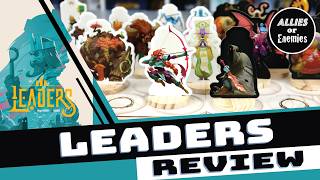
Allies or Enemies spent real time on the physical package: a beautiful box carrying Naiad's artwork, a drawer-style storage tray that slides the components out for setup, standees mounted on wood rather than plastic minis, and cards that are color-coded and information-rich about each character's power. Board Stupid, working from preview images rather than a finished copy, made the same observation from the outside, calling the artwork fantastic.
Potential Drawbacks
Powers Are Easy to Forget, Even With a Reference Card
The same density of unique characters that reviewers praised also created friction. Allies or Enemies said that despite a helper card listing every rule, some players they taught kept picking up cards mid-game to double-check what a character did, and that remembering every power is going to depend on how much a given player can internalize; they added that after about a dozen plays they personally still had not memorized what every character does.
A Simple Board and a Cooling Curve
Allies or Enemies called the board itself a little simplistic, framing it as a minor complaint next to the character cards. BoardGameCo's longer-term experience showed a related drawback: after ten to fifteen plays, the gap between an early game and a later one had narrowed enough that their excitement had tempered somewhat, even though they still rated Leaders highly and kept it in their collection. Board Stupid's caveat sits alongside these: since their comments were based on a preview ahead of the full rules release, they were careful to note that how complex or balanced the final game feels would only become clear once those rules were actually available.
If You Enjoy Leaders
Allies or Enemies placed Leaders in conversation with a specific set of abstract strategy games, saying that if someone is not a fan of Onitama, Santorini, Hive, or to a lesser extent Chess, Leaders is unlikely to win them over, since it works a similar vein of movement-power abstraction rather than doing something wholly unlike those games. They specifically likened the movement powers to Onitama's spatial puzzle and to Santorini's high asymmetry. The Dice Tower reached for the same comparison independently, saying Leaders gives them an Onitama feel even though every drafted character moves differently. Board Stupid, working from an early preview, said the game gave them vibes of Unmatched, describing Leaders as similar in spirit but leaning more toward a Euro or abstract strategy tilt than Unmatched's own combat system.
What Reviewers Are Saying
"Every single one of these cards has a different power. And that is basically how you play the game, but the first thing that you might think of, first thing that most people that I've played this with have said is, oh, it's kind of like chess. And honestly, that's not a bad reference point."
— Allies or Enemies
"Another relatively late entry, but so impressed with this little twoplayer a little skirmish game as you're trying to get two of your pieces next to your enemies piece by using these powers. All these different characters you can draft into your lineup, very very smart, neat, succinct, super fast little game."
— Chairman of the Board
"You have all these different abilities in these characters out there but the whole goal remains the same. That's what makes this game so unique every time you play it because you draft these leaders and play them out there."
— The Dice Tower