









Mythic Battles: Ragnarök Deep Dive
What the Community Thinks About Mythic Battles: Ragnarök
Reviewers who have touched Mythic Battles: Ragnarök agree on its production and its combat, and they split on whether it earns a place on the table. Enthusiasts treat it as a top-tier pick for a group that wants a heavy, thematic skirmish game. More measured voices call it a solid, sometimes overlong, experience with a few rough edges. The early praise comes largely from prototype previews, so reviewers were careful to separate how the game feels from how the final components will look.
Core Mechanics That Define Mythic Battles: Ragnarök
Dice Combat and Rune Cards
Combat is the centerpiece. Attacks resolve in two parts, with dice rolls determining the base outcome and cards shaping how that result plays out. Reviewers describe the system as a way to keep the tension of a dice roll while still giving players tools to influence it. A player can use card effects to increase the value of other dice or to re-roll, so the table never feels like it is simply watching the dice decide everything. Reviewers who favor the design point to this layering as the reason the combat reads as strategic instead of purely random.
Units, Yarls and Damage
Troops are represented by groups of miniatures, and each point of damage removes a figure from the unit. This makes damage a visible, physical cost rather than an abstract number on a sheet, and reviewers note that it creates an ongoing choice about whether to push a weakened unit forward or pull it back. Yarls, the leader-style characters, sit at the center of this system. Their cards and abilities determine how different units can be deployed, which gives each army a distinct rhythm during play.
The Mythic Battles: Ragnarök Experience
Thematic Character and Feel
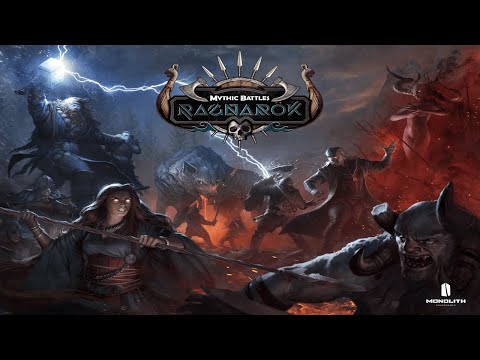
Several reviewers say the game captures the flavor of its Norse source material more than most games in its weight class. Characters feel distinct, and the way gods and heroes interact with the board reinforces the mythology. Players who enjoy a strong narrative identity tend to come away feeling the setting is part of the mechanics rather than a coat of paint on top of them.
Table Presence and Art
The minis and art draw the most immediate reaction. In a Board Game Coffee preview, the presenter stops mid-unboxing to point out the figures, and the enthusiasm is hard to miss. Reviewers praise the detail of the sculpts and the scale of the board presentation. They are quick to add that prototype minis are not final, so the visual judgments come with an asterisk, but the overall impression of a visually impressive product comes through consistently.
What Makes Mythic Battles: Ragnarök Stand Out
Non-Grid Movement and Terrain
Movement is not locked to a grid, and terrain adds real consequences to positioning. Reviewers who have played the game highlight this as one of the features that sets it apart from more rigid tactical games. Terrain effects change how units fight and move, so a turn spent repositioning can matter as much as a turn spent attacking. This openness rewards players who think spatially and gives each battle a shape that depends on the board rather than a preset template.
Unit Design and Replayability
One reviewer who was otherwise unimpressed still praised the unit design. The troop variety, the abilities attached to different units, and the way those abilities interact with the yarl cards give the game a lot of room to change from session to session. Replayability is a recurring theme in positive reviews, and the reviewer who praised it most noted that the amount of content available through the campaign and stretch goal units creates a sense of abundance. The fact that a large part of that content arrived through stretch goals is something reviewers say they will weigh when deciding whether the value is worth the cost.
Potential Drawbacks
Setup and Rulebook Clarity
The most consistent complaint is the setup. Reviewers say the rulebook explains the setup with few diagrams, and some found it hard to get a first game running without referring back to the rules repeatedly. Component organization also drew criticism, with one reviewer noting that the storage and fit of the parts do not always match the box design. Players who plan to teach the game to new groups should budget extra time for the first session.
Dice Tedium and Scenario Structure
Dice rolling can become tedious over a long session, especially when the table is waiting on repeated rolls. Some reviewers felt the randomness was more frustrating than exciting in certain moments, while others felt it struck a good balance. The scenario structure also drew mixed reactions. One critic described the scenarios as more railroaded than expected, with a fixed path that limits player choice. Reviewers who enjoy open sandbox play may find the structure restrictive.
If You Enjoy Mythic Battles: Ragnarök
The comparisons in these reviews mostly point to the same family of games. Reviewers place Mythic Battles: Ragnarök alongside its sibling title Mythic Battles: Pantheon, and several said they would rank Pantheon higher for their own collections because of its more polished feel or stronger sense of balance. Reviewers who are excited about the wider series also mention Mythic Battles: Isfet, which moves the setting to Egypt, as a sign that the system has room to grow. For players deciding between Ragnarök and other heavy tactical games, the reviews suggest choosing based on whether they want a dice-and-card combat engine with a strong theme and a willingness to accept some setup friction.
What Reviewers Are Saying
"I'll give it an eight, an eight, I'm a confident eight, a very very nice eight. I think I agree with you on an eight, but I'm going to bump it up to a nine because I have Pantheon."
— Board Games UnLocked
"Going to an all you can eat Vegas buffet with your friends. Everything looks good, some things are pretty decent to eat, but then overall the things just don't really mesh together."
— Shelfside
"No, aren't these minis amazing?"
— Board Game Coffee