/pic8669620.jpg)
/pic4240471.jpg)
/pic4682702.jpg)

/pic8669620.jpg)










































Patchwork Deep Dive
What the Community Thinks About Patchwork
Patchwork occupies a rare position in modern board gaming: it is simultaneously one of the most celebrated two-player games ever designed and a cultural phenomenon that spawns countless internet memes. Reviewers across experience levels unite around a single conclusion: this 2014 Uwe Rosenberg design is exceptional. Casual players praise its accessibility and charm. Competitive players appreciate its hidden depth. The game appeals equally to non-gamers discovering board games for the first time and to veterans grinding through World Series of Board Gaming tournaments. The consistency of praise is remarkable, with reviewers agreeing on its elegant design, satisfying gameplay loop, and remarkable replayability despite a simple ruleset.
Core Mechanics That Define Patchwork
Polyomino Tile Placement
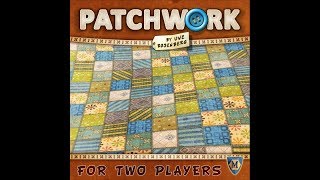
At its heart, Patchwork is a puzzle game about fitting Tetris-like pieces onto a personal nine-by-nine grid. Each of the 33 unique patches represents an irregular polyomino shape, with careful variations ensuring no two are identical (save for three pairs with different artwork). Players select from three available patches at a time, then place their purchase anywhere on their board that permits it. The puzzle deepens because placement is freeform. A piece can be rotated and flipped in any orientation, offering tremendous spatial problem-solving opportunities. The constant goal of filling gaps and completing a seven-by-seven square creates a natural race condition, yet allows players focused on board coverage to ignore this secondary objective entirely. Reviewers consistently note that this mechanical foundation delivers one of the most satisfying aspects of play: the moment when a new tile fits perfectly into an awkward gap, sliding into place with elegant inevitability.
Button Economy and Time Track
Beneath the quilt theme sits a sophisticated economic system. Buttons serve double duty: they are both the in-game currency for purchasing patches and the victory points players accumulate. Every patch purchase costs buttons and advances the player's marker along a shared time track. This creates a fundamental tension at the game's core. Buying expensive patches yields powerful income-generating tiles but costs time, reducing the number of future turns. Passing time by advancing without purchasing grants free buttons, recovering economic strength but ceding initiative. The elegance of this system is that it creates competing pressures without any luck element. Every decision involves managing three finite resources: buttons, time, and board space. Players must evaluate which patches to buy not just for immediate scoring, but for the income they generate and the time cost they incur. This layered decision-making disguises itself behind a friendly quilting theme, making Patchwork accessible to non-gamers while rewarding deeper strategic thinking.
The Patchwork Experience
Solitary Puzzle Over Conflict
Patchwork feels like multiplayer solitaire. Players spend most of their turns focused on their own board, optimizing placements and managing their economic position. Direct player conflict is minimal. There is no dice rolling, no luck, no random events upending careful plans. The only interaction occurs through controlling which patches become available and denying favorable tiles to opponents. This solitary puzzle quality means players can carry on conversations throughout the game. Many reviewers describe it as a perfect vehicle for quality time with a partner, friend, or spouse. One can discuss life, work, relationships, and current events while making board game decisions. The game becomes a framework for connection rather than a source of competitive tension. This atmosphere appeals to players seeking relaxation and bonding over high-stress competition.
Satisfying Economic Escalation
Despite the calm surface, Patchwork delivers a deeply satisfying economic arc. Early turns feel constrained. Button income trickles in slowly, limiting options. Mid-game accelerates as accumulated income surges. Late-game becomes flush with buttons, allowing spending on expensive tiles that would have been impossible earlier. Players watch their purchasing power grow, their board fill, their engine accelerate. When a tile placement is perfect, completing a grid pattern or filling a stubborn gap, the satisfaction is immediate and palpable. The time track ensures the game stays true to its thirty-minute runtime, which itself contributes to the escalating excitement. Players know the end approaches. The knowledge that remaining turns are finite adds urgency to each decision. This combination of economic growth, spatial satisfaction, and time pressure creates an emotional arc that keeps players engaged despite the light ruleset.
What Makes Patchwork Stand Out
Perfect Economic Design
Reviewers repeatedly highlight the elegance of Patchwork's economic system. The button economy is not merely thematic window-dressing but the mechanical core holding the entire game together. The system is so well-balanced that it permits multiple valid strategies. Players can pursue aggressive button income early, betting that superior cash flow in later turns will enable better tile purchases. Others can play defensively, focusing on board coverage and ignoring income optimization. Some pursue the seven-by-seven square bonus aggressively, while others dismiss it as a distraction. The game rewards none of these approaches exclusively. Different patch distributions and market sequences create varied winning conditions, which explains Patchwork's extraordinary replay value. With 33 patches creating countless combinations and infinite board configurations possible on each game, players report playing dozens of times and discovering something new each session.
Streamlined Design Hiding Strategic Depth
The brilliance of Patchwork lies in how simple rules generate complex decisions. Players choose one of three available patches, pay the cost, place it on their board, and advance their time marker. That is the entire turn structure. Yet this simplicity conceals layers of consideration. Every tile purchase triggers multiple decisions cascading across the rest of the game. Buying a patch determines not just which tile joins the board but how much time elapses, how many buttons are spent, and which patches become unavailable to the opponent. Reviewers note that experienced players notice threads of causality linking every action. The current purchase constrains future options. The time position determines turn order. The board state limits future placements. Patchwork is a game where you can learn the rules in ten minutes but spend years mastering optimal play, yet still lose to someone playing casually because the game's elegance ensures that multiple playstyles can succeed.
Potential Drawbacks
Agency Loss from Random Patch Distribution
With 33 patches randomized at the start, some distributions create awkward scenarios. It is entirely possible that the three tiles available for purchase all carry high costs, forcing players to pass repeatedly until sufficient buttons accumulate. This can feel deflating. Some reviewers note that occasional game states arise where purchasing decisions feel predetermined. If only one tile is affordable and realistic, the player's agency vanishes. The counterargument, offered by those who love Patchwork, is that this situation arises rarely and that even limited choices offer meaningful decisions about where to place the purchased tile. However, the concern is legitimate: players seeking consistent, branching decision trees throughout every turn may occasionally find their choices constrained by the market state.
Two-Player Exclusivity and Setup Friction
Patchwork supports exactly two players. It does not scale to higher player counts. This is a design choice rather than an oversight, yet it limits the game's applicability for larger groups. For players who primarily game with three or more people, Patchwork remains inaccessible regardless of how excellent reviewers claim it to be. Additionally, some reviewers mention minor frustrations with setup. The 33 patches must be randomized and arranged in a circle, a task that feels fiddly compared to games with card decks or pre-arranged components. The game includes minimal storage solutions. These are small complaints in the grand scheme, yet they warrant mention for completeness. Players prioritizing fast setup and larger group compatibility may look elsewhere, though the payoff of playing Patchwork typically justifies these minor inconveniences.
If You Enjoy Patchwork
Players captivated by Patchwork's polyomino puzzle will find similar satisfaction in New York Zoo, the most recent Rosenberg polyomino release, which uses a rondel-like mechanism and supports variable player counts. For those seeking the two-player intimacy Patchwork provides, Azul offers comparable accessibility and elegance without the quilting theme. Players drawn to Patchwork's economic depth should explore Suburbia, which expands tile-placement economics into city building. Cascadia delivers peaceful polyomino placement with variable scoring. For those who love Patchwork's re-themeable nature, Patchwork Doodle (the roll-and-write spin-off) provides a distinctly different experience using the same foundation.
What Reviewers Are Saying
"Patchwork is such a calming and relaxing game you might as well be making a quilt in real life. There's minimal player interaction during the game which means there's an opportunity for maximum personal interaction outside of the game."
— Might I Suggest A Game
"Finding that balance between having enough resources, you do generate an income of these resources throughout the game, as well as managing the timing aspect in order to get all the tiles that you can and need to score well in this game, creates a quite competitive game for how relatively easy this game is to learn."
— The Board Gaming Doctor
"Patchwork is one of the finest two-player games ever made with a literally perfect economy in how the button system works."
— Board Stupid