


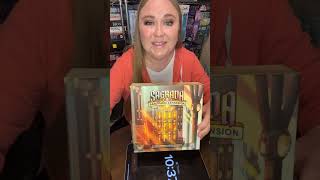
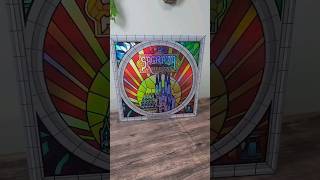
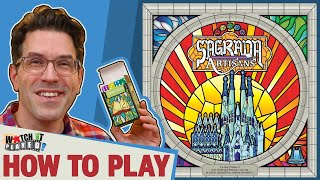



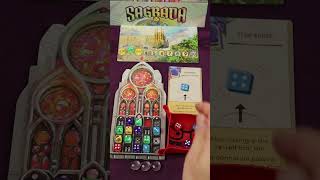
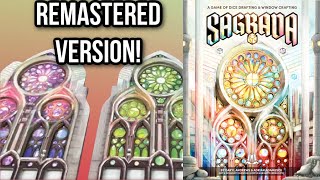




Sagrada box art

Sagrada

Game Info
Year
2017
Players
1-4
Age
10+
Playtime
30 min
Publisher
Floodgate Games
Collection
Ratings
Expansions & Family
Mechanic profile
Percentile rank vs. all games
Vibe profile
How this game feels to play
Description

Draft dice and use the tools-of-the-trade in Sagrada to carefully construct your stained glass window masterpiece.

In more detail, each player builds a stained glass window by building up a grid of dice on their player board. Each board has some restrictions on which color or shade (value) of die can be placed there. Dice of the same shade or color may never be placed next to each other. Dice are drafted in player order, with the start player rotating each round, snaking back around after the last player drafts two dice. Scoring is variable per game based on achieving various patterns and varieties of placement...as well as bonus points for dark shades of a particular hidden goal color.

Special tools can be used to help you break the rules by spending skill tokens; once a tool is used, it then requires more skill tokens for the other players to use them.

The highest scoring window artisan wins!

Ask a Rules Question
All mentions
Browse transcript mentions, sentiments, pros/cons, mechanics, topics, quotes, and references.
Total mentions: 185
This page: 50
Sentiment: pos 39 · mix 3 · neu 4 · neg 0
Mentions per page
Showing 101–150 of 185
Video tNUPh1k_-nU BoardGameGeek Discussion at 7:58 sentiment: neutral
BoardGameGeek - Sagrada video thumbnail
Click to watch at 7:58 · YouTube ↗
Overall sentiment (raw)
neutral
Pros
none
Cons
none
Thematic elements
none
Comparison games
  • Quacks of Quedlinburg
  • Parks 2.0
Mechanics (from transcript analysis)
Mechanics unknown.
Video topics + discussion points
No key topics recorded for this video.
Quotes (from this video)
  • But even when I played for the first time, it does not mean anything until you score a goal.
  • It's very easy to grok that you want to put your goals out first and then get the resources, but it's so hard to implement until you played it a couple of times.
  • I really enjoy this game. I like teaching it because it's one of those lighter strategy games that really get people into the mindset or into trying heavier strategy games.
  • And it is so much fun to just watch people act like they don't care initially about whatever green team. And then like when they're winning like I have I have 17 points.
  • I like teaching heavy games when it's very logical.
  • The fun thing about Settlers is that you only are teaching kind of like 70% of the game because when the aliens come out, they have their own set of rules, and you cannot teach them until they actually show up.
  • But if you're a hobbyist it's like this like when can we play this again? It's It is so my wheelhouse. It's not even funny.
  • And it doesn't outstay its welcome. It's really pretty at the table.
  • It's not a stressful real time game.
  • Are you Amanda from the BGG podcast? ... Someone recognized me from my voice
References (from this video)
No references stored for this video.
Video 7aU46Vt_saQ Review at 0:00 sentiment: positive
Sagrada video thumbnail
Click to watch at 0:00 · YouTube ↗
Overall sentiment (raw)
positive
Pros
  • Expands player count to five and six without significantly increasing game time.
  • Light boards provide more strategic options and planning.
  • Panorama objectives add variety to scoring.
  • The base game is enjoyable and holds up well.
  • The expansion is a 'must-buy'.
Cons
  • The host wished the panorama expansion was more transformative, like a 'Between Two Cities' style gameplay.
  • Some new objective cards in the second edition don't score based on pip count, which the host prefers for strategic depth.
Thematic elements
  • A beautiful church in Barcelona, Spain (Sagrada Familia)
Comparison games
Mechanics (from transcript analysis)
  • Dice Drafting — Players select dice from a central pool, and the host mentions that in drafting games, it's hard to plan because you don't know what's coming or what others will take. The light boards add more security in planning.
  • player count expansion — The panoramic expansion adds boards to take the game up to five and six players, which the host views positively as it doesn't significantly impact game time.
  • Set Collection — The personal objective cards award points based on specific criteria within the player's window.
Video topics + discussion points
No key topics recorded for this video.
Quotes (from this video)
  • This has always been one of my favorite games.
  • It's a quality of life expansion, in my opinion.
  • So, it's a quality of life expansion, in my opinion.
  • The glass really works with the pretty dice.
  • I think I would have liked to have seen this a little bit more like uh between two cities where you literally take the window instead of playing it here, you play it offset and play one here, play one there.
  • All in all, great expansion.
  • This is a must-play, must own expansion if you ask me.
References (from this video)
No references stored for this video.
Video tSnA82YgbJs Playthrough at 4:35 sentiment: positive
Sagrada video thumbnail
Click to watch at 4:35 · YouTube ↗
Overall sentiment (raw)
positive
Pros
  • Easy enough to learn
  • Really pretty
  • Cool unique theme
  • Good for people who like Sudoku
Cons
none
Thematic elements
  • Stained glass
Comparison games
none
Mechanics (from transcript analysis)
  • Dice Drafting — Implied by the context of picking dice to place.
  • Pattern Building — Placing dice to satisfy rules and create stained glass patterns.
  • Set Collection — Collecting dice to fulfill scoring conditions or create visual patterns.
Video topics + discussion points
No key topics recorded for this video.
Quotes (from this video)
  • You can add and take away uh the amount of rules that you use on the cards and stuff to make it a little bit easier. So, I feel like you can kind of scale this as well.
  • And it's just super fun. And uh I think the fact that it's just purely a puzzle game is also going to be easier to get into than like a lot of theme.
  • Turnip is a uh a little card game that is all about like bluffing.
  • It's also got weird like Renaissance art, but with carrots and bunnies. It's very cute.
  • This one you just have a tile in the center of the table and you start building out the map as you go. That's really unique.
  • And because you're working together, you get the satisfaction of like building out tiles so the landscape makes sense and adding some strategy, but the ability to talk about what you think is best uh in a cooperative way.
  • So, if I'm thinking for a new W gamer, um, man, I think I'm gonna pick it. This might be a little too heavy, but I'm gonna go for it.
  • We each have a couple of co-op options I think is always useful.
  • Like you said, which of these lists do you prefer as a way to, you know, bring someone deeper into the hobby and show them some new stuff that maybe they've never seen before?
  • Let us know who won in the comments below. And also, give yourself eight games. Look at your own collection. What are the eight games from your collection you would use for a similar type purpose?
  • Make sure you subscribe while you're here. Just no matter what you do, just show games to people because we need more people in this hobby.
References (from this video)
No references stored for this video.
Video hMjJSBDSZXA Watch It Played Playthrough
Pros
none
Cons
none
Thematic elements
none
Comparison games
none
Mechanics (from transcript analysis)
Mechanics unknown.
Video topics + discussion points
No key topics recorded for this video.
Quotes (from this video)
No quotes stored for this video.
References (from this video)
No references stored for this video.
Video w6mWCDnfLwc Watch It Played Playthrough
Pros
none
Cons
none
Thematic elements
none
Comparison games
none
Mechanics (from transcript analysis)
Mechanics unknown.
Video topics + discussion points
No key topics recorded for this video.
Quotes (from this video)
  • listen anyone who thinks ah there's not a theme up there for me I beg to differ
  • I think we have reached sort of a critical level of puns in this episode already
  • I want you to help me make my windows better give me your suggestions in the comments below
References (from this video)
No references stored for this video.
Video w6mWCDnfLwc Watch It Played Playthrough at 0:25 sentiment: positive
Watch It Played - Sagrada video thumbnail
Click to watch at 0:25 · YouTube ↗
Overall sentiment (raw)
positive
Pros
  • Engaging theme of stained-glass windows
  • Can be a quick game
  • Visually appealing components (even promo items)
Cons
none
Thematic elements
  • Building stained-glass windows
  • 13th century
Comparison games
none
Mechanics (from transcript analysis)
  • Dice Drafting — Players draft dice from a common pool after they are rolled. The order of picking is determined by player order.
  • Dice Placement — Drafted dice are placed into a personal player board (windowpane) following specific color and number adjacency rules.
  • Pattern Building — Players arrange dice to create specific patterns or achieve certain color or number arrangements within their player board for scoring.
  • tool cards — Special tool cards can be used to modify drafting or placement rules, such as rerolling dice or placing dice non-adjacently.
  • Variable objectives — The game includes public and private objectives that players try to fulfill to gain points, influencing their strategy.
Video topics + discussion points
No key topics recorded for this video.
Quotes (from this video)
  • listen anyone who thinks ah there's not a theme up there for me I beg to differ
  • I think we have reached sort of a critical level of puns in this episode already
  • I want you to help me make my windows better give me your suggestions in the comments below
References (from this video)
No references stored for this video.
Video V1_6tnzh-Rw Playthrough at 1:52 sentiment: positive
Sagrada video thumbnail
Click to watch at 1:52 · YouTube ↗
Overall sentiment (raw)
positive
Pros
  • The expansion adds significant differences to gameplay.
  • New personal light boards offer more planning.
  • Shared goals with neighbors encourage new interactions.
  • Expansion supports up to six players.
  • Tools provide powerful strategic options.
  • Goals encourage helping neighbors rather than 'hate drafting'.
Cons
  • Can be hard to track goals due to their number.
  • Some players may feel 'hosed' by others' placements.
Thematic elements
  • Building stained glass windows
  • Sagrada Familia in Barcelona
Comparison games
  • Sagrada Artisans
Mechanics (from transcript analysis)
  • Action Drafting — Players can use tool tokens to perform special actions like re-rolling dice or swapping dice.
  • Dice Drafting — Players draft dice from a communal pool and their personal light boards.
  • Pattern Building — Dice are placed on a player board following specific color and number restrictions.
  • Set Collection — Players aim to fulfill public and private goal cards based on dice placement.
  • shared objectives — Players have shared goals with their immediate neighbors, influencing adjacent column placements.
Video topics + discussion points
No key topics recorded for this video.
Quotes (from this video)
  • So, in this game, we are building stained glass windows in the Sagrada Familia in Barcelona.
  • So, when we draft dice, we're only going to be taking one out of the communal and then we're choosing one from our light board.
  • This is pretty powerful.
  • The last couple of puzzles I'd say like the last two are like mind-meltingly great. in such a good way.
  • You are helping each other. Yes, instead of hate drafting on every turn, Sarah actually gives me strategy advice and helps me. It's great.
  • The sun if you go early morning it will be very blue cool colored light coming through the I guess east
  • And if you wait till afternoon then the setting sun will be shining through the west side of the building and it will be very orange and yellow and red fiery red.
References (from this video)
No references stored for this video.
Video V1_6tnzh-Rw Playthrough at 16:47 sentiment: positive
Sagrada video thumbnail
Click to watch at 16:47 · YouTube ↗
Overall sentiment (raw)
positive
Pros
  • The campaign offers challenging and rewarding puzzles.
  • The tool system helps players who fall behind.
  • Played over a long period, it feels like a significant undertaking.
Cons
  • Long breaks between sessions can make it hard to remember game state and rules.
  • The campaign is very long.
Thematic elements
none
Comparison games
none
Mechanics (from transcript analysis)
  • Campaign play — The game is played as a long-term campaign with evolving objectives.
  • Variable player powers — Tools are acquired and used based on player performance, acting as a catch-up mechanism.
Video topics + discussion points
No key topics recorded for this video.
Quotes (from this video)
  • So, in this game, we are building stained glass windows in the Sagrada Familia in Barcelona.
  • So, when we draft dice, we're only going to be taking one out of the communal and then we're choosing one from our light board.
  • This is pretty powerful.
  • The last couple of puzzles I'd say like the last two are like mind-meltingly great. in such a good way.
  • You are helping each other. Yes, instead of hate drafting on every turn, Sarah actually gives me strategy advice and helps me. It's great.
  • The sun if you go early morning it will be very blue cool colored light coming through the I guess east
  • And if you wait till afternoon then the setting sun will be shining through the west side of the building and it will be very orange and yellow and red fiery red.
References (from this video)
No references stored for this video.
Video S7kwWMQBgZE Rules Teach at 0:00 sentiment: positive
Sagrada video thumbnail
Click to watch at 0:00 · YouTube ↗
Overall sentiment (raw)
positive
Pros
  • Visually appealing ('pretty').
  • Mentally engaging ('puzzly').
  • Satisfying to complete a challenge.
Cons
  • Can be challenging to meet all restrictions ('bad sign', 'how am I going to get this all done').
Thematic elements
  • Dice drafting and pattern building in a stained glass window.
Comparison games
none
Mechanics (from transcript analysis)
  • Dice Drafting — Players select dice from a common pool to place in their player board.
  • Pattern Building — Dice must be placed according to specific adjacency and value restrictions, creating a visual pattern.
  • player powers — The host mentions using a tool or ability to spend dice before drafting, suggesting unique player abilities or tools.
  • Set Collection — Players aim to collect sets of dice based on color and value to score points, implied by the restrictions and scoring goals.
Video topics + discussion points
No key topics recorded for this video.
Quotes (from this video)
  • Sagrada is one of the best pretty and puzzly games out there.
  • Hey, thanks for making me look good on camera.
References (from this video)
No references stored for this video.
Video 5DWHpSAGmMA Playthrough at 0:00 sentiment: positive
Sagrada video thumbnail
Click to watch at 0:00 · YouTube ↗
Overall sentiment (raw)
positive
Pros
  • wake your brain up with a quick, fun challenge
  • requires planning ahead with color placement
Cons
none
Thematic elements
none
Comparison games
none
Mechanics (from transcript analysis)
  • dice rolling and placement with discard — Roll five dice per round; place four dice on your board and discard one; three rerolls; follow standard placement rules to fill the grid.
Video topics + discussion points
No key topics recorded for this video.
Quotes (from this video)
  • Hello. So today, in honor of the new Sagrada Panorama expansion, I am going to take the Sagrada three minute challenge.
  • This is a great wake your brain up in the morning activity or just when you have a few minutes and want to place.
  • you got to plan ahead with your colors.
  • this is super fun.
  • check out the Saga Panorama expansion for all of the awesomeness that it has.
References (from this video)
No references stored for this video.
Video 0JLpaGHL8MQ Watch It Played Rules Teach at 0:24 sentiment: positive
Watch It Played - Sagrada video thumbnail
Click to watch at 0:24 · YouTube ↗
Overall sentiment (raw)
positive
Pros
  • Beautiful stained-glass window creation
  • Strategic dice drafting
  • Objective-driven scoring (public and private)
  • Rule adherence adds challenge
  • Favor tokens provide aids during the game
Cons
  • Penalty for open spaces in the window
Thematic elements
  • Artists competing to make the most beautiful stained-glass window
  • The Sagrada Familia church
Comparison games
none
Mechanics (from transcript analysis)
  • action selection — On their turn, players can choose to draft a die and/or use a tool card. These actions are optional.
  • Dice Drafting — Players select dice from a central pool. The pool is refilled, and dice are drafted in alternating orders over two turns per round.
  • Pattern Building — Players place dice into a personal window frame following specific placement rules to create a stained-glass window.
  • Resource Management — Players manage 'favor tokens' which can be spent to use tool cards, with the cost increasing after the first use.
  • Set Collection — Players collect dice of specific colors and values to fulfill placement rules and scoring objectives.
  • Variable player powers — Players receive private objective cards and select window pattern cards, which can influence their strategy and provide starting advantages (favored tokens).
Video topics + discussion points
No key topics recorded for this video.
Quotes (from this video)
  • hi welcome to watch it played my name is Rodney Smith and in this video we're going to learn the one two four player game sagrada
  • otherwise that's everything you need to know to place the grata
References (from this video)
No references stored for this video.
Video krfa3KCVOQ4 Meeple University Review at 20:19 sentiment: mixed
Meeple University - Sagrada video thumbnail
Click to watch at 20:19 · YouTube ↗
Overall sentiment (raw)
mixed
Pros
  • Creative window patterns
  • Exciting new rules for Sagrada fans
  • Unique first player marker (pencil sharpener)
  • Soothing aspect of coloring
Cons
  • Fiddly
  • Difficult to interpret
  • Adds significant upkeep/downtime
  • Coloring can slow down gameplay
  • Purple pencil color mismatch
Thematic elements
none
Comparison games
  • Sagrada
Mechanics (from transcript analysis)
  • Campaign play — A 10 scenario campaign.
  • Dice Placement — Stack them onto your windows.
  • Drafting — You would draw the dice and drop it roll them onto the board make sure they're all different and draft them in a snake draft order.
  • Legacy Game — This is a 10 scenario campaign that plays through Sagrada.
  • Roll and Write — Turning it into a rolling right.
  • sticker placement — Places for new rule stickers.
Video topics + discussion points
No key topics recorded for this video.
Quotes (from this video)
  • five games in 30 minutes is back we got very exciting games today from after us so brother Addison's a great legacy and we've got herd mentality woolies and Beacon Patrol yes so we're going to take you quickly through them all and give you a review
  • It's clever simple rule set the on the downside potentially if you have an alpha player that would want to control no I want that tiles give me that tiles or I don't know no you have to put it here you have to put it here you know but that is true all the information is public so you just have to make sure that you're playing that appropriately
  • I love tech building and this one is such a great one now this is a bit of multiplayer Solitaire where everyone has got their own puzzle but everyone also trying to work out what's the optimum strategy
  • It is a very very solitary game the really the interaction between players is pretty trivial in this game
  • if however you are the only person who has an odd out answer so if you stand apart from the crowd and no other player stands apart from the crowd you get the pink cow
  • I personally don't feel this Stacks up very well as a party game because I always I think for me the fun in a party game is trying to be creative and trying to find something obscure I understand that tarent so for me a game like this where I'm trying to get the most common answer it's actually quite dull for me.
  • This is so bad what is this anyways
  • Turning it into a rolling right that's that's a big step back for me.
  • I found that the time I spent coloring things in between my turns there was just a lot of it's not downtime per se but it's just upkeep time so I you know so rather was a game that for me it was always just fine I never loved it I didn't dislike it it was just kind of an average game and then this introduces a number of things that just slows it down and boils it down for me so I didn't really didn't really enjoy it
  • I do like also the first player marker it is a pencil sharpener the shape of the grudder.
References (from this video)
No references stored for this video.
Video 4nU3n5QZbd8 Meeple University Rules Teach at 0:02 sentiment: positive
Meeple University - Sagrada video thumbnail
Click to watch at 0:02 · YouTube ↗
Overall sentiment (raw)
positive
Pros
  • aesthetic visuals and pretty coloring
  • clarity of objective types through private and public objectives (implied)
Cons
none
Thematic elements
none
Comparison games
none
Mechanics (from transcript analysis)
  • Compound Scoring — Discussion mentions private objectives and common objectives guiding scoring.
  • Dice Drafting — You get to drop the dice from the common area and place on your windows to color numbers toward objectives.
  • dice drafting onto windows — You get to drop the dice from the common area and place on your windows to color numbers toward objectives.
  • private and public objectives — Discussion mentions private objectives and common objectives guiding scoring.
Video topics + discussion points
No key topics recorded for this video.
Quotes (from this video)
  • look at these pretty coloring
  • oh it looks so pretty
  • you get to drop the dice from the common area and place on your windows coloring numbers to achieve the common objectives and your profit objectives here
  • you also feel a little bit too scared when you have to punch in games
References (from this video)
No references stored for this video.
Video 5t-1OMgsDBM watch it played Rules Teach at 0:13 sentiment: neutral
watch it played - Sagrada video thumbnail
Click to watch at 0:13 · YouTube ↗
Overall sentiment (raw)
neutral
Pros
none
Cons
none
Thematic elements
  • stained glass cathedral construction; family legacy through a campaign
  • the Sagrada Familia cathedral's stained glass windows project
  • journal-based campaign with story text and envelopes
Comparison games
none
Mechanics (from transcript analysis)
  • Adjacency rule — After the first die, every subsequent die drafted must be placed in a space adjacent to already filled spaces, sharing an edge or corner, and never two spaces sharing a full edge with the same color or value.
  • Campaign progression and window advancement — Campaign spans 12 rounds per game, with rounds advancing and the ability to start new windows and track legacy points across generations.
  • Dice Drafting — Drafted dice are assigned to a space in your window; you shade the space with the matching color using the included pencil.
  • Drafting a die — On your turn you select a die from the cathedral board and, without changing its value, place it beside your journal.
  • Envelope events — End-of-round envelopes reveal story details and may add new rules or resources; opening them is spoilers to be discovered by players.
  • Events — End-of-round envelopes reveal story details and may add new rules or resources; opening them is spoilers to be discovered by players.
  • Pre-printed restrictions — Spaces with pre-printed colors or values restrict which dice can fill them—only a die with the matching color or value may fill such a space.
  • Public and private objectives scoring — Public objectives score points at the end of the game; a private objective scores points for spaces matching a color.
  • Tools and tool cards — Tools can modify a die (e.g., flip value, change color) and can be used multiple times per turn; using a tool marks off its symbol, and once all symbols are marked, that tool can't be used again in the game.
  • Window placement and shading — Drafted dice are assigned to a space in your window; you shade the space with the matching color using the included pencil.
Video topics + discussion points
No key topics recorded for this video.
Quotes (from this video)
  • Sagrada Artisans designed by Adrian adamesku and Daryl Andrews
  • The Campaign will end in your crown a final winner
  • Your family will persist over four generations or ages
  • you peel and stick these into the rule book into the space is indicated at the bottom of each sticker
  • rounds will continue until the 12th round has been marked off on your window
References (from this video)
No references stored for this video.
Video qKGcDfPjl_A kovray Playthrough at 0:02 sentiment: positive
kovray - Sagrada video thumbnail
Click to watch at 0:02 · YouTube ↗
Overall sentiment (raw)
positive
Pros
  • The host identifies a clear, constrained puzzle with interesting strategic decisions.
  • The host expresses enjoyment and progress during play.
  • The predetermined windows provide structure and forward planning.
Cons
none
Thematic elements
none
Comparison games
none
Mechanics (from transcript analysis)
  • adjacency/diagonal rule — Each subsequent die must touch the previous die either orthogonally or diagonally; no two numbers or colors may touch.
  • color/number restrictions — No two dice sharing the same color or number may touch each other.
  • edge placement — First dice must be placed near the edge of the window grid.
  • predetermined_windows — Pre-set restrictions guide valid placements.
  • timed_challenge — The task must be completed within three minutes.
Video topics + discussion points
No key topics recorded for this video.
Quotes (from this video)
  • Our goal is to fill this entire square with dice.
  • no two numbers and no two colors can ever touch.
  • predetermined windows are just restrictions already set up by the game.
  • I like this.
  • I like the look of that.
  • that is the Sigra challenge.
References (from this video)
No references stored for this video.
Video rHEkIDNAvUw kovray Playthrough at 0:13 sentiment: positive
kovray - Sagrada video thumbnail
Click to watch at 0:13 · YouTube ↗
Overall sentiment (raw)
positive
Pros
  • Quick play time (~30 minutes) per session
  • Variety of goals and tools creates replayability
  • Smooth scoring with clear visual objectives
Cons
  • Requires careful tracking of color/number adjacency
  • Some rows/columns can be tricky to optimize
Thematic elements
  • stained glass window creation with color and number constraints
  • drafting dice and crafting a stained glass window
Comparison games
none
Mechanics (from transcript analysis)
  • Dice Drafting — Players draft two dice per round from a pool to place in their window.
  • favor tokens — Favor tokens can be spent to activate abilities or score as a point at game end; cost increases when tokens are on a card.
  • placement constraints — No placing same color or same number adjacent to each other.
  • Public/private objectives — Points come from public objectives and a private objective based on color of dye.
  • rounds and scoring — There are 10 rounds; scoring happens after all dice are placed with final scoring based on color column variety and numbers variety.
  • tools — Special tools modify dice after taking them: Flux Brush rerolls, Length Cutter swaps with past round, Grinding Stone flips to opposite side.
  • window placement rules — First die must be placed around the border; subsequent dice must be adjacent to existing dice, diagonals allowed.
Video topics + discussion points
No key topics recorded for this video.
Quotes (from this video)
  • This game is like pretty quick.
  • Grinding stone. After taking a die, flip the die to its opposite side before placing it.
  • Now my favorite part, scoring where we go gently like this and reveal the score track to see who will be the winner of Sigrada.
  • What the secret objective is is a color of the dye that we are aiming for.
References (from this video)
No references stored for this video.
Video 6cpHCqt6Osg Grant Lyon Playthrough at 0:00 sentiment: mixed
Grant Lyon - Sagrada video thumbnail
Click to watch at 0:00 · YouTube ↗
Overall sentiment (raw)
mixed
Pros
  • Purple, finally a little cooperation.
  • That one will work out pretty well right there.
  • I bet you're pretty impressed with me right now.
  • Good job, me.
  • Off to a great start.
Cons
  • Don't make me regret this.
  • This is all bad.
  • NO!
Thematic elements
  • dice drafting/placement puzzle
  • daily challenge with five dice of each color to fill a window
  • first-person commentary during play
Comparison games
none
Mechanics (from transcript analysis)
  • adjacency restrictions — Numbers and colors cannot be the same as adjacent placed dice.
  • Dice Drafting — Roll five dice each round; place four dice on a window and assign one to a placeholder; avoid placing same numbers or same colors adjacent.
  • Dice drafting and placement — Roll five dice each round; place four dice on a window and assign one to a placeholder; avoid placing same numbers or same colors adjacent.
Video topics + discussion points
No key topics recorded for this video.
Quotes (from this video)
  • I bet you're pretty impressed with me right now.
  • Good job, me.
  • Purple, finally a little cooperation.
  • Don't make me regret this.
  • One last shot to get A FOUR HERE.
  • Okay, boom.
  • That was a one.
  • FLIP THE TABLE. FLIP IT. FLIP IT.
  • NO!
References (from this video)
No references stored for this video.
Video PkmbTeAbCTg Jamie, Tabletoptiktok Preview at 0:04 sentiment: positive
Jamie, Tabletoptiktok - Sagrada video thumbnail
Click to watch at 0:04 · YouTube ↗
Overall sentiment (raw)
positive
Pros
  • Shared objectives increase interaction between players
  • New light board and dice tray speeds up gameplay
  • Allows play with up to six players
  • Private objectives add variety to scoring
Cons
none
Thematic elements
none
Comparison games
none
Mechanics (from transcript analysis)
  • light board and dice tray — New light board where two dice of every color are rolled and a dice from the light board is used; speeds up gameplay and allows planning with extra dice.
  • private objectives focused on placement and dice values — Private objectives reward placement and the values of dice rather than color.
  • shared objectives — Players on the right and left work toward the farthest column, collaborating to achieve the objective for mega points.
Video topics + discussion points
No key topics recorded for this video.
Quotes (from this video)
  • Sagrada Panorama expansion that is gorgeous and dazzling and add some new modules to the Sagrada game that we all know and love.
  • This also makes a lot more interaction in the game and is super super cool to have these shared Panorama expansions.
  • You take two dice of every color, roll them, put them out there.
  • If I'm first, I take the dice that I want. All of the normal placement rules apply, but my second dice now comes from here.
  • You get those extra boards.
  • You can mix in one or all three of these, but that is the Sagrada Panorama expansion.
  • Love this. Adds a ton to the game.
  • Great because we can now play with up to six players.
References (from this video)
No references stored for this video.
Video hbl_zlW2Y3k Grant Lyon Review at 0:00 sentiment: positive
Grant Lyon - Sagrada video thumbnail
Click to watch at 0:00 · YouTube ↗
Overall sentiment (raw)
positive
Pros
  • game is gorgeous
  • puzzly
  • full of little mini dice
  • expansion Panorama adds a lot of variability to the game
  • supports five and six players
  • shared objective cards
  • focal point objectives
  • light boards help plan ahead and reduce randomness
  • modules can be mixed and matched
  • highly recommend Sagrada
Cons
none
Thematic elements
none
Comparison games
none
Mechanics (from transcript analysis)
  • focal point objectives — Focal point objectives change what you focus on for scoring.
  • light boards for planning — Light boards help you plan ahead and make the game less random.
  • Modular Board — Expansion modules can be mixed and matched, allowing players to customize which features are used.
  • modular expansion modules — Expansion modules can be mixed and matched, allowing players to customize which features are used.
  • roll dice and place on light board — Each player rolls 10 dice and adds them to their personal light board; on your turn you select one die from the pool and one die from your light board to plan ahead and save dice for certain spots.
  • shared objective cards — Introduction of shared objective cards that require coordination with neighboring players to achieve.
Video topics + discussion points
No key topics recorded for this video.
Quotes (from this video)
  • I love the game Sagrada
  • This game is gorgeous
  • it's puzzly
  • This expansion Panorama adds a lot of variability to the game
  • If you like puzzly games, I highly recommend Sagrada
  • this new expansion Panorama adds a lot of variability to the game
References (from this video)
No references stored for this video.
Video qAqQgGqHlbI All You Can Board Rules Teach at 0:05
All You Can Board - Sagrada video thumbnail
Click to watch at 0:05 · YouTube ↗
Pros
none
Cons
none
Thematic elements
  • Stained-glass window design as a puzzle using dice drafting and placement restrictions.
  • You complete a personal stained-glass window using dice.
Comparison games
none
Mechanics (from transcript analysis)
  • Compound Scoring — Public objectives and private objectives determine scoring.
  • Dice Drafting — Draft a die from the available pool and place it onto your player board.
  • Dice Placement — New dice must be adjacent orthogonally to an existing die and respect color and number restrictions; the first die must be placed on the edge.
  • favor tokens — Favor tokens can be spent to activate tool cards; costs increase with use.
  • Objective Cards — Public objectives and private objectives determine scoring.
  • pace and turns — Ten rounds with each player taking two turns per round; drafting order rotates with the round end.
  • placement rules — New dice must be adjacent orthogonally to an existing die and respect color and number restrictions; the first die must be placed on the edge.
  • round tracker and dice bag — A round tracker and a bag of ninety dice are used to determine draft dice.
  • scoring — Points come from objectives; unspent favor tokens add points; unfilled spaces subtract points.
  • tool cards — Use one of the available tool cards before or after drafting the die.
Video topics + discussion points
No key topics recorded for this video.
Quotes (from this video)
  • Sagrada is a dice drafting game for 2 to 4 players where you try to best complete your personal stained-glass window while working within unique confines on the player cards
  • Sagrada is played over ten rounds with each player taking two turns in a round
  • The first die you place on each player board must be placed on the edge of the board
  • after drafting increase or decrease the value of the drafted diet by one
  • the cost of the card grows after every use
References (from this video)
No references stored for this video.
Video wLSd7-PBA7Q All You Can Board Discussion at 39:36 sentiment: neutral
All You Can Board - Sagrada video thumbnail
Click to watch at 39:36 · YouTube ↗
Overall sentiment (raw)
neutral
Pros
none
Cons
none
Thematic elements
none
Comparison games
none
Mechanics (from transcript analysis)
Mechanics unknown.
Video topics + discussion points
No key topics recorded for this video.
Quotes (from this video)
  • it's not going to be an official debate structure or anything like that it's just something that you know once when we're playing games we notice you know I say something and Dylan disagrees with or vice versa
  • Wingspan is the single most important board game to release since Katan
  • Pandemic would be the most important game of the last five years
  • Charterstone I just straight up disliked
  • Dominion I think from a design standpoint like the first ever deck building game
References (from this video)
No references stored for this video.
Video xGVWr-NbDvE Crimsonboardgames Top List at 11:11 sentiment: positive
Crimsonboardgames - Sagrada video thumbnail
Click to watch at 11:11 · YouTube ↗
Overall sentiment (raw)
positive
Pros
  • gorgeous dice and presentation
  • puzzle is quick to grasp
  • variety from different window patterns
Cons
  • can be punishing if you make mistakes
Thematic elements
  • stained glass puzzle
  • cathedral windows
  • abstract puzzle
Comparison games
none
Mechanics (from transcript analysis)
  • Dice Drafting — draft colorful dice to place in patterns
  • Pattern Building — fill a grid with constraints for scoring
  • pattern-building / tiling — fill a grid with constraints for scoring
Video topics + discussion points
No key topics recorded for this video.
Quotes (from this video)
  • it's like a double puzzle absolutely wonderful absolutely amazing
  • the dice in this game are gorgeous
  • it's quick it's beautiful it has a puzzle element
  • it's basically a dice placement slash worker placement game
  • I will forever love it
  • Andrew Bosley is just the MVP
  • Clank is just so great
  • please God let it happen at some point
References (from this video)
No references stored for this video.
Video VdtG52iEKo0 Game Night Picks - Pair Of Dice Paradise Review at 0:40 sentiment: positive
Game Night Picks - Pair Of Dice Paradise - Sagrada video thumbnail
Click to watch at 0:40 · YouTube ↗
Overall sentiment (raw)
positive
Pros
  • Accessible and easy to teach
  • Turns are brisk and pacing is solid
  • Good scalability for 2–5 players
  • Beautiful components and cohesive theme
  • Relaxing, contemplative puzzle
Cons
  • Tool cards are underused or underpowered in many plays
  • Limited direct player interaction in the base game
  • Expansion required to support 5–6 players (though pacing generally remains solid)
Thematic elements
  • crafting beautiful stained-glass windows with color and pip constraints
  • Medieval to early modern workshop crafting stained glass windows
  • abstract puzzle with minimal or no narrative
Comparison games
none
Mechanics (from transcript analysis)
  • Compound Scoring — scoring combines public objectives and a private goal for each player
  • Dice Drafting — draft colored dice from a central pool to place on a personal window pattern
  • Objective-based scoring — scoring combines public objectives and a private goal for each player
  • Pattern Building — build your window by placing dice to match color and pip-number constraints on your pattern
  • pattern building / window drafting — build your window by placing dice to match color and pip-number constraints on your pattern
  • placement restrictions — cannot place adjacent orthogonally with the same color or the same pip value; wild spaces can be used strategically
Video topics + discussion points
No key topics recorded for this video.
Quotes (from this video)
  • I really really enjoy Sagrada
  • it's a very accessible puzzle like game
  • Sagrada is the saltine cracker of dice drafting modern board games
  • I can sit down and I can teach someone the entire rules - Sagrada in ten minutes, five minutes if I don't use the funny British chimney gremlin voice
  • it's not like the best game ever but I think Sagrada has a place on my current list of favorite games
  • I found it to be a very, very enjoyable filler game
  • the rules are dirt simple
  • Sagrada is serene non-combative
  • it's a game that I'm gonna be keeping in my game library for a long long time
References (from this video)
No references stored for this video.
Video TvKrwqa0aEY Game Night Picks - Pair Of Dice Paradise Top 10 List at 17:46 sentiment: positive
Game Night Picks - Pair Of Dice Paradise - Sagrada video thumbnail
Click to watch at 17:46 · YouTube ↗
Overall sentiment (raw)
positive
Pros
  • Elegant puzzle, accessible
  • Beautiful components
Cons
  • Can be punishing with constraints
Thematic elements
  • pattern building with dice
  • Barcelona, stained glass windows
  • abstract puzzle
Comparison games
  • Abstract dice-drafting games
Mechanics (from transcript analysis)
  • Dice Drafting — Draft dice to place on your grid.
  • Dice Placement — Place dice into a grid obeying constraints.
Video topics + discussion points
No key topics recorded for this video.
Quotes (from this video)
  • I truly believe it is the best hobby in the world.
  • We need more time away from screens and board games does that.
  • The biggest thing for me is it's an analog activity for the most part and that is my favorite thing about it.
References (from this video)
No references stored for this video.
Video d407JT30SYg Board Game Garden Discussion at 16:39 sentiment: neutral
Board Game Garden - Sagrada video thumbnail
Click to watch at 16:39 · YouTube ↗
Overall sentiment (raw)
neutral
Pros
none
Cons
none
Thematic elements
none
Comparison games
none
Mechanics (from transcript analysis)
  • Dice Drafting — Players draft dice to fill a stained-glass window pattern.
  • dice_drafting — Players draft dice to fill a stained-glass window pattern.
  • Polyomino — Dice placed in specific shapes to meet pattern requirements.
  • polyomino_tiling — Dice placed in specific shapes to meet pattern requirements.
Video topics + discussion points
No key topics recorded for this video.
Quotes (from this video)
  • i love the way that it looks when board games are color coordinated
  • this video was kind of just a quick little fun thing that i really want to start doing a little bit more
  • i really enjoy when board game content creators do this more like chill video
  • you are somebody's reason to smile
References (from this video)
No references stored for this video.
Video Tqsg_CYadtU Board Games for One Discussion at 2:45 sentiment: positive
Board Games for One - Sagrada video thumbnail
Click to watch at 2:45 · YouTube ↗
Overall sentiment (raw)
positive
Pros
  • Beautiful art and theme
  • Solid solo mode
  • Accessible introduction to puzzle drafting
Cons
  • Can be fiddly to track rules for beginners
  • High dependency on goal cards
Thematic elements
  • Stained glass art and mosaic patterns
  • Glass artisans crafting stained glass windows
  • Abstract with a vivid art motif
Comparison games
none
Mechanics (from transcript analysis)
  • Dice Drafting — Roll and draft dice to place on your pattern cards
  • pattern-based placement — Place dice to match color/number patterns and spaces
  • placement constraints — No adjacent same color or number; color/number matching rules
  • Round end and tracks — Unused dice are moved to a round tracker; 10 rounds total
  • Scoring with goals — Public and private goals determine points
  • Tooling dice — Use tools to modify dice you've already placed if you can pay
Video topics + discussion points
No key topics recorded for this video.
Quotes (from this video)
  • seven must have cozy games for 2025 and every year after
  • this is a simple dexterity game
  • the most thematic of the games in this video
  • I absolutely love their Achievement System
  • solo game plays like two-player game where you do have an AI opponent
  • you can learn it in about 10 minutes
References (from this video)
No references stored for this video.
Video 8xmIxypvMk8 TheGameBoyGeek - Hi Quality Hi Energy Board Game Reviews Rules Teach at 0:00 sentiment: mixed
TheGameBoyGeek - Hi Quality Hi Energy Board Game Reviews - Sagrada video thumbnail
Click to watch at 0:00 · YouTube ↗
Overall sentiment (raw)
mixed
Pros
  • Engaging puzzle with tight placement decisions
  • Reroll tokens add strategic options
  • Beautiful thematic integration of stained glass
Cons
  • Can be punishing if draft is unfriendly to color/number distribution
  • Rules can be slightly fiddly for new players
Thematic elements
  • Artistic glass window construction using dice
  • Stained-glass window workshop in a cathedral
  • Competitive puzzle solving with drafting and placement of dice
Comparison games
none
Mechanics (from transcript analysis)
  • Dice Drafting — Draft dice from a pool each round to place on your window grid.
  • Dice Placement — Place dice on a grid, following adjacency and color/number restrictions.
  • dice_drafting — Draft dice from a pool each round to place on your window grid.
  • favor_tokens_reroll — Use favor tokens to reroll dice from the draft pool.
  • grid_placement — Place dice on a grid, following adjacency and color/number restrictions.
  • Pattern Building — Place dice to satisfy a window pattern and color/number constraints.
  • pattern_building — Place dice to satisfy a window pattern and color/number constraints.
Video topics + discussion points
No key topics recorded for this video.
Quotes (from this video)
  • I am out. I cannot place any of those dice
  • This is going pretty good
  • I didn't even need to spend that one
  • This last one here is my round counter.
  • Oh no. I can't put it here or there because there's purples.
  • I'm done. I'm good.
References (from this video)
No references stored for this video.
Video B6Aw0evNUpk Board Gaming Ramblings Discussion at 16:47 sentiment: positive
Board Gaming Ramblings - Sagrada video thumbnail
Click to watch at 16:47 · YouTube ↗
Overall sentiment (raw)
positive
Pros
none
Cons
none
Thematic elements
  • legacy / evolving puzzle
Comparison games
none
Mechanics (from transcript analysis)
Mechanics unknown.
Video topics + discussion points
No key topics recorded for this video.
Quotes (from this video)
  • this video is about the games that we have gotten since Spiel
  • it's about dogs in a home
  • Simo is a great game one that I highly recommend
  • this is a story storytelling puzzle game about Mary Shelly the creator of Frankenstein
  • it's a pure negotiation game
  • I love the Euros I love all of that but I really enjoy sitting that playing a fun story-driven game
References (from this video)
No references stored for this video.
Video dPsq2O0uuQk The Board Game Garden Top 10 List at 4:09 sentiment: positive
The Board Game Garden - Sagrada video thumbnail
Click to watch at 4:09 · YouTube ↗
Overall sentiment (raw)
positive
Pros
  • Beloved base game with an artisan twist
  • Solid solo/play options rumored for this variant
  • Aesthetic appeal and thematic cohesion
Cons
  • Box content and component complexity may be intimidating for newcomers
Thematic elements
  • artisanal glass work
  • stained glass studio theme with color and pattern emphasis
  • tableau-building through dice drafting
Comparison games
  • Sagrada
Mechanics (from transcript analysis)
  • Dice Drafting — Draft dice to place on stained-glass panels; scoring based on color, pattern, and placement constraints.
  • Pattern Building — Pattern-based placement with scoring rules that reward thematic color and arrangement.
  • tile/board patterning — Pattern-based placement with scoring rules that reward thematic color and arrangement.
Video topics + discussion points
No key topics recorded for this video.
Quotes (from this video)
  • everything ever the party game you've been preparing for your whole life
  • I am obsessed make good choices for Ella as every step you take will make a huge change
  • Trailblazers which is a like Tableau puzzly card layering game
  • Cosmoctopus sounds very fun
References (from this video)
No references stored for this video.
Video dPsq2O0uuQk The Board Game Garden Top 10 List at 18:24 sentiment: positive
The Board Game Garden - Sagrada video thumbnail
Click to watch at 18:24 · YouTube ↗
Overall sentiment (raw)
positive
Pros
  • Available at Floodgate booth
  • Good balance of accessibility and social interaction
Cons
  • Lacks a strong single-player/offline depth
Thematic elements
  • artisanship and collaborative creation
  • artisanal crafts and craftspersons in a social setting
  • light, social party-leaning with accessible rules
Comparison games
  • party/interactive artisan-themed games
Mechanics (from transcript analysis)
  • party-game framework — Short play cycles with shared discussion and scoring
Video topics + discussion points
No key topics recorded for this video.
Quotes (from this video)
  • everything ever the party game you've been preparing for your whole life
  • I am obsessed make good choices for Ella as every step you take will make a huge change
  • Trailblazers which is a like Tableau puzzly card layering game
  • Cosmoctopus sounds very fun
References (from this video)
No references stored for this video.
Video ODXGL1UgvI8 The Dice Tower Review at 0:10 sentiment: positive
The Dice Tower - Sagrada video thumbnail
Click to watch at 0:10 · YouTube ↗
Overall sentiment (raw)
positive
Pros
  • Improved component quality (cards, dice, scoring sheets) in remastered edition
  • Clearer card art and color differentiation, improving accessibility
  • Backward compatibility with original expansions and cards
  • Brighter, more cheery aesthetic in remastered edition
  • Personal objective cards add variety and strategic goals
Cons
  • Differences between editions are minor; upgrade not essential for existing owners
  • Upgrade cost may not be worthwhile for those satisfied with the original
Thematic elements
  • Stained glass window construction and color/pattern optimization
  • Cathedral workshop focused on stained glass and light interaction
Comparison games
  • Sagrada
Mechanics (from transcript analysis)
  • Compound Scoring — Common scoring goals revealed during the game that all players can aim to meet.
  • Dice Drafting — Players draft colored dice each round to place on their personal boards.
  • Dice Placement — Dice must be placed on the grid following pattern and placement constraints on the board.
  • Hidden Victory Points — Each player has a private objective that scores points based on color distribution or patterns on their board.
  • Pattern Building — Each player uses a pattern card that defines the shape and placement possibilities on their board.
  • pattern-card constraints — Each player uses a pattern card that defines the shape and placement possibilities on their board.
  • Private objective cards — Each player has a private objective that scores points based on color distribution or patterns on their board.
  • public objective cards — Common scoring goals revealed during the game that all players can aim to meet.
  • tool cards (expansions) — Expansions may introduce tool cards that alter placement or scoring mechanics.
Video topics + discussion points
No key topics recorded for this video.
Quotes (from this video)
  • There are differences, but they're minor.
  • If you own Cigrada, there's no reason to run out and buy the new one.
  • I personally prefer the new one a little bit more because I like this brightness.
  • This is definitely one to check out.
  • The good news is if you have an expansion or those cards, extra cards, whatever, they all fit from one to the other.
References (from this video)
No references stored for this video.
Video IQV77Q4HTgg The Board Game Garden Two Player Game Recommendations at 1:23 sentiment: positive
The Board Game Garden - Sagrada video thumbnail
Click to watch at 1:23 · YouTube ↗
Overall sentiment (raw)
positive
Pros
  • Calming, therapeutic puzzle
  • Great two-player feel
  • Beautiful dice art
Cons
  • Fulfilling all objectives can be challenging due to strict color/number requirements
Thematic elements
  • artistic window design with dice
  • Stained glass window drafting workshop
  • abstract puzzle
Comparison games
none
Mechanics (from transcript analysis)
  • Dice Drafting — Draft dice to place into a 5x4 grid, abiding by color/number constraints.
  • dice drafting (snake draft) — Draft dice to place into a 5x4 grid, abiding by color/number constraints.
  • Pattern Building — Fill a stained glass window grid according to objective cards.
  • pattern-building — Fill a stained glass window grid according to objective cards.
Video topics + discussion points
No key topics recorded for this video.
Quotes (from this video)
  • it's a calm and therapeutic game
  • it's a fascinating two-player experience
  • the art is absolutely stunning by Andrew Bosley
  • it's a hoot
References (from this video)
No references stored for this video.
Video s-BeZVJmXNM TheGameBoyGeek - Hi Quality Hi Energy Board Game Reviews Review at 0:06 sentiment: positive
TheGameBoyGeek - Hi Quality Hi Energy Board Game Reviews - Sagrada video thumbnail
Click to watch at 0:06 · YouTube ↗
Overall sentiment (raw)
positive
Pros
  • Beautiful components and improved accessibility in newer printings (textures on color patterns, larger tarot-sized public cards, dual-layer boards).
  • Balanced scoring via private objectives and public goals, with fewer random mismatches due to more even color distribution by player count.
  • Engaging drafting mechanics (snake draft) and clear placement rules that create meaningful decisions.
  • High replayability due to multiple window patterns, objective cards, and randomized tool cards each game.
Cons
  • Placement restrictions can be punishing for weaker draws, potentially slowing down early rounds.
  • Luck of initial dice can influence early strategy before players settle into private/public objective alignment.
  • End-game penalties for empty spaces may lead to rental-like optimizations that reduce flexibility for some players.
Thematic elements
  • dice drafting and window construction; aesthetic and spatial puzzle
  • Stained-glass window crafting in a cathedral workshop inspired by the Sagrada Familia
  • procedural, objective-driven with public and private scoring
Comparison games
none
Mechanics (from transcript analysis)
  • Dice Drafting — Players draft colored dice from a pool each round to place on their window boards.
  • favor tokens (currency) — Favor tokens serve as currency to break rules or modify outcomes, with end-game scoring bonuses for unused tokens.
  • pattern/board placement — Drafted dice must fit on a given pattern and follow color/number restrictions; placement rules constrain adjacency.
  • Private objective cards — Each player has a private objective that rewards a specific color, influencing drafting choices.
  • public objective cards — Three public scoring cards are revealed to guide scoring in addition to private goals.
  • snake drafting — Turns draft in a snake order: first player picks first, then last, then reverse, etc., toward a dynamic drafting sequence.
Video topics + discussion points
No key topics recorded for this video.
Quotes (from this video)
  • Now, Sagrada is a game of dice, drafting, and window crafting.
  • The boards are even more beautiful because there's lots of cutouts just in the way it looks.
  • It's a little more balanced where you'll get three points for every die of that color on your board.
  • This balances out quite a bit.
  • Sigrada will be on the top half of that list, putting it in the top 2 and a half% of the thousands of games that I've played as a reviewer over the last 13 years.
  • If you'd like to see my full review on Sagrada, I've placed that link below.
References (from this video)
No references stored for this video.
Video pj1ylKBVX5w TheGameBoyGeek - Hi Quality Hi Energy Board Game Reviews Discussion at 0:17 sentiment: positive
TheGameBoyGeek - Hi Quality Hi Energy Board Game Reviews - Sagrada video thumbnail
Click to watch at 0:17 · YouTube ↗
Overall sentiment (raw)
positive
Pros
  • Adds modular, scalable expansions within the Great Facades line
  • Increases player count support to 5-6 players with the right expansions
  • Introduces new scoring opportunities and variability through symmetry and rare glass components
  • Private objectives in rare-glass configurations create fresh scoring opportunities
Cons
  • Increases complexity and setup time with multiple modules
  • Full experience requires multiple expansion purchases to access all features
Thematic elements
  • The art and math of constructing beautiful glass windows using down-to-the-pixel patterns and color coordination
  • A cathedral workshop where artisans craft intricate stained glass windows for a grand, light-filled interior
Comparison games
none
Mechanics (from transcript analysis)
  • color/number restrictions — Dice placement must respect the pattern’s color and value constraints; some patterns enforce strict mixes.
  • Dice Drafting — Players draft dice from a central pool to place into a personal window grid, shaping their scoring potential.
  • expansion-enabled tools — Base game interacts with expansion modules that modify tools, favors, and scoring dynamics.
  • Pattern Building — Players follow pattern cards on their window boards, placing dice to satisfy color and number constraints.
  • pattern-based window building — Players follow pattern cards on their window boards, placing dice to satisfy color and number constraints.
  • private/public objectives — Score derives from private objectives and public objectives, with strategic emphasis on symmetry and color distribution.
Video topics + discussion points
No key topics recorded for this video.
Quotes (from this video)
  • I loved this game so much it made my top 10 games of the year and I gave it my dice game of the Year award
  • these expansions will be part of what's called the great facades and they'll be called passion Life & Glory
  • each of these three expansions will be modular where you can add in some or all the different modules within each one
  • I'm gonna show you a preview of the first of the upcoming three modular expansions in the great facade series called passion
  • the essence feel fair is in Germany and it's about to start
References (from this video)
No references stored for this video.
Video j0aFVa7YAKA Paula Deming Rules Teach at 0:31 sentiment: positive
Paula Deming - Sagrada video thumbnail
Click to watch at 0:31 · YouTube ↗
Overall sentiment (raw)
positive
Pros
  • Tight, high-constraint design creates meaningful decision space and strategic depth.
  • Clear, rule-driven flow with a satisfying sense of progression across rounds.
  • The flux brush rerolls add a controlled element of luck without breaking tension.
  • Visually clean and tactile puzzle feel that rewards careful planning.
Cons
  • Early placement can feel punishing if the edge or adjacency constraints trap options.
  • Certain color/number interactions can lead to dead-ends or repetitive moves.
  • Pacing can slow down on harder variations as players chase legal placements.
Thematic elements
  • color-number placement with adjacency and edge-based entry
  • abstract puzzle board with color and numeric constraints
  • non-narrative abstract puzzle solving, emphasis on spatial logic
Comparison games
none
Mechanics (from transcript analysis)
  • Board fill objective — The explicit objective is to fill the entire board while adhering to all placement rules, turning the session into a test of foresight, spatial reasoning, and constraint management.
  • Color/number matching restrictions — If a number or a color is printed on a given cell, the die placed there must match that attribute, introducing a rule layer that can disrupt otherwise obvious placements and require re-evaluation of the board’s markings.
  • Dice Drafting — The game pool contains five dice of each color, introducing a fixed distribution that players must work with as rounds progress and rows fill.
  • Dice Placement — Roll five dice of each color and place four per round onto a board; each placed die must be adjacent (orthogonally or diagonally) to an existing die. This creates a growing, connected pattern where the trajectory of placement constrains future options and visualizes the evolving layout.
  • Dice placement with spatial adjacency — Roll five dice of each color and place four per round onto a board; each placed die must be adjacent (orthogonally or diagonally) to an existing die. This creates a growing, connected pattern where the trajectory of placement constrains future options and visualizes the evolving layout.
  • Edge-entry constraint — The first die you place must be along the edge of the board, establishing a boundary condition that influences subsequent placements and the available shaping of the board.
  • Five-die pool per color — The game pool contains five dice of each color, introducing a fixed distribution that players must work with as rounds progress and rows fill.
  • Matching — If a number or a color is printed on a given cell, the die placed there must match that attribute, introducing a rule layer that can disrupt otherwise obvious placements and require re-evaluation of the board’s markings.
  • Rerolls and flux brush — A flux brush provides up to three rerolls during the game, injecting a controlled element of luck that can correct misreads or bad rolls but cannot fully override structural constraints.
Video topics + discussion points
No key topics recorded for this video.
Quotes (from this video)
  • The first dice you place has to be along the edge of the board.
  • Every other die has to be adjacent to one already placed, either orthogonally or diagonally.
  • If a number or a color is printed on your board, the die you place there has to match it.
  • Round three. Oh boy, those purples are tough.
  • We could put the red two there anyway because there's already a two next to that spot.
  • I need a one. Yes.
References (from this video)
No references stored for this video.
Video 2vshqDnCDz0 Board Gaming Ramblings Top 100 List at 0:00
Board Gaming Ramblings - Sagrada video thumbnail
Click to watch at 0:00 · YouTube ↗
Pros
none
Cons
none
Thematic elements
none
Comparison games
none
Mechanics (from transcript analysis)
Mechanics unknown.
Video topics + discussion points
No key topics recorded for this video.
Quotes (from this video)
  • it's mostly going to be like a check it out yes if we have played it or not
  • the counter for how many games that we have played
  • we are inspired by Foster Maple Series
  • it's a free world and you can comment on stuff
  • we have played it and we own it
References (from this video)
No references stored for this video.
Video tmp3eIbrYMI The Board Game Garden Discussion at 0:09 sentiment: positive
The Board Game Garden - Sagrada video thumbnail
Click to watch at 0:09 · YouTube ↗
Overall sentiment (raw)
positive
Pros
  • Strong dice drafting and grid placement
  • Clear thematic hook with stained glass aesthetics
  • Solid balance of public/secret objectives
Cons
  • Can be punishing for new players who struggle with constraints
Thematic elements
  • Arts and crafts, glassmaking, mosaic aesthetics
  • Stained glass window construction during a religious festival
  • Abstract puzzle-building around window designs
Comparison games
  • Sagrada (base game) and expansions
Mechanics (from transcript analysis)
  • color/number constraints — placement rules require color and number compatibility per grid and objectives
  • Dice Drafting — players draft colored dice and place them on a personal window grid
  • objectives — players race to fulfill public and secret scoring objectives
  • Pattern Building — dice must be placed to fit a grid pattern with constraints
  • pattern-building — dice must be placed to fit a grid pattern with constraints
Video topics + discussion points
No key topics recorded for this video.
Quotes (from this video)
  • this is a chill video
  • Francis is trying to eat his chips quietly
  • I'm a huge sucker for nature themed games
  • I'm bringing six different games for packs
References (from this video)
No references stored for this video.
Video da4VLnSoMkA Our Family Plays Games Discussion at 1:01:38 sentiment: positive
Our Family Plays Games - Sagrada video thumbnail
Click to watch at 1:01:38 · YouTube ↗
Overall sentiment (raw)
positive
Pros
  • anticipated 2026 edition
  • tributes to a popular fantasy aesthetic
Cons
none
Thematic elements
  • wizardry and arcane arts
  • fantasy/magic theme
  • mythic fantasy
Comparison games
none
Mechanics (from transcript analysis)
  • Dice Drafting — dice-based drafting mechanic with thematic twists
Video topics + discussion points
No key topics recorded for this video.
Quotes (from this video)
  • We started OFPG Voices, and we brought together a collection of people from all walks of life.
  • If you don't stand for nothing, you'll fall for anything.
  • Games are for everybody.
  • We want thiscon to be so diverse and so inclusive and we want positive attitudes and people to come in who really want to play with people regardless of what you look like.
References (from this video)
No references stored for this video.
Video rOYyDyGpgjM The Board Game Garden Top List at 8:38 sentiment: positive
The Board Game Garden - Sagrada video thumbnail
Click to watch at 8:38 · YouTube ↗
Overall sentiment (raw)
positive
Pros
  • easy to learn
  • great solo puzzle
  • expansions add variety
  • satisfying sudoku-like challenge
Cons
  • solo rules can feel different from multiplayer norms
Thematic elements
  • design and puzzle of glass windows
  • Stained glass windows in a cathedral
  • puzzle-forward with spatial layout
Comparison games
Mechanics (from transcript analysis)
  • Dice Drafting — draft dice to place on a grid following pattern cards
  • Pattern Building — fill a grid to meet pattern requirements with color/number constraints
  • pattern/slot optimization — fill a grid to meet pattern requirements with color/number constraints
  • tool cards — use cards that modify dice or placements with color constraints
Video topics + discussion points
No key topics recorded for this video.
Quotes (from this video)
  • this solo variant is very much like that where Becky or Becca whatever the heck her name is you are just doing a few things back and forth with her
  • the three different tracks you're going up and you're trying to bring all of these different rides into your park
  • it's a really good like set collection game you're collecting different flowers and different bugs in order to gain some points
  • i scored 50. so i don't know if i just scored it wrong but i was very proud of myself
  • it's so easy at the table it's such a good puzzle
  • i'm very excited to get cartographers and cartographers heroes to the table more
  • this is one of my favorite solo games and i did play it in august
References (from this video)
No references stored for this video.
Video 3KOBsb31EX0 Might I Suggest a Game Playthrough at 0:00 sentiment: positive
Might I Suggest a Game - Sagrada video thumbnail
Click to watch at 0:00 · YouTube ↗
Overall sentiment (raw)
positive
Pros
  • puzzle-like depth
  • tight spatial placement
  • appealing art and theme
  • remastered edition adds polish
Cons
  • die color distribution can be frustrating
  • short game length may limit strategic planning for some players
  • requires careful tracking of rules for new players
Thematic elements
  • Crafting colored dice into a window under pattern constraints
  • Stained-glass window-building puzzle, abstract fantasy setting
Comparison games
  • Sagrada
Mechanics (from transcript analysis)
  • color-adjacency-restriction — No two adjacent dice may share the same color
  • Dice Drafting — Draft dice from a pool to place on your personal window grid
  • Dice Placement — Place dice on a window grid following restrictions and adjacency rules
  • dice-drafting — Draft dice from a pool to place on your personal window grid
  • dice-placement — Place dice on a window grid following restrictions and adjacency rules
  • Pattern Building — Fill a predetermined window pattern with dice
  • pattern-building — Fill a predetermined window pattern with dice
Video topics + discussion points
No key topics recorded for this video.
Quotes (from this video)
  • Sigrada is pretty dang close.
  • Sigraa challenge, which is sort of a shorter version of the game where I have to place a die, place all four of the five die that I have each round and then get rid of one of them.
  • no like dye next to like dye or like color next to like color.
  • I've completed the Sigraa challenge.
References (from this video)
No references stored for this video.
Video e7rZ5oodAuM Watch It Played Rules Teach at 0:12 sentiment: positive
Watch It Played - Sagrada video thumbnail
Click to watch at 0:12 · YouTube ↗
Overall sentiment (raw)
positive
Pros
  • Engaging dice drafting and placement puzzle
  • Clear, beginner-friendly tutorial with updated visuals
  • Multiple strategies via window patterns and objectives
  • Solid demonstration of both two-player dynamics and core mechanics
Cons
  • Rule complexity can be challenging for absolute beginners
  • Edge cases (like solo play) are only briefly touched or left for players to explore on their own
  • A few terms/phrasing may be misread or misheard in a tutorial setting
Thematic elements
  • Design and placement of stained glass windows to score points
  • Stained glass workshop during the construction of the Sagrada Família in Barcelona
  • Abstract, puzzle-driven with a light thematic framing
Comparison games
  • Cigara
Mechanics (from transcript analysis)
  • Card Crafting — Earn favor tokens based on window difficulty and use tool cards to modify placements.
  • Dice Drafting — Roll dice into a central pool and draft them into your window frame according to placement rules.
  • dice drafting / dice pool — Roll dice into a central pool and draft them into your window frame according to placement rules.
  • favor tokens and tool cards — Earn favor tokens based on window difficulty and use tool cards to modify placements.
  • Hidden Victory Points — Score points via private objective dice colors and public objectives related to rows and color variety.
  • one-tool-per-turn — On a turn, a player may take a die and/or use a tool card, with usage costs and restrictions.
  • pattern drafting — Choose window patterns with secret objectives and decide which sides to use.
  • placement restrictions — Spaces constrain placement by color, value, and adjacency; diagonal placement is allowed while sides cannot share color or value.
  • placement rule correction — If a window breaks a rule, the player must correct by moving dice from their window back to the pool until compliant.
  • private and public objectives — Score points via private objective dice colors and public objectives related to rows and color variety.
  • round track / end-of-round mechanics — Track rounds and manage dice leftovers; end of round scoring and round progression.
  • Tile Placement — Place dice on a personal window grid with color/value constraints and adjacency rules.
  • tile/board placement — Place dice on a personal window grid with color/value constraints and adjacency rules.
  • tool card costs and reuse — Using a tool that already has favor tokens costs more; first use costs one favor, subsequent uses cost two.
Video topics + discussion points
No key topics recorded for this video.
Quotes (from this video)
  • The game is played over a total of 10 rounds.
  • There are 90 dice included in the game with 18 in each of these five colors.
  • The first dye you add to your window must be put into one of the spaces that go around its outside edge.
References (from this video)
No references stored for this video.
Video GfULUonvdtI Game Night Picks - Pair Of Dice Paradise Discussion at 4:24 sentiment: positive
Game Night Picks - Pair Of Dice Paradise - Sagrada video thumbnail
Click to watch at 4:24 · YouTube ↗
Overall sentiment (raw)
positive
Pros
  • Elegant theme alignment with mechanics
  • Fits well as a light Euro with family-friendly feel
Cons
  • Punishes players for bad die rolls in a way some may find harsh
Thematic elements
  • Stained glass window construction with colorful dice as glass panes
  • A stained glass studio in a fantasy setting
  • Puzzle-like drafting with aesthetically pleasing components
Comparison games
none
Mechanics (from transcript analysis)
  • Dice Drafting — Draft dice from a common pool to place on your own window grid.
  • Pattern Building — Fill the window with dice obeying color and value constraints, shaping your score strategy.
  • pattern-building puzzle — Fill the window with dice obeying color and value constraints, shaping your score strategy.
Video topics + discussion points
No key topics recorded for this video.
Quotes (from this video)
  • Times Up is a game that every collection should have.
  • I think everyone should have a legacy game.
  • Outside the box to the computer screen. Here's the box. Here's your thinkings.
  • Pandemic Legacy Season 1 is the strongest of them. get season one and it will run you $69.99.
  • Dune Imperium is a great combination of deck building and worker placement.
References (from this video)
No references stored for this video.
Video 6ibljobay0E Board Game Animal Interview at 0:23 sentiment: positive
Board Game Animal - Sagrada video thumbnail
Click to watch at 0:23 · YouTube ↗
Overall sentiment (raw)
positive
Pros
  • The theme significantly aids the teaching of an abstract strategy game.
  • Turn order mechanic provides a fresh, smooth flow.
  • Travel-case packaging is portable and appealing, enhancing presentation.
  • Ability powers add meaningful variability and reduce dryness.
Cons
  • Some players may find the gem/empty-spot scoring system initially opaque.
  • As an abstract, it may be less appealing to players seeking strong narrative themes.
Thematic elements
  • Ants gathering resources (sugar cubes) to power abilities while constructing connections between landmarks
  • Ant-themed, picnic/grassland vibe with gingham motif
  • abstract with thematic teaching potential; theme revealed late in development
Comparison games
Mechanics (from transcript analysis)
  • action selection without a fixed hand — Players pick any action/row to place on their turn, while following the turn-order carryover from lead to followers.
  • bump mechanic — Ants can bump others, causing positional shifts and creating opportunities and threats on the board.
  • flow and production feel — The combination of turn order, placement, and abilities creates a smooth, flowing mechanic that feels cohesive.
  • scoring via empty spots and gems — Scoring opportunities arise on empty spots with random gem draws, adding variability to end-game scoring.
  • sugar cubes as powers — Sugar cubes are spent to activate board abilities, adding a resource-management dimension and strategic timing.
  • Tile Placement — Place tiles at intersections to form connections and routes; tiles are arranged to guide rows/columns by color-suit analogs.
  • tile placement on a grid — Place tiles at intersections to form connections and routes; tiles are arranged to guide rows/columns by color-suit analogs.
  • turn order based on lead/follow — A dynamic turn order where the leader's move influences the next player to act, creating a flowing sequence.
Video topics + discussion points
No key topics recorded for this video.
Quotes (from this video)
  • Honestly, the travel case. I really like the travel case.
  • The real hook of it mechanically is just the flow of it. I think it flows really well.
  • The theme is one of the best themes to teach an abstract strategy game that I've come across.
References (from this video)
No references stored for this video.
Video 5UgW7jaI14I Might I Suggest A Game Review at 0:17 sentiment: positive
Might I Suggest A Game - Sagrada video thumbnail
Click to watch at 0:17 · YouTube ↗
Overall sentiment (raw)
positive
Pros
  • Easy to learn
  • Beautiful, colorful components and artwork
  • Strong entry point for new players as a gateway puzzle game
Cons
  • Dice color/number luck can impact strategic options
  • May feel repetitive after multiple plays for some groups
  • Depth may be limited for experienced players seeking heavy strategy
Thematic elements
  • Pattern-building through stained glass design
  • Stained-glass workshop in a cathedral-inspired setting
  • Abstract puzzle with visual and design emphasis
Comparison games
none
Mechanics (from transcript analysis)
  • Compound Scoring — Score via public and private objective cards; strategic placement affects points.
  • Dice Drafting — Players draft colored dice from a common pool each turn.
  • Dice Placement — Place dice onto a window grid with color and number restrictions plus window-specific requirements.
  • Objective scoring — Score via public and private objective cards; strategic placement affects points.
  • Pattern Building — Use window pattern cards to guide placement and scoring.
  • pattern-building — Use window pattern cards to guide placement and scoring.
Video topics + discussion points
No key topics recorded for this video.
Quotes (from this video)
  • If you're looking for the perfect board game to add to your collection that's easy to learn and easy on the eyes, too, then might I suggest Sigrada from Floodgate Games.
  • It's a nice puzzling game for ages 10 plus, and I can tell you all about it in less than a minute.
  • Hi, I'm Alex. I'm a board game sa, which means I play a bunch of board games so I can tell you which one's the best.
  • If you want to find that perfect board game for you, then follow me.
  • Sagrada is a colorful dice placement game where you'll be placing your multiolored die into your player board to try to make the most beautiful and the highest scoring stained glass windows.
  • Sagrada is a beautiful game. It's easy to learn but difficult to master.
  • The perfect board game to add to your collection that's easy to learn and easy on the eyes.
  • And now, as of today, you can find this on the shelf at your friendly local game store.
  • greatest artisan ever and win the game.
References (from this video)
No references stored for this video.
Video BqLjmrPFUlI The Board Game Garden Discussion at 32:15 sentiment: positive
The Board Game Garden - Sagrada video thumbnail
Click to watch at 32:15 · YouTube ↗
Overall sentiment (raw)
positive
Pros
  • Great for family and teaching pattern recognition
  • Accessible and fast
Cons
  • Luck of the dice can dominate some rounds
Thematic elements
  • Dice drafting and pattern completion
  • Stained glass window creation
  • Light and accessible
Mechanics (from transcript analysis)
  • Dice drafting / pattern building — Draft dice to fit patterns on a window grid
Video topics + discussion points
No key topics recorded for this video.
Quotes (from this video)
  • I don't care about winning I don't care what the end score is I think just board gaming to me I enjoy the journey of playing a game and I don't really care about the destination
  • Patreon has been going wonderfully everyone over there is so nice
  • Hadrian's Wall is my favorite game ever
  • Scout is such a fun freaking game
  • It's a Wonderful World is a fantastic puzzle
References (from this video)
No references stored for this video.
Video pJnsrEqNyiM The Dice Tower Review at 8:13 sentiment: positive
The Dice Tower - Sagrada video thumbnail
Click to watch at 8:13 · YouTube ↗
Overall sentiment (raw)
positive
Pros
  • clever, counterintuitive abstract mechanics
  • satisfying misdirection and control via line-of-sight
  • tactically rich and visually classic
Cons
  • setup can feel random and unbalanced
  • steep learning curve for line-of-sight rules
  • theme is minimal or ambiguous
Thematic elements
  • line-of-sight blocking with mircat and termite mound interaction
  • termite mounds and a mircat on the board; light thematic cueing
  • thematic veneer is light; concept drives the puzzle
Comparison games
  • Yinch
  • GI series
Mechanics (from transcript analysis)
  • Line of Sight — Termite mounds and a mircat constrain where you can place pieces; mircat blocks view unless obstructed by mounds.
  • line-of-sight blocking — Termite mounds and a mircat constrain where you can place pieces; mircat blocks view unless obstructed by mounds.
  • move-and-block dynamic — The mircat is moved to alter line-of-sight; players aim to force opponent to create a three-in-a-row or block all legal moves.
  • placement and restricted visibility — On your turn you place a colored piece anywhere not in the mircat’s line of sight.
  • Two win conditions — Win by forcing three-in-a-row for your opponent or leaving them with no legal moves.
Video topics + discussion points
No key topics recorded for this video.
Quotes (from this video)
  • Gorgeously produced wooden abstract games.
  • The boxes don't look like much, but inside they're always very very nicely.
  • They hunt down different designers.
  • This one feels like almost a tic-tac-toe variant that someone came up with.
  • It's basically Chinese checkers.
  • I like this a lot. I'm giving this an eight.
References (from this video)
No references stored for this video.
Video 21cO1j0gxQ8 The Board Game Garden Top 100 List at 21:58 sentiment: positive
The Board Game Garden - Sagrada video thumbnail
Click to watch at 21:58 · YouTube ↗
Overall sentiment (raw)
positive
Pros
  • Appealing visuals and theme
  • Solid drafting-puzzle experience
Cons
none
Thematic elements
  • pattern drafting with dice
  • Religious stained glass workshop
Comparison games
  • Sagrada (classic drafting/pattern game)
Mechanics (from transcript analysis)
  • Dice Drafting — Draft dice to fill stained glass windows following patterns and objectives.
  • Dice drafting / pattern building — Draft dice to fill stained glass windows following patterns and objectives.
Video topics + discussion points
No key topics recorded for this video.
Quotes (from this video)
  • this game's very comforting to me I love a good roll and write
  • it's a brain burning game
  • it's a solo only game about making the perfect cup of coffee
  • the simultaneous action selection is everyone's going to pick a card
  • all about going out and discovering planets
  • I tried it out solo I did do a live stream of me playing this one solo
References (from this video)
No references stored for this video.
Video Ev7LvHamyTQ Board Game Sanctuary Review at 0:00 sentiment: positive
Board Game Sanctuary - Sagrada video thumbnail
Click to watch at 0:00 · YouTube ↗
Overall sentiment (raw)
positive
Pros
  • Puzzly and thinky drafting with explicit color and value restrictions
  • Beautiful theme and components that reinforce the stained glass motif
  • Window cards offer varying difficulty and replayability
  • Tool card abilities introduce meaningful strategic choices
Cons
none
Thematic elements
  • Artisans shaping glass under color and shade constraints
  • Cathedral-stained glass workshop / competition to create beautiful windows
  • Abstract puzzle framing with thematic veneer around stained glass creation
Comparison games
none
Mechanics (from transcript analysis)
  • Compound Scoring — Score points across 10 rounds based on public and private objectives.
  • Dice Drafting — Draft dice from a shared pool to place on your window grid.
  • placement restrictions — Place dice so that no adjacent dice share the same color or value, applying color/shade rules to window cards.
  • round-based scoring — Score points across 10 rounds based on public and private objectives.
  • tool cards and favor tokens — Spend favor tokens to gain abilities from tool cards that modify dice values, reposition dice, or ignore restrictions.
Video topics + discussion points
No key topics recorded for this video.
Quotes (from this video)
  • This is a game where you are an artist competing with fellow artists to create the most beautiful stained glass windows.
  • The puzzling nature of drafting the dice and trying to fit the colors and the numbers into your window grid is both beautiful, exciting, and cool.
  • It's one of my favorite dice games.
References (from this video)
No references stored for this video.
Video BgTpZ8DoUUI Our Family Plays Games Top List at 17:48 sentiment: positive
Our Family Plays Games - Sagrada video thumbnail
Click to watch at 17:48 · YouTube ↗
Overall sentiment (raw)
positive
Pros
  • Beautiful theme and components
  • Tightly designed puzzle
  • Good for families and casual players
Cons
none
Thematic elements
  • Pattern-based puzzle construction
  • Stained-glass window creation
  • Abstract puzzle with a strong aesthetic
Comparison games
none
Mechanics (from transcript analysis)
  • Deck Manipulation — Dice positioning obeys color and pattern constraints.
  • Dice Drafting — Draft colored dice to place on a pattern card.
  • dice_drafting — Draft colored dice to place on a pattern card.
  • dice_manipulation — Dice positioning obeys color and pattern constraints.
  • Pattern Building — Fill a grid to match patterns and restrictions.
  • pattern_building — Fill a grid to match patterns and restrictions.
Video topics + discussion points
No key topics recorded for this video.
Quotes (from this video)
  • Oh my goodness that game there oh my goodness is addictive
  • it's by Lookout Games
  • the classic granddaddy of all co-ops is pandemic
  • the board is your cauldron
  • it's the engine builder engine building
  • it's basically just area control and just like a it's like a mini war game you know that you can really just learn to play
  • it's not really a war game
  • it's a no-brainer and that's a ticket to ride
  • it's colorful
  • you've got dice rolling and set collection
References (from this video)
No references stored for this video.
Video y09wxbhEezQ Our Family Plays Games Discussion at 31:03 sentiment: positive
Our Family Plays Games - Sagrada video thumbnail
Click to watch at 31:03 · YouTube ↗
Overall sentiment (raw)
positive
Pros
  • Beautiful aesthetics
  • Solid solo mode
  • Accessible for new players
Cons
  • Though accessible, some rules nuances require attention
Thematic elements
  • Art, patterning, color and light
  • Stained glass window drafting in a cathedral workshop
  • Abstract, colorful, visually driven
Comparison games
  • Welcome To... (pattern-building with dice variants)
Mechanics (from transcript analysis)
  • Dice Drafting — Draft colored dice to place on stained-glass patterns
  • Pattern Building — Complete windows while adhering to placement constraints
Video topics + discussion points
No key topics recorded for this video.
Quotes (from this video)
  • the future is mestizo
  • good trouble
  • we're not trying to get rid of nobody we're just trying to make space for everyone to be involved
  • if you could change your mind i could change the world
  • inclusion and diversity in gaming is very important
References (from this video)
No references stored for this video.
Transcript Navigation
Showing 101–150 of 185
Game Deep Dive