/pic1875045.jpg)
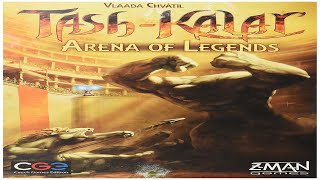
Tash-Kalar: Arena of Legends is a game played by masters of magic. Two to four summoners encounter each other in the Tash-Kalar arena, either in teams or each on his own, and prove their skill and strategy in a short but intense battle. By clever deployment of their minions, they create magic patterns for summoning powerful beings, and then use those to destroy their opponent’s forces or to prepare patterns for the ultimate legendary beings.
The game includes four different factions, each with a unique deck of beings to summon and one deck of legendary creatures. Players take turns placing their common pieces on the board, and if they succeed in creating patterns depicted on one of the cards in hand, they may play it. When played, the card summons a particular being and allows the player to perform an effect described on the card: a giant destroys neighboring pieces, a knight moves through enemy pieces, a warlord orders previously placed pieces to move and fight, an enchantress converts enemy pieces to player's own color, etc. After that, the player discards the card and the summoned being turns into a motionless piece which may be used in patterns for summoning other beings – or even be awakened and moved into combat by the effects of other cards.
Tash-Kalar: Arena of Legends offers two game modes. In the standard mode you score points for fulfilling various quests set by the Arena Masters: controlling certain points or areas of the arena, destroying a number of enemy pieces in a single turn, performing a certain combination of summonings, etc.
In melee mode, your only goal is to entertain the crowd. You do that by destroying your opponents and making them beg (i.e., making them use the catch-up mechanisms) and by summoning legendary beings. After all, people want to see a dragon! Both modes can be played as a two-player duel or as a team game with teammates sharing pieces and legendary cards, but with each controlling his own faction. (The game includes a duplicate of one faction in a different color.) The melee mode can also be played as a fierce free-for-all battle, but don't expect alliances; to achieve a good score, you need to destroy all opponents evenly as you track points scored on each opponent separately, and your lowest score is your final score.
The rules of Tash-Kalar: Arena of Legends are simple and easy to understand, but as you start to discover the tactics and are able to anticipate the opponent's moves and patterns, it turns into a real clash of wits.

- Interesting hybrid of puzzle placement and objective solving
- Frustrating but engaging player interaction
- Strategic puzzle and planning required
- Clear objectives visible to all players
- Components are solid
- Artwork on legendary cards is good
- Alternate modes of play (Deathmatch vs. High Form)
- Game holds up 11 years later
- Some objectives are difficult to achieve
- Frustration from opponent's actions disrupting plans
- Flare cards can be unbalanced and feel unfair
- Limited choice in drawing/using flare cards
- Units are static once placed, limiting tactical movement options
- Luck of the draw is significant
- Rulebook can be difficult to navigate with rules buried in examples
- Artwork on non-legendary cards is more cartoonish and less appealing
- Deathmatch mode is less strategic and satisfying
- Arkhan Wars
- Mage Knight
- Summoner Wars
Mechanics (from transcript analysis)
- Area Control — Not area control yeah you're right you're not necessarily yeah wanting to hold areas.
- Card draw — The only luck is um the card draws.
- Card Play — Objective solving in cards in your hand yeah and strategy for doing so.
- catch-up mechanism — I like the idea of having a catch-up mechanism but the fact that some of them are just way better than others.
- Deck Building — The game starts with two identical decks which is fascinating because it's more of like we both have the same options in Our Deck but the availability is going to be different.
- Limited deck size — The game ends either at nine points or you deck out.
- Objective-based scoring — It's tasks like objectives that everyone's going for whoever gets to nine points wins.
- Skirmish game — At least I would call it a skirmish game but done in such a very go like you know polyomino puzzle placement piece placement where you are trying to get the most victory points.
- Unit Placement — Where you are trying to get the most victory points and the two two ways that we've played it is uh that what was it I don't remember what they were called Death Match and the high high form.
Video topics + discussion points
Quotes (from this video)
- this game is very interesting
- it is certainly a cge production just something about their games you just can just tell that they have a very just a distinct way of making their games with their components with the way they write rules it's just it just screams CG and consistent
- man is it frustrating so then you have to find bad and I guess that's a good thing about the game is you now have to find alternate ways to get rid of that piece right
- I hate those flare cards really
- the flares are I think the game would be worse without them okay um but I also don't like the fact that some are clearly better than others yeah
- it's like okay well I'm just going to not satisfying I I personally didn't think so
- on a scale of 1 to 10 what do you giving Tosh kalaw I'm going to say seven seven that well above average but not outstanding
- it's definitely a good game um and some flaws yeah
References (from this video)

- The designer Vlada has made many highly-regarded games.
- Through the Ages: A New Story of Civilization
- Mage Knight Board Game
- Codenames
- Galaxy Trucker
- Dungeon Petz
- Space Alert
- Dungeon Lords
- Pictomania
- Star Trek Frontiers
Mechanics (from transcript analysis)
Video topics + discussion points
Quotes (from this video)
- do you guys remember the Hasbro when they did the crowdfunding for that
- all the stuff that came with it though is junk I hate them all the little extra figures that are like Silver Surfer and stuff they're like super junky
- you may get [ ] or you may get like you may is a gambling basically
- I sold all my cards played for decades and decades and decades
- Rotten Tomatoes it's miracle I never even heard of the number one stre
- I feel like these are not properly rated these don't make sense
- the ref the ref the ref is [ ] awesome
- this list sucks
- I feel like this list is not good there's way better movies than this
- I feel like Christmas movies are not they used to be good and now now they're not
- like when's the last good Christmas movie I mean is it just because we're older or you know maybe or we all the good ones are made and they don't want to make anymore
- well I mean there's tons but it's a wonderful life was the the reason why it became so well known and everything was because um it basically became free they they forgot to re-up their trademark for it or whatever
- I was just astounded by it's like so yeah I bought it and it didn't it didn't it didn't show up
References (from this video)

- Wizards battling by summoning powerful creatures
Mechanics (from transcript analysis)
- Pattern Building — Deploying common pieces to the arena in specific patterns to invoke powerful creatures.
Video topics + discussion points
Quotes (from this video)
- My name is Rodney Smith and I have something kind of different to share with you today.
- You know, on my channel here, I don't share my opinions, but that's their podcast.
- So, if you would like to hear that or any other amount of their fantastic gaming content, then I recommend you go check out that episode and all the other ones in their archives.
- He's a fellow viewer of Watch It Played and has started his own board game endeavor and hoped that I would share it with you.
- So in short, he's launched an online board game retail store called Dicey Goblin.
- So, amongst all the thousands of options you have, here are some games that we have some confidence, and obviously the community has some confidence that this might be a good one for you.
- Perhaps the most notable difference and maybe the most meaningful difference is that some of the proceeds from every sale that they make is going to go to a gaming really a charity of some kind.
- It is by the mad genius himself, Lada Shiovatel, Tash Kalar, Arena of Legends.
- In short, you're playing as powerful wizards who are battling one another by summoning powerful creatures, but you do this by successfully deploying your common pieces to the arena in specific patterns to invoke the powerful creatures that you have in your hand.
References (from this video)
- very unique abstract with thematic feel
- satisfying pattern-completion and card synergy
- steep learning curve
- can feel cutthroat
- abstract strategy with magical combat
- arena duel between rival mages
Mechanics (from transcript analysis)
- attacks and upgrades — attack opponent pieces and upgrade or move pieces to win objectives
- Card-driven effects — play a card to enact effects once a pattern is formed
- Pattern Building — place tokens to create patterns that match cards in hand
Video topics + discussion points
Quotes (from this video)
- these games still represent like the top five percent of all games I've ever played
- the theme really comes alive
- it's incredibly dynamic and fun highs and lows and a ton of agonizing decisions
- it's a very unique abstract game where the theme actually comes through
- it's cutthroat brutal game actually