


















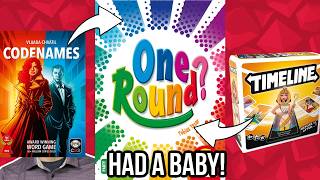

One Round? Deep Dive
What the Community Thinks About One Round?
One Round? has earned strong consensus among reviewers as a fresh, approachable party game. Grant Lyon declared it one of his top cooperative and party games of the year, while BoardGameCo's Alex Rackle rated it 3.5 out of 5, placing it in the "solid but not standout" tier of the word-association genre. Let's Table It's Sarah praised it for sticking around in regular rotation, despite acknowledging it won't appeal to every group. Board Gaming Ramblings included it in their top small-box games of 2025. Where reviewers diverge is primarily on the 20-second timer: some find it essential tension, while others argue it pushes the game away from the clever clue-crafting they prefer. The broader consensus holds that One Round? succeeds because it blends familiar DNA (Codenames, So Clover, Just One, Timeline) into a genuinely distinct package.
Core Mechanics That Define One Round?
Word Placement in a Numbered Circle
At its mechanical heart, One Round? is a game about spatial reasoning applied to word associations. Unlike traditional number-line games, One Round? arranges its 0-100 scale into a circle, creating a puzzle with no single "correct" endpoint. Players begin with three anchor words already placed on the circle at fixed positions: typically 0, 33, and 66. Each round, one player draws a number card and must supply a one-word clue that bridges the two words on either side of where that number falls. The remaining players then collaboratively decide which gap the clue belongs in, choosing from multiple possible positions. For example, Grant Lyon recalled a memorable game where "harvest," "potato," "fried," and "poutine" occupied adjacent positions. At that stage of the game, giving a clue for a number between any two of those four words demands much tighter word association; there is no longer space for loose synonyms. The circular arrangement forces players to think relationally: not merely whether a word sits near two others, but whether it fits one gap better than another. Game Boy Geek noted a further probability layer, since narrowing the range a card can occupy shifts the odds toward a particular gap. That light strategic layer adds depth without overwhelming casual players.
The Timer and the Clue-Giver's Dilemma
One Round? assigns each clue-giver a 20-second timer, a rule that has become the game's most polarizing element among reviewers. The timer forces the clue-giver to supply their word quickly, without the luxury of lengthy deliberation. Notably, once the clue-giver places their word down, the timer flips and the remaining players have that same amount of time to guess. The timer creates what Game Boy Geek called "the agonizing listening" phase: the clue-giver sits silent while others debate and argue about placement, unable to give hints, raise eyebrows, or say anything. Game Boy Geek appreciates timed games generally but finds this one a poorer fit than in other word games, and plays without it by default for more creative clue-crafting. BoardGameCo's Alex Rackle took a different view: the timer shifts the game from a "clever clue" experience toward a "speed-based" one, where panic under pressure can override creative thinking. That tension between rushed clues and careful association defines how players experience the game.
The One Round? Experience
Tension and Conversation
Reviewers consistently highlighted that the mechanical experience is inseparable from the social experience. Let's Table It noted that the game "creates surprisingly fun and funny conversations" because players must reason together about whether "homework" belongs between "dog" and "coconut," and why. The clue-giver is trapped in liminal tension: waiting, listening, mentally cheering or despairing as the group lands on the right (or wrong) placement. Game Boy Geek stressed that the real joy comes from watching players reason together. He emphasized the tension of listening while silent: some players may guess correctly while others argue against them, and the clue-giver must endure all of this without speaking. Grant Lyon described a moment late in a game where the gaps between numbers had narrowed so much that each new clue required exquisite precision. That escalating pressure makes the end-game feel more intense than the opening, a rare quality in party games. Board Gaming Ramblings echoed this: the game is "really fun" partly because the social interaction drives the experience. The conversations are what make One Round? a party game rather than a pure puzzle.
Familiar Yet Fresh
Reviewers repeatedly landed on the same observation: One Round? feels immediately recognizable because it borrows DNA from beloved predecessors, yet it assembles those pieces into something new. Grant Lyon explicitly said it "slots in really well" alongside Just One, Codenames, and So Clover, positioning it as a natural recommendation for fans of those games. Let's Table It compared it to both So Clover (the relational word-bridging) and Edo (the numeric ranking), noting that the game takes a familiar gesture and gives it a circular twist. That combination of comfort and novelty makes One Round? an easy teach: experienced gamers grasp it immediately, and newcomers find the core task of thinking up a connecting word familiar enough that only the context surprises them. Grant Lyon imagined bringing it home to family gatherings, confident it would play equally well with teenagers and grandparents. The light complexity means no one feels lost, yet the creative demands keep engaged players interested across repeated plays.
What Makes One Round? Stand Out
Nearly Infinite Replayability
BoardGameCo's Alex Rackle emphasized a crucial distinction: One Round? is "nearly infinitely replayable" because the clues are player-generated, not drawn from a fixed deck. Every time someone sits at the table, the words they choose are unique to that moment, that group, that table. There is no memorization fatigue, no "I've seen all 200 cards" problem. The challenge mode adds structure by assigning categories (e.g., "choose a vehicle," "choose something on a desk," "choose something sweet"), elevating replayability by creating thematic constraints. The one-life mode, available as a difficulty variant, radically raises the stakes: lose once, and the team enters overtime immediately, where both clue-giver and guessers race against a single dwindling timer. Alex Rackle called this "my favorite way to play," finding it the ideal tuning for experienced groups who want the game to stay challenging.
Content and Accessibility
Let's Table It praised the sheer volume of included scenarios and replayable content. Sarah noted that the rules include provided categories for the challenge mode, removing the burden from players to invent their own constraints while making every game feel fresh. The prompts shipped in the box drive word choice in ways that feel organic rather than forced, so One Round? does not need house rules or expansions to stay interesting across a dozen plays. Grant Lyon appreciated the clarity of teaching and the speed of play: 15 minutes means it fits into social game nights without dominating the evening, allowing multiple rounds or games. That modularity compounds its value for casual and party-game tables.
Potential Drawbacks
The Numbered Circle Is Not Intuitive for Everyone
Let's Table It reported that their daughter struggled with the circular arrangement initially. Sarah explained: "The numbered circle took our daughter a little while to get used to. It seemed a little harder to wrap her head around than a straight number line." This reflects a real accessibility trade-off. The circular layout makes the game unique and prevents a clear "start" and "end" that would make guessing more mechanical, yet it adds a spatial reasoning demand that linear games like Edo sidestep. Players must visualize gaps in a circle, not a line. Once players internalize it, it becomes natural, but the learning curve exists.
Group Dependent and Timer-Driven Tension
Let's Table It observed that the game "really depends on your group. If people struggle to think outside the box or don't enjoy that kind of challenge, it probably won't land quite as well." The creative demands are real: players who prefer deterministic or luck-driven games may find the open-ended clue-giving anxiety-inducing. Additionally, the timer is a built-in pressure mechanic. BoardGameCo's Alex noted that while some players thrive under timed pressure, others find it antagonistic to the "creative clue" experience they seek. For groups that dislike real-time games entirely, the timer is a hard friction point, even if the game offers easy difficulty adjustments and can be played without it via house-rule.
If You Enjoy One Round?
Grant Lyon recommended Just One and Codenames for players seeking similar word-bridging experiences. Let's Table It noted the mechanical kinship with So Clover and Edo, both of which reward creative association and numerical or relational thinking. BoardGameCo's Alex Rackle highlighted So Clover as his preferred game in the genre, praising its simultaneous clue-giving (which removes timer pressure) and elegant cooperative structure. He also recommended Just One for "laughs and fun" and Alibi as an underrated choice for groups that enjoy clever elimination and connection-making. For players wanting higher stakes, Mysterium and Rear Window deliver the tense "silent clue-giver listening to others reason" dynamic that One Round? partially captures.
What Reviewers Are Saying
"It's very enjoyable. Like most of these party games, the most enjoyable part about this is the conversations as to what they mean. It's more about the experience and the conversation than the actual winning of it all. However, I am glad that there is a win-loss condition, because too many party games come out these days with 'Hey, you got a 16. Way to go.' I hate those party games."
— Game Boy Geek
"I think One Round is perfect for fans of party games, people who enjoy word games, players who like games that encourage conversation, and anyone who enjoys making clever connections. It feels familiar enough that almost anyone can jump in, but it still brings a fresh twist to the genre."
— Let's Table It
"I really like One Round, and I think it's going to be one of my top party games, top cooperative games of the year. It's clever, it's fun, it's easy to play. This is a game I'm going to bring home to my family, and I think my family will really like it. I can see it being a hit with different ages and a casual group of people."
— Grant Lyon