/pic3613441.jpg)












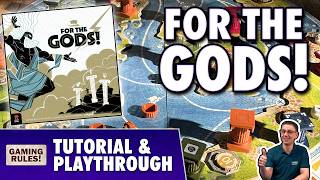


Arena: For the Gods! Deep Dive
What the Community Thinks About Arena: For the Gods!
Arena: For the Gods! has generated genuine excitement among board game reviewers who experienced it at conventions. Across multiple playthroughs and demo sessions, a consistent picture emerges: reviewers praise the game for being deceptively simple to teach yet tactically rewarding to play. Wayne and Matt from Board Stupid, who played it at Essen, called it "legitimately one of the best games we played the entire weekend despite it being in a prototype format," and noted it was "very very surprisingly simple to teach and learn." The game balances accessibility with strategic depth, making it approachable for new players without sacrificing meaningful decisions for experienced ones.
Reviewers appreciate how elegantly the design avoids the mean-spirited cutthroatness found in some area control games. Grant Lyon noted that while there is "certainly still some cutthroatness" in competing for the same territories, "you're not destroying anything that they've built or that sort of thing." This makes the experience feel more like "you're just trying to out clever and build up higher and build in better places than your opponents" rather than direct player elimination or destruction mechanics. The overall sentiment treats Arena: For the Gods! as a fresh take on area majority that respects both competitive play and respectful interaction.
Core Mechanics That Define Arena: For the Gods!
Bag Building and Imperfect Information
At its heart, Arena: For the Gods! uses bag building to drive tension and strategy. Players accumulate tokens in a personal bag throughout the game, drawing a random subset each turn to determine what actions they can take. This creates productive uncertainty: you never know exactly what you'll draw, forcing you to adapt your strategy based on what emerges from your bag. Grant Lyon appreciated this mechanic specifically, noting "I like that tension of it, too, because, you know, it's never perfect information. You're pulling from a bag and then you have to respond to what you have in the bag." The bag also serves as the game's timer, with the game ending when a player can no longer draw enough tokens to refill their hand. This creates a natural push-pull dynamic: spend tokens aggressively to accomplish your goals, or hold back and risk missing opportunities.
Area Majority and Temple Building
Players navigate the Mediterranean archipelago, establishing temples in different regions to claim control. The core challenge is building the tallest temple in each area, where height is determined by the tokens drawn from your bag. Each token type has a pip value (blank, one, two, or three), and all pieces in a single temple must share the same pip value, forcing meaningful tower-building decisions. Board Stupid's reviewers noted the game creates genuine tension during this phase: "especially like when you start playing three four player but even the two players that we tried the first time was really tense as well." Karly from Board Game Buzz observed that "with 12 unique god powers, each game offers fresh strategies and dynamic gameplay, ensuring high variability," keeping the area control feel fresh across multiple plays. The areas themselves are worth different victory points, encouraging players to prioritize high-value territories while also competing in lower-value zones to maintain a balanced presence.
The Arena: For the Gods! Experience
Accessible yet Tactically Engaging
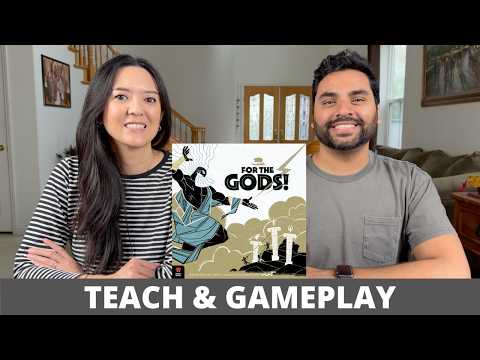
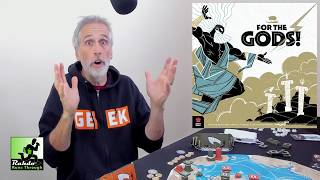
One of Arena: For the Gods!'s greatest strengths is how it bridges the gap between easy-to-teach and deeply strategic. Rahdo, demonstrating the game's full ruleset in a two-player tutorial, walked through the mechanics clearly and smoothly, showing that new players can grasp the core system within a few minutes. Yet the actual play reveals layers of decision-making: which god powers to collect early, how aggressively to commit tokens to particular territories, when to hold back and build presence elsewhere, and how to time the use of special god abilities for maximum impact. The game puts players "on their toes" without overwhelming them. Board Stupid's reviewers captured this balance well: "quite like very easy to learn and easy to play. It's beautiful. You just you got these tokens in the bag. They're basically segments for a column or a tower."
Dynamic Interactive Play Across Player Counts
Arena: For the Gods! adapts meaningfully to different player counts. In a two-player game, the competitive pressure is direct and tense, with fewer islands in play creating focused head-to-head conflict. At three and four players, the game becomes noticeably more interactive and aggressive. Board Stupid noted: "at two players, you got less territories on the on the map. So, it gets very much like I see what you're doing there. I'm going to do that. I'm going to try to set up traps... While a four is very much more like aggro almost maybe way more interactive." This scalability means the same rules create genuinely different game experiences depending on your table size, encouraging repeated plays in different configurations.
What Makes Arena: For the Gods! Stand Out
Elegant God Powers That Reshape Strategy
Each game features a rotating set of randomly assigned gods, each offering unique powers that fundamentally alter how players approach the board. Rahdo's detailed walkthrough revealed the depth here: Demeter allows players to "teleport" temple pieces from one location to another, creating long-distance leverage; Aphrodite grants bonus victory points for controlling specific temples devoted to her; Hera provides wild tokens that add flexibility; Hestus immediately increases a temple's height, providing instant gratification but unpredictability since you can't control when you'll draw the token again. These powers aren't just flavor: they reshape tactical priorities and create asymmetric strategies. With multiple god options available each game and players choosing which to invest in, Arena: For the Gods! ensures that no two games feel identical, rewarding players who discover synergies between their chosen gods and their territorial strategy.
Beautiful Production that Supports Gameplay
Reviewers consistently praised the game's visual presentation, and importantly, its clarity. Board Stupid noted: "the board looks a little bit too simplistic" at first glance, yet "when you're sitting here, it is very easy to tell the heights" of competing temples due to the physical three-dimensionality of the components. This matters mechanically: the visual hierarchy lets players quickly assess the current state without constant verbal recaps. The new artwork is "absolutely beautiful" and the production values are "a step ahead." Mighty Boards' design philosophy, favoring elegant clarity over graphic complexity, serves the game's accessibility and flow. The components do the work of teaching, leaving mental bandwidth for strategy.
Potential Drawbacks
Limited Strategy Space for Some Player Types
While Arena: For the Gods! excels at area majority gameplay, players seeking high-interaction mean-spirited destruction mechanics or direct player conflict will find the experience gentler than expected. Grant Lyon observed that the game prioritizes "out clevering" opponents and building in better positions rather than dismantling their progress. This is intentional design, but it means players accustomed to Catan-style resource denial or aggressive military domination may find the experience less combative than they prefer. The game asks players to accept competition through superior positioning rather than through denying others their resources.
Bag Building Luck Variance in Specific Situations
Like all bag-building games, Arena: For the Gods! subjects players to draw variance. Grant Lyon mentioned this explicitly: "when you build a temple out there, you can only build it the height of the sort of same pip value of the pieces that you got." If you're heavily invested in controlling a particular region and draw the wrong pip values, you may be unable to improve your position as desired. While this variance is mostly positive, creating tension and forcing adaptation, there are moments where a player's ability to capitalize on their strategy depends on what emerges from their bag. Experienced players embrace this as part of the push-and-adapt experience, but players preferring pure strategic predictability may occasionally feel constrained by luck.
If You Enjoy Arena: For the Gods!
Players drawn to Arena: For the Gods! will likely enjoy other elegant area majority games like Goa and Concordia, which emphasize smart positioning and economic engines over destruction. The game's emphasis on building and development without elimination parallels Undaunted (designed by some of the same creative team), which uses its own unique deck-building approach to create tense but respectful conflict. The Mediterranean setting and temple-building theme echo historical games that blend thematic narrative with strategic mechanics.
What Reviewers Are Saying
"This is um coming out on Kickstarter, should be live right now. So check the link down down there and we're talking about one of the new project from uh Mikey Boards. You know, we we love what what they do. Um and this one is for the gods. For the gods is a fantastic easy to learn area majority game that plays in about an hour. Matt and I played it at Essen and it was legitimately one of the best games we played the entire weekend despite it being in a prototype format."
— Board Stupid
"When you build a temple out there, you can only build it the height of the sort of same pip value of the pieces that you got. So, you might draw three ones and one three. Well, you could go build those three ones on a on a spot, but you're trying to not only build the highest temples, but potentially the largest pip temples. And then if there are these little god pieces on the plate area that you are building in, you can add them to your bag. So, there's a light bag building element to it because you can be adding these sort of god pieces into your bag."
— Grant Lyon
"You're just trying to out clever and build up higher and build in better places than your opponents. And so there's certainly still some cutthroatness to it where somebody's going for something and you come in and build just one more higher than them, but it's not quite as mean as like you're not destroying anything that they've built or that sort of thing."
— Grant Lyon