

















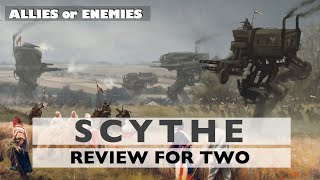
Scythe box art

Scythe

Game Info
Year
2016
Players
1-5
Age
14+
Playtime
115 min
Publisher
Stonemaier Games
Collection
Ratings
Expansions & Family
Mechanic profile
Percentile rank vs. all games
Vibe profile
How this game feels to play
Description

It is a time of unrest in 1920s Europa. The ashes from the first great war still darken the snow. The capitalistic city-state known simply as “The Factory”, which fueled the war with heavily armored mechs, has closed its doors, drawing the attention of several nearby countries.

Scythe is an engine-building game set in a 1920s era, alternate-history. It is a time of farming and war, broken hearts and rusted gears, innovation and valor. In Scythe, each player controls one of five factions of Eastern Europe, all of which are attempting to earn their fortunes and claim their stakes in the land around the mysterious Factory. Players conquer territory, enlist new recruits, reap resources, gain villagers, build structures, and activate monstrous mechs.

Each player begins the game with different resources (power, coins, combat acumen, and popularity), a different starting location, and a hidden goal. Starting positions are specially calibrated to contribute to each faction’s uniqueness and the asymmetrical nature of the game (each faction always starts in the same place). Scythe uses a streamlined action-selection mechanism (no rounds or phases) to keep gameplay moving at a brisk pace and reduce downtime between turns. While there is plenty of direct conflict for players who seek it, there is no player elimination.

Scythe gives players almost complete control over their fate. Other than each player’s individual hidden objective card, the only elements of luck or variability are “encounter” cards that players will draw as they interact with the citizens of newly explored lands. Each encounter card provides the player with several options, allowing them to mitigate the luck of the draw through their selection. Combat is also driven by choices, not luck or randomness. Every part of Scythe has an aspect of engine-building to it. Players can upgrade actions to become more efficient, build structures that improve their position on the map, enlist new recruits to enhance character abilities, activate mechs to deter opponents from invading, and expand their borders to reap greater types and quantities of resources. These engine-building aspects create a sense of momentum and progress throughout the game. The order in which players improve their engines adds to the unique feel of each game, even if having played one faction multiple times.

Ask a Rules Question
All mentions
Browse transcript mentions, sentiments, pros/cons, mechanics, topics, quotes, and references.
Total mentions: 616
This page: 50
Sentiment: pos 33 · mix 8 · neu 3 · neg 1
Mentions per page
Showing 401–450 of 616
Video ffMLIL5qGQg Watch It Played Rules Teach at 0:28 sentiment: positive
Watch It Played - Scythe video thumbnail
Click to watch at 0:28 · YouTube ↗
Overall sentiment (raw)
positive
Pros
  • High level of player interaction through combat and area control.
  • Each faction has unique abilities and starting conditions.
  • Multiple paths to victory through different star placements.
  • Engaging theme and world-building.
  • Modular board offers replayability.
Cons
none
Thematic elements
  • war and its lingering effects, farming, military expansion, exploration
  • alternate history 1920s Eastern Europa
Comparison games
none
Mechanics (from transcript analysis)
  • action selection — Players place an action token on their player mat to choose one of four sections, each with a top and bottom row action. The chosen section must be different from the previous turn.
  • Area Control — Players control territories by having their units present. Structures also grant control over a territory.
  • Combat — Combat is resolved using secret bids of power and combat cards. The winner gains control of the territory and places a star, while the loser retreats units.
  • Engine Building — Upgrading technology, deploying mechs, building structures, and enlisting recruits provide ongoing benefits and new action options.
  • Hand Management — Players manage a hand of combat cards and secret objective cards.
  • Modular Board — The board is double-sided and can be rotated, with optional expansion boards available.
  • Resource Management — Players collect and spend resources like wood, oil, food, and metal to perform actions.
  • Secret objectives — Players have secret objectives that can be revealed and completed for a star.
  • Set Collection — Players collect stars by achieving various goals (upgrades, mechs, buildings, workers, objectives, combat wins, popularity, power).
  • Variable player powers — Each faction has unique abilities and starting conditions.
  • Worker Placement — Workers are placed on territories to gather resources or produce goods. They can also be moved by mechs.
Video topics + discussion points
No key topics recorded for this video.
Quotes (from this video)
  • In an alternate history 1920s, the war might be over, but its effects linger, as you farm the land, enhance your forces, and explore new territories, all within the shadows of great mechanized war-machines that threaten to unleash their payload on enemies that draw their attention.
  • At the end of the game, the player with the most wealth is the winner.
  • The game also comes with solo rules and the components to play them but I will leave that for you to discovery on your own.
References (from this video)
No references stored for this video.
Video oAPJfb7_1Vc watch it played Rules Teach at 0:25 sentiment: positive
watch it played - Scythe video thumbnail
Click to watch at 0:25 · YouTube ↗
Overall sentiment (raw)
positive
Pros
  • Adds two new factions to the game.
  • Enhances gameplay for six or seven player games.
  • Introduces new tokens and player mats that affect strategy.
  • New faction abilities offer unique tactical options.
Cons
  • Game takes longer to play with more players.
  • New players are not recommended to use the new factions initially.
Thematic elements
none
Comparison games
none
Mechanics (from transcript analysis)
  • Combat — New combat-related abilities like 'Sword' and 'Shield' for Albion, and 'Ronin' for Togawa, modify combat power or outcomes.
  • faction abilities — The expansion introduces new faction abilities for Togawa and Albion, influencing movement, combat, and territory control.
  • Movement — Abilities like 'Burrow' and 'Rally' for Albion, and 'Toka' and 'Shinobi' for Togawa, allow for enhanced or altered movement rules, including crossing rivers and moving to territories with tokens.
  • Player Mats — New player mats are included for random distribution, with specific faction mats for the new factions.
  • solo mode — Additional cards are included for using the new factions in the optional solo version of the game.
  • Territory control — Flag tokens for Albion and armed trap tokens for Togawa influence territory control scoring and mechanics.
  • tokens — New tokens are introduced for factions, including flag tokens for Albion and trap tokens for Togawa, each with unique game effects.
Video topics + discussion points
No key topics recorded for this video.
Quotes (from this video)
  • In this video we’re going to learn the Invaders from Afar expansion for Scythe.
  • Designed by Jamie Stegmaier and published by Stonemaier Games with art and world building by Jakub Rozalski.
  • And that’s everything you need to know to include the Invaders from Afar expansion into your games of Scythe.
References (from this video)
No references stored for this video.
Video hKpJZRDPhpY Watch It Played Analysis at 2:31 sentiment: positive
Watch It Played - Scythe video thumbnail
Click to watch at 2:31 · YouTube ↗
Overall sentiment (raw)
positive
Pros
  • Personalizes worker meeples with faction-specific art.
  • Provides more substantial and visually appealing action tokens.
  • Upgrades cardboard tokens for encounters, traps, and flags.
Cons
none
Thematic elements
  • factional competition, resource management, engine building
  • post-WWI alternate history
Comparison games
none
Mechanics (from transcript analysis)
  • action token upgrade — Replaces cardboard action tokens with more substantial wooden pieces featuring faction logos.
  • token upgrade — Wooden pieces for encounters, traps, and flags replace cardboard tokens.
  • worker meeple upgrade — Replaces standard worker meeples with larger, uniquely printed versions specific to each faction.
Video topics + discussion points
No key topics recorded for this video.
Quotes (from this video)
  • My hope was that by showing you some of these products if this is something that you might have an interest in then you get a pretty good idea of what it is that they have to offer.
  • If you have dungeon pets you can now get an upgrade set with pieces that are shaped more appropriately for what they represent.
  • Upgrading components in your games as you might have an interest in would probably make for a pretty impressive presentation.
  • Hopefully this video gave you a sense of the variety and quality of the product.
References (from this video)
No references stored for this video.
Video fzdfK4yEcO4 Watch It Played Rules Teach at 0:21 sentiment: positive
Watch It Played - Scythe video thumbnail
Click to watch at 0:21 · YouTube ↗
Overall sentiment (raw)
positive
Pros
  • The resolution module adds a new, varied end game condition.
  • Airships add new movement capabilities and transport options.
  • Airships can freely move over rivers and into lakes.
  • Airships can enter and exit territories with enemy units.
  • Airships have unique abilities detailed on passive and aggressive tiles.
  • Airships can transport workers or resources.
  • Advanced variant for drawing personal random tile combinations.
Cons
  • Airships cannot initiate combat on their own.
  • Airships do not increase the number of combat cards in a fight.
  • Airships will not trigger traps (with Invaders from Afar expansion).
  • Airships cannot move through tunnels and/or mines.
  • Abilities of unlocked mechs do not apply to airships.
  • Airships never control the territories they are in.
  • When dropping workers off, the space cannot contain any opponents.
  • The advanced variant with personal random tile combinations is not advised for games of four or more players due to information overload.
Thematic elements
none
Comparison games
none
Mechanics (from transcript analysis)
  • Airships — Airships are new units that can be claimed by players in their faction's color. They can move over rivers and into lakes, and can enter and exit territories with enemy units without stopping. They cannot initiate combat on their own and do not increase the number of combat cards available. Airships can transport up to two workers or three resources.
  • Passive and Aggressive Attributes — Airships have passive and aggressive attributes detailed on tiles. An example of a passive ability is producing one extra resource on a location where the airship is present. An aggressive ability example is opponents paying a dollar for each unit moved out of the airship's territory.
  • Resolutions — This is a new end game condition module that adds variety to how the game concludes. Players shuffle piles to select one resolution, which is then read aloud and becomes the new end game condition. This can lead to multiple players achieving certain milestones before the game ends, as it allows for additional turns after the sixth star is placed.
  • Transport — Airships have the ability to transport up to two workers or three resources. Picking up or dropping off happens before, during, or after movement as part of a move action. Resources are under control while in the airship and can be spent. Workers cannot bring resources with them when transported and cannot produce or trade from the airship.
Video topics + discussion points
No key topics recorded for this video.
Quotes (from this video)
  • This was designed by Kai Stark and Jamey Steggmaier, and was published by Stonemaier Games.
  • But this expansion is going to add two new modules to the base game, both airships and resolutions.
  • Normally, a game of Scythe will end immediately after a player puts their sixth star into play.
  • But with the optional resolution module, you'll shuffle these piles randomly, selecting one to place face-up near this triumph track.
  • This new resolution is then read aloud and will be the new end game condition for all of the players.
  • For example, this is Mission Possible and it says that during the setup you'll reveal two objectives, and place them here.
  • After a player has placed their sixth star, each other player takes one final turn, but may not move units.
  • With that understood, now let's learn about the airship module.
  • For this, each player will claim an airship in their faction's color, and place it on their home base during the setup.
  • You'll now shuffle the two airship decks separately distinguishing them by their backs.
  • So again just to be clear all airships in the game will share these exact same attributes.
  • To move an airship, like any unit, you select the move action and then choose the airship as one of the units moving.
  • The distance it can travel is equal to the range showing on its passive card in the upper right hand corner here.
  • So it can move up to two hexes in this case.
  • But remember in Scythe, moving zero spaces is not an option in a move action, so this could move one or two hexes.
  • If you're moving an airship using factory movement, instead add one extra space of movement to its normal amount.
  • So in this case, the airship could move up to 3 hexes in total.
  • Airships do have some other special rules as well.
  • First of all, as we just saw, they can freely move over rivers and into lakes.
  • They can also go into and out of territories with enemy units.
  • Entering an enemy territory does not force an airship to stop even if it contains another airship.
  • That said, like other units, an airship may not move onto its own or an opponent's home base.
  • It's also important to realize that these cannot initiate combat on their own.
  • In other words, even though it's moved into a territory with enemy workers, these will not be scared off.
  • It also can't initiate combat by moving into this territory with an airship, or with other enemy units.
  • In the same way, those enemy units cannot initiate combat with the airship.
  • Now that said, it might be in a territory when a fight would break out, but if so, they do not increase the number of combat cards that a player would be able to use in that fight.
  • If you have the Invaders from Afar expansion, you should also be aware that airships will not trigger traps.
  • They also can't move through tunnels and/or mines, and the abilities of your unlocked mechs do not apply to them since they are not mechs or characters themselves.
  • Now that said, they will have their own unique abilities as printed on both of their tiles so keep those in mind.
  • For example, in this combination, the passive ability says that when you produce on a location where your airship is present, you'll produce one extra of that resource.
  • And on the aggressive tile, it says that opponents may not move their characters or mechs out of your airship's territory unless they pay you one dollar for each unit moved.
  • Remember, there are 8 different passive and aggressive tiles, so a variety of combinations can be created each time you play.
  • And while I said that airships don't actively cause combat themseves, that can change if their special ability allows it.
  • Like you'd find on this blitzkrieg aggressive tile.
  • It's also important to realize that airships never control the territories that they are in.
  • You would still need other pieces in that space to control it.
  • So if you had an airship in a territory alone, with resources on the ground, you do not own them, and they can't be spent by you.
  • That said, on every aggressive tile, you'll find this ship either has the ability to transport up to two workers or three resources of any type.
  • Picking up or dropping them off happens before, during, or after movement as part of a move action,
  • and the resources or workers can be put into the ship during the movement like this.
  • If you're carrying resources, they are under your control while in the airship, which means that you can also spend them.
  • If your airship allows you to transport workers instead, they cannot bring resources with them.
  • Also, they can't produce or trade from here and they don't allow you to control a territory from within the airship.
  • You'd still need some units on the ground.
  • Also, when dropping workers off, the space can't contain any opponents.
  • For the purposes of scoring remember, an airship in a territory alone cannot control it, but you can count any resources that it's holding at that time.
  • As we wrap up, I should mention that as an advanced variant, players can choose to draw their own random aggressive and passive tile combinations that will affect their airship only.
  • But this is not necessarily advised in games of four or more players as it's a lot of information to keep track of, So choose to use that variant wisely.
  • The back of rulebook also includes some Errata and other variants that you can try, And there's also Automa rules and cards for using airships in solo play along with a new achievement sheet, but I'll leave those for you to discover on your own.
  • That said, if you have any questions about anything that you saw here, don't hesitate to put them in the comments below and I'll gladly answer them as soon as I get a chance.
  • But until the next episode, thanks for watching!
References (from this video)
No references stored for this video.
Video I-s37rXji9A watch it played Rules Teach at 0:25 sentiment: positive
watch it played - Scythe video thumbnail
Click to watch at 0:25 · YouTube ↗
Overall sentiment (raw)
positive
Pros
  • The expansion offers an eight-episode campaign with a changing storyline.
  • Players can unlock new rules and game components during the campaign.
  • After the campaign, players can reset and play it again.
  • The expansion includes 11 individual modules to mix into regular games.
  • Compatible with other expansions for more players (Invaders from Afar, The Wind Gambit).
  • Modules can be played outside the campaign, and there are rules for solo and cooperative play.
Cons
  • Players must carefully read each section of the campaign as they play.
  • The video is a visual aid, not a complete rules replacement.
  • Spoilers are present and warnings are given before new sections are discussed.
  • Modules can be a surprise if not viewed ahead of time.
  • Players must avoid exploring box contents until told to during the campaign.
  • Breaking an alliance results in a $10 coin penalty.
  • The Fenris faction starts with -16 dollars due to influence tokens.
  • Mods marked with a specific icon cannot be used against non-player units.
  • Certain mods do not apply to combat against Mad Tesla.
Thematic elements
none
Comparison games
  • Scythe
  • Scythe: Invaders from Afar
  • Scythe: The Wind Gambit
Mechanics (from transcript analysis)
  • alliances — Players can propose an alliance, exchanging alliance tokens and gaining coin bonuses. Allies can use each other's faction abilities, but attacking an ally breaks the alliance, resulting in a $10 coin penalty at the end of the game.
  • Campaign play — An eight-episode campaign with a changing storyline, unlocking new rules and components as you play. The campaign can be reset and played again.
  • faction abilities — Specific modules introduce new factions with unique abilities, such as the Vestan faction's use of extra factory cards and random mecha-bility tokens, or the Fenris faction's 'influence' ability.
  • infrastructure mods — These mods are purchased following the same restrictions as mech mods, costing $50 each, and can be used once per game by flipping the mod over.
  • Mad Tesla — A non-player unit that moves around the board and can initiate or be engaged in combat. Its strength is determined by dice rolls and combat cards. Defeating it grants popularity and reduces its health, with rewards for destruction.
  • mech mods — Players draw two random mod tokens at the end of each episode and can purchase them to customize their mech abilities, with a limit of 6 mods at a time.
  • Modular expansion — 11 individual modules that can be mixed in any combination into regular games of Scythe.
  • peace triumph track — Another variant triumph track that changes scoring objectives, allowing players to complete up to two objectives and gain stars for various conditions like having mechs, recruits, popularity, or controlling resources.
  • perks — Players can spend $15 wealth at the beginning of each new episode to purchase a single perk for that episode, which can only be chosen once per campaign.
  • rivals — Players can declare rival relationships by placing stars on other players' home bases. Winning combat allows players to take back a star from an opponent's base, with a bonus if it was from the defeated opponent.
  • Tesla module — Introduced in episode 7, players track encounter tokens to locate Tesla. In episode 8, Tesla becomes a character and mech. It acts as a non-player combat unit with its own health and turn.
  • triumph track — At the end of each episode, players check off boxes on the triumph track based on achievements. Fully filled rows and columns grant a $25 bonus to the final score.
  • war triumph track — A variant triumph track that introduces new scoring conditions for upgrades, structures, combat stars, and holding combat cards.
Video topics + discussion points
No key topics recorded for this video.
Quotes (from this video)
  • We're going to learn the 1 to 5 player expansion to Scythe The Rise of Fenris
  • This is an eight-episode campaign with a changing storyline that unfolds as you play
  • You'll unlock new rules and game components as you go and when you finish the campaign you can reset everything and play it all again
  • You can also skip the campaign and directly open everything where you'll find 11 individual modules that you can then mix in any combination you like into your regular games of Scythe
  • This video should be seen as a visual aid but not a complete rules replacement
  • The rules for the various modules that get introduced during the campaign those we're going to go over right now
  • You may then purchase neither of them either of them or both at a cost of 50 each
  • You can never have more than 6 mods at a time and you'll mark them here as they'll carry over from game to game
  • Your total wealth will not factor into winning the campaign so don't be afraid to spend it
  • This is an entirely new faction that becomes available at the conclusion of episode 3 in the campaign
  • This figure represents a unit that is not controlled by any of the players
  • Mad Tesla will always take his turn last
  • if you lose resolve a loss as normal and retreat mad Tesla back to the factory which might start another combat
  • on the other hand if you win you immediately gain one popularity and place a combat star on the triumph track if possible
References (from this video)
No references stored for this video.
Video svRha4lqoQs Meeple University Analysis at 4:37 sentiment: positive
Meeple University - Scythe video thumbnail
Click to watch at 4:37 · YouTube ↗
Overall sentiment (raw)
positive
Pros
  • Combining trade and produce actions on the second turn allows access to bottom row actions.
  • Focusing on gaining three coins from bottom row actions can be a continuous source of income.
  • Focusing on achieving six stars is a key strategy, rather than spreading efforts too thin across all ten categories.
Cons
  • Trying to achieve all ten categories for stars is impossible.
  • Spreading oneself too thin may result in not getting any stars.
Thematic elements
none
Comparison games
none
Mechanics (from transcript analysis)
  • Resource Management — Focus on gaining as many coins as possible from bottom row actions, specifically the section that gives three coins, which can be used repeatedly even after completing the objective.
  • Star Placement — Focus on achieving six stars, as there are only six available and trying to do all ten categories is impossible.
  • Worker Placement — The first bottom row action on the second turn can be taken by combining the trade and produce actions.
Video topics + discussion points
No key topics recorded for this video.
Quotes (from this video)
  • hopefully using the additives video I've done and find them useful otherwise check them out here or check the descriptions below this video
  • if you like and if they are against you want to be featured in this series and I will try to get it right good or if you just want to say hi
  • if we have videos for the game switcher here I'll also put links in the description so you can have a look at our review how to pay up title videos
  • I think that's okay that's something that I think players overlooking Viticulture but they don't want every card to have utility
  • This is a big area of the game where you should actively discuss it with other players
References (from this video)
No references stored for this video.
Video tLp6mPtIj5U Meeple University Unboxing at 0:00 sentiment: positive
Meeple University - Scythe video thumbnail
Click to watch at 0:00 · YouTube ↗
Overall sentiment (raw)
positive
Pros
  • Minis described as detailed with a deluxe edition presence.
  • Clear on-box/side-of-box instructions and good component organization.
  • Compartments and optional under-playboard storage improve accessibility.
  • Space for expansions and ongoing component slots for future content.
  • Deluxe components (coins, tokens) and varied starting cards for different characters.
Cons
  • The game is large and may be cumbersome to transport on holidays or flights.
Thematic elements
none
Comparison games
  • Scythe
Mechanics (from transcript analysis)
  • card_tableau — Cards can be placed into a personal Tableau to earn points; indicates a card-based engine or tableau-building element.
  • gather — Described as one of the actions (gather) that can be chosen as part of a three-action set (move, play, gather) and used for gathering resources.
  • hex_tile_setup_and_location_tiles — The map uses hex tiles with designated zones (south, central, north) and location tiles that influence setup and play.
  • Move — One of the actions listed alongside play and gather; used for moving pieces on the map.
  • play — One of the actions listed alongside move and gather; used to play cards or take actions on the board.
  • recruit_workers — Workers are recruited into a player's area using tokens, indicating an engine-building or worker recruitment mechanic.
  • starting_cards_and_characters — There are starting cards for six different characters, each with a companion, implying a character-selection mechanic with asymmetry.
  • use_of_tokens_and_corruption_tokens — Corruption tokens and various tokens (e.g., for workers and other game effects) are used as part of the component economy.
Video topics + discussion points
No key topics recorded for this video.
Quotes (from this video)
  • these minis are pretty detailed I think I'm not really experienced with minis but just for by the look of it I've seen the worst ones I guess
  • I should probably paint this
  • the deluxe coin Edition
  • it's a big game
  • I am very excited to play these and I will definitely show you how it goes
  • do you keep the punch board
  • there's still space for more tiles
  • I am considering to bring this it is a big game
  • are you excited for Expeditions
References (from this video)
No references stored for this video.
Video 6xgCqomTKPQ Meeple University Review at 0:08 sentiment: positive
Meeple University - Scythe video thumbnail
Click to watch at 0:08 · YouTube ↗
Overall sentiment (raw)
positive
Pros
  • Unique deck-building style with Concordia-like hand management
  • Engaging engine-building and card synergy
  • Tight pacing with an urgent race feel
  • Interactive elements and blocking opportunities at higher player counts
  • Box has space for expansion and strong component design (minis)
Cons
  • Learning curve can be steep; may take half a game to figure out what's important
  • The board is large and visually overwhelming; can distract from what is important
  • Deck-building is a central focus (60% of the game) which may be heavy for some players
Thematic elements
  • sci-fi/space exploration with corruption, stars, melds
  • the Scythe world (same setting as Scythe)
Mechanics (from transcript analysis)
  • deck-building/hand management — You have a hand of cards that you play from, then refresh back into your hand, forming a deck-building engine.
  • End condition: four stars — Game ends when someone places four stars on the board.
  • Melds and meteorite cards — Gain instant money by melding meteorite cards, then score melds repeatedly as you gain more.
  • Move/gather actions — Move up to three spaces, explore, reveal tiles, collect map tokens, and then perform actions at locations.
  • Quests and stars — Solve quests to increase star levels, enabling end-game scoring shifts.
  • Resolution of card text with workers — Play a card and activate its text if you have a matching blue worker.
  • Upgrades and item slots — Upgrade actions slot items to the right of your board, granting money and an ongoing ability.
  • Vanquish and corruption tokens — Spend power/guile to gain corruption tokens, ultimately worth points/coins; melds interact with scoring.
Video topics + discussion points
No key topics recorded for this video.
Quotes (from this video)
  • Aside Expeditions this is sequel to Scythe so somebody say Scythe 2.0
  • it's a very different game
  • it's mostly a deck builder a deck and hand building game kind of in the Concordia Style
  • I would say this game is 60 deck builder
  • there's essentially four main actions that you'll have in the game move play gather and refresh
  • it's a race towards that moment
  • I love the engine build
  • Red Rising sort of feel to it in the pace
References (from this video)
No references stored for this video.
Video YyLBa5DXi1w watch it played Rules Teach at 0:21 sentiment: neutral
watch it played - Scythe video thumbnail
Click to watch at 0:21 · YouTube ↗
Overall sentiment (raw)
neutral
Pros
none
Cons
none
Thematic elements
  • wealth and glory through exploration; confrontation with corruption
  • Siberia after a meteorite crash awakening an ancient corruption
  • standalone thematic sequel setup with location exploration, questing, and character-driven abilities
Comparison games
  • Scythe
Mechanics (from transcript analysis)
  • boast — Boast moves glory tokens from your mat to completed goals on the base camp, which ends the game when all four are placed and triggers final scoring.
  • Corruption tokens /地图 tokens — Corruption tokens are gained and tracked, and map tokens are used to track exploration and resources across the board.
  • gather — Resolve symbols at a location to gain benefits, including gaining cards, coins, or other resources; some benefits are conditional or require certain prerequisites.
  • Meld — Have to meld meteorite cards with a token setup, placing the card under the bottom edge of your mat to reveal meld bonuses and resolve all meld bonuses you have.
  • Melding and Splaying — Have to meld meteorite cards with a token setup, placing the card under the bottom edge of your mat to reveal meld bonuses and resolve all meld bonuses you have.
  • Move — On a turn you move your Mech 1-3 locations to adjacent hexes; you must end on an unoccupied location and cannot move into open areas with a card in them.
  • play a card — Choose a card from your hand, move it to the rightmost active row, then resolve its core value and any conditions or ongoing effects.
  • Quest — Solve quests by paying costs at matching locations; completing quests contributes to end-game scoring and glory.
  • Reclaim as Action — Instead of resolving actions, a player can refresh: return all workers from the active row to the mat and move all cards back to hand, then resume on the next turn.
  • refresh — Instead of resolving actions, a player can refresh: return all workers from the active row to the mat and move all cards back to hand, then resume on the next turn.
  • Rescue — Rescue a card from the active row back to your hand, returning any worker on it to your mat, with potential additional effects if the rescued card has workers.
  • upgrade — Resolve an upgrade by placing an item under the mat; this grants ongoing benefits such as extra power whenever you gain a worker, with a limit of four active upgrades.
  • Vanquish — Spend guile or power to vanquish corruption tokens on a location, potentially repeating to remove multiple tokens, unlocking a new benefit when cleared.
Video topics + discussion points
No key topics recorded for this video.
Quotes (from this video)
  • Expeditions is the Standalone sequel to 2016's Scythe
  • heading for Siberia after a giant meteorite crash there Awakening an ancient corruption
  • The game comes with six unique characters and each has a specific companion
References (from this video)
No references stored for this video.
Video NqA2VL8tS44 kovray Review at 0:16 sentiment: positive
kovray - Scythe video thumbnail
Click to watch at 0:16 · YouTube ↗
Overall sentiment (raw)
positive
Pros
  • Fast-paced and engaging gameplay once you know the flow
  • High replayability with evolving strategies
  • Clear planning and on-the-fly adaptation during turns
  • Depth from engine/deck-building and underboard interactions
Cons
  • First impressions may not cover all mechanics; some aspects require more playthroughs to fully evaluate
Thematic elements
  • glory through expeditions, meteor fragments, and defeating corruption
  • In the world of Scythe, a post-war future timeline featuring expeditions and a meteor event
Comparison games
  • Scythe
Mechanics (from transcript analysis)
  • Action cube movement determines actions — Your cube position on the board determines which actions are available (move, gather, or plan).
  • Asymmetric characters and familiars — Asymmetric characters and familiars influence strategy and options during play.
  • Deck-under-board engine — Played cards are tucked under your board and can be activated by meeple placement, enhancing resources and actions.
  • End condition via four stars — The game ends when a player places four stars; the most Glory wins.
  • Glory acquisition methods — Glory is earned through cards, collecting meteor fragments, defeating corruption, and completing events.
  • Multi-Use Cards — Some cards provide resources and extra actions via meeples, enabling multi-use effects.
  • Multi-use cards with meeples — Some cards provide resources and extra actions via meeples, enabling multi-use effects.
  • Reclaim as Action — To regain all three actions, you must refresh, which consumes a turn.
  • Refresh mechanic — To regain all three actions, you must refresh, which consumes a turn.
  • Three progress streams — Progress via meteors/fragments, items, and events to reach Glory.
  • Three-board upgrade/expansion — There are three board sections you can enhance by playing and layering cards.
Video topics + discussion points
No key topics recorded for this video.
Quotes (from this video)
  • Expeditions is designed by Jamie Stagmire.
  • it's set in the world of Scythe, it's the future Scythe.
  • the way the game is played is you'll have a little action Cube that you'll move and based on where you move it you'll do the actions which are move, gather or plan action.
  • the only time you'll ever have that is if you refresh.
  • it's very fast-paced.
  • I love games that you can adapt to easily.
  • three sections of your board that you can add cards to by completing various missions or events or contributing to expulsion of corruption.
  • multi-use cards as well because... you tuck under your board and the meeples can activate them.
  • familiars in the game so each movie characters has a familiar with a monkey a dog a bear, Jamie's cats I Believe are in the game as well.
  • there's so much more to be left uncovered strategy wise.
References (from this video)
No references stored for this video.
Video FEEqeHmmShY Meeple University Rules Teach at 0:05 sentiment: neutral
Meeple University - Scythe video thumbnail
Click to watch at 0:05 · YouTube ↗
Overall sentiment (raw)
neutral
Pros
none
Cons
none
Thematic elements
  • collect and promote cards, vanquish corruption, score Glory to gain money
  • wildernesses of Siberia
  • instructional overview of setup and play
Comparison games
  • Scythe
Mechanics (from transcript analysis)
  • boast — Take a Glory star by meeting conditions on the Glory track and placing a star where possible.
  • gather — Gain benefits on your current hex; some benefits require conditions; corruption can block gains; certain card icons grant card draws or activations.
  • Meld — Meld meteorite cards under the board for scoring bonuses; increases value of remaining meteorite cards as you meld more.
  • Melding and Splaying — Meld meteorite cards under the board for scoring bonuses; increases value of remaining meteorite cards as you meld more.
  • Move — Move your Mech 1-3 hexes; cannot finish on a space occupied by another player's Mech; moving through hexes with caveats; first move can be anywhere on base camp, later must enter from specific spaces.
  • Reclaim as Action — Retrieve all workers back to your board and move all cards from your active row back to your hand; can be used as part of a full refresh or alternative effects.
  • refresh — Retrieve all workers back to your board and move all cards from your active row back to your hand; can be used as part of a full refresh or alternative effects.
  • Solve — Solve Quest cards by spending guile or power; requires Mech on the matching hex; rewards are gained and cards are tucked beneath the Mech board.
  • upgrade — Gain money and permanent benefits from item cards; upgrade places the card under your board and provides ongoing effects plus endgame coins.
  • Vanquish — Remove corruption tokens from a hex by spending power or guile; converts progress into points and reveals stronger later actions.
Video topics + discussion points
No key topics recorded for this video.
Quotes (from this video)
  • Expeditions a sequel to but distinct game from scythe set in the same universe
  • the aim to collect and promote the best cards in their tableaus Vanquish corruption and score Glory all in the aim of gaining the most money
  • the game end triggers once one player has four Glory stars on the track and the gay money is given out and whoever has the most money wins
  • the five actions which are of most relevance to gaining money and winning the game these are upgrade meld solve Vanquish and boast
  • the action Cube goes on the refresh space of Your Action track
References (from this video)
No references stored for this video.
Video YDFH-irUee4 Watch It Played Playthrough at 0:33 sentiment: positive
Watch It Played - Scythe video thumbnail
Click to watch at 0:33 · YouTube ↗
Overall sentiment (raw)
positive
Pros
  • Strong engine-building via workers, guile, power, and upgrades.
  • Thematic and evocative production values and storytelling through cards.
  • Challenging solo/automa mode with a clear end-game trigger.
Cons
  • End-game pressure can escalate quickly if the automa accrues glory rapidly.
  • Early setup and some decisions can feel constrained or slow for a fresh start.
Thematic elements
  • expedition exploration confronting ancient corruption
  • World of Europa; meteorite crashes in Tunguska; expedition into Siberia
  • evocative quest and event cards that convey theme and story
Comparison games
none
Mechanics (from transcript analysis)
  • Automa (solo mode) deck — An automa AI opponent uses its own deck to perform actions and drive end-game conditions in solo play.
  • Boast and glory track — Boasting places glory tokens to trigger end-game and provide scoring bonuses.
  • Gather action — Gather resources (workers, map tokens, etc.) by moving to adjacent tiles and performing a gather.
  • Melting meteorites / meteorite assets — Certain meteorites can be melted or used to gain benefits and interact with a card economy.
  • Movement — Move up to three hexes per turn, within adjacency to base camp, to explore or gather.
  • Play from hand to active area — Played cards move from hand to an active area; activation can require workers and produces powers or other effects.
  • quests — Face-up face-down quest cards be acquired and solved to gain rewards and glory.
  • Vanquish and corruption management — Locations have corruption; spending power/guile to vanquish and clear corruption yields upgrades and points.
Video topics + discussion points
No key topics recorded for this video.
Quotes (from this video)
  • Expeditions, which is designed by Jamie Stegmaier with art and world building by Jacob Rozalski, and it's published by Stonemaier Games.
  • This is a sweet card. I'm excited about that.
  • I'm really pumped about it.
  • I've never been able to do this in any of my play throughs. I'm really excited.
References (from this video)
No references stored for this video.
Video sut2KCCKAbA Stonemaier Games Discussion sentiment: positive
Overall sentiment (raw)
positive
Pros
none
Cons
none
Thematic elements
none
Comparison games
Mechanics (from transcript analysis)
Mechanics unknown.
Video topics + discussion points
No key topics recorded for this video.
Quotes (from this video)
  • Viticulture is one that always comes back to me.
  • it's easy to teach, easy to play.
  • My beloved Moon Colony Bloodbath is going away along with Viticulture and Speakeasy.
  • It's not Edge. It's Andromeda's Eedee.
  • I love Dwellings of Eldervale because you get to put a little roof on your character and make it into an actual building.
  • Red Rising is such a good game.
References (from this video)
No references stored for this video.
Video xTAgkcK76g0 Getting Games Discussion at 5:55 sentiment: positive
Getting Games - Scythe video thumbnail
Click to watch at 5:55 · YouTube ↗
Overall sentiment (raw)
positive
Pros
  • Simple core turn structure with depth
  • Two layers of asymmetry add variety and replayability
  • Slow movement can mitigate blitzes and protect resources
  • Popularity mechanic influences endgame and access to better items
Cons
none
Thematic elements
  • asymmetric factions and mech abilities
  • territory control with asymmetry and mechs
Comparison games
none
Mechanics (from transcript analysis)
  • Action economy — Four different actions per turn (move, increase military power, trade to get resources, produce on current hex); you cannot repeat the last turn's action; there are secondary actions like building or upgrading
  • asymmetry — Two layers of asymmetry with different factions and asymmetric bottom boards
Video topics + discussion points
No key topics recorded for this video.
Quotes (from this video)
  • I'm very excited with how things are going and I hope it continues
  • it's by far the best month of the entire life of the channel
  • I essentially needed a little bit of a taste to see what was going on
  • the channel has simply been growing at a very surprising rate
References (from this video)
No references stored for this video.
Video vaVf4CXCPz4 Getting Games Playthrough at 0:05
Getting Games - Scythe video thumbnail
Click to watch at 0:05 · YouTube ↗
Pros
none
Cons
none
Thematic elements
none
Comparison games
none
Mechanics (from transcript analysis)
Mechanics unknown.
Video topics + discussion points
No key topics recorded for this video.
Quotes (from this video)
No quotes stored for this video.
References (from this video)
No references stored for this video.
Video 3ReUcMMH1v0 Getting Games Top List at 15:23 sentiment: mixed
Getting Games - Scythe video thumbnail
Click to watch at 15:23 · YouTube ↗
Overall sentiment (raw)
mixed
Pros
none
Cons
none
Thematic elements
none
Comparison games
none
Mechanics (from transcript analysis)
Mechanics unknown.
Video topics + discussion points
No key topics recorded for this video.
Quotes (from this video)
  • Pandemic Legacy Season 1 is amazing
  • Through the Ages… I am a huge fan of this game
  • this persistent story line with some tiny little Legacy elements… it has This brilliant combat mechanic
  • I would love to see more content come out for this one
  • I really like this game and would probably play it again
References (from this video)
No references stored for this video.
Video TTzhVHmKe3E Getting Games Playthrough at 1:17 sentiment: mixed
Getting Games - Scythe video thumbnail
Click to watch at 1:17 · YouTube ↗
Overall sentiment (raw)
mixed
Pros
  • Deep engine-building paths via meteorites, quests, and items
  • asymmetry and exploration-driven interaction
Cons
  • asymmetry can slow early game
  • heavy iconography may be challenging for new players
Thematic elements
  • exploration, glory, corruption, quests, resource management
  • time after Scythe in Siberia following a meteorite impact
  • hand-management tableau building with asymmetrical powers and exploration
Comparison games
  • Scythe
Mechanics (from transcript analysis)
  • asymmetry Odin's Wrath — each player has asymmetrical abilities; for example Odin's Wrath allows trashing map tokens for resources.
  • boast action — boast actions place Glory tokens to contribute to end-game scoring; end-game bonuses depend on configured conditions.
  • Card Crafting — cards can be tucked under the board or into an item area to grant permanent effects; upgraded items gain end-game value.
  • End Game Bonuses — glory tokens are earned to advance toward end-game; the game ends when a player places four Glory tokens.
  • exploration / map tokens — explore hexes to reveal map tokens; map tokens contribute to Glory goals and can unlock actions.
  • glory tokens / end-game trigger — glory tokens are earned to advance toward end-game; the game ends when a player places four Glory tokens.
  • hand building / tableau management — players acquire and play cards from a hand and build a tableau mixed with hex-based locations and cards from the deck.
  • meteorites / meld / items — meteorites can be melded underneath the player board to activate abilities; items provide ongoing effects when played or melded.
  • Movement — on a turn you move your Mech (1-3 spaces) and activate actions on the spots you land.
  • quests and solving — quests provide points; solving them requires meeting location requirements and paying costs to gain rewards.
  • Resource Management — players use power, guile, and coins, plus workers of different colors, to pay costs and enable actions.
  • resources / currencies — players use power, guile, and coins, plus workers of different colors, to pay costs and enable actions.
  • tucking / upgrading items — cards can be tucked under the board or into an item area to grant permanent effects; upgraded items gain end-game value.
  • vanquish / corruption — corruption tokens on locations can be vanquished by spending appropriate resources to gain rewards.
Video topics + discussion points
No key topics recorded for this video.
Quotes (from this video)
  • This is the sequel to Scythe and it has Scythe artwork
  • The main goal of the game is Glory
  • we're never going to be fighting each other we're just going to be trying to out explore each other
References (from this video)
No references stored for this video.
Video TTzhVHmKe3E Getting Games Playthrough at 1:17
Getting Games - Scythe video thumbnail
Click to watch at 1:17 · YouTube ↗
Pros
none
Cons
none
Thematic elements
none
Comparison games
none
Mechanics (from transcript analysis)
Mechanics unknown.
Video topics + discussion points
No key topics recorded for this video.
Quotes (from this video)
  • This is the sequel to Scythe and it has Scythe artwork
  • The main goal of the game is Glory
  • we're never going to be fighting each other we're just going to be trying to out explore each other
References (from this video)
No references stored for this video.
Video yr9UzWNmG4g Board Game Buzzz Review at 0:04 sentiment: mixed
Board Game Buzzz - Scythe video thumbnail
Click to watch at 0:04 · YouTube ↗
Overall sentiment (raw)
mixed
Pros
  • Engaging action-cube puzzle and tight action economy
  • Accessible to new players; easy to teach
  • Large variety of cards with powers/abilities; high replay value
  • Multiple paths to victory; balanced scoring opportunities
  • Tension created by the boast/God track and end-game trigger
Cons
  • Card text is small and narrow, which hampers readability during play
  • Theme feels underdeveloped; mechanistic rather than narrative
  • Some Mech abilities are weak or seemingly pointless
  • Power and guile tokens are bulky and clutter tracks
  • Boards can warp or shift when tucking cards from multiple directions; maintenance stickers sometimes ineffective
Thematic elements
none
Comparison games
  • Scythe
Mechanics (from transcript analysis)
  • Action cube action selection — Each player shifts an action cube to an open location on their mat to expose and activate actions (Move, Gather, Play) in a chosen order.
  • Gather action — Gathers all exposed benefits at the current location, such as workers or other resources.
  • Melding meteorites — Meteorite cards can be melded under the Mech mat to unlock additional effects and money pathways.
Video topics + discussion points
No key topics recorded for this video.
Quotes (from this video)
  • I really really really loved the puzzle behind moving your cube in this upper right hand corner of your board.
  • I’m coming at Expeditions with a 7 out of 10.
  • it's just not one that I'll necessarily feel super drawn to pull off the shelf.
References (from this video)
No references stored for this video.
Video yr9UzWNmG4g Board Game Buzzz Review at 0:21 sentiment: neutral
Board Game Buzzz - Scythe video thumbnail
Click to watch at 0:21 · YouTube ↗
Overall sentiment (raw)
neutral
Pros
none
Cons
none
Thematic elements
none
Comparison games
  • Expeditions
Mechanics (from transcript analysis)
Mechanics unknown.
Video topics + discussion points
No key topics recorded for this video.
Quotes (from this video)
  • I really really really loved the puzzle behind moving your cube in this upper right hand corner of your board.
  • I’m coming at Expeditions with a 7 out of 10.
  • it's just not one that I'll necessarily feel super drawn to pull off the shelf.
References (from this video)
No references stored for this video.
Video uTVCQuKg7Q4 Board Game Buzzz Discussion at 5:11 sentiment: positive
Board Game Buzzz - Scythe video thumbnail
Click to watch at 5:11 · YouTube ↗
Overall sentiment (raw)
positive
Pros
  • phenomenal engine-building game
  • great for people who like deep, somewhat meeting complex games
  • neoprene mat is gorgeous
Cons
none
Thematic elements
  • exploration and resource optimization
  • exploring a map through engine-building and tile reveals
  • mechanics-forward with thematic flavor
Comparison games
none
Mechanics (from transcript analysis)
  • Engine Building — building an engine by revealing and using action tiles
  • engine-building — building an engine by revealing and using action tiles
  • mega turn — restoration/recovery phase that allows a mega turn with three actions
  • Multi-Use Cards — cards in hand that can be used in multiple ways to solve quests or build items
Video topics + discussion points
No key topics recorded for this video.
Quotes (from this video)
  • I've played it I now recommend it to everybody especially people who really love a good meaty board game and who just are serious about board games
  • you are building a zoo you are collecting animals and you are filling them into your zoo but it's a lot more complicated than just like oh this cute animal I'm going to put in here because there's also like conservation things that are going on
  • it's just so fun to like puzzle it all together
  • apiary was one that actually really really surprised me
  • once we sat down and started playing it I really really loved the puzzle in apiary
  • it's an engine building game you are expanding your map and you're revealing tiles
  • Mega turn and it feels so satisfying when this when you get to take that Mega turn because then you get to do all three of those actions
  • neoprene mat for this game is so gorgeous and I'm obsessed with it
  • Earth is a very interesting game in the sense that you are collecting cards which you're placing out in a grid in front of you
  • Race for the Galaxy is such a great game
References (from this video)
No references stored for this video.
Video P5lgtnJ5Z-4 Stonemaier Games Top List at 23:35 sentiment: positive
Stonemaier Games - Scythe video thumbnail
Click to watch at 23:35 · YouTube ↗
Overall sentiment (raw)
positive
Pros
none
Cons
none
Thematic elements
none
Comparison games
Mechanics (from transcript analysis)
Mechanics unknown.
Video topics + discussion points
No key topics recorded for this video.
Quotes (from this video)
  • In the game Forest Shuffle, many of the cards in the game have two cards on the same face.
  • One side of the sleeved card is for you and the other side is the foe that you need to defeat.
  • This might be a stretch because you don't quite play or use these as multi-use cards, but from a design perspective, the layout of the outer rim cards is a really nice way to integrate the stories, encounters, and missions into the game.
  • two event two cards into the same single card face
  • the card layout really serves that goal
References (from this video)
No references stored for this video.
Video yJw0h9NONIo the mill Rules Teach at 0:05 sentiment: positive
the mill - Scythe video thumbnail
Click to watch at 0:05 · YouTube ↗
Overall sentiment (raw)
positive
Pros
  • abundant combos between map locations, character cards, and Mech abilities
  • strong engine-building potential with multiple end-game conditions
  • flexibility to pivot in crowded games and adapt to board blocking
  • vanquish mechanics reward risk and provide end-game points
  • refresh turns enable powerful turns and sequencing opportunities
Cons
  • larger games can block spots on the board
  • some setups require careful planning due to location blocking
  • players may chase specific tokens (e.g., the 20) at the expense of others
  • eight-card requirement for achievements can constrain early decisions
Thematic elements
none
Comparison games
none
Mechanics (from transcript analysis)
  • activate — activating a character Mech or card to gain power or trigger effects (e.g., gaining a power when activating a Mech).
  • activate adjacent location — activating an adjacent location to gain benefits.
  • animal companions — animal companions affect final bonuses and card interactions.
  • base camp / quests multipliers — end-game scoring tied to base camp multipliers and quests solved.
  • Corruption tokens — tokens that contribute to Glory and provide end-game points.
  • draw from anywhere — a card you can pick from anywhere.
  • End Game Bonuses — end-game triggers based on tokens and board state; involves boasting and scoring.
  • end-game scoring from upgrades — upgraded items provide points in the corner and ongoing effects.
  • End-game trigger — end-game triggers based on tokens and board state; involves boasting and scoring.
  • gather — on the first turn you can perform your move by gathering to gain resources.
  • hand size / achievement condition — eight cards must be in hand or active area to count toward a specific achievement; melded or solved cards do not count.
  • Reclaim as Action — on the first turn you can perform your move by gathering to gain resources.
  • refresh turn — taking a refresh turn can yield an overpowered next turn; sacrifices one action but provides three actions next turn.
  • river side piece — river side piece lets you take from an adjacent location with limitations.
  • sweep / Crater Rim — sweep actions allow refreshing and cycling cards from the hand.
  • upgrade/meld up to five times — cards can be upgraded or melded up to five times each.
  • Vanquish — vanquish actions related to map tokens and corruption; used to gain Glory and points.
Video topics + discussion points
No key topics recorded for this video.
Quotes (from this video)
  • Don't Be Afraid especially early on to take that refresh
  • these eight cards have to be in your hand or your active area if you've melded those cards or solved those quests they don't count for that achievement anymore
  • start looking for those combinations off the bat
References (from this video)
No references stored for this video.
Video mZITRJY8FIs the mill Review at 0:07 sentiment: positive
the mill - Scythe video thumbnail
Click to watch at 0:07 · YouTube ↗
Overall sentiment (raw)
positive
Pros
  • Togawa is a very unique faction
  • great addition to the game
  • aesthetically they're really interesting
  • mechanically very interesting
  • fantastic combination of both game design and World building
Cons
  • Togawa is slower than core five factions; speed does not come until reaching the factory
  • the map does not incentivize building, making buildings trickier and often less prioritized
  • upgrade path requires six steps to reach a star (slower progression compared to other factions)
Thematic elements
none
Comparison games
  • Albion
  • Nordic
  • Polonia
  • Crimea
Mechanics (from transcript analysis)
  • Engine Building — Upgrade actions provide power and cards; upgrades are performed repeatedly to gain stronger effects (six steps to a star).
  • Lake movement / lake combat — Factions can move to and from lakes; on a lake you may play one additional combat card.
  • Recruit and production engine — Recruitment engine and production actions drive resource flow and star accumulation; decisions on when to produce and recruit are discussed.
  • Riverwalk visibility (digital feature) — Riverwalk is a feature that shows river paths and where factions can river-walk; highlighted in the digital edition.
  • Shinobi interaction with Maifuku — Shinobi interacts with the Maifuku ability when moving to a territory with a Trap and arming it.
  • Togawa river movement — Togawa's Toca allows its character and mechs to move across rivers with the limitation of one unit per turn.
  • Trap tokens — Trap tokens are placed face down; traps cause penalties (coins, popularity, power, or combat cards) to the affected player.
  • Upgrade mechanism — Upgrade actions provide power and cards; upgrades are performed repeatedly to gain stronger effects (six steps to a star).
Video topics + discussion points
No key topics recorded for this video.
Quotes (from this video)
  • I think they are a very unique faction
  • great addition to the game
  • aesthetically they're really interesting mechanically very interesting
  • fantastic combination of both game design and World building
References (from this video)
No references stored for this video.
Video Pp69e-yxm40 The Mill Discussion at 0:09
The Mill - Scythe video thumbnail
Click to watch at 0:09 · YouTube ↗
Pros
none
Cons
none
Thematic elements
none
Comparison games
Mechanics (from transcript analysis)
Mechanics unknown.
Video topics + discussion points
No key topics recorded for this video.
Quotes (from this video)
No quotes stored for this video.
References (from this video)
No references stored for this video.
Video ykGJ5E8Qbbg The Mill Discussion at 0:12 sentiment: positive
The Mill - Scythe video thumbnail
Click to watch at 0:12 · YouTube ↗
Overall sentiment (raw)
positive
Pros
  • modular board adds replayability and new possibilities
  • double-sided tiles and variable setups
  • new build tiles and structure bonus tiles
  • localization/multilingual book included
Cons
none
Thematic elements
none
Comparison games
none
Mechanics (from transcript analysis)
  • building tiles and tokens — new build tiles and structure bonus tiles
  • Compound Scoring — counting structures adjacent to home base or Factory, same Lake, diamond formation, village territories, mountains and forests, and encounter territories
  • dynamic board orientation and setup variations — board layout changes between sides and villages appearing in different zones
  • encounter/territory expansion — randomly placing a tile to create a new encounter area
  • Modular Board — discussion of a modular board with double-sided tiles and how tiles determine play area
  • modular board and tile placement — discussion of a modular board with double-sided tiles and how tiles determine play area
  • structure scoring based on adjacency — counting structures adjacent to home base or Factory, same Lake, diamond formation, village territories, mountains and forests, and encounter territories
Video topics + discussion points
No key topics recorded for this video.
Quotes (from this video)
  • I cannot wait to give this a shot
  • very cool
  • this bad boy will be going available on pre-order here very soon
References (from this video)
No references stored for this video.
Video w7nq6FL2Tq4 The Mill Discussion at 0:14 sentiment: positive
The Mill - Scythe video thumbnail
Click to watch at 0:14 · YouTube ↗
Overall sentiment (raw)
positive
Pros
  • Quest cards influence end-of-game scoring
  • Sticker solution addresses fan feedback about card-tucking under mats
Cons
none
Thematic elements
none
Comparison games
  • Arc Nova
Mechanics (from transcript analysis)
  • Quest cards — cards used as part of the engine and influence end-of-game scoring
  • tucking cards under mech mats — addressing card-tucking concerns by offering a sticker solution to lift the mat slightly
Video topics + discussion points
No key topics recorded for this video.
Quotes (from this video)
  • how the quest cards work in Expeditions and how those are kind of part of your engine and they help you with your end of game scoring
  • we're super excited about that one
  • this one's really cool I love it
  • it passively increases even if you're not interacting with the realm at all
References (from this video)
No references stored for this video.
Video zhgY0fVeiJg the mill Analysis at 0:15 sentiment: positive
the mill - Scythe video thumbnail
Click to watch at 0:15 · YouTube ↗
Overall sentiment (raw)
positive
Pros
  • Relentless provides a powerful engine and flexibility
  • River Walk and Township enable strong map mobility to Factory
  • People's Army offers strong defensive capability
  • Mobile Factory can accelerate endgame and upgrades
Cons
  • Buildings are not rewarding on this board, making building-focused strategies weaker
  • Accessing wood/buildings can be difficult depending on the map
Thematic elements
  • mobile factory-driven resource engine and rapid expansion
  • Roosviet faction on a map with rivers, farms, villages and starting peninsula
  • instructional playthrough
Comparison games
none
Mechanics (from transcript analysis)
  • Factory action (mobile Factory) — The mobile Factory enables powerful production but Factory actions cannot be taken multiple times in a row
  • People's Army — If you have at least one wooden worker, you can play an additional combat card
  • Popularity and stars — Popularity affects endgame scoring; spending coins/power to achieve popularity and gain stars
  • recruit — Recruit is described as one of the strongest actions
  • Relentless — Roosevelt's ability to choose any action on every turn
  • River Walk — Allows moving across rivers to farms or villages
  • Township — Move from a village you control to the central Factory
Video topics + discussion points
No key topics recorded for this video.
Quotes (from this video)
  • Relentless... powerful on its face it's also important to know when to use it and when not to use it
  • River Walk that allows us to move across rivers to either Farms or to villages
  • People's Army in a combat where you have at least a wooden worker you can play an additional combat card
  • Roosevelt has such a strong Faction ability that it was one of the original band faction matte combos
References (from this video)
No references stored for this video.
Video 43js6jjASto The Mill Analysis at 0:17 sentiment: positive
The Mill - Scythe video thumbnail
Click to watch at 0:17 · YouTube ↗
Overall sentiment (raw)
positive
Pros
  • Meander allows selecting two encounter options, increasing flexibility
  • Factory grants extra movement, enabling rapid cross-board progression
  • Camaraderie prevents popularity loss in combat, supporting sustained scoring
  • Strong synergy with recruit actions and resource cycling
Cons
  • Carrying large amounts of resources can be cumbersome and potentially inefficient
  • Strategy can be highly dependent on opponent faction placement (requires adaptation)
Thematic elements
none
Comparison games
none
Mechanics (from transcript analysis)
  • camaraderie — Ability that prevents losing popularity when opposing workers are brought home during combat.
  • Compound Scoring — Popularity contributes to a scoring multiplier, influencing end-game scoring.
  • Encounter cards — Encounter tiles present on the board; landing here draws an encounter card with three options, with the Polonia Meander enabling two options.
  • End Game Bonuses — Factory action that allows building structures with a bonus; separate from basic build or upgrade actions.
  • factory interaction — Factory provides an extra move and interacts with encounter cards; can influence movement and expansion strategy.
  • Meander (Polonia ability) — Polonia can pick up to two options from encounter cards instead of one.
  • popularity as scoring factor — Popularity contributes to a scoring multiplier, influencing end-game scoring.
  • recruit action — Recruit action is highly powerful; can be triggered early and repeatedly for economic advantage.
  • Riverwalk — Another Mech ability mentioned as part of Polonia's toolkit for movement across the board.
  • structure bonus — Factory action that allows building structures with a bonus; separate from basic build or upgrade actions.
  • submerge / Mech movement — Mech ability allows movement to and from lakes and between lakes; combined with factory movement enhances board-wide mobility.
Video topics + discussion points
No key topics recorded for this video.
Quotes (from this video)
  • Meander it allows you to pick up to two options for encounter card
  • this gives the Polonia character a lot of movement all across the board
  • camaraderie allows you to not lose that popularity
  • I've talked regularly throughout these videos over how powerful the recruit action is
References (from this video)
No references stored for this video.
Video Kfl9EQ4mlA8 The Mill Playthrough at 1:43 sentiment: mixed
The Mill - Scythe video thumbnail
Click to watch at 1:43 · YouTube ↗
Overall sentiment (raw)
mixed
Pros
  • Automa is easy to manage
  • Automation is easy to run and predictable
  • Art ties to location/quest themes
  • Sweep mechanic helps manage the board
  • Multiple ways to gain resources and actions (map tokens, meteorites, quests)
Cons
  • Automa can block access to map tokens and disrupt plans
  • Endgame can come quickly once Glory threshold is reached
  • Board can be cluttered with tokens and cards; visibility can be challenging
  • New iconography and interactions require learning and can slow play
Thematic elements
  • Locations such as Ancient Temple (location 15), Observatory, Weird Forest, central/south/north tiles; map tokens, corruption tokens, glory tokens; automa opponents
  • live solo playthrough with chat interactions
Comparison games
none
Mechanics (from transcript analysis)
  • Automa turns — Solo opponent turns that progress on a track, collect map tokens and corruption, gain glory, and may sweep or move.
  • Glory stars and boaster/quest scoring — Glory stars track progress; completing quests and boasting affect scoring; endgame is triggered when the automa reaches eight glory stars.
  • Map tokens and corruption tokens — Locations provide map tokens; corruption tokens are added to locations and cleared for rewards.
  • Melding meteorites and items — Meteorites can be melded for bonuses; items attach to a Mech and provide ongoing benefits or abilities.
  • Portals and movement — Portals influence automa and character movement; some tiles indicate teleport-like movement between areas.
  • Quests, locations and cards — Quest cards are gained/played; cards go to an active row and may grant abilities or bonuses; location-based quests tie into board space.
  • Sweeps — Automa sweeps remove adjacent cards from the board, potentially removing desirable cards.
  • Track Advancement — Solo opponent turns that progress on a track, collect map tokens and corruption, gain glory, and may sweep or move.
  • Worker Placement — Players use yellow, green, and red workers to perform actions, gain power, guile, or to solve/vanquish.
  • Worker placement and resource gathering — Players use yellow, green, and red workers to perform actions, gain power, guile, or to solve/vanquish.
Video topics + discussion points
No key topics recorded for this video.
Quotes (from this video)
  • the automa is really easy to manage and that's a great thing
  • the automa is very easy to run I think
  • I really like the sweep option in this too because it does two things
References (from this video)
No references stored for this video.
Video ENXJ1GnLgNg the mill Discussion at 1:49 sentiment: positive
the mill - Scythe video thumbnail
Click to watch at 1:49 · YouTube ↗
Overall sentiment (raw)
positive
Pros
none
Cons
none
Thematic elements
none
Comparison games
none
Mechanics (from transcript analysis)
Mechanics unknown.
Video topics + discussion points
No key topics recorded for this video.
Quotes (from this video)
  • but that sounded really cool
  • Expeditions definitely is making progress and sounds like it's on gonna be on the way hopefully this summer
  • what's a game that makes you smile or makes your family smile or your friends smile
  • my non-stowmeyer game that always brings us joy in my family and makes us smile has to be dice thrown
  • the expansion dies Throne Adventures
References (from this video)
No references stored for this video.
Video LT1iyPNx9JI The Mill Discussion at 4:15 sentiment: positive
The Mill - Scythe video thumbnail
Click to watch at 4:15 · YouTube ↗
Overall sentiment (raw)
positive
Pros
  • Massive expeditions playmat with gorgeous art
  • New Expeditions content this year
Cons
none
Thematic elements
  • Expeditions
Comparison games
none
Mechanics (from transcript analysis)
Mechanics unknown.
Video topics + discussion points
No key topics recorded for this video.
Quotes (from this video)
  • my favorite Ston Meer game is vulture
  • I absolutely love the metal lra
  • Wingspan Vision friendly cards these are for all the expansions released so far
  • rolling Realms I love rolling Realms
References (from this video)
No references stored for this video.
Video LT1iyPNx9JI The Mill Discussion at 4:36 sentiment: positive
The Mill - Scythe video thumbnail
Click to watch at 4:36 · YouTube ↗
Overall sentiment (raw)
positive
Pros
  • Scythe metal coins with a new five red ones
Cons
none
Thematic elements
none
Comparison games
none
Mechanics (from transcript analysis)
Mechanics unknown.
Video topics + discussion points
No key topics recorded for this video.
Quotes (from this video)
  • my favorite Ston Meer game is vulture
  • I absolutely love the metal lra
  • Wingspan Vision friendly cards these are for all the expansions released so far
  • rolling Realms I love rolling Realms
References (from this video)
No references stored for this video.
Video WgSstFkSv3I the mill Discussion at 6:25 sentiment: positive
the mill - Scythe video thumbnail
Click to watch at 6:25 · YouTube ↗
Overall sentiment (raw)
positive
Pros
  • combines war game depth with Euro-style engine building
  • accessible approach to a heavier game
  • offers varied paths and strategic pacing
  • modular board and expansions enable replayability
  • campaign mode provides long-term progression
Cons
none
Thematic elements
  • war game blended with engine-building Euro feel
  • Cold War era with a tense, edge-of-battle atmosphere
  • strategic, multi-path with asymmetric powers
Comparison games
none
Mechanics (from transcript analysis)
  • action selection system — a structured decision space that keeps choices meaningful each turn
  • Area Control — players vie for control of territories and resources
  • Asymmetric Player Powers — different factions/powers with unique abilities
  • Betting and Bluffing — areas of control involve bluffing and strategic decisions
  • bluffing — areas of control involve bluffing and strategic decisions
  • Engine Building — combines engine-building with war-game decisions
Video topics + discussion points
No key topics recorded for this video.
Quotes (from this video)
  • this is one of stone Meyer's quickest games which allows for great replayability
  • a quick shuffling of the tiles and a change of the seating order and you're good to go for a whole new play
  • the basic gameplay in between two cities is collecting different sets of building tiles with each color building tile having a unique scoring mechanism
  • this creates a great Natural Balance in the game as everyone is striving to score both their cities equally
  • the scoring in between two cities is actually your lowest of your two cities
  • my son who before he was even six was able to actually play these with us because it's not hidden information once they're flipped over I can read these to him and he can feel like he's involved and in the game and actually you know win
  • adorable Miniatures and super chunky Dice and pieces which kids love
  • Kitty approved as all stonemeyer games are
  • I can personally vouch for this one and all the great memories and happy yelling there will be as you have pie fights across the table
  • it's not only because once again art is beautiful but it also has this amazing synchronous gameplay that kind of that keeps even a higher player count game within a reasonable time frame
  • the first time I taught this it was with six players and I think we still kept it under an hour
  • has a couple different modes you have your kind of more friendly mode for when you're scoring these amazing treasure tiles while you also have more of a Cutthroat pirate mode for your friends who rwit or family even who want that more take that mechanism in there
  • a nice little Treasure Chest to keep track of all your treasure
References (from this video)
No references stored for this video.
Video ENXJ1GnLgNg the mill Discussion at 11:06 sentiment: positive
the mill - Scythe video thumbnail
Click to watch at 11:06 · YouTube ↗
Overall sentiment (raw)
positive
Pros
none
Cons
none
Thematic elements
none
Comparison games
none
Mechanics (from transcript analysis)
Mechanics unknown.
Video topics + discussion points
No key topics recorded for this video.
Quotes (from this video)
  • but that sounded really cool
  • Expeditions definitely is making progress and sounds like it's on gonna be on the way hopefully this summer
  • what's a game that makes you smile or makes your family smile or your friends smile
  • my non-stowmeyer game that always brings us joy in my family and makes us smile has to be dice thrown
  • the expansion dies Throne Adventures
References (from this video)
No references stored for this video.
Video g-P6uKtIX6Q Board Game Critique Discussion at 11:42
Board Game Critique - Scythe video thumbnail
Click to watch at 11:42 · YouTube ↗
Pros
none
Cons
none
Thematic elements
none
Comparison games
none
Mechanics (from transcript analysis)
Mechanics unknown.
Video topics + discussion points
No key topics recorded for this video.
Quotes (from this video)
  • The cult of the new isn't an affliction of the careless.
  • Judge the game, not the funding number.
  • The crowd is not wise.
  • Great theme compensates for mediocre mechanics. Theme gets you to the table once. Mechanics determine whether you come back.
References (from this video)
No references stored for this video.
Video 4mMnF39Cfxs Neon Gorilla Discussion at 0:07 sentiment: positive
Neon Gorilla - Scythe video thumbnail
Click to watch at 0:07 · YouTube ↗
Overall sentiment (raw)
positive
Pros
  • Multi-use cards increase the layers of decisions and make card play more interesting
Cons
none
Thematic elements
none
Comparison games
  • Arnak
Mechanics (from transcript analysis)
  • Multi-Use Cards — cards serve multiple purposes (e.g., placing workers, providing reveal abilities) and enable card interactions when held back
Video topics + discussion points
No key topics recorded for this video.
Quotes (from this video)
  • one of the most recent examples, Scythe, does it incredibly well.
  • Dune Imperium in particular in this deck-building multi-use card area does it the best
  • it's not a really great deck builder
  • is another game that I absolutely love,
References (from this video)
No references stored for this video.
Video ObfX2iNjp00 Neon Gorilla Discussion at 0:16 sentiment: mixed
Neon Gorilla - Scythe video thumbnail
Click to watch at 0:16 · YouTube ↗
Overall sentiment (raw)
mixed
Pros
  • concept of exploring tiles and revealing hidden information is appealing
Cons
  • not a game the speaker absolutely loves
Thematic elements
none
Comparison games
Mechanics (from transcript analysis)
  • tile flipping exploration — flip tiles to reveal what's underneath as you explore.
  • Tile/Map Shifting — flip tiles to reveal what's underneath as you explore.
Video topics + discussion points
No key topics recorded for this video.
Quotes (from this video)
  • one of the core features, it had so many great mechanics, but one of the core features is that you're exploring the ocean and there's five different levels.
  • it's that sense of exploration is tough to simulate in board games in general.
  • Expeditions. Wasn't a game that I absolutely love from Stonemaier, but I did love this idea of exploring tiles, not knowing what's underneath them, kind of flipping them as you go along.
  • Dead Reckoning as well is a is another one that's similar where you'll kind of explore and and flip these as you go. And it's just uh it's just fun.
References (from this video)
No references stored for this video.
Video bpz6agv5ArE the mill Discussion at 3:19 sentiment: positive
the mill - Scythe video thumbnail
Click to watch at 3:19 · YouTube ↗
Overall sentiment (raw)
positive
Pros
none
Cons
none
Thematic elements
none
Comparison games
none
Mechanics (from transcript analysis)
Mechanics unknown.
Video topics + discussion points
No key topics recorded for this video.
Quotes (from this video)
No quotes stored for this video.
References (from this video)
No references stored for this video.
Video 9YzHSPvvE3k the mill Interview at 6:44
the mill - Scythe video thumbnail
Click to watch at 6:44 · YouTube ↗
Pros
none
Cons
none
Thematic elements
none
Comparison games
none
Mechanics (from transcript analysis)
Mechanics unknown.
Video topics + discussion points
No key topics recorded for this video.
Quotes (from this video)
  • There is a universal rule of thematic fun.
  • This game is all about the journey.
  • Journey before Destination.
  • The art isn't just there for set dressing. It's meant to give you information.
  • the theme of loneliness is a little bit in the game like being lonely together.
References (from this video)
No references stored for this video.
Video 440HTGYDSo0 All You Can Board Discussion at 0:46 sentiment: mixed
All You Can Board - Scythe video thumbnail
Click to watch at 0:46 · YouTube ↗
Overall sentiment (raw)
mixed
Pros
  • Interesting, focused engine-building with card play
  • Solo mode with basic AI (Ottoa) adds replayability
  • Varied card deck provides multiple paths
Cons
  • Some rule interactions can be confusing without a proper guide
  • Solo mode lacks direct player interaction
Thematic elements
none
Comparison games
  • Scythe
Mechanics (from transcript analysis)
  • Action limitation — On a turn you can perform two of three actions: play a card, gather on the current tile, or move, with a refresh granting access to all three on the next turn.
  • Engine Building — A large deck of unique cards fuels engines; discarding vs playing triggers different card abilities.
  • engine-building with card interactions — A large deck of unique cards fuels engines; discarding vs playing triggers different card abilities.
  • Tableau Building — Your hand sits to the left of your board and your tableau sits to the right; played or discarded cards both move to the right; you refresh to the left to regroup.
Video topics + discussion points
No key topics recorded for this video.
Quotes (from this video)
  • two players, not enough time
  • steal someone's donkey
  • bang for your buck
  • eight maps in the base box
  • you can draw from the deck. Each card has its own way of like yes, you can use it as an item, but it's also one of the endgame conditions
References (from this video)
No references stored for this video.
Video ZBpPmfb649U Board Game Critique Discussion at 1:15 sentiment: negative
Board Game Critique - Scythe video thumbnail
Click to watch at 1:15 · YouTube ↗
Overall sentiment (raw)
negative
Pros
  • Stunning art and production values
  • Distinct faction aesthetics and feel
Cons
  • Combat often discouraged in practice
  • Feels more euro-engine than war game
  • Opening strategy can feel scripted
Thematic elements
  • conquest, resource competition, and factional development
  • Alternate history Europe with mechs in a post-war period.
Comparison games
Mechanics (from transcript analysis)
Mechanics unknown.
Video topics + discussion points
No key topics recorded for this video.
Quotes (from this video)
  • The theme and the mechanics are completely disconnected.
  • Yes, Terrammystica.
  • Masquerade looks silly at first. You're given a character card.
  • Descent solved the overhead problem by integrating a free companion app that handles almost everything Gloom Haven makes you do manually.
  • Station Fall is making your own story.
  • Aons is exceptional for people who want depth without the homework.
References (from this video)
No references stored for this video.
Video B5G70dA_0c0 Board Game Critique Analysis at 9:00 sentiment: mixed
Board Game Critique - Scythe video thumbnail
Click to watch at 9:00 · YouTube ↗
Overall sentiment (raw)
mixed
Pros
  • Beautiful components and theme
  • tight strategy options
Cons
  • Attacking costs mobility; fighting punished within mechs context
Thematic elements
  • economic engine within war game framing
  • alternate-history 1920s with mechs
  • economic engine with combat mechanics
Comparison games
none
Mechanics (from transcript analysis)
  • area control with mobility costs — movement and combat incur trade-offs.
  • economic engine — resources produced and spent to advance on the board.
Video topics + discussion points
No key topics recorded for this video.
Quotes (from this video)
  • It's not engagement. It's everyone doing their own puzzle in the same room.
  • Gorgeous production quality, but multiple simultaneous subsystems that can feel complex initially for new players.
  • Turn order determines a lot in this game's economy.
  • One wrong move with how the link network system works, and you've completely invalidated your entire strategy.
  • The clue giver walks a razor line between clever and intuitive that new players haven't calibrated.
  • Eight-hour day commitment, full group attendance, full mental energy required throughout.
References (from this video)
No references stored for this video.
Video 2Wb0geN6iAE Let's Table It Review at 0:00 sentiment: positive
Let's Table It - Scythe video thumbnail
Click to watch at 0:00 · YouTube ↗
Overall sentiment (raw)
positive
Pros
  • Asymmetric boards provide depth and replayability
  • Layered action selection creates strategic depth without excessive decision length
  • Integration of territory control, production, and economy around victory via stars
  • High-quality components and art; polished production
  • Balanced mix of Euro mechanics with thematic flavor and minis
Cons
none
Thematic elements
  • territory control, economic growth, and asymmetric faction power
  • Eastern Europe in a stylized, alternate 1920s with a dieselpunk/steampunk flavor
  • strategic, faction-driven play with thematic flavor through unique abilities
Comparison games
none
Mechanics (from transcript analysis)
  • Action selection (top and bottom rows) — Players choose one or two actions from the top and bottom rows on their board; upgrading actions can modify future actions.
  • Asymmetric player boards — Each faction starts with different resources and a unique set of top/bottom action pairings, creating replayability and variety.
  • combat resolution — Combat uses a hidden strength dial combined with optional combat cards; the highest total wins the battle.
  • Encounters — Encounter tokens trigger encounter cards read aloud, adding flavor and decisions to movement.
  • End-game scoring — Final scores come from coins, territories, resources, popularity, and stars; highest total wins.
  • Engine Building — Produce resources, build structures, and upgrade actions to strengthen the board and future turns.
  • Influence Points — A track that increases income and affects outcomes, influencing scoring and power dynamics.
  • popularity track — A track that increases income and affects outcomes, influencing scoring and power dynamics.
  • Production/building/upgrading — Produce resources, build structures, and upgrade actions to strengthen the board and future turns.
  • Star/Objective system — Earn stars for various achievements; the first player to six stars ends the game.
  • Territory control and resource production — Units in hexes control territory; resources stay on the board and can be spent when you control a space.
  • Upgrade action mechanics — Upgrading moves cubes from top to bottom actions to enhance power or reduce costs.
Video topics + discussion points
No key topics recorded for this video.
Quotes (from this video)
  • The best thing is the game leaves the strategy to you.
  • Scythe has a lot to offer and a lot of the newer games has actually borrowed their mechanics that is used in this game because it's tried and it's tested and it's true.
  • Overall, this is a game designed almost 10 years ago and continues to be played and talked about today.
References (from this video)
No references stored for this video.
Video FbUP5sjBJXI Let's Table It Top List at 3:13 sentiment: positive
Let's Table It - Scythe video thumbnail
Click to watch at 3:13 · YouTube ↗
Overall sentiment (raw)
positive
Pros
  • takes the world of Scythe and makes it more approachable
  • faster pacing relative to Scythe
  • strong thematic integration and exploration flavor
Cons
  • long play at higher player counts
  • requires balancing multiple victory conditions to climb the ladder
Thematic elements
  • exploration and development with multiple victory paths
  • World of Scythe universe with exploration and expansion
  • strategic, multi-objective progression
Comparison games
  • Scythe
Mechanics (from transcript analysis)
  • Engine Building — players develop their economies and capabilities across a shared world
  • engine-building — players develop their economies and capabilities across a shared world
  • exploration — map exploration and uncovering new opportunities as play progresses
  • multi-condition victory — victory is achieved by meeting several different, balanced conditions
Video topics + discussion points
No key topics recorded for this video.
Quotes (from this video)
  • this is my number one game of all time right now.
  • And the art is beautiful. The world building is so interesting.
  • Expeditions, however, from what I've heard, is one that you only want to play at lower player counts cuz it gets long.
  • the tableau isn't set in stone. It's constantly moving.
  • We love a co-op.
References (from this video)
No references stored for this video.
Video dzV1udKNM8M Let's Table It Discussion at 4:46 sentiment: mixed
Let's Table It - Scythe video thumbnail
Click to watch at 4:46 · YouTube ↗
Overall sentiment (raw)
mixed
Pros
  • strong artistic presentation and thematic feel
  • layered decisions and long-term planning
Cons
  • lengthy play sessions
  • not highly interactive in practice
  • potential to fall behind in two-player games
Thematic elements
  • resource management, engine-building, territory control
  • alternate 1920s with a war-game feel
  • heavy, strategic, with long-term planning
Comparison games
none
Mechanics (from transcript analysis)
  • Area Control — control vast territories across the board
  • Engine Building — optimize actions to gain efficiency and power
  • engine-building — optimize actions to gain efficiency and power
  • Resource Management — manage workers, resources, and upgrades
Video topics + discussion points
No key topics recorded for this video.
Quotes (from this video)
  • Beacon Patrol is a newer title for us, it's a tile-laying game where you are working together and you are moving your boats around these islands to explore them
  • you have no agency over how you're going to flip those tiles you have to place them in a single Direction
  • I compare it to Dorf Romantic which is one of my favorite games and the freedom the relaxation the open feeling of being able to put those tiles and just build the best way
  • I just love the logic of Search for Planet X
  • the horror vibe is not my jam
  • production quality everything components are amazing is gorgeous
  • Darwin's Journey hits in a weird place for me where I'm on the record as being a pretty light gamer I don't particularly care for super heavy games
  • it's got a few more plays in it for me
  • the big boy everdale the complete collection
  • it's enough that I think that's part of what holds us back to true just getting it to the table
References (from this video)
No references stored for this video.
Video Qr0mAGPMA4k Get Into Games Discussion at 0:00 sentiment: positive
Get Into Games - Scythe video thumbnail
Click to watch at 0:00 · YouTube ↗
Overall sentiment (raw)
positive
Pros
  • Deep, multi-path scoring with high replayability
  • Asymmetrical factions keep games fresh
  • Robust base game with strong expansion potential
Cons
  • Long and heavy; steeper learning curve
  • Can be lengthy at higher player counts
Thematic elements
  • Resource management, area control and engine progression
  • Alternate-history Europe in the 1920s after a great war
  • Euro-style strategic with thematic flavor
Comparison games
  • Rise of Fenris
  • Expeditions
Mechanics (from transcript analysis)
  • action selection — Players choose from a diverse action wheel to perform strategic moves.
  • Area Control — Players compete for territory and resources to unlock scoring paths.
  • Engine Building — Asymmetrical player powers grow through actions and upgrades.
  • engine-building — Asymmetrical player powers grow through actions and upgrades.
Video topics + discussion points
No key topics recorded for this video.
Quotes (from this video)
  • "it's the best smelling board game there is"
  • "Wingspan Asia is a perfect board game gift because two players can play it competitively learn how to play it"
  • "Rise of Fenis has enhanced my love of Scythe"
References (from this video)
No references stored for this video.
Video TqWZgCsJTKo Get into games Review at 0:27 sentiment: positive
Get into games - Scythe video thumbnail
Click to watch at 0:27 · YouTube ↗
Overall sentiment (raw)
positive
Pros
  • Beautiful, asymmetrical miniatures and distinct mech designs
  • Deep, engine-building potential with rich combo interactions
  • Strong exploration feel with a modular, evolving board
  • Tight pacing and meaningful space-blocking interaction
  • Clear theme integration; not a direct clone of Scythe
Cons
  • Steep initial learning curve and some feel-it-in-time-cumbersomeness
  • Large footprint and pronounced table-hug factor requiring ample space
  • Iconography can be dense; some rule details live in the rulebook rather than on cards
  • Not identical to Scythe; fan expectations may differ depending on the desired feel
Thematic elements
  • Exploration, resource management, and corruption vanquishing within a mechanically dense, post-science-fantasy setting.
  • A sprawling hex-based exploration world with mechs, corruption tokens, guardians, and a central base camp that dictates win conditions.
  • Story-driven exploration with asymmetrical character abilities and animal companions guiding progress.
Comparison games
Mechanics (from transcript analysis)
  • Asymmetric meeples and abilities — Each mech and companion animal has unique abilities affecting movement, vanquishing corruption, and storage.
  • Card-driven action selection — Actions are enhanced by playing cards; players refresh to perform move, play, and gather actions, unlocking ongoing combos.
  • Deck Building — Not a pure deck-builder; card acquisition and play shape a personal engine tied to the board and actions.
  • End-game engine and scoring tension — Players aim to place stars on their base and advance abilities, racing to achieve four stars before others.
  • Integrated deck-building progression — Not a pure deck-builder; card acquisition and play shape a personal engine tied to the board and actions.
  • Modular Board — Players reveal tiles, encounter guardians, and uncover resources as mechs move across a large board.
  • Modular hex map exploration — Players reveal tiles, encounter guardians, and uncover resources as mechs move across a large board.
  • Resource/Power economy and corruption vanquishing — Power and GU energy are spent to vanquish corruption on tiles, driving progression and ability use.
  • Space blocking and non-violent competition — No direct combat; players interact primarily through blocking spaces and racing to explore first.
  • Table presence and card-tuck mechanics — Cards are tucked under the mech boards using raised tabs to manage the hand and actions without clutter.
  • Worker tokens as resources — Colored workers function both as workforce and a resource pool used to pay costs and activate abilities.
Video topics + discussion points
No key topics recorded for this video.
Quotes (from this video)
  • Expeditions is the spiritual sequel to Scythe.
  • it's a race to explore the most as quickly as possible before anyone else can.
  • it's a solid game.
  • go in with the mind of Expeditions this isn't Scythe.
  • this is Expeditions.
References (from this video)
No references stored for this video.
Video zqjbqNezrGA Allies or Enemies Analysis at 0:09 sentiment: positive
Allies or Enemies - Scythe video thumbnail
Click to watch at 0:09 · YouTube ↗
Overall sentiment (raw)
positive
Pros
  • Gorgeous, high-quality components and artwork
  • Strong asymmetry and faction variety
  • Engaging engine-building with accessible learning curve
  • Solid table presence and theme
  • Good two-player support and expansion options
Cons
  • Factions are not perfectly balanced
  • Combat can be less central than some players expect
  • Some players may prefer more direct interaction at lower player counts
Thematic elements
  • Resource management, empire building, and engine-building within a dystopian alternate history
  • Alternate-history Europe with mechs, inspired by Jacob Rozalski artwork
  • Hybrid of thematic story and modular event-driven elements; faction-specific backstory implied by artwork and cards
Comparison games
none
Mechanics (from transcript analysis)
  • action_selection — Each turn you choose a pair of actions, with a top action always available and bottom action if resources permit.
  • Area Control — Players spread workers and mechs on a shared map to gain control and bonuses.
  • area_control — Players spread workers and mechs on a shared map to gain control and bonuses.
  • asymmetry — Five factions with unique abilities, starting positions, and costs create varied playstyles.
  • combat_resolution — Conflicts resolved by military strength plus combat cards, with outcomes affecting control and resources.
  • Combat: Deterministic — Conflicts resolved by military strength plus combat cards, with outcomes affecting control and resources.
  • Engine Building — Your actions and upgrades push you toward accumulating stars via multiple victory conditions.
  • engine_building — Your actions and upgrades push you toward accumulating stars via multiple victory conditions.
  • Events — Event cards introduce mini-choices during play; objectives and bonuses vary per game.
  • random_event_deck — Event cards introduce mini-choices during play; objectives and bonuses vary per game.
  • Resource Management — Managing coins, goods, and other resources to enable actions and build upgrades.
  • resource_management — Managing coins, goods, and other resources to enable actions and build upgrades.
Video topics + discussion points
No key topics recorded for this video.
Quotes (from this video)
  • gorgeous all of that starts with the art
  • it's deceptively easy to learn
  • engine building is central to Scythe's appeal
  • combat tends to be few and far between
References (from this video)
No references stored for this video.
Video MecK6zPxyoc Allies or Enemies Review at 0:39 sentiment: positive
Allies or Enemies - Scythe video thumbnail
Click to watch at 0:39 · YouTube ↗
Overall sentiment (raw)
positive
Pros
  • Engaging card-driven engine-building that scales with player count
  • Strong replayability driven by companions, mechs, and a large card pool with varied powers
  • Beautiful, thematic artwork and components that evoke the world well
  • Solid solo mode with approachable yet competitive AI bots
  • Pacing that shifts noticeably from the first half to the second half of the game
  • Two-player sessions are quick and tight, offering a fast, satisfying experience
Cons
  • Tone and weight are lighter than some players may expect from Scythe-era titles, which can disappoint heavier-game fans
  • Tile real estate on the board is substantial; some players may feel space-heavy components dominate the table
  • Four-player games can feel longer and slightly more chaotic, potentially reducing pacing benefits for some groups
  • Interaction is more about space competition and card acquisition than direct combat, which may disappoint players seeking heavy interaction
Thematic elements
  • Deck-driven exploration where players assemble and manipulate a personal engine while racing to complete Glory-based objectives.
  • A modular board exploration experience set on a distant world with a focus on uncovering locations, managing resources, and racing to fulfill goals.
  • Procedural, mechanically driven exploration with a light thematic overlay rather than a strong, scripted narrative.
Comparison games
  • Scythe
  • Rise of Fenris
Mechanics (from transcript analysis)
  • Boasting / Glory tokens and goals — Glory tokens are earned by meeting goals and can trigger an additional endgame phase when players reach the required thresholds, creating a national race to finish.
  • Card-driven resource generation and worker placement on cards — Cards provide the primary actions, including gaining coins, workers, or triggering power-based effects; workers placed on cards enable additional bonuses and synergies.
  • Companion and mech variety — Different character companions and mechs introduce stable variety in each game, affecting starting powers, secondary actions, and movement possibilities.
  • Deck management / hand optimization — Players start with a small hand and progressively add cards to their deck; many cards are tucked under the player's mat to gain power or points, creating a dynamic tension between short-term actions and long-term engine shaping.
  • End Game Bonuses — The game ends after a player places their fourth Glory token; then all players finalize scoring for coins, corruption, items, and Glory tokens.
  • Endgame timing / four-Glory trigger — The game ends after a player places their fourth Glory token; then all players finalize scoring for coins, corruption, items, and Glory tokens.
  • Location exploration and map token collection — Moving around the board reveals spaces, flips tiles, and earns map tokens that are needed for certain goals and to unlock later abilities.
  • Melding / tucking under mat — Meteorite, quest, and item cards can be tucked under the mat to grant coins, powers, or points, forming a core endgame trigger and engine-tuning layer.
  • Solo mode with ATOMA bots — A modular solo system using bots to simulate opponents, with multiple difficulty levels and scalable timing that preserves the race feel.
  • Solving / quest stacking — Quest cards tucked under the mat increase victory points, creating a targeted path to score while balancing immediate actions.
  • Three-action engine with forced refresh — On most turns, a player moves their cube to cover one of three main actions, then performs the other two actions; a refresh action redraws all cards and prepares the next turn, enabling a rapid tempo and shifting options.
  • Upgrading / tucking under mat — Tucking items under the mat grants ongoing powers and point potential, influencing long-term planning and power pacing.
  • Vanquishing corruption — A mechanism that removes corruption tokens to open up more powerful actions and progression paths, contributing to endgame acceleration.
Video topics + discussion points
No key topics recorded for this video.
Quotes (from this video)
  • this is a sequel to sithe but it is quite a bit different
  • it's a race for exploration
  • this is a much much lighter gaming
  • the art in particular I think the art inspired the original game
  • the components... they knock it out of the park
  • the art across the board is stunning
  • two players it's super fast and we play a whole game in 40 45 minutes
  • it's a midweight card game
  • being able to explore and see a lot of that map as you play is very satisfying
References (from this video)
No references stored for this video.
Transcript Navigation
Showing 401–450 of 616
Game Deep Dive