/pic4458123.jpg)
/pic7947338.png)
/pic8634453.jpg)
/pic4982682.jpg)


















WINGSPAN: OCEANIA EXPANSION Deep Dive
What the Community Thinks About WINGSPAN: OCEANIA EXPANSION
Reviewers across the board view Wingspan: Oceania Expansion as a transformative product, not merely an add-on. The near-universal sentiment is that Oceania addresses fundamental balance issues in the base game with surgical precision. While some see it as essential for rebalancing the economy, others simply appreciate it as a natural evolution of the core design. The expansion has become so central to how people play that many regular players now use the Oceania boards exclusively, even in games where they do not use Oceania bird cards. The general consensus is that Oceania removed friction points players had learned to live with, then added new strategic layers that made the experience richer.
Core Mechanics That Define WINGSPAN: OCEANIA EXPANSION
Nectar as a Wild Food Resource
The nectar resource is the expansion's signature addition, introduced as a new food type represented by tokens added to the bird feeder dice. Nectar functions as a wild food, meaning players can spend it to satisfy any food cost when playing birds or activating board abilities, giving far more flexibility than the base game allowed. This wildcard role expands which bird cards become playable in any given game by offering a solution when the bird feeder does not show the specific food type a strategy requires. Reviewers highlight how nectar removes a specific frustration: in the base game, your options were locked to whatever food appeared in the tray, but nectar opens the door to long-term planning. The mechanic carries an elegant constraint: all unspent nectar must be discarded at the end of each round, which means players face a timing puzzle. Holding too much nectar hoping to use it later results in wasted resources, so players must calibrate how much they can realistically spend before the round ends.
End-of-Round Goals and Revised Player Boards
Oceania introduces four new double-sided goal tiles and replaces the base game player mats entirely with redesigned versions. The new goal tiles include a no-goal option, allowing one round per game to have no majority scoring, which alleviates pressure during teaching moments. More distinctively, the tiles pivot away from egg-centric scoring. One tile scores based on the direction birds face on the board, another on wingspan progression, and another on food type distribution in player card costs. The redesigned player mats include reset actions in the forest and wetland rows, columns two and four, allowing players to reset either the bird feeder or the bird tray for a single food cost. This solves a known pain point: in the base game, when nobody wanted the available birds, players would top-deck until the tray flushed naturally. Now they have agency.
The WINGSPAN: OCEANIA EXPANSION Experience
Strategic Tension Through Resource Timing
Nectar introduces a persistent time-pressure element absent from the base game. Because nectar evaporates at round's end, every unspent token represents a lost opportunity. This forces constant recalibration: should you hoard nectar hoping for the right bird card, or deploy it now to guarantee value? The tension is palpable but not punishing, encouraging forward-thinking play without creating analysis paralysis. Players report that this mechanic makes every decision about resource spending feel more consequential.
Restored Balance and Diverse Victory Paths
The base Wingspan favored a single dominant strategy: rushing eggs in the wetland habitat to both power mid-game actions and secure end-game points. Oceania rebalances by making the egg economy less efficient and expanding alternative routes to victory. The new goal tiles no longer lean on egg-scoring, and the revised boards spread scoring opportunities across all three habitats. This transforms the experience from watching experienced players gravitate toward the same strategy into a game where diverse bird combinations and habitat specializations remain genuinely competitive.
What Makes WINGSPAN: OCEANIA EXPANSION Stand Out
Surgical Design: Fixing Without Breaking
What sets Oceania apart is how deliberately it addresses specific problems. Rather than adding sprawl, the expansion replaces core components: new player mats, new goal tiles, new dice with the nectar face. Each addition maps directly to a pain point players had identified. The wetland egg rush is defanged not by removing eggs but by adjusting the economy. Nectar is not an optional add-on for players who want it; it integrates throughout because the food dice include it and the majority scoring space on player mats exists to track spent nectar. This integration ensures that even players who dislike the expansion cannot simply ignore it, though reviewers suggest this is not necessary because the design is cohesive.
95 New Birds with Expanded Mechanical Variety
Oceania includes 95 new bird cards representing the colorful avifauna of Oceania, Australia, New Zealand, and nearby regions. These cards expand the mechanical space considerably. Some birds interact with nectar directly, others introduce flightless birds that treat wingspan as a wildcard value, and still others feature end-of-game scoring effects that reward long-term setup. The art and thematic integration are strong, with reviewers noting the genuine ecological inspiration behind the card designs. The roster also introduces adjacency-based powers and other interaction patterns, increasing the likelihood of discovering novel synergies with cards from the base game or other expansions.
Potential Drawbacks
Component Storage and Organization Complexity
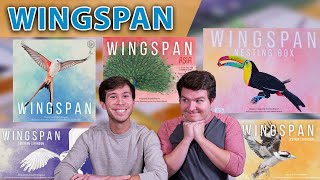
Expansion box sizes differ wildly across the Wingspan line. The base game ships in a standard box, the European expansion in a different footprint, and Oceania in yet another shape. Storing all components together requires aftermarket solutions like the Nesting Box, adding cost and complexity to collection management. Reviewers note that while individual expansions fit in the base box with careful Tetris-like packing, combining multiple expansions with all components accessible during play demands external organization.
Setup Overhead and Learning Curve When Combined
The expansion works smoothly standalone, but when mixed with the European or Asia expansions, the component count and rule interactions multiply. Players new to Wingspan who begin with Oceania included find more moving parts to track than the base game alone introduces. The nectar majority scoring, reset actions, new goal tile variations, and end-of-game bird powers each require attention. Experienced players absorb these layers easily, but the first plays can feel less streamlined than intended for teaching groups unfamiliar with the base game.
If You Enjoy WINGSPAN: OCEANIA EXPANSION
Players who enjoy Wingspan: Oceania Expansion's resource management depth and flexible bird economy will find similar satisfaction in Wingspan: European Expansion, which adds 81 European birds and round-end bird powers that create new timing opportunities. The incremental complexity of new bird abilities mirrors Oceania's approach of expanding tactical options. Those drawn to Oceania's rebalancing philosophy will also appreciate Wingspan: Asia Expansion, which introduces duet mode for two-player focused play and the solo-friendly duet mechanics. Players seeking engine-building games with strategic depth comparable to Oceania's revised economy might explore Splendor, which similarly manages tight resource allocation and majority scoring, or Calico, which combines tableau building with spatial puzzle-solving. For those who love the thematic integration and card-draw satisfaction of Wingspan, Cascadia offers similar environmental themes in a different mechanical context.
What Reviewers Are Saying
"Base Wingspan has this massive issue where experienced players figure out that the wetland egg rush is just dominant. Laying eggs is both a productive mid-game action and a reliable end-game scoring mechanism."
— Board Game Critique
"The new nectar resource which is special because it's considered a wild food that means any time you're paying food costs to play a bird or to pay for an any food bird ability or upgrade an action on the board that costs any food you can choose to pay with nectar tokens instead of any of the other five food types you'd normally have to pay."
— Watch It Played
"In this game if it's not in the bird feeder the resource you don't get to have it there's no way to get it like you can in other span universe games. I think nectar solved it."
— Watch Review