Board Games 101: What are Expansions?
Games in This Video
14 games are featured in this video — they unlock as you watch.


Transcript
Hi! It's professor Ryan from Nights Around a Table. What is an expansion? Today on (singing) Board Games 101!! They say in business it's way easier to get an existing customer to buy something else from you than it is to get a new customer to buy something completely fresh, and that's what a board game expansion is. It's a way for board game publishers to take their existing customer base that has already purchased something from them, and say "Well you like that? Heeere's more!" Board game expansions might add to the number of ways that you can score in the game, they might add extra pieces to the game, extra boards, extra cards - it really all depends on the way that the publisher and the game designers have swung it. Now why is this important? Well, as somebody who's relatively new to the board game world, you don't want to make the same mistake that i did when i was relatively new to the board game world, and walk into a store, pick something off the shelf, buy it, get it home, and then realize - whoops!
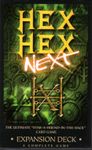
It's an expansion! Because usually expansions require you to have the base game in order to play with them. Now, the game that i went home with was called Hex Hex Next, and surprisingly - and luckily - it was one of the rare cases where you could actually play the expansion without the base game. Now we're pretty lucky these days, because with very few exceptions, whenever you pick up a board game expansion in the store these days, there's usually a proviso on it that says "This is an expansion! It requires the base game to play." so that you don't get it home and get disappointed or feel ripped off. So i mentioned there are different flavours of expansions. i've identified about five different types that you'll see most commonly. Rhe first is maybe more accurately called an "extension." What it does is it takes your base game, and it just adds player account to it.
So if you were only able to play up to four players before, now you can play maybe five and six players. So the classic example there is the Settlers of Catan, now called Catan... correctly pronounced "Catahn," but i'm a redhead... where the game plays two to four players, but then if you buy an extension, you can actually play with five or six players. And back when i was playing this game, i thought that was a grand idea! i could play with more people. But what didn't dawn on me when i bought those extensions for that game and the expansion The Cities & Knights of Catan, is that certain games just don't play well at certain player counts, and i think maybe Catan is one of them. Five or six players, it's gonna take a whole lot longer, the game's kind of gonna bog down... it wasn't really designed for that many players. So you CAN do it, if you've got maybe three couples who like to play together, you can extend it up to six players, but it doesn't always mean that just because you can, you should.
Now, a trend that you'll see a lot now is that this play with one extra player, play with two extra players, is rolled into an expansion that's more, sort of, like a grab bag of modules, and the idea here is you have the base game, you buy this expansion, and it's just pieces that you, by your own prerogative, can mix in with the game. And often the rulebook will say "Well, pick one or two that you like... make sure... play the base game, and play it with module number one, and then next time you play it, play with just module number two. Don't add them all in at once, now!" And the cynical side of me suspects that that's just a way for publishers to train their customers to try to play their games more than other people's games, right? Sort of like this training wheels approach, where it's like "Nah, don't...
don't do the whole thing at once! Do little bits and pieces, and then make sure that every single game night it's my game that's on your table!" i am NOT a huge fan of this approach. Some examples of grab bag expansions can be found with the Seas of Glory expansion for Merchants & Marauders, the Cities of Splendor expansion for Splendor, and the Scoundrels of Skullport expansion for the Lords of Waterdeep. But! i will say that's a fantastic expansion, and forget the fact that it's modular. Just take Scoundrels of Skullport and the Undermountain stuff, mix them together, and play them all together. i would actually never play Lords of Waterdeep without the expansions. That's how good they are. The third type of expansion that i've identified is the kind of expansion where you don't actually have to have the base game in order to play it.
And this is so exceedingly rare that i almost can't think of very many examples at all. Hex Hex Next off the top of the video is the one that i knew about. In 99% of cases, you're gonna require the base game to play the expansion. The fourth type of expansion you're gonna run into is the "more of the same" expansion. Your game has 50 cards? Well here's 100 cards! You got a couple o' dice? Here's a bunch more dice! Personally, this is the style of expansion that i really prefer. It takes whatever you enjoyed about the main game, and it puts more of that stuff in there. Very often expansions can extend gameplay length, where the game might have been already a good length. They can over complicate gameplay, when game playing might have been already complicated enough.
So expansions that add new mechanics into the game may be a good idea, may be a bad idea... it's really hard to say definitively. My experiences with that kind of thing, and i've bought a ton of expansions, have been really hit or miss. Fifth type of expansion i've identified is the component upgrade. So this isn't really technically an expansion, because the game doesn't do anything new when you buy this expansion, but what it does is it beautifies the components. So i'm thinking of things like the ship packs for Eclipse, or those cool domed cities for Alien Frontiers, before they became standard with the game. Some of these component upgrades are even aftermarket - they're third-party - they're made by a completely different company. So, like, these cool DnDeeples for Lords of Waterdeep, or component upgrades for games like Scythe.
There are a few companies out there that will make metal coins to replace the cardboard coins that you have in your games. Now maybe if you haven't played a board game where you haven't improve the components, you think "Well... that's kind of silly. Why would i do that? It doesn't add anything to the game. There's no new stuff," but believe me: i'm a... i'm a big fan of this this kind of thing! If you've never upgraded a board game from cardboard coins to metal coins, i can highly recommend it! It should go without saying, but it just feels better playing with better stuff! Now there are a few important things that i think you need to know or consider about expansions for board games. Generally - and this is the most important thing - unless your gaming group - the people you play with regularly - are very familiar with the game, you're gonna have a hard time getting that expansion to the table.
i own a ton of games where i bought the expansion, and i'm constantly bringing new people in to play games with me, and so i'll bust out a game that i have an expansion for, but i think "Oh, shoot - that's kind of too complicated. Rhey need to learn the base game first," and then the next time we go to play, it's either a different game, or a different group of people, and i can't bring out that expansion, because that group of people doesn't know that... that game! So i have a lot of expansions in my collection that are either unopened, or they've... i've just opened them and organized them, i've played them maybe once, or they're on my big list of things that i desperately want to play, and it's all because the people i play with don't know the base game. So that is an issue that you are certainly going to run into if you go hog-wild on an expansions like i usually do. Another thing to know is that not all expansions are compatible with each other, and this drives me nuts.
i really don't like this. So the first three expansions for Race for the Galaxy are all compatible - you can fold them all in - and play them with the base game. But the fourth expansion for Race for the Galaxy, and the fifth expansion - so we're talking Xeno Invasion and Alien Artifacts - those are two separate forks. So you can't play Xeno Invasion with the first three expansions. And you can't play Xeno Invasion with Alien Artifacts, and you can't play Alien Artifacts and Xeno Invasion together - it's either base game and these three, base game and this one, base game and this one, and they... never the twain shall meet. So that's really important to know going in, hoping - you know - hoping that you can mix everything together, and then finding out that you can't. So a little bit of research may be required. Some things that may look like expansions are actually just gigantic empty boxes for collectors to throw all their base game and expansion stuff into because - there's another thing you'll run into if you buy expansions - there's not always room in the base game box to stick all the stuff.
So certain games have these big empty boxes. So the Scythe Legendary box, the Star Realms Universal Storage Box, or the Cards Against Humanity Bigger Blacker Box. These are all just big empty boxes where you put things into. And i know i'd be pretty bummed if i paid money for something and i got it home, and i opened it, and there was nothing inside. So, again, a little bit of research is required, but i think you'd probably suss out, hopefully, that the thing you've bought, if you picked it up physically in the store, doesn't have anything in it. If you were online, maybe not so much. If you buy a game and there's a little starburst call-out in the corner that says it includes a mini expansion, no it doesn't! That's just a base game component and what you're reading is marketing to get you to buy the game.
It's like the boardgame equivalent of a cereal box saying "30% extra." So it wasn't always the case, but now i don't think there's a board game in existence that goes through the development without the designer thinking about what could happen if it were to be expanded, if it were to do well enough that expansion was warranted. And a lot of board game companies are selling their games on Kickstarter, which is a popular crowdfunding platform. So what they'll do is they'll come out with this campaign with all these bells and whistles in the board game. People will pay big bucks and big money on shipping to try to get that thing, and then when it goes to retail, if it ever does go to retail, they'll carve that game up into a bunch of separate smaller products, each with a different SKU. So it really depends on the campaign, but you might end up paying more at retail for each little box and diddly bit and doo-dad, or you might be paying more through the Kickstarter - it depends.
But it's possible that you can, if you are ok to wait the year or whatever it takes for that project to be fulfilled, you might be able to save a little bit of money by catching it on Kickstarter and buying it there, than waiting until it's all carved out in separate SKUs at retail. Another thing that we see a lot is where a publisher has a game, and they release an expansion and expansion expansion - it did well enough that they've got... i don't know... seven expansions going - and then they take it after - you know - a decade and they tie it all together in one product called a Big Box, which is the base game with all the expansions and in a box big enough to fit all the stuff. And i gather those have sold fairly well, because certain board game publishers... that's their whole aim, is to get a big box product out. So the whole thing is they'll run Kickstarter campaigns, or they'll put out product and product and product, maybe even if the game didn't even sell that well, but well enough, hoping that they can then take all those products and tie them together in a big box product, and that'll be their big seller.
So if you're interested in a game, and you notice that it has a bunch of expansions out for it already, maybe do a little bit of research and find out if either there's a big box version available, or if there are rumours, or the company has announced that they're headed toward a big box product, because it might be a big money savings for you to wait for that big box product to come out on the shelf. And then finally, about price and picking: so usually expansions are less expensive than the base game, maybe by about half. You buy base game... heh... in Canuck-buck prices for 60 bucks, expansion maybe 20-30 bucks. But it's not always the case. So if you take an expansion like the Food Chain Magnate Ketchup Mechanism and Other Ideas, well that expansion is the same cost as the already pretty expensive base game.
And then if you look at something like Roll for the Galaxy Rivalry, that's half again the cost of the base game! So what you really have to try to figure out, and it's difficult i realize, is: will paying that extra money be worth that amount of enjoyment that i will get out of extending the lifespan of the game? Have i even played the game enough to warrant extending or expanding the gameplay? Or will that 30 bucks or 60 bucks or a hundred bucks be better spent towards buying a new game? Or two? Consider what i've said about who you play with, and how well your gaming group knows the games that you already know before diving into an expansion. But if you're a completist, and you're rich, and you've got a very big amount of shelf space...
BUY!!! BUY!!! BUY!!! So a couple questions for my TA's in the room: what's your favorite expansion? Are there any games that have expansions where you wouldn't play the base game without them? Are there any expansion that you're really impressed with? Are there any expansions that fell really flat, and really disappointed you? Let me know in the comments section below, or hit me up during my office hours on Discord. That's it for this lecture on (singing) Board Games 101!! Nights Around a Table is the only place you can earn your pHB in board games! (disclaimer voice) Nights Around a Table is not an accredited educational institution. (Ryan) They get it. To see a full course syllabus, visit nightsaroundatable.com. To fund an endowment, visit me at my Patreon page. And as usual, click the subscribe button and the bell to get notifications when new course materials are available.
No, i don't sleep in my car and shower in the athletic facilities. Who even told you that?