












Ascension Tactics: Miniatures Deckbuilding Game Deep Dive
What the Community Thinks About Ascension Tactics: Miniatures Deckbuilding Game
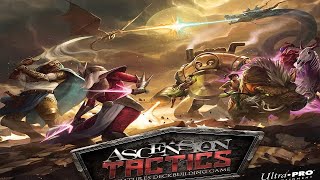
Reviewers approach Ascension Tactics: Miniatures Deckbuilding Game as a direct descendant of Ascension, the deck-building game Justin Gary of Stoneblade Entertainment launched in 2010. The shared DNA is the first thing most reviewers mention. Drive Thru Reviews notes that the starting deck is the same Apprentice and Militia pairing, that runes still buy cards from a center row, and that power still gets spent, only now to activate characters on a hex map instead of to defeat monsters. The Cardboard Herald's interview with Gary frames the game as the next step for the Ascension brand, adding a tactical miniatures layer to a deck-building core.
Opinions diverge on whether that added layer earns its place. The hosts of Rolling Dice & Taking Names came in enthusiastic and spent much of their episode praising the design and the conversation with Gary. Board Games UnLocked was more skeptical. Its hosts described the deck-building side as a "bog standard" deck builder and argued that a game named for tactics should not depend so heavily on random draws. Drive Thru Reviews landed between the two, saying the reviewer would recommend the game for its gameplay alone while finding the two-player experience the strongest of its modes.
Core Mechanics That Define Ascension Tactics: Miniatures Deckbuilding Game
Center Row Deckbuilding With Ambush
The deck-building engine keeps the signature center row that Ascension introduced. Six shared cards sit face up, and buying one replaces it immediately, so both players draw from the same changing market. Gary told The Cardboard Herald that the center row was the core innovation of the original Ascension, a shared pool that forces each player to react to what the opponent takes. Purchases cost runes, and most cards add constructs, heroes, or champions to the deck in the familiar way. The biggest departure is ambush. Rolling Dice & Taking Names reports that the team first borrowed a "fast play" mechanic from Shards of Infinity, which let players either keep a card or use its effect immediately. In Tactics, players almost always chose the immediate effect because board control mattered so much, and their decks stopped growing. Ambush solves this by firing a card's effect the moment it is bought while the card still joins the deck for later.
Command Points and Miniature Activation
In Ascension Tactics, the power that Ascension players once used to fight monsters now commands miniatures. Drive Thru Reviews explains that each turn grants two power, and activating a champion costs power that scales with the character. The Unbound Emissary, for example, has four attack and costs two power to activate, while heavier champions cost more. Champions move three spaces by default, buffs can extend that movement, and force terrain blocks line of sight. Gary explained in the Rolling Dice & Taking Names interview that a defeated miniature is not removed for good. It is knocked off the board, exhausts, and cannot be commanded on the opponent's next turn, which Gary described as a setback rather than the end of the game. Victory points come from controlling territory rather than from knockouts, a design choice meant to counter the attrition snowball common to miniatures games. There are no dice. Combat outcomes come from printed attack and defense values, and hidden treasure tokens supply much of the uncertainty.
The Ascension Tactics: Miniatures Deckbuilding Game Experience
A Snappy Rhythm With a Tactical Puzzle on Top
Drive Thru Reviews describes the pacing as "really snappy," with a typical game lasting about 45 minutes once players know the cards. The reviewer wanted to reset and play again immediately, the way the original Ascension encouraged. The deck-building cycle delivers a steady stream of small rewards: each new hand presents a combo to find, and the game keeps offering those moments roughly every minute or two. The tactical board adds a second puzzle beside that loop, and the reviewer described the pairing as a quick, buttery deck-building engine with a positioning puzzle alongside it. The Board Games UnLocked hosts similarly found the game simple to bring out and set up.
Frustration When the Draw Refuses to Cooperate
The enthusiasm comes with a recurring frustration. Board Games UnLocked described a cooperative game in which their squad was too slow to reach anything, a single tyrant boss took "literally everything we had," and the win depended on drawing a lucky treasure. The same hosts said they would be furious in competitive play if a poor hand left them with no command to attack with. Drive Thru Reviews reported that the solo villain deck can simply beat a player on a bad run, though a rethought approach often turns a loss into a narrow win. The result is a mix of satisfaction when a plan comes together and deflation when the market refuses to cooperate.
What Makes Ascension Tactics: Miniatures Deckbuilding Game Stand Out
Miniatures With Distinct Character
Drive Thru Reviews singled out the sculpts as a highlight, calling them "very full of character." The set avoids repetition, with the cultist as the only figure that appears frequently, and the reviewer felt the characters look like they belong to the Ascension universe rather than to generic fantasy. Board Games UnLocked was more measured, calling the figures nice enough and noting that they stand up better than expected. Gary's interview adds that the Kickstarter edition uses plastic miniatures sculpted by a team of established artists, and that the figures were sized to match ordinary D&D miniatures so they can also serve in tabletop roleplaying.
Scenario Variety and Multiple Player Modes
Reviewers consistently point to how much the box contains. Drive Thru Reviews counted a dozen or more scenarios for one to four players, with objectives that shift from one scenario to the next, plus a branching campaign tied to the faction a player chooses. Gary described the same scope in the Rolling Dice & Taking Names interview, citing cooperative and solo modes, a PvP option in which players draft their champions before the first turn, a Tabletop Simulator build for players without the box, and a hope that fans will design their own scenarios. The Cardboard Herald conversation makes a similar claim for depth, with Gary arguing that few games offer more strategy from a single box. The practical effect is that one purchase covers several play styles without relying on expansions.
Potential Drawbacks
Randomness Against Tactical Planning
The most substantive criticism comes from Board Games UnLocked, which argued that the tactical framing sits uneasily on a random deck. The hosts pointed out that treasures, the deck, and the market are all random, and said a game that wants to be called tactical should not let so much hinge on the shuffle. They also found the pacing uneven, noting that the scheme deck ramps up sharply so the player can suddenly do nothing useful. Gary's answer in the Rolling Dice & Taking Names interview is that removing dice lets players plan their turns with confidence, but the reviewers were not persuaded that a bad draw can always be planned around.
Retail Components and Standees
Drive Thru Reviews was openly disappointed with the retail edition. Retail copies replace the miniatures with standees, and the reviewer disliked that each champion marker is simply a square bearing art, arguing that die-cut shapes matching the figures would have worked far better. The reviewer noted that the change did not affect their own play because they owned the Kickstarter version. Board Games UnLocked was blunter, calling the square standees "ugly" and suggesting that players would almost have to own the miniatures to enjoy the game fully.
If You Enjoy Ascension Tactics: Miniatures Deckbuilding Game
Players who enjoy the center row and its ambush timing will feel at home with Dominion, the deck-building game that Gary says Ascension itself built upon. Dominion offers the same buy-and-build loop without the board, making it the purest comparison for players who want the deck engine alone.
Players who enjoy the quick, back-and-forth deck-building duel will find similar satisfaction in Hero Realms and Star Realms. Board Games UnLocked compared Ascension Tactics to these one-on-one deck builders while noting that the miniatures and tactical positioning are what set it apart from them.
Players who like the way Ascension Tactics places characters on a board will find a similar appeal in Warhammer Underworlds. Drive Thru Reviews drew this link directly, describing both as miniatures games with a card-driven heart, while pointing out that Ascension Tactics delivers a full experience in a single box rather than requiring a growing ecosystem of expansions.
What Reviewers Are Saying
"It's almost like Pavlov's dog, if you've ever heard of that, where you kind of ring the bell and the dog gets a treat. The game just kind of gives you a gift like every minute, every like two minutes, because of the whole cycle of the deck building. It gives you a quick little puzzle to solve, and you can get it, and then it hits you again and again and again."
— Drive Thru Reviews
"So really what this game comes down to for me is, if you're going to call it a tactics game, don't have everything be random. That's kind of like, the treasures are random, your deck's random, the market's random. That's just, I can't not let that be a problem."
— Board Games UnLocked
"Okay, so now instead of using power to attack, I just use power to activate my champions and they can move a couple spaces and attack. I've got this, yeah. I was so surprised at how simple the ruleset is. If you've played Ascension, literally in five minutes you can just say, here's the only twist: you now have these miniatures, and here's how you activate them and what you can do with them. That's it. Yeah, this has always been a really important thing for me as a designer, is really trying to distill things down to their essence."
— Tony, Rolling Dice & Taking Names