
























Gaia Project Deep Dive
What the Community Thinks About Gaia Project
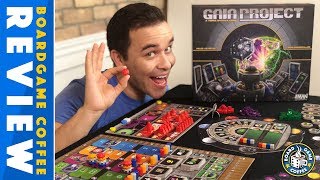
Reviewers agree on one thing before anything else: Gaia Project is a lot of game. Board Game Coffee calls it "a really complicated game for 1 to 4 players" and admits the box demands a genuine time commitment before it clicks. Shelfside goes further, handing the game a 9 out of 10 and describing it as a "hardcore deep game," while Neon Gorilla logged around twenty plays this year and still says they "don't fully understand it," treating that as part of the appeal rather than a flaw.
Not everyone lands in the same place. Board Game Dad host Ben places Gaia Project on his top-100 list only reluctantly, calling it "just space Terra Mystica" and admitting the game hinders his ability to think critically about it because he prefers the original. He concedes that "everyone says Gaia Project is better" than Terra Mystica and notes it carries a higher rating and an app version, even though he personally does not connect with it. That tension between the game's reputation and one host's personal taste runs through the coverage: Meeple University frames the split as a matter of flavor rather than quality, describing Gaia Project as the "relatively open-ended explorative game" next to the tighter, more competitive feel of its sibling titles.
3 Minute Board Games covered the game from a publisher-provided review copy and still awarded it a gold medal, calling the decision space "colossal" and warning that it is "not a quick jolly party time game."
Core Mechanics That Define Gaia Project
The Upgrade Building System
Board Game Coffee singles out the building upgrade system as the mechanic that hooked them: structures are built by upgrading one type into another, which means gaining a stronger resource generator always costs the generator it replaces. The reviewer called that trade-off the strategic core of the game, saying they "love the strategy that mechanic added." 3 Minute Board Games lays out the resources feeding that system: money, ore, and research, plus a power track that moves through three bowls, where power sitting in the final bowl can be spent on a range of actions.
Terraforming and the Tech Tree
Terraforming is the other half of the engine. 3 Minute Board Games explains that a player's tech tree determines how far and how cheaply they can terraform, how many QICs they hold for range extension, and how easily they can convert a transdimensional planet into a Gaia planet using a Gaiaformer. Once a faction controls enough connected planets, it can spend power to form a federation and claim one of the federation tokens that unlock the top row of tech upgrades. Meeple University describes the underlying turn structure as a "soft action draft," clarifying mid-video that what looks like worker placement is really action drafting without physical workers to place.
The Gaia Project Experience
A Quiet, Inward Kind of Focus
Shelfside describes Gaia Project as a game that pulls players into their own heads rather than toward the table: with perfect information and no randomness, it "almost feels more like chess where there's zero emergent luck," and most of the satisfying moments happen silently, inside a player's own planning, rather than as a shared story with friends. That same fairness cuts both ways for Board Game Coffee, who noted that starting positions can feel wildly uneven at first, yet the asymmetric factions balance back out by the end of a full game.
Sandbox Freedom Over a Competitive Bite
Meeple University's comparison to the wider Terra Mystica family captures how the game feels moment to moment: where a tighter cousin punishes every missed opportunity, Gaia Project leaves more room to route around a blocked play, so losing a coveted space feels less like a disaster and more like a detour. Board Game Coffee frames the win condition the same way: there is no attack in Gaia Project, so success comes from doing more with a starting position than the other factions do with theirs, even as randomly drawn round-scoring tiles nudge everyone's plans in a shared direction.
What Makes Gaia Project Stand Out
Fourteen Asymmetric Factions
Every reviewer circles back to the factions. Board Game Coffee highlights that each race has "its own unique set of abilities," which pushes players to try a new one every game rather than repeat a winning combination. Neon Gorilla calls the amount of "asymmetry with different factions" one of the reasons the game rewards dozens of plays without feeling solved, and 3 Minute Board Games notes the setup spans seven starting worlds, each hosting two distinct factions with their own strengths and weaknesses.
A Well-Built Solo Mode
Allies or Enemies ranked Gaia Project among a short list of favorite solo games, praising a bot that "actually makes sensible decisions" and interacts with the player in a believable way, built from a single card per faction that changes how that faction behaves. Shelfside independently reaches the same conclusion about the underlying Automa card system, calling it "brilliantly done" because it lets a solo player skip setting up a second physical faction board while still simulating a believable opponent.
Potential Drawbacks
A Punishing Learning Curve With No Comeback
Shelfside warns that Gaia Project "is actually pretty punishing if you make rookie mistakes," such as spending resources early without securing income, and that the game offers no comeback mechanics to recover from that kind of early misstep. Board Game Coffee agrees that this is not an easy game to learn, noting that even experienced players "will require a game or two before they start feeling comfortable" with its systems, and that the rulebook runs 24 dense pages that single-player games require reading in full.
A Rulebook That Fights Back
Shelfside's most detailed criticism targets the rulebook itself: there is no index and no FAQ, so tracking down a specific rule means paging through the whole book, and faction abilities are explained only in a cramped appendix that is awkward to pass around the table. The same review flags a physical nitpick alongside otherwise strong production: the first player marker is a flimsy cardboard stand whose base keeps falling out. Board Game Coffee adds that simply keeping track of the game's many resource types and conversion chains is, on its own, one of the toughest parts of a first session.
If You Enjoy Gaia Project
3 Minute Board Games points players toward the game's own roots and a genre neighbor: "prefer fantasy try the precursor game Terra Mystica," and "for a more realistic setting consider Space Corp." Neon Gorilla groups Gaia Project with Brass Birmingham as another network builder worth exploring, even though they consider Brass the lighter of the two. Board Game Dad recommends Concordia as another exploration-and-settlement pick for players weighing where to start in that style of game.
What Reviewers Are Saying
"Gaia Project is a great game for gamers looking for something a little more advanced. It's not easy and even more experienced players will require a game or two before they start feeling comfortable with the game's mechanics. And it's got loads of strategy and all the different races add tons of replay value."
— Board Game Coffee
"It is excellent, no doubt about it whatsoever. This is a hardcore deep game, just look at all this setup going on."
— Shelfside
"I played a ton of Gaia project and early on I didn't really understand it and even now I don't fully understand it, which I think is pretty intriguing. There's a lot of asymmetry with different factions and why and how you might play the game. It's an incredibly tight resource management engine builder, network builder in space."
— Neon Gorilla