/pic4739757.jpg)



















































Inis Deep Dive
What the Community Thinks About Inis
Reviewers who cover Inis keep landing on the same core appeal: a Celtic-themed area control game built around drafting cards and negotiating with a table that is actively trying to stop whoever gets closest to winning. The Discriminating Gamer, working from a review copy supplied by Asmodee, called the game a pleasant surprise, praising the ease of learning sitting right next to a deeper underlying strategy, and landed on a seven out of ten on their own scale. Board Game Critique, weighing Inis against four other major area control titles, singled it out as the outlier of the group because it drops victory point accumulation entirely in favor of three separate paths to the throne, and rated its long-term replayability the highest of the five games covered. Grant Lyon introduced the Seasons of Inis and Nemed expansions by describing the base game as very popular and well-loved, and BoardGameCo's retrospective on their collection still called Inis an amazing game years after picking it up. On the Stonemaier Games podcast, a host who had only played the game once still praised its clever draft system and its Celtic mythology theme.
Not every take lands the same way. Board to Death TV also scored Inis a seven out of ten, but arrived there from a more mixed set of sessions, noting that their games tended to slide toward a kingmaker finish where the eventual winner was propped up by other players rather than outplaying them. Board Game Critique's praise for the three-victory-condition design came with its own caveat: the same system that keeps games unpredictable also makes Inis a longer teach than similar titles, and groups already prone to analysis paralysis can find that difficulty compounding.
Core Mechanics That Define Inis
Drafting Action Cards Each Round
Every round opens with an assembly phase where the player holding the Bren token flips a marker to set turn direction, then deals out a hand of action cards for that season. Board to Death TV walked through the pick-and-pass structure directly: players take one card of their choice, pass the rest to the next player, and keep drafting until everyone is holding a full hand. The Discriminating Gamer described the same drafting loop from the player's seat, noting that the cards simply tell you what to do on your turn, whether that means adding more clans to the board, moving clans between territories, or building a new sanctuary or citadel.
Clashes, Citadels, and the Three Paths to the Throne
Combat in Inis is handled through clashes rather than a running score. The Discriminating Gamer explained that when clans collide, the attacker forces the defender to either discard an action card or remove an exposed clan, while units tucked inside a citadel sit out of the fight entirely and cannot be eliminated. Reaching for the crown works the same way across every review that touches it: a player needs a pretender token and at least one of three conditions, being chieftain over territories holding six or more opposing clans, holding clans in six different territories, or controlling territories with six total sanctuaries between them. The Discriminating Gamer also pointed out that deed tokens shave one clan off whatever six-unit threshold a player is chasing, making the closing stretch a little more forgiving.
The Inis Experience
Tense Negotiation Without Formal Alliances
Board Game Critique described the moment a pretender token comes out as the point where the entire table turns against whoever is holding it, even though no other player can directly strip away their progress. Instead, everyone can only move units to contest territory and deny the remaining conditions, which the channel described as cooperative blocking without formal alliances. Board to Death TV felt that same table-wide pressure play out differently in practice, describing games that dragged into extra rounds while players kept each other in check, with no runaway leader ever quite able to close things out.
A Different Island Every Session
The board itself is not fixed. Board Game Critique noted that territory tiles are drawn randomly and placed to build the starting landscape, with new territories able to enter later through explore action cards, so the layout a group is negotiating over is never the same twice. The Discriminating Gamer's walkthrough of setup, drawing and arranging territory tiles so that each one touches at least two others, matches that same randomized foundation from the first turn of the game.
What Makes Inis Stand Out
Celtic Artwork and Component Quality
Board to Death TV opened their review by pointing straight at the presentation, calling the artwork a huge pro point and noting that the tiles and oversized cards are a huge plus on their own. The Stonemaier Games podcast echoed that reaction from a collector's seat, calling the game beautiful and its artwork visually stunning while tying that look directly to its Celtic mythology setting. BoardGameCo's later look back at the Big Box edition still landed on the same conclusion, describing Inis as a fantastic game even while being mixed on some of the changes bundled into its Nemesis expansion.
Replayability Built Into the Board
Board Game Critique put a number on this strength directly, reporting extremely high replayability thanks to the randomized territory draws and noting that Inis still felt fresh after more than fifty plays. Grant Lyon connected that same longevity to the three victory conditions themselves, explaining that having multiple ways to win keeps the game interesting because a winning strategy will look different from one session to the next.
Potential Drawbacks
Kingmaker Endings
Board to Death TV's biggest reservation was how their games tended to resolve. They felt the endgame could build toward a kingmaker scenario where several players were positioned to win, and that the eventual victory was not always earned so much as handed over by other players or by an unbalanced epic card. The same review noted that sessions regularly ran past the box's printed hour, dragging as the table circled another round waiting for someone to close out a condition.
A Longer Teach for a Three-Path Win
Board Game Critique flagged the flip side of Inis's design ambition: understanding three separate victory conditions is a genuinely unique teaching challenge compared to the other area control games in their lineup, even with a discovery-style first game built to ease new players in. That same complexity, the channel noted, can feel cumbersome or push toward analysis paralysis for groups that are not already comfortable weighing several paths to victory at once.
If You Enjoy Inis
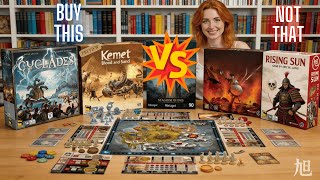
Board Game Critique placed Inis alongside Kemet and Rising Sun in a head-to-head look at major area control games, treating all three as cousins from the same family that solve different problems for different tables. On the Stonemaier Games podcast, Kemet came up in the same breath as Inis as part of a loose trilogy of collection favorites, with the host calling it really cool for the way it channels Egyptian mythology the way Inis channels Celtic myth.
What Reviewers Are Saying
"I was really quite taken with the simplicity of the game. I was really quite taken with the how easily you can learn the game, and there's a deep strategy there, but it's a fairly easy game to get into and to learn."
— The Discriminating Gamer
"In all our games we played, we felt the end result led to a kingmaker scenario where the game just builds until multiple candidates can simply win, and in that regard, we also felt the victory wasn't necessarily earned but rather given by other players or unbalanced epic cards."
— Board to Death TV - Board Game Reviews
"Inis is the outlier here because it doesn't use victory point accumulation at all. That's the fundamental design difference. Instead, there are three victory conditions you're trying to meet."
— Board Game Critique