





















Pandemic Legacy: Season 2 Deep Dive
What the Community Thinks About Pandemic Legacy: Season 2
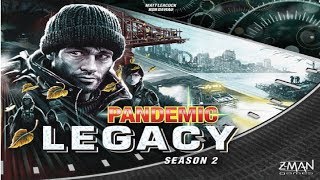
Reviewers generally treat Pandemic Legacy: Season 2 as a worthy successor to the original campaign, though opinions on its pacing and difficulty vary. Designed by Rob Daviau, the 2017 release is a cooperative campaign for two to four players that works against the team from the start. Board Games UnLocked ranks it highly and praises its twist, its sense of exploration, and the satisfaction of building up the map. The same channel does note that the late-game objectives can feel like a grind that could be condensed.
The strongest disagreement concerns how the game moves at the table. Chaz Marlar, Pair of Dice Paradise reports that their group has progressed more slowly through Season 2 than through Risk Legacy or Season 1, and that some game nights passed over the campaign in favor of other titles. Chaz Marlar has not yet reached a final verdict. Other reviewers describe the experience as more demanding but more rewarding once the group settles into its rhythm.
Core Mechanics That Define Pandemic Legacy: Season 2
Legacy Game
The defining feature of Pandemic Legacy: Season 2 is its legacy structure. Each session changes the physical game. Stickers are applied to the board, new cities are connected to the grid, and sealed packages and boxes open only after particular conditions are met. Rules and story beats arrive as the campaign advances, so the outcome of one game shapes the setup of the next. Chaz Marlar, Pair of Dice Paradise describes the box contents as secrets revealed through play, and advises viewers not to spoil them.
Reviewers consistently point to how the campaign state carries forward. Board Games UnLocked describes the Holloman figures and the defection objectives as a major part of the story, and notes that the group must keep track of how earlier decisions affect later months. Because the board is permanently altered, every group ends up with a copy that reflects its own history.
Cooperative Actions
The second mechanic that shapes the play is cooperative action. Each character has an ability, and the team can chain those abilities together. Players can move supply cubes, transfer city cards, and pass characters across the map so that one turn can set up several others. Reviewers describe the central challenge as a planning puzzle: deciding who should move where, which cards to hand off, and when to spend actions on building Supply Centers rather than on immediate threats.
In the Board Games UnLocked play-through, the group works out how a single character's free move and card transfers can create a winning sequence on the final turn. The channel describes the moment as a near-loss turned into a win, driven by careful coordination rather than luck.
The Pandemic Legacy: Season 2 Experience
Intense
Reviewers describe the game as tense from start to finish. The cities are close to collapse, the disease cubes accumulate quickly, and a single poor draw can end a month. In one Board Games UnLocked session the group nearly lost during the middle of the campaign and only recovered by coordinating their final moves. The tension comes from knowing that every decision has a cost that will follow into later games.
Discovery-Driven
Another consistent theme is the pleasure of discovery. New packages, new city cards, and new stickers keep the game feeling unpredictable. Board Games UnLocked highlights the exploration of the world map and the sense that the campaign keeps opening new avenues. Chaz Marlar similarly frames the campaign's unopened contents as a reason to stay invested, even when their group has slowed down.
What Makes Pandemic Legacy: Season 2 Stand Out
Twists and Reveals
Reviewers repeatedly praise the story reveals. Board Games UnLocked calls one mid-campaign twist a very good one, and the channel's enthusiasm reflects a wider appreciation for how the game rewards players who continue into later months. Because the reveals are tied to mechanical changes, the story never feels detached from the play.
A More Forgiving Scar System
Several reviewers compare the scar mechanic with the original campaign. Scars are permanent penalties that a team may accumulate when its characters are hurt or exposed, and they can weaken future games. Board Games UnLocked notes that Season 2 handles scars more gracefully than Season 1 did, which makes losses feel less punishing and keeps the campaign moving. The channel still notes that the Supply Center objective requires steady planning, so the forgiveness does not remove the challenge.
Potential Drawbacks
Late-Game Grind
The most common criticism concerns the late-campaign objectives. Board Games UnLocked praises the Supply Center system but argues that the final objectives become a repetitive grind that could have been condensed. Players who prefer a brisk campaign may find the closing months slower than the opening.
Pacing and Group Engagement
Chaz Marlar's experience points to a concern that many groups may share. Season 2 can progress more slowly than its predecessors, and some groups may lose momentum between sessions. Their group's decision to set the campaign aside on certain nights shows that the game does not hold every table equally. Players who expect the same tempo as Risk Legacy or Season 1 should be prepared for a different rhythm.
If You Enjoy Pandemic Legacy: Season 2
Players who enjoy the legacy structure and the way each session changes the board will find similar satisfaction in Charterstone, another legacy game in which the components evolve across a campaign. Chaz Marlar pairs the two directly in their box opening, noting that both use hidden contents and progressive storytelling.
Players who want the cooperative core without the campaign can start with Pandemic. The base game shares the same disease-fighting logic and the same planning puzzle of combining character abilities, though it has no permanent changes between sessions.
Players who want the closest comparison should consider Pandemic Legacy Season 1. Reviewers frequently discuss the two campaigns side by side, and the scar system and tone will feel familiar to anyone who has finished the first season.
Players who enjoy the escalating story and the permanent consequences of their decisions will find a similar experience in Risk Legacy, which also rewrites its own board and rules as the campaign progresses.
What Reviewers Are Saying
"With Risk Legacy and Pandemic Legacy Season 1, we would be nearly, I'd say, 3/4 of the way through the game, but this, this one, we've been going at a slower pace. In fact, there have even been some game days where the game group I am playing with have passed by Pandemic Legacy to, to choose to play another title. That never happened with Pandemic Legacy."
— Chaz Marlar, Pair of Dice Paradise
"I would like to win this game, you know, and I've played it a few times before, and I think I know how to win a game like this now."
— John Perkus, Actualol
"I'm pretty sure the creators of Pandemic just went out of their way to make this feel hard."
— Board Games UnLocked