/pic4852372.jpg)
/pic8660069.jpg)
/pic4852372.jpg)



































PARKS Deep Dive
What the Community Thinks About PARKS
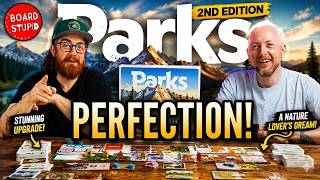
PARKS is a celebration that reviewers across the board embraced with genuine enthusiasm. The consensus is clear: this is a beautiful, well-crafted game that succeeds as both a gateway experience and a thematic journey through America's natural landscape. While reviewers acknowledge some mechanical limitations in the base game, the overwhelming sentiment centers on PARKS' remarkable production quality, its strong thematic coherence, and its ability to create a satisfying experience at the table. The game resonates particularly with players who value presentation and accessible gameplay, though those seeking deeper strategic complexity have found that expansions like Nightfall add meaningful layers to the core design.
Core Mechanics That Define PARKS
Worker Placement with Linear Movement
PARKS employs a worker placement system with a distinctive constraint: your two hikers move forward along a trail, unable to backtrack. Each turn, you advance one hiker to an unoccupied space and take the action depicted there, gathering resources like sun, water, trees, mountains, and wildlife tokens. This linear progression creates a race element, as once all players reach the trail end, the season advances and hikers return to the trailhead. The elegance of this design lies in how it forces meaningful decisions about pacing and positioning. You cannot simply camp on desirable spaces; you must commit to forward momentum. The campfire token offers one exception per round, allowing you to share a space with an opponent's hiker, adding a layer of tactical depth to turn order and movement strategy.
Set Collection Through Park Cards
The primary scoring mechanism revolves around collecting parks from a shared display. To visit a park, you must spend specific combinations of resources gathered during your journey down the trail. With 48 unique park cards in the base game, each representing an actual US National Park with artwork from the Fifty-Nine Parks print series, the set collection system encourages varied strategies. Parks cost different resource combinations, forcing you to balance accumulating wide resources against pursuing a focused collecting strategy. Additional scoring comes from year cards, which offer end-game bonuses for specific conditions, and from photographs taken using the camera token. Reviewers highlighted how this multi-pathway scoring system keeps final standings uncertain until the final tally, preventing any single strategy from dominating.
The PARKS Experience
Thematic Immersion Through Integration
What sets PARKS apart experientially is how thoroughly its theme permeates every mechanical system. The canteens you fill, the weather patterns that evolve with each season, the way resources represent memories of different locations, the efficient box organization that mirrors hiking preparation, even the photography mechanic capturing moments within a game about discovery. Reviewers consistently noted how the game feels like the mechanics emerged from the theme rather than being imposed upon it. This cohesion creates an atmosphere that invites players to inhabit the role of hikers actually preparing for and executing a journey. The decision to use full-art cards throughout the game means that each acquired park becomes a visual memory, reinforcing the thematic fantasy. Players reported wanting to visit the depicted national parks after playing, a testament to how effectively the theme bridges the gap between cardboard and real-world wonder.
Satisfying Tension and Pacing
The resource limit of twelve tokens creates constant tension throughout each season. You cannot hoard indefinitely, forcing ongoing decisions about when to commit resources to parks versus waiting for better options. This constraint, combined with the forward-only movement system and shared trail spaces, generates a dynamic that rewards careful planning while remaining accessible to newcomers. The pacing accelerates through the four seasons as players gain more parks and can chain actions more effectively, creating a sense of escalating momentum. Reviewers praised how PARKS maintains engagement by ensuring downtime stays minimal, even with higher player counts, and how the decision space remains tight without becoming overwhelming.
What Makes PARKS Stand Out
Exceptional Component Quality and Organization
PARKS represents meticulous attention to physical production. The box contains wooden resource tokens featuring different animal meeples for wildlife, thick cardboard tiles, and a metal first player token that feels weighty and distinctive. But what reviewers highlighted most frequently was the organizational excellence. The game ships with custom trays and inserts that hold every component in designated spaces. A storage diagram on the box shows exactly where everything belongs, and the insert features divots that allow you to pop components free by pressing from below. This eliminates the frustration that plagues many games with inserts. For players who value clean setup and takedown, PARKS delivers an unusually premium experience right out of the box.
Artistic Excellence from Fifty-Nine Parks
The collaboration between Keymaster Games and Fifty-Nine Parks, the print and poster illustration company, resulted in artwork that reviewers consistently called some of the finest they had encountered in board gaming. The base game features 48 pieces of art from 35 different illustrators, creating tremendous visual variety. Some parks display photorealistic landscapes while others employ minimalist or more stylized approaches, yet the collection reads as cohesive. Each park card feels like a collectible postcard celebrating American natural heritage. This artistic commitment extends throughout the game, from the season cards to the resource tokens. The inclusion of artist names, following the precedent set by Magic: The Gathering, adds a personal touch. Reviewers noted that the game actively encourages people to engage with the artwork by flipping each new park card with genuine anticipation about what comes next.
Potential Drawbacks
Limited Strategic Depth in the Base Game
While reviewers appreciated PARKS' accessibility, several noted that the base game's optimal strategy can narrow over extended plays. The fundamental truth is that visiting parks consistently yields the most points, while gear cards and year-card bonuses rarely justify the action opportunity cost. This creates a scenario where the strongest path forward involves spreading your resource collection wide and simply visiting whichever parks appear on the trail. Reviewers found that once you recognize this pattern, playing optimally becomes somewhat mechanical. Some described the base game mechanics as solid but simple, where the decision space, while present, lacks the branching complexity that keeps strategic players constantly discovering new approaches. The introduction of the Nightfall expansion helps address this by adding parks with instant actions and tent tokens that provide alternative actions, but these additions come at the cost of increased complexity and potential analysis paralysis for new players.
Reduced Variability and Replayability Concerns
PARKS contains only four variable trail sections and a relatively fixed distribution of seasons, canteens, and gear cards. While you will not exhaust these resources quickly, some reviewers noted that the games tend to follow similar patterns from play to play. The end-game year cards provide some variability, but most reward the same strategy of collecting parks with specific resources. This means that players seeking high replayability may eventually feel that PARKS hits its ceiling, especially without expansions. The base game succeeds brilliantly as a gateway title that works equally well at two or five players, remains quick to teach and play, and looks spectacular on the table. However, dedicated hobbyist players seeking campaign depth, legacy systems, or dramatic mechanical swings may find the experience somewhat predictable after a dozen plays. Expansions add more parks and new mechanics, but the core loop remains fundamentally the same.
If You Enjoy PARKS
Players drawn to PARKS for its thematic elegance should explore Ticket to Ride, which shares the gentle competitive spirit of claiming valuable routes while managing limited resources. Those fascinated by the set collection core will find similar satisfaction in Splendor, though with less thematic integration. For players specifically engaged by the trail-hiking aesthetic and resource trading, Tokaido offers a parallel journey structure with different mechanics. If the camping theme resonates, Everdell and Wingspan deliver comparable production quality with more mechanical depth. Players who discovered that the Nightfall expansion significantly enhanced their experience should also investigate Takenoko, which combines similar ease of learning with modular depth that allows the game to grow alongside your group. For those who want PARKS' aesthetic appeal combined with more strategic options, Scythe proves that games can achieve museum-quality artwork while supporting multiple viable victory paths.
What Reviewers Are Saying
"I also love how deeply the theme of this game permeates every part of it. From the filling up of your canteen to the changing weather patterns, even to the way the components are so efficiently packed inside the box, everything works together so seamlessly and it all feels really intuitive."
— Might I Suggest A Game
"The game is incredibly well organized right out of the box. Everything has its own little store slot cuz of these inserts and trays. But wait, there's more. Parks also has this neat little storage diagram on the side of the box which also points out that the insert has divots in its base so you can simply push on any side of the piece to just release it."
— Shelfside
"Parks is such an awesome game. There's like, you know, this nice tension that's created by you only being able to hold, I think it's 12 resources, so you can't really hold back and let the other player rush to the end. But if they rush to the end you can get more done, although if they rush to the end there's like bonus resources on each and every spot. It's just an overall really fun, wonderful game."
— Neon Gorilla