/pic5153482.png)
Your Roll Player characters have been called to adventure! In Monsters & Minions, you went to war against Dragul invaders. In Fiends & Familiars, you befriended wild beasts and dispelled cruel spirits. Now your fully formed, battle-hardened heroes must defend the kingdom of Nalos and uncover a mystery that lies at the heart of the Abandoned Lands.
Navigate your missions with care. It's up to you who to befriend and who to battle. Will you slay the giant troll or attempt to make peace? Will you do the vampire's bidding or defend the mysterious cultists he wants to destroy? Will you remain loyal to king and country — or side with the enemies of Nalos? Whatever choices you make, someone will remember and respond.
Roll Player Adventures is a co-operative storybook board game for 1-4 players set in the World of Ulos. Players take the role of fantasy heroes, face challenges, and make decisions that will change the story as they progress through eleven core adventures and a replayable side quest.
Adventures does not require the Roll Player base game or any of its expansions to play. Pick from one of thirty-six pre-generated characters, or import a favorite Roll Player character you created (including any expansion or promo content) and take them on a heroic journey.


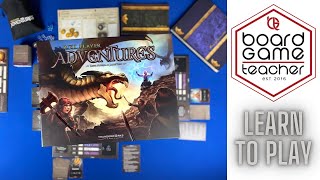
Roll Player Adventures: Learn to Play

Roll Player - Game Play 2

Roll Player Adventures 4K Unboxing

- Great recommendation for people new to or intimidated by D&D
- Provides a similar feel to D&D but more accessible
- Structured story that remains engaging
- Players become powerful, mirroring high-level D&D
- Serviceable writing and stories
- Short enough campaigns for replayability
- Affordable
- Expansion was done extremely well with background mechanisms
- Drops in rank slightly due to not being played as much
- Physically heavy due to the numerous books
- Narrative-driven campaign
- Structured story with connected one-shots
- Role Player
- Dungeons & Dragons
- Fate Forge
- Divinity
- Gloomhaven
- Fireteam Zero
- Chronicles of Crime
- Clash of the Immortals
Mechanics (from transcript analysis)
- Campaign play — A narrative-driven campaign game with structured stories and connected adventure books.
- Character creation — Players can create characters using Role Player and then jump into this game.
- Dice Drafting — Players draft dice to perform actions, and can use cubes to guarantee specific colored dice or draw randomly from a bag.
- Storytelling — The game focuses on narrative with well-written stories and allows for branching narratives based on player decisions.
- Variable player powers — Characters have unique abilities and backgrounds that influence gameplay.
Video topics + discussion points
Quotes (from this video)
- Freelancers God this cover I think is awful yeah I I think it's the color scheme more so than anything like that that weird ass pink
- this one just encapsulates that that DND wackiness because they knew what they were doing with the writing this game is so [expletive] funny and legitimately the writing and voice acting is topnotch for it
- this game victorum on its own if you play the entire storyline is a long game
- if you miss it's just like well big old middle finger so I think the dice resolution kind of uh irks me
- this one is fun in a box that is Thunder Road Vendetta
- this would be this I could see a game that I would love to to get those extra copies cuz it just really would amp to the uh or add to the atmosphere
- if you take this game way too seriously or if you're playing with people who are taking this way too seriously get the [expletive] out of there
- the mechanics of it and everything was just hit right
- I think kind of in terms of what I want from Euros I don't really like the almost The Meta that this game has
- as for Pure deck building this is the best one I'd say just because of the sheer amount of content that it has in gameplay
- I really like the art for this game like a lot of people [expletive] on it and I'm I don't know why
- this is one of those games you know that that it has uh multiuse cards your your hand is your life all this different stuff you can play it on other people's turns to help to give other people benefits
- the monsters are constantly spawning it's just a constant barrage of of enemies
References (from this video)

- Solid cooperative storytelling
- Meaningful player choices
- High replayability due to branching narratives
- Works well with pre-made characters
- Can feel too easy as players become powerful
- Narrative writing could be improved in some areas
- Requires a significant time investment for the campaign
- Cooperative adventure and storytelling
- The world of Antaloor
- Scenario-based storytelling with player choices impacting the narrative.
- Roll Player
- Primal
- Fate Forge
Mechanics (from transcript analysis)
- Card Play — Players use cards to perform actions and abilities.
- Character creation — Players can create their characters using the Roll Player system or use pre-made characters.
- cooperative play — The game is played cooperatively, with players working together to overcome challenges.
- Dice Rolling — Dice are used for skill checks and combat.
Video topics + discussion points
Quotes (from this video)
- The setup is always different at the beginning of the game as well.
- This game is so much fun I I was just I got the feeling that I got when I first played it.
- The gameplay is still extremely solid uh it's a very very difficult Cooperative game but that's what you want.
- Every single one you've brought up and this is not like a knock on you just even if I was describing them it's like uh you're Gathering resources and going up on a track they all sound the [ __ ] same but I know when you play them they they all play differently and feel different.
- This game has the most video game feel versus other board games that try to incorporate that.
- This is topnotch if you like seven seven wonders duel this is a better version of Seven Wonders duel.
- Thank you from the bottom of my heart to everyone who has shown concerns about my health after a long diagnostic process I have been diagnosed with ALS and we are still coming to terms with the news.
References (from this video)
- Stayed engaging throughout its 10 adventures and finale.
- Encouraged creative strategies in combat and skill checks.
- Provided a satisfying narrative experience that branched out from the base Role Player game.
- The story was a good starting point and went in unexpected directions.
- The progression felt like becoming a badass by the end.
- Choices felt impactful and wrapped up in the narrative.
- The game is story-driven and not like a simple 'do it again' if you fail.
- Party travel is considered smart and prevents tedious backtracking.
- Adventures are relatively quick, averaging 1.5 to 2 hours.
- The title system is loved for its narrative recall and personalization.
- There's significant replayability due to different choices and paths.
- The game offers nine technically different endings based on titles.
- The alignment system adds depth and personality.
- Favorite adventures included the Bog Root Swamp with the demon and the vampire one.
- The finale opens up possibilities for a multiverse and leaves things open-ended.
- It's a great jumping-off point for those wanting a D&D-like fantasy experience without a DM.
- Using the Role Player system to create characters adds a lot.
- The pre-built characters offer a lot of content.
- The game is a fantastic jumping-off point.
- The potential for future support and expansions is exciting.
- The story had some holes, like the late introduction of Tarik.
- The progression could feel too quick at a certain point, making skill checks feel less impactful.
- The game can be unforgiving if resting is not managed properly.
- The lack of an integrated narration app (like Foreteller) leads to a lot of reading, which can be taxing.
- The game can feel limited in role-playing due to the party sheet system, where only stats and items are unique.
- The Legendary Mode is rarely used.
- Difficulty modifiers could have been implemented more broadly.
- Some narrative inconsistencies, like fighting a vampire lord you were previously allied with.
- The overall story didn't always feel like it was culminating in a large battle until later adventures.
- Minor typos were present in the text.
- In future iterations, moving away from adventure books to a more open map could enhance the sense of world.
- DND light story
- Role Player
- Dungeons & Dragons
- God of War
- Assassin's Creed
- Risk of Rain
- Gloomhaven
- Gloomhaven: Jaws of the Lion
- Madara
- Sleeping Gods
- Skyrim
Mechanics (from transcript analysis)
- Alignment — The game tracks alignment, which can grant unique rare items and adds a personalized element to the end of the story.
- Card Play — Cards are used to mitigate dice rolls and overcome challenges, with players accumulating a significant number of cards for powerful turns.
- Character progression — Players progress by acquiring items and stats, similar to leveling up in D&D, leading to a feeling of becoming powerful.
- Combat — Combat encounters are a key part of the game, with a dice limit that can be managed through cards.
- Dice Rolling — Dice rolls are central to the game, but mitigation through cards is crucial, especially when dice limits are a factor.
- item acquisition — Players acquire items that can be distributed among the party based on character needs or strategic advantage.
- Party-based actions — Actions like sharing gold, XP, and play limits are done as a party, making the party sheet unique.
- resting — Managing resting is crucial to avoid difficulty spikes and ensure success in challenges.
- Skill checks — Players engage in skill checks that require creative strategies and a mix-and-match approach to succeed.
- Titles system — Players earn titles that reflect their in-game achievements and decisions, adding a layer of personalization and narrative recall.
Video topics + discussion points
Quotes (from this video)
- and then they branched out to this where it's like hey take those characters and put them into an actual narrative dnd light story
- this game is very unforgiving but as you grow and get stronger it you learn how to deal with that
- you do feel like a badass by the end
- the app just narration it's everyone's invested everyone can listen and get into it
- the title system is loved for its narrative recall and personalization
- the finale opens up possibilities for a multiverse and leaves things open-ended
References (from this video)
- So much fun
- Perfect expansion for Role Player
- Fantastic job incorporating Role Player base mechanics with a choice-based story campaign
- Extremely smart design with adventure books offering huge variety
- Base game comes with ten linked adventures
- Spending gold or XP to improve character is fun
- Variety of choices even in the first adventure
- Branching paths in adventures
- Prototype is very streamlined
- Decisions can lead to completely different campaigns
- Mechanics roll over extremely well from original Role Player
- Allows players to use characters they've made in Role Player
- Ability to roleplay characters based on their stats
- Use of cards to mitigate dice is thematic and helpful
- Combat is quick and not a slog
- Cards provide a flow and resource management
- Fatigue/exhaustion mechanics add to the experience
- Clean design with separate encounter and story books
- Perfect solo game without needing a DM
- Smooth and clean gameplay
- Innovative use of inset boards and character sheet slots
- Allows character to grow and become a badass
- Very smooth and not overly complicated
- Strictly on Kickstarter and a prototype version was played
- Niche market, may not appeal to those who dislike D&D-style games
- First adventure is very much an introduction with not a lot happening on the map
- In the first adventure, there's not a whole lot of sweet card play or die stuff, less involved than Role Player
- May involve a lot of reading, which some might not consider an activity
- story campaign
- choice based
- Role Player
- Dungeons & Dragons
- Pathfinder
Mechanics (from transcript analysis)
- attribute checks — Skills and combat checks are based on dice rolls, influenced by character attributes and available cards.
- Campaign play — The game features linked adventures that form a story campaign, with choices affecting future missions.
- Card Play — Players have a hand of cards that can be used to mitigate dice rolls or activate abilities. Some cards are one-time use until resting.
- Character creation — Players can create their own characters or use pre-constructed ones. Characters from the base Role Player game can be used.
- Dice Drafting — Mentioned as a mechanic in the original Role Player, but not present in Role Player Adventures. Players no longer draft dice.
- Resource Management — Players manage gold and XP to buy items and level up characters, and stamina is a resource for mitigating dice.
- Stamina/Skills — Stamina is used to spend and compensate for dice colors or activate abilities. Fatigue builds from spending stamina, leading to exhaustion.
Video topics + discussion points
Quotes (from this video)
- oh man this game is so much fun
- this is a perfect expansion for role player
- they figured it out because they did such a fantastic job with incorporating role player but also incorporating the choice based story campaign
- it is so so much fun I absolutely love the variety of choices
- now you get to take that same character and actually go on an adventure with it that is that is so so cool
- this is a perfect solo game you don't have to rely on a dungeon master you have it all here and the game is so clean and so smooth
- I love it I love it I think it's so much fun
- it's a blast
References (from this video)
- Carrying over characters and items from previous games.
- The choice-based narrative offers replayability.
- The game mechanics feel thematic and integrated.
- The prototype art is noted as looking good and will improve.
- Discovery cards and item combinations add interesting options.
- The game mechanics and narrative are well-integrated.
- The carry-over of gold and XP is a nice feature.
- The host's dice rolls were sometimes unfavorable.
- Some imported character cards may not be useful in every situation.
- The dexterity of the host's dice rolling is criticized.
- The host's intelligence score is zero.
- D&D but as a dice drafting game where you go on adventures with your constructed character.
- Nalos
- D&D
- Role Player
Mechanics (from transcript analysis)
- Card Play — Trait and item cards are used to modify dice rolls and resolve challenges.
- Character creation — Players create characters using dice, and these characters can be used in the adventure game.
- Combat — Players engage in combat against enemies, requiring dice matching and strategic use of abilities and cards.
- cooperative play — Players work together to resolve skill checks and combat, though the host plays solo.
- Dice Drafting — The core mechanic of the original Role Player game, which is maintained and expanded upon.
- Discovery cards — Cards that introduce new items or map updates are revealed during play.
- Keyword System — Keywords are recorded to track decisions and influence future game events and narrative branches.
- legacy elements — Elements such as character stats, items, experience points, gold, and titles carry over between games.
- Skill checks — Players resolve challenges by matching dice to skill check requirements, often using character attributes.
- Storybook/Tome — The game uses a storybook and tomb of encounters to guide the narrative and present challenges.
Video topics + discussion points
Quotes (from this video)
- I honestly cannot wait because basically what you do is you can take your constructed role player character or a pre constructed one that comes with the game and go on adventures like yes there's gonna be so far in the base game ten adventures and I will be doing adventure one battle at the Black Lake.
- The Minotaur that I played uh yep I was able to even with this prototype I was able to actually upload I guess the character that I played so I have the Minotaur the hunter um the only thing that it doesn't take is the backstory I'm assuming you might make your own backstory as the game goes on but I have named him roar get yeah you know like rawr you know but those scene kids used to say all the time in junior high but with a G with an apostrophe G so R are good yep he's a hunter.
- Well I am gonna have to spend that to find it so like it will find if I feel alone I mean I essentially have a one in six chance there this one in six chance to get it but who knows maybe I'll get lucky I I did get oh my god that is awesome Thank You shadow Drake.
- So as he's rushing towards me swinging wildly I was able to use my my hunter skills to nimbly dodge out and slash across the stomach with the short-sword as I went back to attack him he catches it and then just like whacks me across the body which caused me to like fly across the the outposts interior I slowly get up and as he's about to do his final blow I was able to come up with my bow and arrow which I don't have but I do anyway no with my horns and I impale him so as I am completely wiped.
- It seems like they give you kind of a idea of maybe an alternate route like that rogues accomplice yeah I killed the ogre and then but it tolls me it tells me hey that one's a little weird the Caliph you could have learned something from him and there revealer of Secrets it's like well if I just didn't get it what if I didn't care well if I ended it I'm like you know what just leave it in the chest who knows.
References (from this video)
- Engaging narrative with branching choices.
- Interesting character creation process.
- Challenging combat and skill checks.
- Combat can be very difficult and punishing.
- Dice rolls can be frustrating.
- Some mechanics are not immediately clear.
- Role player
Mechanics (from transcript analysis)
- Character creation — Players create characters by choosing a class and taking a backstory which provides stats and flavor text.
- Combat — Combat involves building a dice pool, playing cards to modify dice, and suffering counterattacks if criteria are not met. It is described as stressful and difficult.
- Factions/Reputation — Player choices can affect their standing with different factions, like King's Favor, Starlet Door Favor, and Dragool's Favor.
- Item Use — Items can be found and used at specific points in the game, such as a bomb to breach a gate or a pendant to interact with a chest.
- resting — Players can choose to rest to recover stamina and cards, which involves spending experience points.
- Skill checks — Players must roll dice and meet certain criteria or use cards/abilities to succeed in skill checks, such as sneaking past a sentry or understanding the ogre's speech.
- Titles/Cards — Players can earn titles (like Rogue's Accomplice or Revealer of Secrets) which provide bonuses or narrative elements.
Video topics + discussion points
Quotes (from this video)
- So you guys are stuck with me um for for at least 12 and 12 videos yeah
- The sexual tension it's like a will they won't they the entire time.
- I'm feeling a little spiteful.
- Spoiler alert knowles or hyenas.
- This is hard.
- This is stressful yahtzee.
- I really want to be with the jagual is the thing.
- I cannot be unangered I'm going to kill you.
- You're so smart and cool.
- We didn't want the hair I don't know why you had to bring it up.
References (from this video)
- Engaging narrative with player choices that have consequences.
- Interesting mechanics involving dice pools, card play, and item usage.
- World-building and thematic elements contribute to an immersive experience.
- Progression system where characters gain experience, attributes, and titles.
- The game can be quite punishing, with significant damage and setbacks.
- Some mechanics, like managing fatigue and spent cards, can be complex.
- The narrative can lead to morally challenging situations for the players.
- A perceived lack of clarity on certain objectives or how to progress optimally.
- Vampiric characters navigating a world with interplanar threats and political intrigue.
- Sabic and its surrounding areas, involving planar rifts and magic.
Mechanics (from transcript analysis)
- Alignment — Player alignment can shift based on choices, impacting interactions and available actions.
- Card Play — Players use cards from their hand to modify dice rolls, gain advantages, or trigger special abilities.
- Character Attributes — Characters have attributes like Strength, Wisdom, and Constitution that are increased throughout the game.
- dice pool — Players assemble a dice pool for skill checks and combat, with various cards and abilities influencing the dice available and their results.
- Discovery cards — Finding discovery cards can lead to new items, mechanics, or story developments.
- Fatigue — Players can gain fatigue, which can negatively impact their stamina or attributes.
- Item Use — Players find and use items like pry bars, reflective shards, and wands to interact with the game world and overcome obstacles.
- Keyword System — Certain game events and interactions are triggered by keywords associated with locations or character actions.
- market — A market allows players to purchase cards using gold.
- resting — Players can choose to rest to recover stamina and potentially other resources.
- Skill checks — Players perform skill checks using dice, with limits and modifiers that can affect outcomes.
- Title Cards — Players earn title cards that provide ongoing benefits or signify achievements.
Video topics + discussion points
Quotes (from this video)
- You know mintharak says to his mate, I've been reading up on prophecy since the invasion started, listen to this, Ye shall know my time is nigh when red moons float through Sabic sky.
- We are vigilantes at this point.
- Oh hell no, we're vampires now.
- You join with the guard and attacking the well, I guess if we joined with the goal, we'll probably get through the gate that way.
- We don't like the dragool anymore than you do, but we also don't really like you.
References (from this video)
- Super fun
- Cool little twist on an RPG
- Challenging
- Uses logic
- Dice mitigation exists
- Keeps the spirit of regular Role Player
- The puzzle of combat is fun
- Hand builder aspect is cool
- Party-based cooperation is good
- Thematic item cards
- Importing characters from Role Player is cool
- No DM needed
- Streamlined and not fiddly
- Accessible and easy to get into
- Good writing
- Backstory options provide flexibility
- Combat has story elements even on failure
- Rewarding even on failure
- Can be very frustrating to try and succeed on every skill check
- RNG can be a factor
- Imported characters can be weak if the original Role Player game went poorly
- Less freedom than traditional D&D
- storybook drives the action
- D&D
- Regular Role Player
- Gloomhaven
- Sleeping Gods
Mechanics (from transcript analysis)
- Backstory integration — Backstories are provided and can be chosen by players, adding thematic depth to characters.
- Campaign — The game is structured as a campaign with a series of adventures. Decisions and outcomes carry over between adventures.
- Character creation — Making characters is deterministic on dice but you have so many ways to mitigate that. Dice give a little bit of element of randomness to it. You can change the color of dice and change the number of dice.
- cooperative play — Players must work together on skill checks and combat, unlike some D&D where one player can handle everything.
- Dice Rolling — Rolling dice for skill checks and combat. Mitigation options exist to alter dice results or numbers.
- Hand Management — You have a limited number of dice for combat and skill checks, and you can build a hand of cards to mitigate or enhance these actions. There's no hand limit.
- Item Usage — Players can use items to overcome challenges, sometimes requiring combinations of items.
- storybook choices — The storybook presents players with choices that impact the narrative and gameplay.
Video topics + discussion points
Quotes (from this video)
- It's almost like a stressful Yahtzee.
- You have to work with your party versus like an actual D&D game where one person can tank.
- Role Player Adventures is very much like a pre-generated campaign like an adventure module.
- It's accessible, it's really like no rules.
- The puzzle of combat is so much fun.
- Even when you fail there's a story element to that.
- This is definitely going to give you what you want and it's super easy to get into.
References (from this video)
- Players are making good progress in the game and gaining experience and gold.
- The gameplay mechanics are engaging and lead to interesting choices.
- The narrative presents compelling and often dark scenarios.
- Players enjoy the dynamic and the choices they are making.
- Some encounters are described as difficult or frustrating.
- Players express occasional frustration with dice rolls or card draws.
- Certain mechanics or encounters are described as 'stupid' or 'annoying'.
- Escaping prison, uncovering conspiracies, and dealing with spirits and ancient commanders.
- A prison called Cullback, and later, catacombs beneath it.
Mechanics (from transcript analysis)
- attribute checks — The players frequently perform checks based on attributes like Dexterity, Intelligence, Strength, and Charisma to overcome challenges and progress.
- Card Play — Players use cards from their hand to modify dice rolls, activate abilities, or gain advantages during encounters.
- Dice Rolling — Dice rolls are central to resolving combat and skill checks, with players modifying dice pools using various abilities and cards.
- Discovery cards — The players reveal discovery cards that introduce new plot points, items, or challenges into the game.
- Item Usage — Items like a chisel, a skeleton key, and a potion of strength are used to overcome specific obstacles and unlock new paths.
- Keyword System — The game utilizes keywords that players acquire, influencing encounters and unlocking new options or titles.
- Title Cards — Players can earn title cards that represent achievements or affiliations, impacting gameplay and narrative.
Video topics + discussion points
Quotes (from this video)
- The Dragoool are victorious
- you fought well the goblin claims but that his spirit cries out for justice free that your ghoul bring coal back to its knees
- we have to get our [ __ ] back
- you killed warden mercy but there were no witnesses who would testify against you
- the spirit of content or disperses a blue mist again fills the crypt and gradually dissipates
- the spirit of kathandor disperses a blue mist again fills the crypt and gradually dissipates
References (from this video)
- Engaging narrative and story progression.
- Interesting mechanics involving dice manipulation and skill checks.
- Satisfying character progression and customization.
- Discovering new items and abilities through exploration.
- The thematic integration of the Colossus as a playable environment.
- Occasional frustration with dice rolls not cooperating.
- Some mechanics or rules may require careful attention to detail.
- Continuing an adventure in a fantasy world, navigating a giant mechanical structure and dealing with its inhabitants.
- The Girlung Colossus, a giant mechanical structure.
Mechanics (from transcript analysis)
- Card Play — Players utilize a hand of cards, often spending them to influence dice rolls, activate abilities, or gain benefits.
- Character progression — Players gain experience points (XP) and can improve their character's attributes and abilities over the course of the game.
- Combat — Players engage in dice-based combat against various creatures and entities encountered within the game.
- dice manipulation — Players use cards and abilities to change the values or colors of dice rolls to meet skill check requirements.
- exploration — Players move between different locations within the game's environment, uncovering new areas and events.
- Item Combination — Players can combine certain item cards to create new effects or unlock further interactions.
- Keyword System — The game utilizes keywords that are gained or lost throughout play, which can affect future events or trigger specific conditions.
- Skill checks — Players roll dice to overcome challenges, with success depending on the number and type of dice rolled, and the use of various cards and abilities to modify results.
Video topics + discussion points
Quotes (from this video)
- "Oh, it's a mechanical sparrow. That's kind of tight."
- "The immortal Knight is lost in another plane and that the Girlung Colossus can take you to him if you can get it working again."
- "Tarik hops to his feet and the creature, now outnumbered, hustles away."
- "Your tinkering proves successful as the aperture slides open granting you passage upward towards the colossus's head."
- "You sneak up behind the Sentry and pull its lever before it knows where you are."
- "The Starlet Door couldn't have a more reliable spy than the king himself."
- "The Colossus reaches forward and rips the air before it in two."
- "Hostile life form."
References (from this video)
Mechanics (from transcript analysis)
Video topics + discussion points
Quotes (from this video)
- Winning isn't everything it's the only thing
- I'm here for the party I'm here for the friends I'm here for the fun
- we win together with your friends there's no losers or we lose together
- I would rather try out a new strategy
- I've had way more memorable fun moments in losing than I have in winning
- it's not about winning it's about playing with other people
- I love cooperative games for instance where everybody's around the table everyone's engaged
References (from this video)

- cooperative storybook board game
- storytelling
- role-playing
- puzzles
- mystery
- pop-ups
- fantasy adventure
- Malice Nala
- storybook
- Role Player
- Fiends and Familiars
Mechanics (from transcript analysis)
- Character Import — Players can either pick from one of six pre-generated characters to play or import a character they've developed in previous incarnations of the game along with any special promo cards, boards and other attributes it may have.
- cooperative play — Role Player Adventures is a cooperative storybook board game for 1 to 4 players.
Video topics + discussion points
Quotes (from this video)
- These are the top ten games that recently stood out from the crowd to us and are now on our radar.
- Heartland first published back in 2009 was reimplemented in 2018 as Gùn Mò with a new theme set in feudal Japan but this recent resurgence and buzz for the game was likely due in part to a recent reddit post which listed games that people enjoy that are in need of a facelift and that reddit post led to the publication of an article on opinionated gamers calm covering the same topic and that article led to this segment about the game which you are watching right now.
- Volt Robot Battle Arena is somewhat reminiscent of 2000's BattleBots.
- It's just the way cartography works.
- The shivers is the game on my personal radar this month because I mean just think about all of the things that I just said to describe it and what you know about me and my taste in games it's got storytelling it's got role-playing it's got puzzles so I mean it's got mystery you've got pop-ups pop-ups pop-ups pop-up books I don't know really what else I need to say but pop-up books pop-up books.
- Is this Stockholm Syndrome in the card game Race for the Galaxy which comes in at number four this month.
- also the vending machine is out of Fresca.
- The game that made the biggest blip on our radar this month is that Terraforming Mars Big Box which recently wrapped up its Kickstarter campaign after around 23,000 backers raised over 2.7 million dollars to finance its production.
- Like every gamer all of them the Terraforming Mars Big Bucks is not only a storage solution for all the Terraforming Mars material released to date including the base game five expansions and the first player rover but it also includes a set of 3D terrain tiles to dress up the game because you don't want your game to be too casual you want it to be dressed up it's a sign of respect that your game dresses up a little to impress you when you get together that was so weird why would I say that.
References (from this video)
- Heavy and thinky gameplay
- Neat asymmetrical character boards
- Chunky dice with many actions
- Satisfying strategic depth
- Expansion adds a strategic tic-tac-toe element
- Heavy complexity
- Gaining reputation and becoming the emperor's second hand
- Rebuilding the city of Rome after a fire
Mechanics (from transcript analysis)
- area control/exploration — Players can explore and take over lands around Rome.
- asymmetrical player powers — Each player has a unique character board with different abilities.
- Building/Tableau Building — Players draw buildings around which have different ways of scoring points.
- Dice Placement — Dice are used for actions, with chunky dice featuring multiple actions.
- reputation track — Players build reputation to be selected by the new emperor.
Video topics + discussion points
Quotes (from this video)
- This is the only cooperative role practice if we're wrong it's a cooperative gem.
- Oh my goodness this is like it's it's one of the heavier villain rights for sure but it's so cool.
- My first impression of this game is these dice are beautiful and wow there's a lot going on.
- This one's cool because of the track the board track.
- This is another really I'd say it's really heavy.
- It's super neat because you get an asymmetrical character board that has different abilities different advisors.
- I wasn't able to connect my paths and I was getting so frustrated because I was just sitting there I was like this isn't working this isn't working this isn't working and there was no alternative for me and I just got a little frustrated.
- This is a fantastic game hadrian's wall.
- My first impressions amazing super crunchy though holy holy.
- This game has won my heart.
References (from this video)
Mechanics (from transcript analysis)
Video topics + discussion points
Quotes (from this video)
- welcome to the unboxing of role player adventures and the expansion nephra's judgment
- thank you for watching this unboxing video
References (from this video)
- strong storytelling hook and flexible character options
- solid dice-card interactivity
- can be dense for new players
- requires commitment to follow through eras
- dice-driven combat with card-assisted progression
- narrative-driven dungeon crawl with a Choose Your Own Adventure flavor
- episodic chapters and eras with player-driven choices
Mechanics (from transcript analysis)
- Card Crafting — cards alter dice results and upgrade capabilities across the story
- card-enhanced progression — cards alter dice results and upgrade capabilities across the story
- character creation and crossover — players can introduce own characters and carry them across sessions
- Combat: Dice — you roll dice and try to match die colors to enemy slots to resolve actions
- dice-based combat with color-slot matching — you roll dice and try to match die colors to enemy slots to resolve actions
- era-based narrative — story progresses across multiple eras with evolving challenges
- Narrative Choice — story progresses across multiple eras with evolving challenges
Video topics + discussion points
Quotes (from this video)
- this gorgeous pop-up book and it's its own story
- we played through the entire thing had a good time
- it's my game of the year two years ago
- I finished the rest of the story and it was a lot of fun
- it's just this knife fight in a phone booth area control style game, it's very fast very quick
- I played through an entire two chapters of the first era and I'm really excited to dive into more
- I'm going to take it with me on a trip and power through the rest of the era
- the cube Tower is actually in the box so you just put the Box on the side of the board
- you’re rolling Dice and using those dice to pick different actions
References (from this video)
Mechanics (from transcript analysis)
Video topics + discussion points
Quotes (from this video)
- Time Story is a great game if you haven't played Time Stories go check it out with a lot of caveats
- the narration is a big part of it
- Time Stories is a great game
- I love how it makes then all of the things you're doing in Clank evolve and change
- the story part was so good yes like it was fantastic
- We are so lucky to have all these great games in our lives
References (from this video)
- Top-tier exploration, narrative, and choice elements
- Expansion provides great content
- Better version of Fate Forge's approach
- Great gateway to D&D-like experiences
- Closest campaign game to a D&D session
- Clean structure for content creation
- Prepainted minis are good quality
- Leveling system is clean
- Incentivizes roleplaying
- Travel is not cumbersome
- Awesome dice system
- Amazing card combos
- Great customer support
- Original rules made tests too easy, losing tension (mitigated by legendary rules)
- Skill resolution can feel too puzzly
- Theme integration can be goofy
- Expansion content release felt like a single chapter reprint initially
- Some might find the tech tree system restrictive
- Character creation, narrative choices, exploration
- Fantasy RPG-like
- Choose your own adventure, branching narrative
- Fate Forge
- Dungeons & Dragons (comparison for gameplay feel)
- Kingdoms of Ruin (mentioned as restrictive)
- Nefra's Judgment (expansion comparison)
Mechanics (from transcript analysis)
- branching paths — Significant branching narratives and choices.
- Campaign play — Features a campaign structure with interconnected adventures.
- Character building — Allows for diverse character builds and combinations.
- Dice Drafting — Core mechanic involves drafting dice (from the Roleplayer game).
- Faction alignment — Players can align with different factions.
- Skill Resolution — Uses a dice-based skill resolution system with mitigation.
Video topics + discussion points
Quotes (from this video)
- This is what Seventh Continent wanted to be.
- Distant Skies is a cleaner, more streamlined system.
- Primeial Apparel is like the the, you know, a third as long, like little it it it's done before it can get broken version.
- The game kicks me in the nard sometimes.
- Aon Trespass Odyssey to me does everything better.
- So damn cool.
- The rule book is awful.
References (from this video)
- love roleplayer adventures
- love the adventures that I went on in this game
- Vantage
- Sleeping Gods
Mechanics (from transcript analysis)
Video topics + discussion points
Quotes (from this video)
- My neurodivergent brain loves efficiency puzzles and building my strategy to to time a slingshot to build up to really big turns later in the game.
- I think that it has to be a game where the tags are used as a discount and not just as a requirement or if it is a requirement that there's an alternate cost to pay for that requirement.
- We usually plan around three years in advance. So we are already working on the games that we will release in 2028.
- The top pick here was watching, reading, or listening to a review.
- Nearly 50% of people say they're willing to wait between six and 18 months to get a game.
- 33% of people said they want to buy more games from their local game hobby or bookstores.
- Vidiculture is practically a must-own game for any gamer.
- I was really excited to bring something new to the hobby for the first time in a while.
- Maybe some people are willing to wait longer because their gaming shelves are already full.
- The most successful friendly game stores have large gaming areas that are free or low-cost.
References (from this video)
- Provides a fun experience when tailored
- Allows for additional stories
- Consistent play pace
- Not played as intended by the designer
- Slow pace due to campaign nature
- Character progression and story development.
- Campaign-based with potential for player-created stories through modified play.
Mechanics (from transcript analysis)
- Campaign play — The game is played through a campaign.
- Dice puzzles — These mechanics are skipped by the host.
- House rules/customization — The host intentionally modifies rules for a more enjoyable personal experience.
Video topics + discussion points
Quotes (from this video)
- Things that interest me from a solo perspective and kind of lean into cozy, lightweight to midweight.
- I'm really there for the storytelling and I enjoy that part of it.
- So, there's going to be some very indepth experience I'm sure as I go on this journey with Darwin.
- And it seems like a very different, and I say this with when I say a weird sort of world. It's not an expected sort of thing.
- This is a narrative storytelling type of game, but it is also about kind of defending.
- The text is larger and I prefer that. So, I lose out on the flavor text and some of the information about the birds, but I can see the cards easier and they're clearer.
- But the play area was just visually there's a lot going on. There's a lot of iconography and unfortunately those are not really well defined in the rule book.
- And I feel like that was still a really good experience because sometimes losing at your favorite game does not diminish the fact that it's your favorite.
- And yes, that means that I am sort of auto succeeding at everything and moving forward, but it still gives a fun experience for me.
- And that's how I tailor that to work for myself sometimes.
- Cozy Stickerville.
- Mostly though it was drawn in by the art and just the idea of creating this cozy sort of daydream literally.
- Uh, this is a solo game that seemed interesting, but I one of the reasons why I just I I couldn't get a good idea of it with all the different motion that was going on in the crowdfunding page.
- I'm notorious for not doing that. But I am just enjoying this hobby at a very slow calm pace right now.
- I don't need to sit at my table for eight hours trying to fly through games and hurry up and learn rules so that I can be like, 'Yeah, look how much I did on this day.'
- I'm just enjoying the moments, enjoying the experience, and hopefully that will continue to be fun as I explore more and more games.
References (from this video)
- Finished the campaign, which is not often done.
- Lots of fun.
- Great storydriven game.
- Got tired of the combat mechanisms towards the end, but wanted to read the story.
- Takes up a lot of space.
- story-driven
Mechanics (from transcript analysis)
- Campaign play — A game played over multiple sessions as a campaign.
- cooperative play — A cooperative game where players work together.
- Story Driven — The game focuses on a narrative and story.
Video topics + discussion points
Quotes (from this video)
- This is not science. This is a snapshot of feelings.
- It's tight but it's tight in a nice way.
- it's an exploration game you will be exploring.
- It's wonderfully thematically. It's funny.
- Role Player Adventures, it was a great storydriven game.
- it's fun and fast and simple and easy to teach and uh it's just like a lot of laughs.
- Hard to get is like um mix between similar and code names I usually say.
- Prince of Florence is a great classic uh game that I will always enjoy.
- And this also is one that I really appreciate because it's so easy to get it played.
- It's one of the best games I've played.
- We still have the original and I don't think we're going to let it go.
References (from this video)
- great storydriven game
- fun combat puzzle
- mechanisms became a chore
- combat became tedious towards the end
- campaign
- campaign
- storydriven
Mechanics (from transcript analysis)
- Campaign — roleplayer adventures.
- Combat — the puzzle of the combat was fun
- Storytelling — it was a great storydriven game.
Video topics + discussion points
Quotes (from this video)
- This is not science. This is a snapshot of feelings.
- It's tight but it's tight in a nice way.
- it's an exploration game you will be exploring.
- It's wonderfully thematically. It's funny.
- Role Player Adventures, it was a great storydriven game.
- it's fun and fast and simple and easy to teach and uh it's just like a lot of laughs.
- Hard to get is like um mix between similar and code names I usually say.
- Prince of Florence is a great classic uh game that I will always enjoy.
- And this also is one that I really appreciate because it's so easy to get it played.
- It's one of the best games I've played.
- We still have the original and I don't think we're going to let it go.
References (from this video)
- excellent story with engaging choices
- dice manipulation tools add strategic depth
- midpoint onward it becomes predictable as risks disappear
- story and game balance can feel divorced when outcomes are guaranteed
- choose-your-own-adventure with dice customization
Mechanics (from transcript analysis)
- Unspecified — Not discussed in detail in the video.
Video topics + discussion points
Quotes (from this video)
- these are 10 games I played my way out of liking them.
- the initial charm after five or six plays was very much present, but that charm wore off the more I played it.
- that 45 to 90 minutes is a bold-faced lie.
- as soon as I got to a point where everything's going to become a guaranteed win
- I would rather do other things with my time than play another eight games of a game that I'm just playing for the sake of checking off a box of completion.
References (from this video)
- Excellent starting point for new campaign gamers.
- Empowering progression system with easy success later in the game.
- Modular adventure structure allows for replayability.
- RPG-like feel with character progression and decision-making.
- Family-friendly and enjoyable for diverse groups.
- Later stages can become less challenging due to player power scaling.
- Tabletop RPG simulation
- Fantasy
- Cooperative campaign
- Pandemic Legacy
- Gloomhaven
- Sleeping Gods
- Roll Player
Mechanics (from transcript analysis)
- Character Import — Allows characters created in the dice-drafting game 'Roll Player' to be imported.
- cooperative play — Designed as a fully cooperative experience.
- Decision Impact — Choices made within adventures matter and can open up different paths in the campaign.
- Short Adventures — The campaign is broken into small-form adventures, making each session manageable.
- Skill Checks and Dice Manipulation — Players gain abilities to manipulate dice rolls and succeed at skill checks and combat.
Video topics + discussion points
Quotes (from this video)
- This is one of my favorite things about this game, is you actually get to have armor pieces that are on various sections of your body
- I think Tainted Grail did the best campaign like board game writing first.
- it's so descriptive and captivating that you actually feel like you are watching a show or reading a novel
- It really got a good reaction out of me.
- the reason why I think Roll Player Adventures is a the best beginning game is because it's not complicated at all.
- You get a big sprawling world that is completely open world
- I love this game.
- So, that's why it's my favorite.
References (from this video)
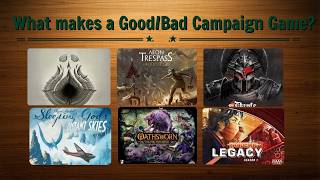
- great player agency
- serviceable narration
- large amount of reading due to no audio narration
- Serviceable, but not exquisite
Mechanics (from transcript analysis)
- Chapter-based stories — Players pick a storybook and go through chapter-based scenarios with keywords and decisions carrying over.
Video topics + discussion points
Quotes (from this video)
- This is very like tribal like morbid.
- It's um it's Dark Souls King Arthur, the Arthurian legend.
- this one is kind of like it's very like tribal like morbid.
- But if we're looking at themes of negative like negative games that I just did not care about the theme
- I typically don't buy them if I if I don't like the theme.
- the way that they did the theme was was so uninspired.
- Odelin is again a good one just because it's it's Diablo generic demon fantasy thing. I find that incredibly tired.
- Vagrant song certainly unique. I don't call it bad, but it had a hard time ringing with me
- I was actually kind of glad you decided to quit that one.
- So, if we're looking at games that I think does CA uh combat one of the best I'm trying to think is I mean Osworn is definitely up there.
- That's the highlight. I mean, this is also a boss battler, but it is a campaign. But each boss is unique. I love the way that it utilizes the battle flow system. The fact that you can use cards or dice.
- Their dedication to the secret boss. I applaud. That they they did everything they could to keep it all a mystery.
- But then on repeat, the the mystery is gone, but the combat is still still great.
- Because that's all it is is boss fights. I think a game funny enough that does boss fights terribly is one we've already talked about Madara
- Madara's boss fights are [ __ ] bullet sponges with 800 health
- the AI itself when you're doing the mobs, that works relatively well for the various enemies that are in the game, and they do level up, which is nice. They get more challenging, but it kind of just boils down to more HP and more damage. It does. They still kind of run the exact same way, but they color code it so it's not just a hodgepodge of just enemies.
- the inverted paradigm system is amazing.
- And actually a good positive and probably a good negative for some is atto to KDM. It depends on how you like your boss fights.
- Don't get me wrong, they're they're extremely similar. And it just kind of depends on how you want your boss fights. KDM does it. I'm not saying KDM is necessarily a negative, but in the sense that it's combat can literally boil down to I have a character that can crit on everything
- It's too It's just way too clunky.
- God, no. A green [ __ ] Who the hell goes off a D 100?
- But yeah, folklore the affliction. This was the one had had a really cool world. I like the the fable element, the gothic horror stuff. I think the characters were unique. Um but man, fiddly as all hell.
- Yeah. And I mean, they shot for the open world.
- It would have just been better if it was if it was uh scenario based.
- but he doesn't want to carry any of his [ __ ] to my house.
- I want to see it. I want to see this game of his that he owns like everything for
- I didn't ever bring this one up because I haven't touched it in years.
- Yeah, I know. I know. You would think with how much [ __ ] he has and how much he doesn't touch it, you would that he would want to play it. I told him we could have three. We could get cuz you'd be in on it, but he doesn't want to carry it over to my house.
References (from this video)
- Narrative driven
- Cooperative adventure game
- narrative driven adventure
- Role Player
Mechanics (from transcript analysis)
- Action Point Allowance — Players have a play limit to play cards from their hand.
- Bag Building — Attribute dice are placed in a dice bag to be drawn randomly.
- Campaign play — The game is played over a series of adventures, with progress carrying over.
- Cooperative — Players work together to overcome challenges.
- cooperative play — Players work together as a party to complete the adventure.
- Deck Building — Market decks are used to acquire cards like armor, scrolls, skills, traits, and weapons.
- dice as resources — Dice are rolled and placed on indicated slots during skill checks and combat.
- Dice Rolling — Players roll dice as part of skill checks and combat.
- Push Your Luck — Players can spend stamina to add dice but cannot become exhausted.
- Resource Management — Players manage stamina cubes, gold, and XP.
- Set Collection — Players collect various types of cards (discovery, title, rare, market cards) that are used during the game.
- Worker Placement — Stamina cubes are spent to add specific colored dice to a pool.
Video topics + discussion points
Quotes (from this video)
- welcome today we'll be taking a look at role player adventures
- if you and your party survive to the end of the adventure then you win the game
References (from this video)
- rich, branching narrative with a large word count
- strong world-building and continuity across expansions
- legacy-style memory affects future adventures
- large and heavy (box weight) which can be cumbersome
- it's a heavy production requiring time to play
- fantasy adventure with branching stories and character-driven narratives
- world of Allos
- story-driven with branching decisions and consequences across adventures
- Cartographers
- The Lord of the Rings
Mechanics (from transcript analysis)
- branching decision trees — player choices influence future encounters and outcomes
- memory/legacy progression — game remembers past decisions to affect future play
- Narrative Choice — player choices influence future encounters and outcomes
Video topics + discussion points
Quotes (from this video)
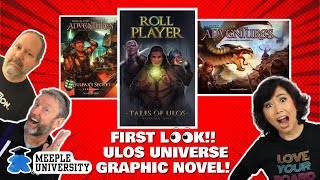
- Roleplay Adventures has over 440 000 words in it
- the graphic novel is part of the Kickstarter campaign
- the new expansion gold Pack's secret is the name of the expansion
- it's Standalone so it doesn't use nephras's Judgment
- Cartographers has got to be one of the best games that has ever been made and I need more
- I love World Building you know working on these games is all about
- Kickstarter is November 1st through the 18th
- there's a lot of paper in that box for sure
- the base game is 17 pounds
- Role Player Adventures has over 440 000 words in it
References (from this video)
Mechanics (from transcript analysis)
Video topics + discussion points
Quotes (from this video)
- Role Player Adventures is a narrative driven quest game
- the game plays wonderful
- cooperative puzzle game
- Role Player Adventures has eleven scenarios as well as an expansion exploring the backstories of all 41 playable characters
References (from this video)
- narrative-driven quest with immersive storytelling
- cooperative puzzle gameplay
- extensive replayability with multiple scenarios and backstories
- integration with the original Role Player game
- large catalog of title cards and character backstories
- narrative-driven quest
- Role Player universe
- read-aloud passages from game books; scenario-based branching narratives
- Role Player
Mechanics (from transcript analysis)
- Branching Narrative — Scenarios progress via paragraphs in game books; players choose pathways that alter the story.
- combat_and_skill_checks_as_puzzles — Combat and skill checks are solved as cooperative dice manipulation puzzles.
- Combat: Dice — Combat and skill checks are solved as cooperative dice manipulation puzzles.
- Deck Manipulation — Roll and place colored attribute dice on test spaces; spend stamina to buy dice; attempt to match colors and numbers.
- dice manipulation — Roll and place colored attribute dice on test spaces; spend stamina to buy dice; attempt to match colors and numbers.
- integration_with_base_game — Can be integrated with the original Role Player game using rules outlined in the rulebook.
- Narrative Choice — Scenarios progress via paragraphs in game books; players choose pathways that alter the story.
- Resource Management — Gain keywords, experience points, and gold to affect future cards and challenges; resting costs experience.
- resource_management — Gain keywords, experience points, and gold to affect future cards and challenges; resting costs experience.
- title_cards — Earn title cards (over a hundred possibilities) that steer narrative directions.
Video topics + discussion points
Quotes (from this video)
- Role Player Adventures is a narrative driven quest game
- the game plays wonderful
- cooperative puzzle game
- Role Player Adventures has eleven scenarios as well as an expansion exploring the backstories of all 41 playable characters
References (from this video)

- Gaining points from matching dice colors to class or backstory.
- Gaining points from completing attribute rows.
- Gaining victory points for sets of cards (weapons, skills, traits, armor).
- Gaining victory points for weapon cards.
- Gaining victory points for armor sets.
- Ability to reroll dice to get desired outcomes.
- Gaining gold as a resource and for various actions.
- Flexibility in placing dice to meet specific goals.
- Dice rolls can sometimes be unfavorable, requiring rerolls or difficult choices.
- Some abilities require specific dice colors or values.
- The need to manage alignment markers.
- The cost of certain cards can be high.
- Difficulty in hitting specific attribute goals without manipulation.
Mechanics (from transcript analysis)
- action selection — Players choose from a variety of actions on their turn, often influenced by dice rolls and card abilities.
- Card Drafting — Players draft cards from a marketplace or pool of available options.
- Dice Placement — Players place dice into various rows or abilities to trigger effects or gain benefits.
- Initiative tracking — Initiative cards are used to determine turn order in certain phases, like the market phase.
- player interaction — Some actions, like pickpocketing, directly affect other players.
- Resource Management — Players manage resources like gold and dice to perform actions and purchase items.
- Set Collection — Players collect sets of cards (e.g., weapon, skill, trait, armor) to gain victory points.
Video topics + discussion points
Quotes (from this video)
- three heads are better than one
- Oh Rhoda's gonna kill you in your sleep.
- sock is basically just coins at this point.
- Oh dark like leather how dare you take talks leather away you would had matching gloves and boots.
- Oh my gosh oh wow looks like Rose the lucky savage barbarian.
- one place I'm not lucky is I just don't have money for this market face.
- dog doing pretty well but talk like friends so friends help dog needs friends.
References (from this video)
- memorable campaign experiences
- expansions add variety and modules
- some scenarios may feel repetitive over time
- adventure with collaborative narrative
- story-driven campaign with role-playing flavor
- campaign with evolving scenarios
Mechanics (from transcript analysis)
- campaign / scenario-based play — narrative arcs guide progression and choices
- cooperative/story-driven decisions — players collaborate through actions and story moments
Video topics + discussion points
Quotes (from this video)
- it's a work replacement game
- it's a fantastic game
- the expansion really elevates it
- it's a very slow deck builder essentially in combination with the work placement
References (from this video)
- Array
- Array
- adventure and storytelling within a tabletop framework
- Array
- fantasy world with a campaign-driven quest structure
- Array
- Array
- Array
- mixed
Mechanics (from transcript analysis)
Video topics + discussion points
Quotes (from this video)
- It's been very quiet, which we all know what that usually means. There's going to be like 10 Kickstarter deliveries all at once, but we'll see what happens in March.
- I'm very picky with new games that I want to pick up.
- Games are always there waiting for you to come back and there's always more fun to have.
References (from this video)
- expands Role Player concept
- nice box and production value
- plastic off only; limited progress in playthrough
- expansion of Role Player with adventure
- fantasy role-playing vibe
- Role Player
Mechanics (from transcript analysis)
- dice-driven character creation — roll to build a hero, then adventure
Video topics + discussion points
Quotes (from this video)
- "Netrunner is a fabulous game now I used to play this all the time"
- "it's the best of those"
- "it's so good I can't emphasize how good this is"
- "Claustrophobia is a must-have for your collection if you're a Dungeon Crawler"
- "Gardenbau sponsored by 25th Century Games"
- "you buy one of these packs and you're good to go"
References (from this video)

- immersive storytelling with two professional writers
- possibility to import a Role Player character into the adventure
- appealing narrative depth for campaign-style play
- needs commitment for multi-book campaign play
- may be complex for players seeking light games
- story-driven, narrative-driven adventure in the Role Player universe
- fantasy role-playing campaign within a board game
- novel-like adventure with branching choices
Mechanics (from transcript analysis)
- character progression using pre-generated or existing角色 — develop a character fromRole Player material or pre-generated options
- Choose-your-own-adventure narrative — participants influence the story through decisions that shape the fate of the character and plot
- Dice-based resolution — dice outcomes drive events and outcomes in the storyline
Video topics + discussion points
Quotes (from this video)
- Galaxy Trucker is a game about watching something you love get destroyed.
- the rules are dead simple
- a quirky cute tableau builder with dice activation
- collect dinosaurs fossils score points win big
- my landscaping crew is better than your landscaping crew
- a true epic adventure
References (from this video)
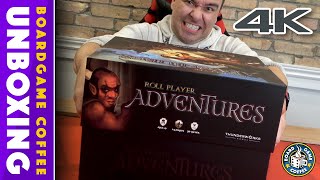
- innovative, modular components with writable tracking sheets
- strong artistic presentation that fits the setting
- immersive encounter and storybook structure
- heavy setup and reading load can be daunting
- potential misprints or production variances in early copies
- learning curve may deter casual players
- Adventure, branching storytelling, player-driven paths
- Fantasy role-playing adventure with modular maps and storybooks
- Story-driven with encounter-based progression and reader-led exploration
- Solomon Kane
- Sleeping Gods
- Hero Quest
Mechanics (from transcript analysis)
- character sheets and trait/skill tracking — personalized character progression with fatigue counters and skill checks
- dice-based skill checks and randomization — dice pools tied to skills; more dice increases odds but remains dependent on skill relevance
- modular tracking sheets — windows to record stats and fatigue, enabling per-player monitoring
- narrative encounter books — pages and cross-references guide the story flow and choices
- overlay/map and terrain alteration — maps with layered elements to modify exploration area and encounters
Video topics + discussion points
Quotes (from this video)
- it's heavy
- my back is blown out by this box
- this is heavy and dense and it feels like a big investment
- the innovation of these sheets is my favorite so far
- i like when games do that, they give you a way to track things
- read, then read again, then go play
References (from this video)

- Epic scope and narrative breadth
- Potential for long, memorable campaigns
- Setup/movement heavy and campaign commitment
- Role-playing narrative with module-driven progression
- Campaign dungeon-crawling role-playing adventure
- Story-forward, collaborative storytelling
- Gloomhaven
Mechanics (from transcript analysis)
- Role-playing narrative progression — Narrative arcs unfold through player choices and campaign structure.
Video topics + discussion points
Quotes (from this video)
- it's our list let it be
- we're here today with a very exciting video so exciting jeff can't even open his eyes
- this is the most immersive experience
- it's a brain burning game
- I freaking love Role Player Adventures
References (from this video)
- serves as a strong reference point for campaign-based curation
- solid RPG-inspired cooperative progression
- fantasy RPG-adventure
- campaign/role-playing
- Kinfire Chronicles
Mechanics (from transcript analysis)
- story-driven quests — players progress via narrative-driven decisions and card interactions
Video topics + discussion points
Quotes (from this video)
- "Shared topics actually work."
- "This is what I love about Stonemire what you do."
- "There's this sort of nervous excitement, but just generally getting it out there and seeing the response and seeing people enjoying themselves."
- "goosebumps thinking about it"
References (from this video)

- Strong narrative drive and branching missions
- Creative card play adds depth to dice resolution
- Failure is not terminal; progress continues and can be rewarding
- Brutal skill checks can be punishing
- Rules are complex and can require repeated rule-checks
- Role-playing, dice tests, and story-driven progression
- Fantasy campaign with text-based adventures and branching paths
- Brutal but forgiving forward progress; heavy emphasis on story
- One Deck Dungeon
- Ingenious
Mechanics (from transcript analysis)
- Campaign progression with character transfer — Imported characters retain stats and items from the original Role Player into the campaign hand
- Dice pool / dice placement — Assemble and spend stamina to roll and resolve skill tests and combats
- Fail-forward / continue playing — Even on failure you progress the story and encounter a death section with healing
- Hand Management — Use item cards to modify dice outcomes and re-use between encounters
Video topics + discussion points
Quotes (from this video)
- the infinity gauntlet is its own encounter set and i think that makes so much sense
- the game really is the story and the skill checks
- it's a real blast to play
- the rules themselves are easy but it's the potential to string those bonuses together
- the sandboxy feel is really appealing and addictive
References (from this video)
- Cooperative, narrative-driven play with branching paths and a strong story framework.
- Pre-generated characters enable quick entry without owning Roll Player, with the option to import characters from Roll Player.
- Shared inventory and discovery cards add flavor and strategic depth.
- No strict win/lose condition; emphasis on narrative progression and campaign continuity.
- Prototype art and components may differ from the final production version.
- Rule density and setup complexity can be intimidating for newcomers.
- Two-player optimization can require careful management of resources and fatigue.
- Cooperative narrative exploration with branching story paths and discovery-driven encounters
- Fantasy campaign world with outposts, maps, and central intrigue involving a niedestined conflict in Mallos against dracool factions
- Storybook-driven branching narrative augmented by a tome of encounters and discovery cards
- Roll Player
Mechanics (from transcript analysis)
- Combat with modifiers and fatigue tracking — Combat uses dice pools, modifiers from cards, round tracking, and fatigue consequences that can exhaust characters.
- cooperative play — Two or more players work together to advance the story rather than competing to win.
- Dice pool management and stamina system — Players build and modify dice pools, spend stamina to influence rolls, and track fatigue and exhaustion.
- Item sharing and discovery cards — Items are held by the party as a shared resource; discovery cards can alter maps, provide items, or affect encounters.
- Rest and progression — Resting recovers stamina, refreshes cards, and advances the party’s campaign state.
- Skill checks with card and dice resolution — Skill checks combine dice pools with spent or spent icons from cards to succeed or fail challenges.
- Storybook and encounter book navigation — Entry selections move players through the adventure via keywords and storybook pages.
- Storybook-driven exploration and decision points — Decisions affect which storybook entries are opened and which keywords drive the flow of the adventure.
Video topics + discussion points
Quotes (from this video)
- this is a fully cooperative narrative adventure game
- there is no winning or losing in these adventures
- we are going to jump into the game out here the game is fully set up and ready to play
- if you have a copy of role player you can import characters you make in that game into a game of role player adventures