







































The Resistance: Avalon Deep Dive
What the Community Thinks About The Resistance: Avalon
Reviewers who cover The Resistance: Avalon generally agree that it is one of the strongest social deduction games in its class, and that its strength comes from how much it accomplishes with very little. Chairman of the Board calls it their favorite social deduction game, and found that returning to it after a long break still felt familiar and fresh. John Perkins, Actualol places it at number 10 on a top 100 list, praising its ability to deliver a full hidden traitor experience in about half an hour. BigPasti is the most pointed advocate, arguing that Avalon is a better designed game than Secret Hitler.
The enthusiasm is broad, but the reviews are most useful when read for the conditions they describe. Meeple University notes that the team selection phase takes the longest and generates the most discussion, and Rum & Board describes that phase as designed for lots and lots of arguing. Some players will find that friction is the point, while others will find it slows the game down. In more casual settings, Ryan and Bethany Board Game Reviews describe Avalon as a huge hit with their family, one they return to several times a year, provided everyone stays interactive and pays attention.
Core Mechanics That Define The Resistance: Avalon
Hidden Roles
Each player begins with a secret allegiance that only that player may look at, and the tension comes from what the teams do not know about one another. Meeple University walks through the setup in detail, explaining that spies open their eyes during the night phase to identify each other while the loyal players see nothing. Avalon adds the special role cards that the original The Resistance lacks. Merlin knows the evil players, Percival learns who Merlin is, and Morgana appears as a second Merlin to confuse Percival. BigPasti argues that this layering holds up well, since the core rules stay stable whether the table adds Oberon, Percival, and Morgana to the base assassin and Merlin pairing. Merlin is the role reviewers single out as the hardest to play, because Merlin must steer the good team toward three quest successes without making the assassin's final guess easy.
Voting
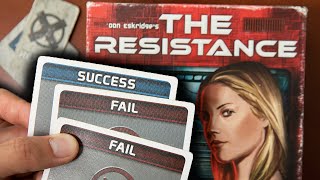
Every proposed team is put to a vote, and the design turns that vote into evidence. Meeple University explains that votes are placed face down and revealed simultaneously, so no player can react to someone else's vote, and that a team needs a majority of approvals to proceed. A rejected team passes leadership clockwise, and a fifth consecutive rejection hands the evil side the game. Actualol points out that good players want to be on every quest because they know their own loyalty, while evil players want to be on a quest so they can sabotage it. That logic turns each proposal into a read on the group. Meeple University's worked examples show how mission results and voting patterns combine to narrow down who is a spy.
The Resistance: Avalon Experience
Social
Reviewers describe the table as the main event. Ryan and Bethany call the game straightforward, but one that requires everyone to be interactive and to understand what is happening at each step. BigPasti describes the story as one the players write together, emerging from betrayals rather than from a deck or randomness. Rum & Board recommends setting a narrative premise before play begins, such as a medieval court or a pool party full of dinosaurs, and says the storytelling enriches the game and gets every player more invested.
Interactive and Dynamic
What other players do directly affects your plans in Avalon, and reviewers describe the feeling of a table shifting around every vote. Meeple University's team selection discussion is described as the phase where players put forward their theories about who should be selected, and the leader's choice is the only one that counts. Rum & Board describes discussion before, during, and after every part of the team phase, which is the moment when bluffing, persuasion, and mind-reading all get tested. The result is a game where the board state changes with the group's collective reads, not with a fixed sequence of turns.
What Makes The Resistance: Avalon Stand Out
Truthful Information Instead of Randomness
BigPasti's central argument is that Avalon avoids randomness entirely. The game does not rely on a policy deck or a shuffled outcome to drive its story, and each round feels important because the information the table receives is accurate. BigPasti contrasts this directly with Secret Hitler, where the reviewer says the game state tends to return to the same position regardless of player decisions. In Avalon, the reviewer argues, the decisions carry weight, and the story belongs to the players.
A Modular Cast of Characters
Reviewers consistently treat the optional characters as a strength rather than a complication. BigPasti notes that Avalon can accommodate additions such as Oberon, Percival, and Morgana without losing its core balance, and that a table playing with a strong evil team can add a character that is fun to play badly. Chairman of the Board describes a six-player game with Merlin and Percival that gave the table a good little array of roles and created plenty of good decisions. The flexibility lets each group tune the balance and the feel of the game.
Potential Drawbacks
A Single Guess Can Decide the Game
Chairman of the Board describes a six-player session where the good players appeared to be winning, but the assassin correctly identified Merlin and the evil side took the game. The reviewer enjoyed the session overall, but the reversal illustrates how the final guess can override three successful quests. Merlin's role makes that outcome hard to avoid, since Merlin cannot be used without the assassin and must balance hiding identity with helping the good side win.
Dependence on the Table
Several reviewers make clear that Avalon's experience depends on the people at the table. Meeple University acknowledges that team selection takes the longest and produces the most discussion, and Rum & Board jokes that the process is as terrible and amazing as it sounds. Ryan and Bethany's recollection of a session with a late and distracted guest shows how quickly the game loses its momentum when one player does not engage. Players who want a brisk, low-friction game may find the table talk more demanding than they expected.
If You Enjoy The Resistance: Avalon
Players who enjoy Avalon's hidden roles and table talk will find satisfying parallels in One Night Ultimate Werewolf, which BigPasti names among the well-loved in-person social deduction games. Players who value deduction backed by information over guesswork will find a similar appeal in Deception: Murder in Hong Kong, which BoardGameGeek describes as one of the top tier social deduction games, precisely because players have concrete evidence to work from. BoardGameGeek also places Avalon alongside classic werewolf and mafia-style games, where one side must succeed while the other must avoid being obvious. For players drawn to Avalon's team loyalty tension, Secret Hitler is the comparison BigPasti draws most directly, although BigPasti argues it leans on a predetermined rhythm rather than player deduction, so it is best approached as a contrast.
What Reviewers Are Saying
"This one is definitely my favorite social deduction game, and it was really nice to go back and visit this one, especially with that kind of refreshed mindset. We hadn't played in a while, it felt good again, but it still felt familiar."
— Chairman of the Board
"Avalon is a mechanism to actually deduce what people's intentions are, and when you are revealed information, you know it's truthful, and it's fun because of that."
— BigPasti
"Merlin is a very difficult character, a very difficult role to play. Merlin needs to strike a balance between doing two things. Merlin, like the other good players, needs to see three missions succeed, but at the same time Merlin also needs to make sure that at the end of the game the assassin does not know who they are."
— Meeple University