Favorite Mechanisms: 2026 Mid-Year
Games in This Video
15 games are featured in this video — they unlock as you watch.




Transcript
I'm Jamie from Stonemaier Games, and we are now midway through 2026. So, I thought it would be a good time to talk about my favorite mechanisms of new-to-me games, expansions, products, anything that that is new to me in 2026 so far that I have already talked about on this channel. So, January through June uh videos about games that I that I have my favorite mechanisms for, they are eligible for this list.
I ended up coming up with 12 total favorite mechanisms, the top 12, in no particular order. They're roughly in chronological order on this list. Before I jump into the list, I did want to mention that we have four new Stonemaier products so far this year, um including two more to come in the very near future, but I won't count those yet. I'll I'll look those in the second half of the year. But, we had Wingspan Asia, and that has these tiny honey hummingbird cards that flutter back and forth between the central garden and your player mat. Um I really like that mechanism. Viticulture Bordeaux, an expansion to Viticulture that offers a completely new board for Viticulture. Not completely new, mostly new board for Viticulture that has these experts, these ways that you can upgrade action spaces just for you or actions just for you. Um Wingspan Sharks and Reefs, very recent product. I really like the idea that you have these coral reefs that you can grow if you want to, and if you do, not only is it worth points at the end of the game, but it makes many different fish better, too, because fish thrive when when there's a healthy coral in their environment, or reef fish do at least. And last we have Euphoria Essential, a reworked version of an older Stonemaier game that I designed, and I really like the new lost and found mechanism in the game.
This idea where if you lose a worker because you pushed your luck a little bit too much, you had too many workers, a worker got smart, figured out they were in a dystopia, and ran away, it's now much easier to get that worker back. It still takes an action to do it and a small cost um and some consequences, but it's easier to get that worker back. It's less of a setback than just having a bad roll early in the game and losing that worker. So, those are the Stonemaier products released so far, my favorite mechanisms in each. Let's jump into the list that I'm starting with a game that I played right at the beginning of the year, or at least that's what the video would suggest. This is Jingle Bell Roll, a very light push your luck game involving these beautiful custom dice that I have just really enjoyed playing. I think it's a delightful push your luck dice rolling game. And the thing that makes it particularly special, in my opinion, is this mechanism that in general, you don't want to roll bells. Bells don't give you any points during the game. Uh they or at any time in the game. You're trying to get the most points over, I believe, six rounds, five or six rounds. Bells don't help.
However, if you roll bells and you if you roll enough bells, and they're also locked in, so you can't reroll bells. So, generally, you don't want to roll bells. But, if you roll enough of them, you can get upgrades. So, I think it's really neat that a game like this has progression. You can actually get better at the actions that you're taking during the game. And in addition to that, if you find yourself falling behind, or if you just roll a bunch of bells in your first roll, and you get two more rerolls after that of the non-bell rolls, you can try to push your luck and try to roll seven total bells. And if you do, you instantly win the game. You just win. So, points don't matter. You don't have to keep playing the game. You don't have to finish the the game. You just win. So, it gives you this feeling that I think is so brilliant in a push your luck game, where you have a chance, even if you have not rolled well throughout most of the game, that you can come down to the wire in that last turn, and you have a chance to win, even if you have two points over the course of the game.
Someone else has 50. You can still win if you roll seven bells. Um I really like this. I've seen it happen, I think, once. And there are ways to sometimes manipulate dice in the bells. You can you can craft a strategy around increasing your chances of this happening. It's still a very rare thing, and that's what makes it special. The uh the the the bell roll in Jingle Bell roll. Next up, we have uh the Mandalorian faction expansion to one of my favorite games, the Star Wars deck-building game. Uh there's just a really simple mechanism in here that I think is really clever, where in Star Wars the deck-building game, there is a force track. You can kind of see it it's split into two parts down here. But over the course of the game in most games of Star Wars the deck-building game, you were hoping to have uh the force the force be with you, and even all the way over to you because you get an extra resource on your turn.
Many cards trigger if you if the force is with you. However, the Mandalorians thematically are a neutral faction. They aren't sided necessarily with the emperor the empire or the rebels or any of the different factions. They are their own neutral or they try to be neutral faction, and as a result, they have cards that want the uh the force to be in the middle. They want it to be completely neutral on this track. Let me see if I happen to draw any cards here that want that. No, none of the these featured cards want it. But there are a number of cards in the Mandalorian deck that just want neutral force. Uh and while the force doesn't entirely make sense for this, maybe a little bit, but it's more about neutrality in terms of alliances and allegiances. And I thought that was a really clever mechanism to put in the game, where previous to this, you always just wanted the force to be with you.
So that is my favorite mechanism, the neutrality of the force track in the Mandalorian expansion. Here we have Oh, and I should mention before I go on, you are going to see games on this list that were played that were released before 2026. In fact, quite a few of them were. I counted games Any any of the games that I put on my channel as my favorite mechanism videos in 2026 so far are eligible for this. Some of them are new games for 2026, but um they're all new to me at least in 2026. That's what's important for this list. And that for example is this game Priorities, which I think came out around 5 years ago. This is a really delightful um cooperative game, cooperative ranking game, where you put five cards on the table. Uh one player secretly uh writes down the order of how they prioritize those cards, how much they value the things on those cards.
Let's see what we can see here. I think we have millennials maybe over here and being organized is two of the five cards. And on the back of each of these cards is a letter. And this is what I think is really particularly clever about this game in that you are racing to spell the word priority. So whenever uh you you uh whenever the other players rank these cards correctly, so if I said being organized is my number one priority, and everyone got that, they or players work together, they they said, "Okay, the Jimmy, we think this is your number one." They got that exactly correct. We'd flip this card over and it would show a letter in the word priorities, and it would join our word for the priorities. But say uh millennial, say I ranked millennials much lower on the list, number five, it wasn't it wasn't number two on my list.
It was incorrect. That card flips over and becomes part of the game's spelling of priorities. So I really like the game that the game presents this fairly organic timer to you. It isn't a set number of rounds, it isn't even you could even get a little bit lucky and have the game like spell most of the word priorities, but maybe they're missing in this case what the T, they're missing the T, and they just don't draw the T. So you get a little bit longer of a chance to get these right. Um in this style of cooperative game, I don't generally care who wins or loses, I don't care about points or things like that, but um but it is nice to have a little bit of pressure, a little bit of organic pressure from the game, and I thought Priorities did that in a really clever way in their timer. That's Priorities. Next up, we have uh unfortunately the picture is in a different language than I speak, um but this is Three Chapters, one of my favorite games that I played for the first time in 2026.
Uh this game has you drafting cards and then doing two things with those cards. One, at the end of the game, all the cards that you draft, you were going to score them uh in combination with each other. So, uh based on these three different types of tokens that you can gain, stars, hearts, and gems. And so for example, Alice says you get a star for each other mushroom icon on card. So, I might collect cards with a few with like here's Humpty Dumpty has a mushroom on it, so I would get one heart for Humpty Dumpty. Um and so a lot of these cards combo off other types of cards, other specific cards sometimes. They want to be with other specific cards. So, all the cards that you're drafting, you're drafting so that you can score those cards based on your based on that hand of cards at the end of the game. However, the thing I think is really clever in particular is that in addition to that, there's a middle round of the game where you are playing a trick-taking style game where each player is going to play a card and the highest number wins.
No complexity of suits or anything like that. The highest number wins. So, pretend these aren't my hand of cards. Pretend Pretend this is a uh trick that was played. The player with the 46 would win. They would get a star for winning that trick, for just having the highest card. However, every other card played into the trick, base the for the player who played that card, they will score that card based on the cards in the trick. So, whereas this Alice is really good for me to have at the end of the game with other mushrooms that I drafted, Alice is also good for me to play into a trick where a lot of other play players played mushroom cards. So, it's this really nice interaction in the game. Not only are you drafting cards to score points, but you're also trying to play those cards at exactly the right time so that you score off of them. After I play Alice, Alice then enters my tableau where regardless of who won the trick.
So I'm still going to score Alice at the end of the game. But I thought this was really really clever that you're scoring these special abilities based on the current trick as well. That's three chapters. Really clever mechanism. Tag team is up next. A little dueling game and it does something I think is really really clever where there's no shuffling in tag team except maybe at the very beginning of the game. Instead, round around you are revealing these cards one by one from your deck matching them up with the opponent's played the opponent's card the card that they are revealing. So you have no agency here at this moment. You are just revealing a card and match it up with the opponent. Maybe some of the cards have some different options on them but but you're just revealing doing what the card says against what the opponent revealed. And then at the end of the round, you get to draw three cards from a separate deck, choose one of them and insert it somewhere into your deck. You get to choose exactly where you insert it but you aren't reshuffling, you aren't reorganizing, you are just inserting a single card.
And yet this leads to so many varied deck decisions in the game. The order really really matters because not only are you matching up with the opponent's order of operations and and their cards in their deck, but also you might have some cards in your deck that want certain icons like you might have a card that says okay for every every three attack icons or it won't be attack but a special icon that you've accumulated up to this point this card is now more powerful as a result. So the order of operations matters for you as well as in relation to your opponent. But I just love that without any shuffling. Like you don't need to sleeve this game. There's no shuffling in this game in this deck building game. You are inserting cards instead and I think that's such a clever twist that I really want to use it in the game where you are kind of crafting a a deck but you're inserting cards in specific places in that deck and how that matters. But maybe I don't need to design that because tag team already does it so well. I really really like this mechanism in tag team. The the card insertion.
Next up, again, in no particular order. These are just the order in which I played these games this year, roughly, or the order of the videos, at least. This is Machi Koro 2, the new version of Machi Koro. It came out a few years ago. And this game does something I thought was really, really clever in that you are trying to have three landmarks. I believe that's the trigger for the end of the game, gaining three landmark cards. They are very expensive cards that you're buying. Um And when you do that, so if essentially if I use my turn to buy a landmark, I am saying, "Okay, I am 1/3 of the way to winning. I am ahead of the other players at this moment." However, many of the landmark cards, and this is my favorite mechanism, have benefits that say all players I think some might say all other players, but I think most say all players gain this benefit when this card is purchased.
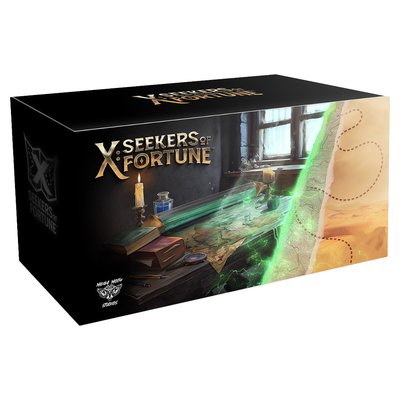
So, there's this nice, slight catch-up mechanism. Uh if a player who has pulled ahead a little bit, they've they've bought one of these landmark cards that moves them towards winning, that all players get a benefit when they do that. And so, uh I just like that. I like positive player interaction, but I also like close games, and I think this does it in a really nice way. It doesn't discourage a player from actually get getting that landmark. You still want to get that landmark if you can. Um but, you are helping all the players when you do that. So, yeah, I really like that about Machi Koro 2. This is kind of a wild card pick. This is X: Seekers of Fortune, a game I think that that tried to be kind of an Indiana Jones style adventure adventure game. I think they did pretty well at accomplishing this. But, my favorite mechanism in the game is that many of the cards that you can play have a choice. You can choose the noble option or the ruthless option. For example, let's say the card that's fully revealed here, the excavators pick. If you choose the noble option when you play this card, when you would draw an action X card, instead look at the top two, draw one, discard the other.
Helpful for you. Or, you can be ruthless. Ruthless says, "When a rival, an opponent, draws an action deck card, instead you look at the top two, put one into their hand, and discard the other. So, this is actually a choice that you make when you play the card, but it's an ongoing ability. So, you have this card in play, it's ongoing, uh and so you are kind of leaning into being noble, leaning into being ruthless. And I think what this does is that lets players be themselves. Uh and it be themselves at different moments in the game, too. Like, I might start off a game of X: Seekers of Fortune wanting to play noble and choosing the noble option. But, we might get pretty close to the end of the game, and I realize, okay, if I am just if I'm not ruthless in this moment, the other player is going to win. They are going to win. And so, I need to be ruthless in this moment to give myself a chance of winning. I think that is so cool that these cards give you that flexibility. It's a little bit like the split cards in Forest Shuffle, although um like it's it's two cards in one, but divided in a thematic way of of being noble or ruthless. I think that's really clever in X: Seekers of Fortune.
Next up, we have Mind Bug, another slightly older game that I played for the first time this year. This game is a it's a dueling game. It's a quick, snappy dueling game where you're just trying to win three points. Um and that the the hook of the game is my favorite mechanism. I think it's so clever in that whenever you on your turn you are either playing a card or you are attacking with a card. There's no cost to just decide a card from your hand that you're going to put into play or card that's already in play, and you attack with that card. Uh when you choose to play a card, the opponent throughout the entire game has two opportunities. They have two Mind Bug cards where they can say, "Okay, instead of you getting to keep this card uh so, I played the card. I I played a card. They say, "Instead of you getting to keep this card as your own, I'm going to Mind Bug it. I'm going to use one of one of my two chances to claim that card as my own." They get to claim the card.
And so, every time you play a card, you're kind of deciding, is this a card that I really want or am I trying to bait the opponent into taking it so that I can play the card that I really want? Um and sometimes you know that the opponent will want the card, but you also want it, so you're waiting for the right moment to play that card. Maybe you'll stall a little bit in the hopes that they use their mind bug so they don't notice it. Um I think that is so clever that you have a few chances to take over your opponent's cards. And when you do, importantly, if you if I play if I play the card on my my turn, you mind bugged it, it then goes back to my turn. It's as if your entire turn, your reaction, was the mind bug. So, I don't have just a dead turn as a result. I I still get another turn after that. Yeah, mind bug. Really really clever mechanism there. I also I should note that I previously misspoke and said that Richard Garfield was the designer of Mind Bug. Uh he is involved in the game, but he is not the designer. There's actually a pair of designers that uh that are that are not Richard Garfield.
Um this game, beautiful game here. This is Etherstone. Etherstone is a game that I've been thinking about since playing it. I let a friend borrow it, and I still haven't gotten to play it again, but I love Etherstone. I look forward to borrowing it back from this friend so I can play it again. Um and Etherstone, it is a a a handcrafting game where you're deciding certain cards to play at different times to build an engine. Uh you you have very few cards that you're playing, so you're really deciding which of these cards do I want to play and when do I want to play them? And two thing I there I have to mention two things about Etherstone cuz there's two things I thought were really really clever. One is the dice system. Every round is a little bit is a little different because you're rolling these dice in the middle of the table, and on your turn, you can choose to claim one of these dice to activate an ability. And you might have cards that say, like whenever you claim a six, you activate this ability, or whenever you use a six, or or or whatever the number may be, you get an extra bonus from this card. So, your cards will have you lean into certain numbers. You're hoping to see those numbers rolled. I think that's really clever. It gives a lot of variability to the game and it's a shared space. All players are sharing these dice.
The other thing that I think I I was slow to realize how much I how much I enjoyed this is that even though there are opportunities in either stone to hurt the opponent, to slow them down, to to impede them a little bit, the game leans more into the idea that you are fighting NPC monsters. There's there's a set of monsters that are out there on the table that uh you can that you can fight. Um and uh and that that works you that gives you victory points and potentially helps you win the game. But I really like that the core element of conflict and combat in the game isn't player-to-player even though this is I think primarily a dueling game. Instead of being two player-to-player, it's player to these NPC monsters. And so even though it's a it's more indirect that way, you are still competing over them. If there's a cheap monster to take out, both players might probably want to take out that monster.
And so I really like that there's still interaction in that way without being a direct combat dueling style game. So yeah, Ethersworn. I've really enjoyed this game. Beautiful art, too. Stunning art in this game. That's my favorite mechanism. Here we have Cozy Sticker Ville. This is I think the only campaign game that I played so far this year and I am continually delighted by it. I think it works so well because of its simplicity. It's very easy to get to the table. All you do when you play Cozy Sticker Ville is that you shuffle a deck of I believe it's 10 cards. I couldn't find this in the rule book. It's either 10 cards or 12 cards um for the current year and you you shuffle them up and uh there there's 10 specific cards or 12 specific cards. And then on your turn, you draw one of those cards and it gives you something to do. It might give you something that you can do later or it might give you a decision to make right now at this moment.
And no matter the player count, uh th- this is this there that's how the game works. Like even though all players are cooperating together and you're taking turns, there's not like a bigger deck for different player counts. You're not taking different numbers of turns. You are taking whatever the number is of cards in that deck. Well, again, I'll just say 10. You're taking 10 turns per round total among shared among all players at the table. Megan and I are playing it together. So, I take I draw a card and then Megan draws a card. On your turn, you're drawing a card and then you get to take an action, so then you do these two things and you go on to the next player. But, I really like this idea of shared deck with no other player scaling that you need to remember. I I always find player scaling to be a little fiddly in games unless the game makes it really really overtly easy during setup. Um and cuz this game says like we we don't care about player scaling. Just these are the number of actions These are the number of turns that you get in the game.
Take turns doing it and all players can be a part of this discussion and this decision if they want to be. Uh using this one single shared deck of cards. I think that's brilliant. Sanctuary, the follow-up to Ark Nova, tile-based Ark Nova. The mechanism that they keep coming back to in this game is that you have a similar action system to Ark Nova, this idea of these sliding, in this case, tiles instead of cards that uh power up, they level up um based on how long you haven't used them. And they each have an upgraded side. You can upgrade them to the other side. And the way that you do that is the game gives you these short-term goals. They're always the same short-term goals. Uh things like uh two of them have been flipped over. One is to have a certain number of I'm forgetting the projects, I think, is the name of this.
If you have two projects in play, you get to upgrade a tile. This one says have four different animal icons and you get to upgrade this. But, the game gives you In a In a game where there's a light a a lot to focus on, a lot of different paths that you could choose, the game says, "Here's four things. They're constant. They're always in the game. Whenever you accomplish one of these things, you get to upgrade one of your actions. You get to get better for the rest of the game. So, here are some things to on. I really appreciate when games do this, especially fairly complex games like Sanctuary. And uh yeah, I think this this short-term goal system um of things to pursue, I think, is really really helpful in Sanctuary. And they even they had these flipped over, but this tile has a number one on it. This tile has a number three on it. So, it's just 1 2 3 4. It even kind of says, you might want to do this number one first because the number one it isn't like you have don't have to do it in a specific order, but it's one thing that you have to have, two things, two projects, three things, four different icons. Kind of shows you the order that you might consider doing it in when you when you play Sanctuary.
And last up, the 12th game, and I kind of saved this one for last cuz I I still think this is my favorite game of 20 26 so far. This is Moon Colony Bloodbath. And similar to Cozy Sticker Ville, but in a very different way, in a competitive way, there is a single shared deck of cards in this game. All you're doing on on a turn on a simultaneous turn in Moon Colony Bloodbath is you are revealing one card from the deck, and all players do the thing on that card. In this case, the card they drew was robot waiter. Every all players lose four people, and they lose two food. It's a bad thing that happens. There are many bad things in this deck. There's also a few good things, but many bad things. I love that all it's so easy to teach this game to to get into this game, to steer players in this game a little bit, not steer what they do, but steer what they are allowed to do on their turn because you just get to go through this together. And there's this shared There's a little bit of shared trauma in this game cuz when this robot comes up, it hurts everybody.
Um and so you're even though it's is a competitive game, you were all in that, you're sharing that trauma together. But I also really like in this single shared deck that there's ways that you can put your own cards into the deck. And they aren't they they do eventually get shuffled in, but you're putting them on the top of the deck. So, when you put a card into the deck, you are going to see it right away, and then later on it'll be shuffled to the deck. So, that Oftentimes those cards are only helpful for you. Sometimes they're good for all players or bad for all players, but typically they are your own personal cards that you're putting into the deck, which is nice to see that when these moments where you get something that you put in there that you invested in and uh it didn't hurt other players, but it just particularly helps you. I think it's such a clean system. Um and also actually to make this even better, in each game that you play Moon Colony Bloodbath, you shuffle in two special cards. Typically they make the they're they're good cards for all players, but sometimes they might have a little bit of a downside, and they really because you are shuffling them into a small deck of cards and you are repeat over the course of the game you're shuffling this deck of cards multiple times, probably five, six, seven times. So, you're seeing the these two cards, these two loan cards have a huge impact on the game.
Um I really I love the variability that adds and how it kind of can shape the decisions that you make on any given game. It's such a clever system. I really love this in Moon Colony Bloodbath. That's it. Uh 12 games plus the four from Stonemaier Games, those are my favorite mechanisms of the year so far. Some of these games will show up on my top 10 mid-year list as well. Um but not all of them. Sometimes I really just love a certain mechanism in a game. Maybe I don't love the overall game, but I can appreciate and learn from a specific mechanism. It's why I love to play a wide variety of new to me games. Uh but yeah, I'd love to hear what your favorite mechanism mechanism is from the list that I've offered here and also your favorite mechanism in general from the games that you've played. I know it's hard to think about 2026 as the last 6 months, but maybe a game that you've played recently that you want to share in the comments, one that you would that you really enjoy and maybe you'd love to see others iterate on in other games in the future. I look forward to hearing your thoughts.
Thanks.