/pic6966955.jpg)


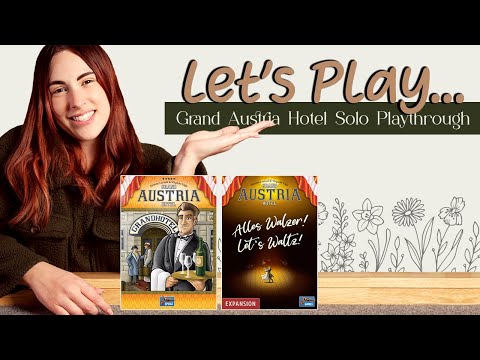






































Grand Austria Hotel Deep Dive
What the Community Thinks About Grand Austria Hotel
Reviewers largely agree that Grand Austria Hotel packs a surprising amount of decision-making into a compact structure built around drafting dice and cards rather than pure worker placement. Board Of It frames the game as more open than Agricola, with a wider spread of viable paths and turns that can snowball into big combo plays. BoardGameBollocks calls it a very fun Euro built on a novel turn order and a thematic staff and guest system, while still flagging real friction around downtime and dice luck. 3 Minute Board Games goes further, treating Grand Austria Hotel as close to an ideal European-style design built around a strong hotel theme.
Where the community splits is on how well that design holds up at the table. One channel turned an entire episode into a debate between its two hosts, Alex and Liz: Alex treats the puzzle of dice mitigation and action strength as a personal favorite, while Liz never warmed to the dated art and components or the amount of thinking demanded by a game wearing a light hotel theme. Let's Table It went further still, eventually removing Grand Austria Hotel from their collection because the action economy felt too restrictive for their taste, even while giving credit to the theme and core idea. Board Game Sanctuary's Danny represents a middle path, describing a first play that felt constrained and forgettable, only for a return visit years later to reveal synergies between staff and guest cards that had gone unnoticed the first time.
Core Mechanics That Define Grand Austria Hotel
Rolling and Drafting Dice for Action Strength
Each round begins with a shared pool of dice that gets sorted into rows of actions, and BoardGameBollocks explains that the number of dice sitting in a row becomes the strength of that action, so a row with several dice lets a player repeat the action that many times in one turn. Players can also pass on their draft to reroll the remaining dice rather than take a weak option, a safety valve BoardGameBollocks points to as part of what keeps the drafting interesting. 3 Minute Board Games adds that the game runs on a serpentine turn order, so the player who goes first in a round is also the player who goes last, which keeps the dice draft from simply rewarding whoever sits in the strongest seat.
Guests, Staff Cards, and the Hotel Puzzle
Beyond the dice, players are drafting guest cards to feed and house and staff cards that sit in a personal hand as ongoing or one-time bonuses. 3 Minute Board Games describes staff cards as carrying real variety, from one-time bonuses to effects that trigger whenever a certain die is gained to bonuses that only pay off at the end of the game. BoardGameBollocks highlights the emperor track that rewards players at set milestones through the game, layered on top of the room-building and guest-serving loop, as the piece that ties the hotel theme to actual scoring.
The Grand Austria Hotel Experience
A Puzzle That Rewards Repeat Plays
Board Game Sanctuary's Danny describes a first play of Grand Austria Hotel as underwhelming, with the options feeling arbitrary rather than meaningful, but says a second play much later revealed how staff cards and guest cards were meant to click together, turning the same box into a genuinely engaging puzzle. Alex, from that same debate video, echoes the appreciation for the puzzle itself, treating the tension between which dice to draft and which staff bonuses to chase as the most satisfying part of the design.
Turn Order and Table Dynamics
BoardGameBollocks calls out the tile-passing turn order as one of the best things about the game, since the player holding the low number and the player holding the high number both get to act at the edges of the round, and the tile then moves around the table so no single seat keeps that advantage. Board Of It notes that this structure produces long stretches where a player is quietly building toward something, punctuated by turns where several actions chain together at once, which the group found far more dynamic than the more linear turn structure of Agricola.
What Makes Grand Austria Hotel Stand Out
A Theme That Actually Lands
3 Minute Board Games singles out the theme as one of the strongest reasons to like Grand Austria Hotel, describing it as capturing the feel of a grand European hotel from the nineteenth and twentieth centuries in a way that few Euro games manage with their setting. BoardGameBollocks agrees that the staff and guest cards carry real flavor, with named roles and services that make the hotel feel like an actual operation rather than a coat of paint over abstract cubes.
Combos and a Fair Turn Order
Board Of It's favorite part of the design is the way a quiet early turn can suddenly explode into a long chain, completing a guest, freeing up a room, filling that room, and collecting money in a single sequence, calling those turns some of the most interesting the group has felt in a Euro game. Paired with a turn order that keeps rotating who benefits from going first or last, the game avoids the fixed pecking order that both Board Of It and BoardGameBollocks say can make other worker-style Euros feel stale by the middle rounds.
Potential Drawbacks
Dice Luck and Restrictive Actions
BoardGameBollocks is candid that money can feel scarce and that a poor dice draft leaves a player at the mercy of what's left in the pool, and Let's Table It goes further, saying the distribution of strong and weak actions across a round often means nothing available feels worth taking, which was ultimately why the game left their collection. Liz, from that debate, adds that the amount of calculation the game demands never matched her expectations for what a hotel-themed game should feel like at the table.
Rules Overhead and Iconography
Board Of It says that even after several plays, the iconography is such that the group still has to check the rulebook for what individual staff cards and guest cards do, since there's such a variety across the cards that the symbols never fully cover it. BoardGameBollocks separately points to the sheer number of staff card effects as a memory burden, since a player can accumulate several ongoing bonuses over a game and needs to remember to apply all of them each turn.
If You Enjoy Grand Austria Hotel
Board Of It's entire episode is built around comparing Grand Austria Hotel to Agricola, and fans of Grand Austria Hotel's open, combo-friendly turns over Agricola's more restrictive rondel of actions may want to try that comparison for themselves. 3 Minute Board Games recommends Troyes for players who want an even more cutthroat take on dice drafting, and Tiletum for those who liked the drafting but want more direct interaction with what other players are building.
What Reviewers Are Saying
"The first thing that we really like about this game is the turn order is quite novel. At the beginning of the game you're going to get a tile with like a one and an eight on it and this will mean that you'll go first and last on your turn. Another thing that's really good about this is that at the end of each round you'll be passing the tile to your left."
— BoardGameBollocks
"The iconography is such that we often still have to check in the rule book what the staff cards do, what the guest cards do, because there's such a variety for the symbologies, not quite there."
— Board Of It
"Grand Austria Hotel is the most European sounding game imaginable and it comes close to being the perfect European style game. The theme works really well here and if you know anything about the grand hotels of the 19th and 20th centuries it feels very thematic."
— 3 Minute Board Games