










































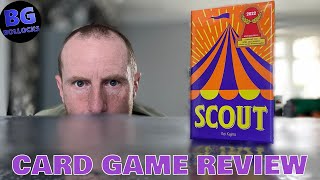


SCOUT Deep Dive
What the Community Thinks About SCOUT
Most reviewers who cover SCOUT land somewhere between fond and obsessed. Getting Games called it the best game of the year, ranking it above Arcanova and comparing it favorably to longtime favorites like Tichu and Teach You. BoardGameCo put SCOUT ahead of two other shedding games it reviewed in the same episode, Jungle and Down Up, scoring it four out of five and calling it "possibly my favorite from the bunch." Gaming with Edo & Jessica framed it as a close cousin to Fuji Flush, good enough that a copy was bought on the spot. BoardGameBollocks landed on a strong recommendation too, even while spending a good portion of the review complaining about the theme and the rulebook.
Not everyone agrees. The Broken Meeple broke from the pack hard, scoring SCOUT a three out of ten and describing round after round of being unable to beat the active set, calling the whole experience "Rummy with extra steps." Where Brains On Games treated the game's swingy scoring as an acceptable trade for a quick family game, The Broken Meeple treated that same swinginess as proof the game is mostly luck dressed up as strategy. The split mostly comes down to how much the dual-use, unrearrangeable hand feels like a puzzle worth solving versus a gimmick bolted onto a game of Rummy.
Core Mechanics That Define SCOUT
The Frozen, Flippable Hand
Every card carries two different numbers, one on each end, and the deck spans every combination from one to ten. Peaky Boardgamer's teach walks through how the deck is trimmed by player count before the deal, and how, once a player picks up their hand, they cannot rearrange the cards for the rest of the round. Brains On Games described the one decision players do get at that moment: keep the hand as dealt or flip the entire thing over to use the numbers printed on the other end. Getting Games pointed to that same choice as the game's opening puzzle, since a jumbled hand of unrelated numbers can become a much stronger hand once flipped, or once cards start arriving from scouting.
Showing Sets and Scouting
On a turn a player either shows a set stronger than whatever is active on the table or scouts. BoardGameCo explained the strength ladder plainly: more cards beats fewer cards, and among sets of equal size a matching set beats a run. Gaming with Edo & Jessica and Brains On Games both walked through the alternative to showing, scouting, where a player takes a card from either end of the active set, decides which face it shows, and slots it anywhere in their hand. Peaky Boardgamer's teach adds the two-player variant, where players start with a fixed pool of scout tokens instead of a shared show-once token, changing how often scouting is available late in a round.
The SCOUT Experience
Fast Rounds That Compound
Brains On Games clocked games at around twenty minutes and pitched it as a family table game suitable for players as young as nine, with rounds equal to the number of players. cardboardrhino leaned into the same portability, recommending SCOUT as a pack-along game for a beach bag because it is small, quick, and easy to get a table for. BoardGameCo echoed that speed, noting the game is one that gets pulled out again and again in a single sitting rather than played once and shelved.
Escalating Tension and Swings
BoardGameBollocks singled out the tension in showing a strong set: putting out two high cards can look like a power play, but it can also hand an opponent exactly the card they need for an even stronger set of their own. Brains On Games described the same dynamic from the scoring side, noting the game produces wide swings in points because of how much depends on which cards get dealt and which get scouted away. The Broken Meeple felt that swing from the losing end, describing round after round of scouting a card that never improved the hand while an opponent quietly built toward an unbeatable set.
What Makes SCOUT Stand Out
The Dual-Use, Reorientable Cards
BoardGameBollocks called the dual-use cards the game's best idea, noting that reorienting a scouted card into a hand gives players two options for the price of one and pushes the strategy well past a simple pick-a-card mechanic. Getting Games made the same mechanic the center of its praise, describing scouting as the tool that turns "this jumbled random mess of cards" into a hand that can actually win a round.
Compact and Endlessly Replayable
Gaming with Edo & Jessica praised the components directly, calling the cards and production "great" and the game "easy to recommend" and quick to play. cardboardrhino made the same case for its size, fitting it into a short list of compact games worth carrying anywhere. Getting Games backed that up with volume, reporting a dozen plays in short order and multiple same-session repeat games, more than most titles in that collection ever get.
Potential Drawbacks
A Theme That Never Shows Up
BoardGameBollocks was blunt about the circus theme, calling it "virtually non-existent" and pointing to the named performer cards as an in-joke that borders on embarrassing rather than charming. Brains On Games reached a gentler version of the same conclusion, noting the theme feels tacked on and that players rarely look at the card art or names once a game is underway, focusing on the numbers instead.
Luck, Teaching Friction, and a Cluttered Rulebook
The Broken Meeple's core complaint was that outcomes feel driven by the luck of the deal rather than by skillful play, describing the choice to flip a hand at the start of a round as a one-time decision made with no information, more mulligan than strategy. BoardGameBollocks raised a separate concern about accessibility, saying the concept is genuinely difficult for new players to grasp and that the rulebook itself, printed in small type on a shopping-list layout, led to missed rules in early plays.
If You Enjoy SCOUT
BoardGameCo compared SCOUT directly against two other hand-restricted shedding games it reviewed alongside it. Jungle was described as a more accessible take that removes some of SCOUT's complexity, while Down Up was called the most intricate of the three thanks to its extra actions. Gaming with Edo & Jessica drew a direct line to Fuji Flush, calling SCOUT remarkably similar to it, close enough that choosing between the two came down to personal preference rather than a difference in quality. BoardGameBollocks placed SCOUT alongside Bonanza for its unmovable-hand concept and alongside the UVO Rose and Bird card game as an earlier example of the same idea. Getting Games, coming from a background of climbing and shedding games, put SCOUT in the company of Tichu and Teach You, noting that SCOUT succeeds at reaching new players in a way those partnership-heavy classics struggle to match.
What Reviewers Are Saying
"Scout is one of the best small card games that we have played in a very long time. I would say as novel mechanics, but we have sort of seen this thing before with the UVO Rose and Bird card game, Bonanza. So it's not completely original."
— BoardGameBollocks
"The reason this game is absolutely brilliant is because of the scout mechanic, which is what the game is called. Now on your turn you can either play cards out, trying to beat somebody else's set of cards, or you can scout the previous set of cards or run of cards or whatever; when you scout, you take that card off the table, so these are cards your opponent removed from their hand, they're on the table, you remove one of those cards and you put it into your hand, and you can decide what side it's going to be."
— Getting Games
"I did not see the point of this. This just felt like Rummy with extra steps. That's literally what this game is, it's Rummy with some more restrictive rules in it."
— Luke Hector, The Broken Meeple