









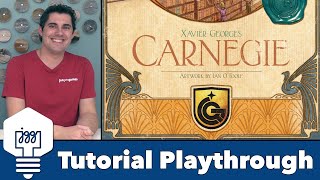







Carnegie box art

Carnegie

Game Info
Year
2022
Players
1-4
Age
12+
Playtime
180 min
Publisher
Collection
Ratings
Mechanic profile
Percentile rank vs. all games
Vibe profile
How this game feels to play
Description

Carnegie was inspired by the life of Andrew Carnegie who was born in Scotland in 1835. Andrew Carnegie and his parents emigrated to the United States in 1848. Although he started his career as a telegraphist, his role as one of the major players in the rise of the United States’ steel industry made him one of the richest men in the world and an icon of the American dream.

Andrew Carnegie was also a benefactor and philanthropist; upon his death in 1919, more than $350 million of his wealth was bequeathed to various foundations, with another $30 million going to various charities. His endowments created nearly 2,500 free public libraries that bear his name: the Carnegie Libraries.

During the game you will recruit and manage employees, expand your business, invest in real estate, produce and sell goods, and create transport chains across the United States; you may even work with important personalities of the era. Perhaps you will even become an illustrious benefactor who contributes to the greatness of his country through deeds and generosity!

The game takes place over 20 rounds; players will each have one turn per round. On each turn, the active player will choose one of four actions, which the other players may follow.

The goal of the game is to build the most prestigious company, as symbolized by victory points.
 
—description from the publisher

Ask a Rules Question
All mentions
Browse transcript mentions, sentiments, pros/cons, mechanics, topics, quotes, and references.
Total mentions: 76
This page: 26
Sentiment: pos 23 · mix 2 · neu 0 · neg 0
Mentions per page
Showing 51–76 of 76
Video nKj73VuN4kQ Board Game Dad Top List at 4:33 sentiment: positive
Board Game Dad - Carnegie video thumbnail
Click to watch at 4:33 · YouTube ↗
Overall sentiment (raw)
positive
Pros
  • engages attention to opponents' timing
  • layered planning around worker reclamation
Cons
none
Thematic elements
none
Comparison games
none
Mechanics (from transcript analysis)
  • End Game Bonuses — when you bring workers back, you gain benefits; timing matters and others can sync with you
  • returned worker bonus — when you bring workers back, you gain benefits; timing matters and others can sync with you
Video topics + discussion points
No key topics recorded for this video.
Quotes (from this video)
  • my five favorite board game mechanics
  • cards have multiple uses regardless of what your hand draw is
  • I love games that engage you when it's not even your turn
  • every player gets to do something at the same time
  • not only when you pull your workers you get something but every other player also has the option of pulling their workers back at the same time
  • stock buying mechanic ... the objective is to have the most money at the end of the game and the way you get the most money is by buying stock in the players
References (from this video)
No references stored for this video.
Video 1YvQsYqOGx0 BoardGameGeek Top 10 List at 1:22 sentiment: positive
BoardGameGeek - Carnegie video thumbnail
Click to watch at 1:22 · YouTube ↗
Overall sentiment (raw)
positive
Pros
  • Beautiful art by ENO Tool
  • Innovative income/tab system
  • Philanthropy aspect adds thematic depth
  • Strong visual presence and theme integration
Cons
none
Thematic elements
  • philanthropy and industrial enterprise
  • Old-timey America, industrial era
  • historical/biographical
Comparison games
Mechanics (from transcript analysis)
  • employee/manager population — Populate tiles with employees and managers to unlock abilities.
  • income/tabs mechanic — Tabs on the main board advance to unlock income and bonuses; discs placed on tabs grant bonuses.
  • philanthropy scoring — A philanthropy module allows players to gain points through charitable actions.
  • Tile Placement — Main board with spots for location tiles that drive actions and income.
  • Tile/Location placement — Main board with spots for location tiles that drive actions and income.
Video topics + discussion points
No key topics recorded for this video.
Quotes (from this video)
  • Carnegie is a beautiful game and a really really cool game.
  • It's got this really interesting board that's again part of your main board, but you have these kind of like I guess the best way of putting them is tabs.
  • I really like Carnegie.
  • This game is absolutely incredible.
  • Speak Easy is so good.
References (from this video)
No references stored for this video.
Video BBgHqqzyGuY Board Of It Top List at 16:52 sentiment: positive
Board Of It - Carnegie video thumbnail
Click to watch at 16:52 · YouTube ↗
Overall sentiment (raw)
positive
Pros
  • interactive and novel action-selection dynamic
  • strong production quality and components
  • great teachability for a Euro with depth
Cons
  • rulebook can be dense and intimidating
  • Kickstarter content can feel essential for full experience
Thematic elements
  • business-building, revenue, and strategy
  • Early 20th-century corporate growth and innovation
  • euro-style economic engine with rich systems
Comparison games
Mechanics (from transcript analysis)
  • action selection with interactivity — On each turn, players choose an action; everyone executes, creating indirect competition.
  • Department tiles and asymmetry — Buy department tiles that grant unique scoring and actions, creating asymmetric strategy.
  • donations and VP scoring — Certain actions trigger donations and movement toward victory points; interaction with other players’ plans.
  • Worker Placement — Place workers in offices to trigger actions and generate income.
Video topics + discussion points
No key topics recorded for this video.
Quotes (from this video)
  • it's fun to be the person whose clues you're guessing
  • the tactility of the game it's fun to play in touch
  • it's a tug of war game and you want to have 20-30 minutes to play something
  • it's really puzzly thinking but it's not too heavy
  • this is one of the best take-that-style euros with strong interactions
References (from this video)
No references stored for this video.
Video o_Vd86p1MZo Board Game Dad Top List at 18:41 sentiment: positive
Board Game Dad - Carnegie video thumbnail
Click to watch at 18:41 · YouTube ↗
Overall sentiment (raw)
positive
Pros
  • Deep strategic play with many viable routes to victory
  • Asymmetrical setup enhances replayability
  • Engaging long-term planning and regional economy mechanics
Cons
  • Learning curve can be steep
  • Game length and complexity may deter some players
Thematic elements
  • Corporate strategy, regional resource management, and scoring multipliers.
  • Industrial expansion across the United States with regional decision-making and income.
  • Historically inspired, asymmetrical company boards and strategic depth.
Comparison games
Mechanics (from transcript analysis)
  • Asymmetrical setup — Different starting strengths create unique strategic paths and replayability.
  • Company board actions — Each player operates a different company with departments and board actions to develop regions.
  • Compound Scoring — Income from regions is shared and multiplied based on employees present.
  • Player Board | Main Board — Each player operates a different company with departments and board actions to develop regions.
  • Regional income and scoring multipliers — Income from regions is shared and multiplied based on employees present.
Video topics + discussion points
No key topics recorded for this video.
Quotes (from this video)
  • Strategy is the process of creating a set of well-aligned activities with the aim of occupying a valuable position in a competitive landscape
  • Tactics are single activities and aligning them together is what comprises a strategy
  • There is no luck for the rest of the game
  • The five games do have that little something extra
  • Carnegie this is a kind of a complicated game to explain
  • I did do a full length review about this game so I'll be sure to make links available for that
References (from this video)
No references stored for this video.
Video bnHjQ2pSpRI Board of It Review at 2:25 sentiment: positive
Board of It - Carnegie video thumbnail
Click to watch at 2:25 · YouTube ↗
Overall sentiment (raw)
positive
Pros
  • Engaging, tense action selection drives player interaction
  • Asymmetric growth and department tiles create variety and replayability
  • Excellent production and components; top-tier art and inserts
  • Set-up is straightforward and table presence is strong
Cons
  • Heavy teaching burden and complex rules
  • Deluxe/Kickstarter content can imbalance the retail version
  • Expansions alter balance and can be expensive to obtain
Thematic elements
  • Building and coordinating a diversified American company under Andrew Carnegie; infrastructure, donations, and growth
  • Late 19th to early 20th century United States during the industrial era; expansion of rail, infrastructure, and philanthropy
  • Economic strategy with action selection and worker-management tension
Comparison games
Mechanics (from transcript analysis)
  • action selection — First player selects one of four actions (HR management, construction, and RD) and all players activate corresponding departments.
  • Department tiles and asymmetry — Purchasing department tiles increases asymmetry and strengthens actions depending on tiles.
  • Endgame scoring via connectivity and donations — Points come from connecting major cities and endgame donations; blocking and undercutting affect scores.
  • Infrastructure building and relocation — Construction builds infrastructure and routes on the main board; movement across HR and departments matters.
  • Region and donation triggers — Main board regions yield income; 'donation' spaces allow endgame scoring opportunities for all players.
  • Worker placement and activation — Workers must be upright to be activated; some actions require sending workers to the main board.
Video topics + discussion points
No key topics recorded for this video.
Quotes (from this video)
  • The core of Carnegie is its absolutely devilish action selection system.
  • It's a wonderful dance of work management and planning.
  • Carnegie is a really terrific Euro and one of the best new pure Euros out there.
  • Oh dear, teaching this thing is a bear; it's on the heavier side.
References (from this video)
No references stored for this video.
Video wrp1cwbLJSA Board Of It Top 10 List at 11:22 sentiment: positive
Board Of It - Carnegie video thumbnail
Click to watch at 11:22 · YouTube ↗
Overall sentiment (raw)
positive
Pros
  • highly regarded Euro with deep production and turn structure
  • exploratory first game leads to deeper play later
Cons
  • may require multiple plays to fully grok
Thematic elements
none
Comparison games
none
Mechanics (from transcript analysis)
Mechanics unknown.
Video topics + discussion points
No key topics recorded for this video.
Quotes (from this video)
  • review is more of a snapshot of a game in time than something that will last forever
  • Cult of the new we get a new game in from Kickstarter... we want to play this
  • it's evergreen for us probably like Ultimate Railroads
  • the app integration in Return to Dark Tower is probably the best board game app I've seen
  • Return to Dark Tower... the toy factor is strong, but the new expansion Covenant didn't change how I feel about the base game
References (from this video)
No references stored for this video.
Video wrp1cwbLJSA Board Of It Top 10 List at 28:52 sentiment: positive
Board Of It - Carnegie video thumbnail
Click to watch at 28:52 · YouTube ↗
Overall sentiment (raw)
positive
Pros
  • strong production and deep, exploratory gameplay
  • high replayability and interaction
Cons
  • takes time to grasp for new players
Thematic elements
none
Comparison games
none
Mechanics (from transcript analysis)
Mechanics unknown.
Video topics + discussion points
No key topics recorded for this video.
Quotes (from this video)
  • review is more of a snapshot of a game in time than something that will last forever
  • Cult of the new we get a new game in from Kickstarter... we want to play this
  • it's evergreen for us probably like Ultimate Railroads
  • the app integration in Return to Dark Tower is probably the best board game app I've seen
  • Return to Dark Tower... the toy factor is strong, but the new expansion Covenant didn't change how I feel about the base game
References (from this video)
No references stored for this video.
Video P7yM5Al9lL8 Totally Tabled Top List at 10:34 sentiment: positive
Totally Tabled - Carnegie video thumbnail
Click to watch at 10:34 · YouTube ↗
Overall sentiment (raw)
positive
Pros
  • smart, streamlined solo mode
  • engaging action loop with multiple action types
Cons
none
Thematic elements
  • Worker-based action selection and project management
  • Industrial city-building and office development
Comparison games
none
Mechanics (from transcript analysis)
  • action selection with four shared actions — Players choose one of four actions; all players perform that action.
  • evolving action strength and AI opposition in solo — In solo, an opponent may take actions when you’re not ready, creating a constrained tempo.
  • Worker Placement — Workers placed to construct offices that unlock more actions and effects.
  • worker placement to build offices and unlock actions — Workers placed to construct offices that unlock more actions and effects.
Video topics + discussion points
No key topics recorded for this video.
Quotes (from this video)
  • my number 10 is Woodcraft
  • the zombies are represented by little cubes
  • I love the voucher system here where when you take one of the actions you have to pay certain vouchers and then you also receive other ones
  • Frostpunk has aspects of War of Mine it has aspects of Robinson Crusoe
References (from this video)
No references stored for this video.
Video SfmJai0NZEA Totally Tabled Top List at 1:10 sentiment: positive
Totally Tabled - Carnegie video thumbnail
Click to watch at 1:10 · YouTube ↗
Overall sentiment (raw)
positive
Pros
  • Smart and streamline AI system
  • Accessible and well-designed
Cons
  • Initial replayability concerns mentioned but not observed as a problem in the speaker's experience
Thematic elements
none
Comparison games
none
Mechanics (from transcript analysis)
Mechanics unknown.
Video topics + discussion points
No key topics recorded for this video.
Quotes (from this video)
  • I still absolutely love this design
  • the AI system is so smart
  • it's on the totally table Todo list
  • Frost Punk is incredible
  • I absolutely plan to get to the table this year
  • the slide puzzle mechanism I love
  • Weather Machine remains one of my favorites
  • Sleeping Gods no reason to believe that I won't love this one as well
References (from this video)
No references stored for this video.
Video AaFI-rLHrQg BoardGameCo Analysis at 11:13
BoardGameCo - Carnegie video thumbnail
Click to watch at 11:13 · YouTube ↗
Pros
none
Cons
none
Thematic elements
none
Comparison games
none
Mechanics (from transcript analysis)
Mechanics unknown.
Video topics + discussion points
No key topics recorded for this video.
Quotes (from this video)
  • What enters my collection is a whole another story.
  • I'm absolutely hooked on it. I love Primal.
  • If I add something to my collection, ideally I want to see it there a year from now, at least a year from now.
  • It is such a good implementation of the Glass Road system.
  • It's not forever, but it feels like a forever game for me.
References (from this video)
No references stored for this video.
Video aZLvvPFpCuQ Before You Play Discussion at 17:06 sentiment: positive
Before You Play - Carnegie video thumbnail
Click to watch at 17:06 · YouTube ↗
Overall sentiment (raw)
positive
Pros
  • Neat design and thematic cohesion
  • Enjoyable mix of worker management and construction
Cons
  • Not as economically heavy as some anticipated; more worker-driven
Thematic elements
  • Infrastructure/building and industry management
  • Industrial era, early modern economic expansion
  • Worker management with economic coordination
Comparison games
Mechanics (from transcript analysis)
  • follow action — ability to mimic others’ actions for strategic advantage
  • Worker Placement — place workers to develop and utilize board components
Video topics + discussion points
No key topics recorded for this video.
Quotes (from this video)
  • i left my job and i'm going to be going full time in content
  • this is something that we've actually been discussing with our patreon community for the past couple of months
  • we're going to be doing sponsored content right because we have to make our time worth it
  • our three-year channel anniversary this month
  • we are going to do a live stream it's going to be primarily like a live q a
  • we want to thank you all for the support
References (from this video)
No references stored for this video.
Video 74SacIKG1xc Our Family Plays Games Discussion at 34:06 sentiment: positive
Our Family Plays Games - Carnegie video thumbnail
Click to watch at 34:06 · YouTube ↗
Overall sentiment (raw)
positive
Pros
  • deep thinky Euro with strong engine-building
  • table presence and tactile components
Cons
  • art and theme not standout
  • slower pacing for some players
Thematic elements
  • corporate growth and employee management
  • Gilded Age of industry / Carnegie-era
  • economic strategy with a historical flavor
Comparison games
none
Mechanics (from transcript analysis)
  • tile drafting / district building — compose a city-like board with departmental tiles
  • worker placement / engine-building hybrid — build an organization, place workers, and develop departments
Video topics + discussion points
No key topics recorded for this video.
Quotes (from this video)
  • it's not cohesive at all
  • we're going to rate our games on a scale of one to ten
  • OFPG endorsement for the top picks
  • don't sleep on Acropolis
  • you can carry Cat in the Box easily
  • we love you bye now
References (from this video)
No references stored for this video.
Video s7z-PF9khY0 Chairman of the Board Discussion at 5:06 sentiment: positive
Chairman of the Board - Carnegie video thumbnail
Click to watch at 5:06 · YouTube ↗
Overall sentiment (raw)
positive
Pros
  • Noted designer pedigree; heavy euro appeal
Cons
  • Speaker hasn't learned rules yet; unplayed at time of video
Thematic elements
  • Industrial era economics
  • Industrial age; economic development
  • economic strategy
Comparison games
none
Mechanics (from transcript analysis)
  • economic engine-building — heavy euro with engine-building around industrial expansion
Video topics + discussion points
No key topics recorded for this video.
Quotes (from this video)
  • "Caesar sees Rome in 20 minutes"
  • "this is like the spiritual successor or at least a sister game or a partner game to paulo maurice blitzkrieg"
  • "I believe you're investing in these companies these companies can merge with each other so it's just all about making profit"
  • "Detective Club and the expansion"
References (from this video)
No references stored for this video.
Video SVG-JP8JJXs Board With Steve Top List at 9:39 sentiment: positive
Board With Steve - Carnegie video thumbnail
Click to watch at 9:39 · YouTube ↗
Overall sentiment (raw)
positive
Pros
  • interactive Euro that rewards careful timing
  • multi-turn planning with depth in every choice
  • notable for how engaging action-following feels
Cons
  • name pronunciation and naming clarity could be tricky for some players
  • visual/iconography may require learning aid
Thematic elements
  • factory production and supply chains across the country
  • American factory-based transport network, expansionist industrial theme
  • strategy-forward with strong timing and interaction
Comparison games
none
Mechanics (from transcript analysis)
  • action selection — Each action offers depth; timing is critical as opponents can follow.
  • interactive sequencing — When you take an action, the next player gets to follow, creating pressure and pacing.
  • Worker Placement — Strategic placement to drive production and chain-building across the country.
Video topics + discussion points
No key topics recorded for this video.
Quotes (from this video)
  • Blocking becomes super important because you can only build roofs and pillars so many times during the game.
  • There's a ton of mind games involved in this game.
  • The dice rolls affect everybody equally. So, we both have to work with the same puzzle.
  • It's tense, it's brainy, and it's super satisfying.
  • I don't understand why it's not up there with the likes of Brass, Terrammystica, Bough Island, even a bunch of other big strategic games.
  • For me, it is Magnum Opus and it deserves all the credit in the universe.
  • This is my favorite co-op game of all time and I believe it's the best two-player co-op experience ever.
  • There are multiple ways to win and the exploration of discovering new scoring methods is thrilling.
References (from this video)
No references stored for this video.
Video qzOLpDZlBDg The Brothers Murph Playthrough at 0:22 sentiment: positive
The Brothers Murph - Carnegie video thumbnail
Click to watch at 0:22 · YouTube ↗
Overall sentiment (raw)
positive
Pros
  • Interesting resource management
  • Complex strategic decisions
  • Multiple paths to scoring
  • Thematic gameplay
Cons
  • Complex rule set
  • Expensive actions
  • Can be difficult to manage workers
Thematic elements
  • Industrial development and infrastructure building
  • United States during industrial expansion
  • Economic strategy
Comparison games
none
Mechanics (from transcript analysis)
  • Area Control — Players build infrastructure and place discs in different regions
  • Resource Management — Managing money, goods, and worker actions
  • Worker Placement — Players place workers in different regions and departments to gain resources and actions
Video topics + discussion points
No key topics recorded for this video.
Quotes (from this video)
  • We get points for goodness, we need more of that in games
  • Carnegie: not a good person but did some good things
  • You get points for being a good person
References (from this video)
No references stored for this video.
Video K85LCaWhcy4 Getting Games Playthrough at 0:00 sentiment: positive
Getting Games - Carnegie video thumbnail
Click to watch at 0:00 · YouTube ↗
Overall sentiment (raw)
positive
Pros
  • Deep, multi-layered economy with multiple income streams
  • Charity donations introduce meaningful end-game scoring choices
  • Flexible department activation and movement options
  • Tight coupling between map placement and regional income effects
Cons
  • High complexity; can be daunting for new players
  • Prototype components in tutorial may differ from final version
  • Map setup errors can misrepresent starting assets (e.g., housing projects)
Thematic elements
  • Industrial empire building with philanthropy
  • Late 19th-century United States, industrial era
  • Historical company simulation with charity-endgame scoring
Comparison games
none
Mechanics (from transcript analysis)
  • Charity and end-game scoring — Donate to charities with VP potential; end-game scoring via networks, city scoring, and donations.
  • End-game network scoring — Score networks of major cities connected by players' projects; regional tech levels determine network value; city scoring at end.
  • Human resources action — Broker hiring and memory of new employees; activate employees to hire more workers and upgrade the board.
  • Project construction and placement — Construct projects by spending goods cubes; place projects in regions/cities on the map; some cities have special rules.
  • resource and income management — Income from transportation tracks, mission areas, and project icons; spend money and goods to gain income and project benefits.
  • Timeline action selection — Active player selects a timeline row; all players perform the same action that corresponds to that row.
  • Worker placement / activation of departments — Players activate departments using active workers; each employee's activation triggers actions tied to departments.
Video topics + discussion points
No key topics recorded for this video.
Quotes (from this video)
  • it is inspired by the life of andrew carnegie
  • a big part of this game is indeed charitable donations
  • these donations can be worth a maximum of 12 victory points once the game is over
  • the game will be over once 20 rounds have happened
References (from this video)
No references stored for this video.
Video gmtraazEwKY Tabletop Turtle Discussion sentiment: positive
Overall sentiment (raw)
positive
Pros
none
Cons
none
Thematic elements
  • Route building and strategic planning
  • Industrial era
Comparison games
none
Mechanics (from transcript analysis)
  • Route Building — Connecting locations with strategic planning
Video topics + discussion points
No key topics recorded for this video.
Quotes (from this video)
  • Sometimes there's just something about a game that you just can't explain
  • We're essentially replacing Katan using science
  • We wanted a way to suggest new games that we think do certain mechanics just a little bit better
References (from this video)
No references stored for this video.
Video LkLlnqhP3ks The Dice Tower Top List at 1:42 sentiment: positive
The Dice Tower - Carnegie video thumbnail
Click to watch at 1:42 · YouTube ↗
Overall sentiment (raw)
positive
Pros
  • Elegant action-selection structure with deep long-term planning
  • Dynamic regional events add meaningful tension
  • Minimized downtime due to simultaneous play
Cons
  • Complex rule set may deter newcomers
  • Can be lengthy and heavy for some groups
Thematic elements
  • Business expansion, employment, real estate, and philanthropy
  • Early- to mid-20th-century industrial growth and city development
  • Strategic planning with simultaneous action options and region-based events
Comparison games
none
Mechanics (from transcript analysis)
  • Action Following — Active player chooses from four core actions while others perform chosen actions in parallel
  • action_selection — Active player chooses from four core actions while others perform chosen actions in parallel
  • event_tracks — Regional events influence scoring and opportunities each round
  • multi_action_optimization — Players balance short-term gains with long-term regional strategy
  • Simultaneous Actions — All players execute actions in a round, reducing downtime
  • simultaneous_actions — All players execute actions in a round, reducing downtime
Video topics + discussion points
No key topics recorded for this video.
Quotes (from this video)
  • The joy of Power Grid comes from the economic planning and watching what the other players are doing.
  • The better you're doing, the later in turn order you go.
  • One of the key gameplay mechanisms for me is I always have to be anticipating the future actions and making my board ready to take full advantage of it.
  • The game does an excellent job of blending dice drafting, tile placement, and engine building into a satisfying strategic puzzle.
  • This game is a feast for Odin.
  • The engine building and kind of a deck builder. The theme is pretty shaky for this one.
  • What sets this game apart is the time aspect.
  • The joy of this one is seeing what cards you have to work with and coming up with a long-term strategy, but being agile enough that if you get cards that may be a better engine or scoring, you can pivot midame, maybe even pivot several times during the game to figure out what's best for you.
  • The dice drafting is not just about luck. It is a layer decision-making puzzle.
References (from this video)
No references stored for this video.
Video EIiUSBj15xE Getting Games Discussion at 8:37 sentiment: positive
Getting Games - Carnegie video thumbnail
Click to watch at 8:37 · YouTube ↗
Overall sentiment (raw)
positive
Pros
  • Delight in deluxe edition and planned replays
  • Strategic depth
Cons
  • Balance tweaks and changes over time
Thematic elements
  • Economic strategy, resource management
  • Renaissance era / industrialization
  • Mechanistic
Comparison games
none
Mechanics (from transcript analysis)
  • economic engine-building — Balance investments, actions and city development
  • Engine Building — Balance investments, actions and city development
Video topics + discussion points
No key topics recorded for this video.
Quotes (from this video)
  • it's a euro style game that plays up to six
  • it's fully simultaneous
  • Concordia Venus ... brings in team play and that lets you play two on two which is a four player game and it also lets you play two versus two which is a six player game
  • not a euro game really it's more of a deduction style game where it's one versus many
  • I started to work on that video and I'm hoping to make it happen
  • Miniatures don't do anything for me
References (from this video)
No references stored for this video.
Video SiQomak9riM Meeple Mountain Top List at 12:02 sentiment: positive
Meeple Mountain - Carnegie video thumbnail
Click to watch at 12:02 · YouTube ↗
Overall sentiment (raw)
positive
Pros
  • Tight action economy and scalable strategy
  • Clear branching paths with meaningful choices
  • Well-balanced yet deep
Cons
none
Thematic elements
  • Company growth and regional development
  • Industrial expansion and city-building
  • Strategic, with heavy planning and engine optimization
Comparison games
none
Mechanics (from transcript analysis)
  • area/region control — Four regions drive scoring; strategic placement matters.
  • Engine-building / worker placement — Optimize moves and personnel to grow the company efficiently.
  • limited action selection per turn — Four main actions chosen each turn, varying by department.
Video topics + discussion points
No key topics recorded for this video.
Quotes (from this video)
  • the rules are quick and easy to get through
  • my daughter really likes birds
  • the game uses the game trays making it a lot better easier to set up and take down
  • one of the best components that I've ever seen
References (from this video)
No references stored for this video.
Video 1LXH9KE5KKE Getting Games Discussion at 1:29 sentiment: positive
Getting Games - Carnegie video thumbnail
Click to watch at 1:29 · YouTube ↗
Overall sentiment (raw)
positive
Pros
  • Deep strategic planning
  • Strong thematic integration with economic engine-building
Cons
  • Heavy rules could be daunting for newcomers
  • Longer playtime compared to lighter card games
Thematic elements
  • influence and industrial growth through strategic action
  • Industrial era/early modern economy
Comparison games
  • Santiba
  • Through the Ages
  • Scout
Mechanics (from transcript analysis)
  • engine-building — Players build engines of production and economic growth through actions and resources.
  • Set collection / resource optimization — Managing and collecting resources to optimize city-building and production.
Video topics + discussion points
No key topics recorded for this video.
Quotes (from this video)
  • this is a game that anybody can play with a standard deck of cards
  • the real awesome part of this game is taking those cards from the Tableau
  • Carnegie is right up there and I've played it dozens of times
  • I strongly recommend it I don't think it's necessarily going to blow you away and be the best game you've played this year but I found it fresh I found it interesting and very enjoyable
  • it's a really smart Super Fresh really easy to teach game that everyone can play
References (from this video)
No references stored for this video.
Video 5Kry7ELGvsw Before You Play Top List at 59:11 sentiment: positive
Before You Play - Carnegie video thumbnail
Click to watch at 59:11 · YouTube ↗
Overall sentiment (raw)
positive
Pros
  • deep, involved engine-building with rich flavor
  • high interaction via borrowing and competition
Cons
  • very heavy and long; not ideal for casual play
Thematic elements
  • corporate empire-building and workforce management
  • industrial era and Andrew Carnegie’s enterprises
  • heavy Euro with deep intervention mechanics
Comparison games
Mechanics (from transcript analysis)
  • department-based actions and worker placement — build up departments and hire employees to power actions
  • follow-on actions and borrowing — you borrow from others to access scarce resources and expand your empire
Video topics + discussion points
No key topics recorded for this video.
Quotes (from this video)
  • it's basically discussing our top 10 games that were new to us in 2022
  • this is like a podcast today
  • Weather Machine ... would have made this list if it came out this year
  • it's a pure Euro for sure through and through
  • hirelings ... game changer for the two-player Root
References (from this video)
No references stored for this video.
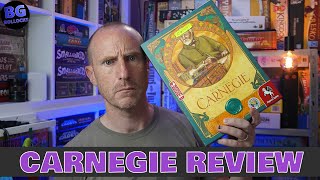
Video lifDSbXNJSA BoardGameBollocks Review at 0:00 sentiment: mixed
BoardGameBollocks - Carnegie video thumbnail
Click to watch at 0:00 · YouTube ↗
Overall sentiment (raw)
mixed
Pros
  • Clear two-stage income choices create interesting trade-offs
  • End-game scoring creates tense, unpredictable finales
  • Action availability across most of the game supports ongoing strategic decisions
  • Solid Euro-style design for fans of resource optimization
Cons
  • Slider mechanism is a controversial gimmick that takes excessive space and muddles setup
  • Artwork and color palette are criticized as unattractive and off-putting
  • Main board and overall footprint feel wasteful in terms of space utilization
  • Some actions can become effectively unusable if players press a given path too soon or too late
Thematic elements
  • Industrialization and philanthropy; managing a workforce to build a network of urban departments
  • Late 19th/early 20th century Pittsburgh industrial era
  • Euro-style puzzle with historical veneer and philanthropic rhetoric
Comparison games
Mechanics (from transcript analysis)
  • Action selection and progression — Selected action tokens move to the right; the current space activates for income and effects.
  • Donations and tiered costs — Donations slots grant effects but require escalating funds, influencing early vs late-game planning.
  • End-game scoring network — Scoring hinges on linked city links, discs placed in cities, and other late-game criteria.
  • Housing and city discs — Discs are taken from sliders, placed on city/region symbols to unlock benefits or scoring potential.
  • Income and track management — Income is collected from the position on the map and revealed sliders on the right side of the board.
  • Movement Points — HR action allows movement of workers around the departments based on department movement points.
  • Movement points and HR action — HR action allows movement of workers around the departments based on department movement points.
  • Worker Placement — Players place workers on department actions, triggering income and progress on the board.
Video topics + discussion points
No key topics recorded for this video.
Quotes (from this video)
  • the end game scoring provides a really really tense finale there are victory points that are going to be available but these are few and far between
  • the sliders are one of the dumbest gimmicks I've seen in ages
  • Carnegie is a solid Euro worker placement game
  • it's a nice choice in terms of income
  • most of the scoring comes at the end of the game
  • the main board is by and large a wasted space
  • you could quite easily do what Carcassonne does and have a score on track to the side of the board
  • Carnegie worth your time bother today and in the future
  • loads of media decisions like that in this game
References (from this video)
No references stored for this video.
Video FMjAlu5F1WA Tabletop Turtle Discussion at 11:43 sentiment: positive
Tabletop Turtle - Carnegie video thumbnail
Click to watch at 11:43 · YouTube ↗
Overall sentiment (raw)
positive
Pros
  • Engaging engine interactions
  • Good balance and pacing
Cons
  • Can feel lengthy for some groups
Thematic elements
  • Industrial age / urban development
Mechanics (from transcript analysis)
  • Variable phase order / hand management — Players plan and react to others; card-driven sequence affects engine building.
Video topics + discussion points
No key topics recorded for this video.
Quotes (from this video)
  • I'm very bold in my opinions, I hate it but I'm still willing to give it a second and third try because it's better it's an expensive game
  • America blue shell is when you brace Mario Kart and then if you're in last place you get rewarded the blue shell
  • it's a shared objective, you really pay attention to what other people are doing
  • canvas... what a stinker... you're a pile of poops I love that game
  • Rise of X added ... I had the Dreadnought portion and it replaced the main board
  • I'll take it from me, I think he's French no he's Jamaican
References (from this video)
No references stored for this video.
Video zpCpiLHDgEY Chairman of the Board Discussion at 12:32 sentiment: mixed
Chairman of the Board - Carnegie video thumbnail
Click to watch at 12:32 · YouTube ↗
Overall sentiment (raw)
mixed
Pros
  • Solid core engine
  • Innovative personal boards
Cons
  • Lacked a strong unique identity
  • Long to teach, complex for some players
Thematic elements
  • economic development and organization
  • early 20th century industrial expansion
  • economic strategy with department boards
Comparison games
none
Mechanics (from transcript analysis)
  • Engine Building — blend of mechanisms to drive the economy
  • engine building / economic planning — blend of mechanisms to drive the economy
  • personal player boards — each player has unique boards for actions
  • Player Board | Main Board — each player has unique boards for actions
  • Worker Placement — move workers to departments to trigger effects
  • worker placement / department actions — move workers to departments to trigger effects
Video topics + discussion points
No key topics recorded for this video.
Quotes (from this video)
  • the production and the visual aesthetic of the game was absolutely stunning
  • the decisions were relatively uninteresting and pretty obvious once you've groked the game
  • one and done style game so once you've done one of the missions you've experienced it can't go play it again
  • it's a gorgeous looking game
  • the money in this game, particularly in the first half was extremely tight
  • this game's out there that I enjoy more that are faster they're a bit more succinct
References (from this video)
No references stored for this video.
Video Ne8jdTF5Qvk Our Family Plays Games Discussion at 41:18 sentiment: positive
Our Family Plays Games - Carnegie video thumbnail
Click to watch at 41:18 · YouTube ↗
Overall sentiment (raw)
positive
Pros
  • great euro with tight decisions
Cons
none
Thematic elements
  • economic development with shared actions
  • early American rail/industrial era
Comparison games
none
Mechanics (from transcript analysis)
  • Hand Management — deck or card-driven actions
  • shared actions — limited actions each round; hustle at start
  • Simultaneous Actions — limited actions each round; hustle at start
Video topics + discussion points
No key topics recorded for this video.
Quotes (from this video)
  • we love y'all we love having you guys
  • that's a green light
  • it's a great reboot of settlers of the stone age
  • the baby yak is adorable
  • splendor duel coming soon
References (from this video)
No references stored for this video.
Transcript Navigation
Showing 51–76 of 76
Game Deep Dive